Orpheus and Eurydice: In Plato, the Gods Show Him a Phantom
In Plato’s Symposium, the speaker Phaedrus says the gods never gave Eurydice back but showed Orpheus a phantom; the rule and the fatal look appear only in the later texts compared here.
By Once Upon a Version
Published
How a version is traced · Version history · Contact · Report an error (contact@onceuponaversion.com)
In short
- In Plato’s Symposium (179d), the speaker Phaedrus says the gods showed Orpheus only an apparition of his wife and sent him away; that passage has no rule and no look back.
- Of the five texts compared here, four have a rule against looking and three tell the look itself: Virgil’s Georgics (4.491), Ovid’s Metamorphoses (10.57) and Boethius’s Consolation of Philosophy (Book III, Song XII).
- In these five texts, only Plato has the phantom, only Ovid brings the pair together again after Orpheus dies, and only Plato leaves the wife unnamed.
Telling card
- Tale
- Orpheus and Eurydice (Plato, Symposium 179d–e)
- Type
- myth told inside a philosophical dialogue (no tale-type number cited)
- Teller
- Phaedrus, a speaker in the dialogue; written by Plato (427–347 BC)
- Recorded by
- n/a (inside the dialogue, Apollodorus repeats what Aristodemus told him)
5 more fields: edited by, told, published, this text, earliest known
- Edited by
- Greek text: John Burnet, Platonis Opera (1910)
- Told
- unrecorded; the dialogue sets the speech at a banquet in the house of Agathon
- Published
- Plato, Symposium; written probably between 384 and 369 BC (Jowett’s estimate)
- This text
- Benjamin Jowett’s English translation (Project Gutenberg 1600); Greek cited by page only
- Earliest known
- not traced on this page; the oldest of the five texts compared here
This card as CSV · where these values come from
Data: Plato, Symposium (Jowett, Project Gutenberg 1600) and GND 118594893, retrieved 2026-11-03
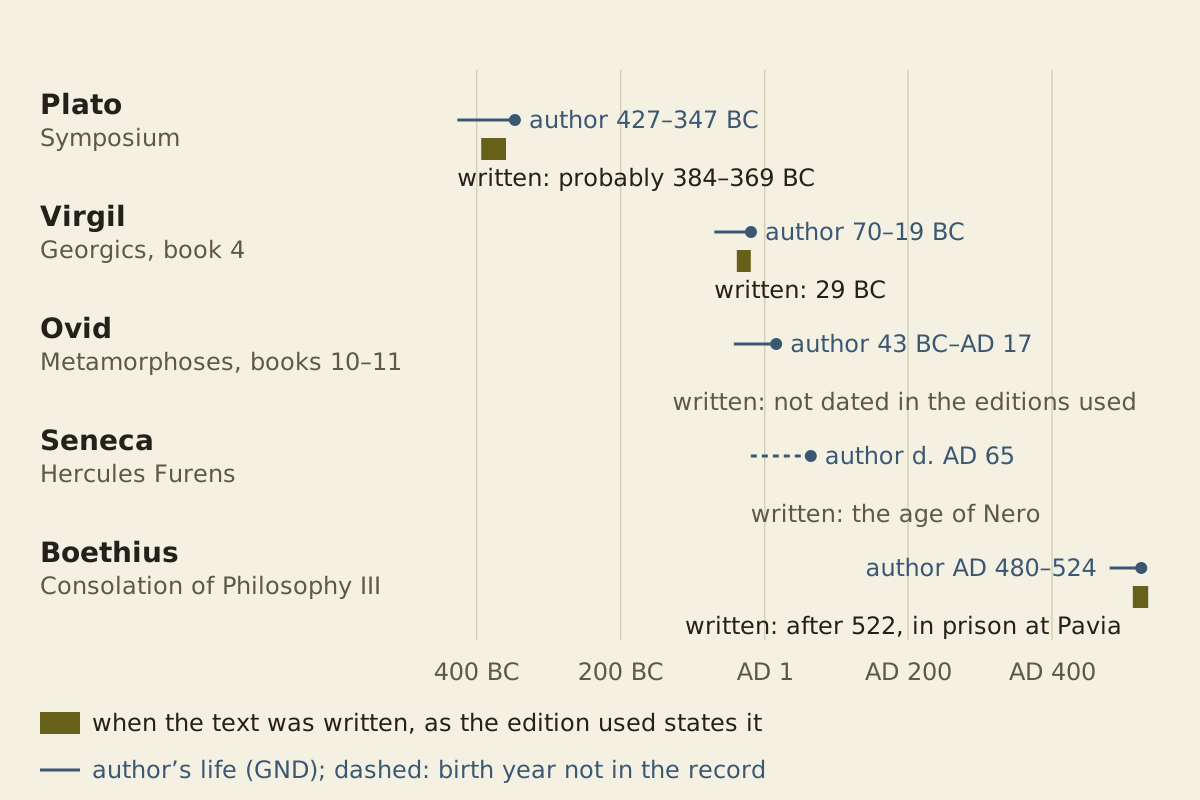
The five texts compared on this page, with each author’s life dates and, where the edition used gives one, the date of writing.
Credit line for reuse
"Five tellings of Orpheus and Eurydice, by date" by Once Upon a Version — https://onceuponaversion.com/across-cultures/orpheus-eurydice-versions/ — licensed under CC BY 4.0 (https://creativecommons.org/licenses/by/4.0/)
Data: GND authority records via lobid-gnd, retrieved 2026-11-03; editions as named on the page
In Plato’s Symposium, the speaker Phaedrus says the gods never gave Orpheus his wife back. The speech is set at a banquet in the house of Agathon, in a dialogue that Plato wrote probably between 384 and 369 BC, according to Benjamin Jowett’s introduction. In this telling of Orpheus and Eurydice, the gods display an apparition and dismiss the singer. They impose no condition that he could break by looking back.
The rule, the backward look and the second loss belong to other tellers. Four of the five texts compared here have a rule against looking, and three of them narrate the look: Virgil’s Georgics, Ovid’s Metamorphoses and Boethius’s Consolation of Philosophy. In Seneca’s Hercules Furens, the chorus says only that Orpheus hurried to see her, which is why that cell of the grid is marked as transformed rather than present.
Which tellings are compared here?
The comparison takes five passages, each read in a named public-domain English translation. For Plato, Virgil, Ovid and Seneca, line and page numbers follow the Greek or Latin text, so that a reader holding any modern edition can locate exactly the same lines; Boethius is counted in James’s English verse.
- Plato, Symposium 179d–e. Phaedrus’s speech in praise of Love (178a–180b), in Benjamin Jowett’s translation (Project Gutenberg 1600, which does not name the printed edition or year it follows); Greek text edited by John Burnet (1910).
- Virgil, Georgics 4.453–527. The speech of Proteus, in James Rhoades’s translation (Project Gutenberg 232, which does not name the printed edition or year it follows).
- Ovid, Metamorphoses 10.1–85 and 11.1–66. In Brookes More’s translation (Boston, 1922); Latin text edited by Hugo Magnus.
- Seneca, Hercules Furens 569–591. A choral song, in Frank Justus Miller’s translation (Chicago, 1907).
- Boethius, The Consolation of Philosophy, Book III, Song XII. In H. R. James’s verse translation (London, 1897), whose 76 short lines are counted here one by one.
Each of the five is what this site calls a one-evening text: a single passage that can be pinned to an edition and a line, not the myth itself.
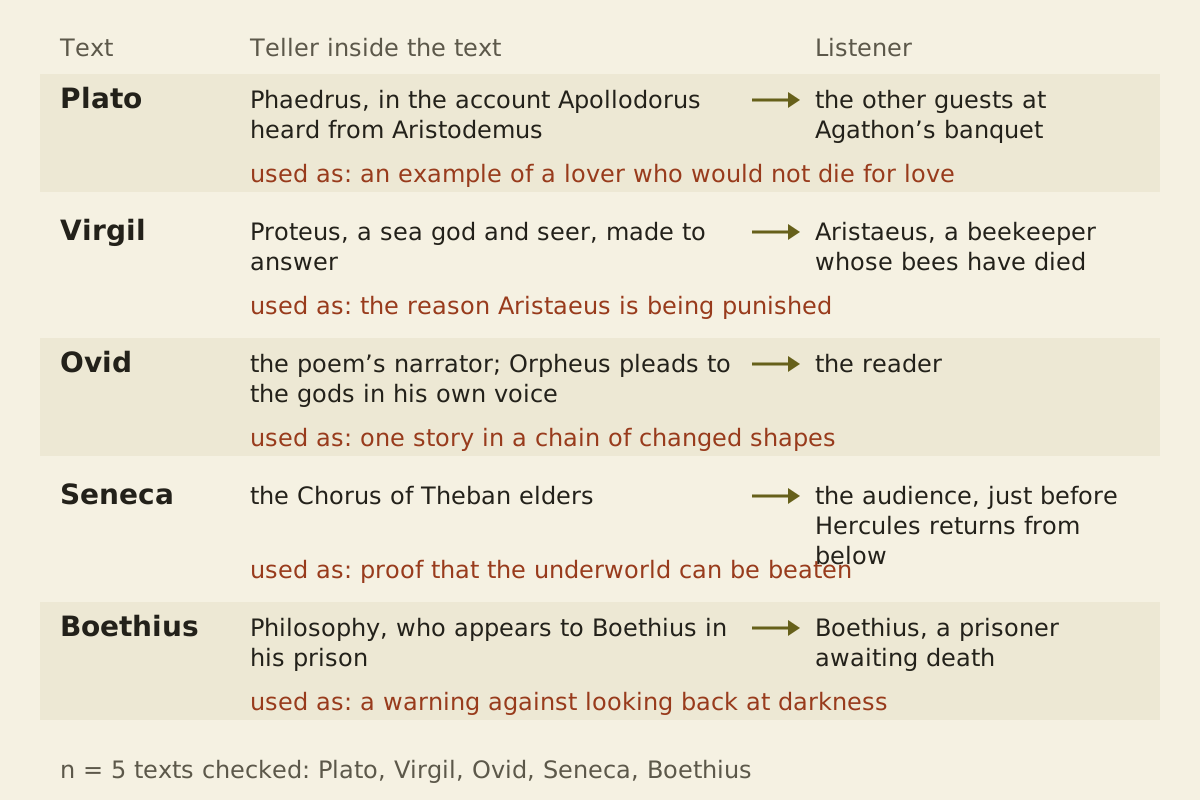
Who speaks the story inside each text, to whom, and what the story is used for there.
Credit line for reuse
"Who tells the Orpheus story inside each text" by Once Upon a Version — https://onceuponaversion.com/across-cultures/orpheus-eurydice-versions/ — licensed under CC BY 4.0 (https://creativecommons.org/licenses/by/4.0/)
Data: The five editions named on the page, retrieved 2026-11-03
The five texts, their tellers and editions, as CSV (where the data comes from) Data: The five editions named in the CSV and GND authority records via lobid-gnd, retrieved 2026-11-03
| Text | Teller inside the text | Listener | English text used |
|---|---|---|---|
| Plato, Symposium | Phaedrus, in the account Apollodorus heard from Aristodemus | the other guests at Agathon’s banquet | Benjamin Jowett, Project Gutenberg 1600 |
| Virgil, Georgics, book 4 | Proteus, a sea god and seer, made to answer | Aristaeus, a beekeeper whose bees have died | James Rhoades, Project Gutenberg 232 |
| Ovid, Metamorphoses, books 10–11 | the poem’s narrator; Orpheus pleads to the gods in his own voice | the reader | Brookes More, 1922 (Perseus Digital Library text) |
| Seneca, Hercules Furens | the Chorus of Theban elders | the audience, just before Hercules returns from below | Frank Justus Miller, The Tragedies of Seneca (Chicago, 1907), Project Gutenberg 57999 |
| Boethius, The Consolation of Philosophy, book 3, song 12 | Philosophy, who appears to Boethius in his prison | Boethius, a prisoner awaiting death | H. R. James (London, 1897), Project Gutenberg 14328 |
None of the five is narrated by Orpheus. Ovid comes closest, because he lets Orpheus plead with the rulers of the dead in his own voice for more than twenty lines (10.17–39), before the narrator takes the story back.
That plea is practical rather than heroic. Every mortal comes to the underworld sooner or later, Orpheus argues, so Eurydice will belong to its rulers again once her years are complete, and he asks only for the use of her life in the meantime (10.32–37). If they refuse, he will not return to the upper world, and they may enjoy two deaths instead of one (10.38–39). The song works: for the first time, report says, the cheeks of the Eumenides were wet with tears (10.45–46).
Two of the other tellers are characters with motives of their own. Virgil hands the story to Proteus, who must explain a punishment to the beekeeper Aristaeus, and Boethius hands it to Philosophy, who sings it to him in his cell. A tale entrusted to a teller inside the story is a device of the same kind as Scheherazade’s frame in the Arabian Nights, a similar structure, not a borrowed one.
How are the five texts dated?
The dates come from the editions themselves wherever possible. Jowett places the Symposium between 384 and 369 BC because the dialogue alludes to the division of Arcadia after the destruction of Mantinea.
The Project Gutenberg text of the Georgics is headed 29 BC, Miller assigns the tragedies to the age of Nero, and James’s introduction puts the Consolation in a prison at Pavia, written after 522. Neither edition of Ovid used here gives a date, so the timeline at the top of this page shows only his life dates from the German national authority file, the same source that gives Plato’s as 427–347 BC. Measured from those dates, between 891 and 907 years separate Plato’s dialogue from Boethius’s song.
What does Plato’s Phaedrus say happened?
Phaedrus speaks first at the banquet, and his subject is Love. To show that lovers will die for one another, he praises Alcestis, who gave her life for her husband and whom the gods allowed to return from the dead. Orpheus is his counter-example, and Achilles, whom the gods sent to the Islands of the Blest, is his final proof.
But Orpheus, the son of Oeagrus, the harper, they sent empty away, and presented to him an apparition only of her whom he sought, but herself they would not give up, because he showed no spirit; he was only a harp-player, and did not dare like Alcestis to die for love, but was contriving how he might enter Hades alive; moreover, they afterwards caused him to suffer death at the hands of women, as the punishment of his cowardliness.
told by Phaedrus · written by Plato · translated by Benjamin Jowett · Symposium 179d–e, Project Gutenberg 1600
Set this passage beside the other four texts and three elements are missing. Phaedrus never names the wife: Jowett’s English calls her “her whom he sought,” and the Greek has only the ordinary word for a woman or wife (179d). There is no prohibition, and consequently no look. She is never lost a second time, because she is never returned in the first place.
The Greek word for what the gods display is phasma, an apparition (179d). His music is mentioned, but as evidence against him: he “was only a harp-player,” too timid to die for love. The punishment, however, does appear. According to Phaedrus, the gods arranged for Orpheus to die at the hands of women, and the speech offers cowardice as the only reason.
The complaint is specific. Alcestis was willing to die so that her husband could live, whereas Orpheus, in Phaedrus’s words, “was contriving how he might enter Hades alive.” In this speech the descent itself is the failure, because a true lover would have followed his wife by dying, and the gods reward the willingness to die rather than the skill to get in and out.
Phaedrus’s words also reach the reader at third hand. Apollodorus, who narrates the dialogue, repeats what Aristodemus told him, and before the first speech he cautions that neither of them remembers everything.
Aristodemus did not recollect all that was said, nor do I recollect all that he related to me; but I will tell you what I thought most worthy of remembrance, and what the chief speakers said.
told by Apollodorus · written by Plato · translated by Benjamin Jowett · Symposium 178a, Project Gutenberg 1600
When the speech ends, Apollodorus adds that “This, or something like this, was the speech of Phaedrus” (180c). Painters have depicted the scene that the speech omits. In Camille Corot’s canvas of 1861, Orpheus strides ahead with his lyre raised and leads Eurydice by the hand, and he has not yet turned.
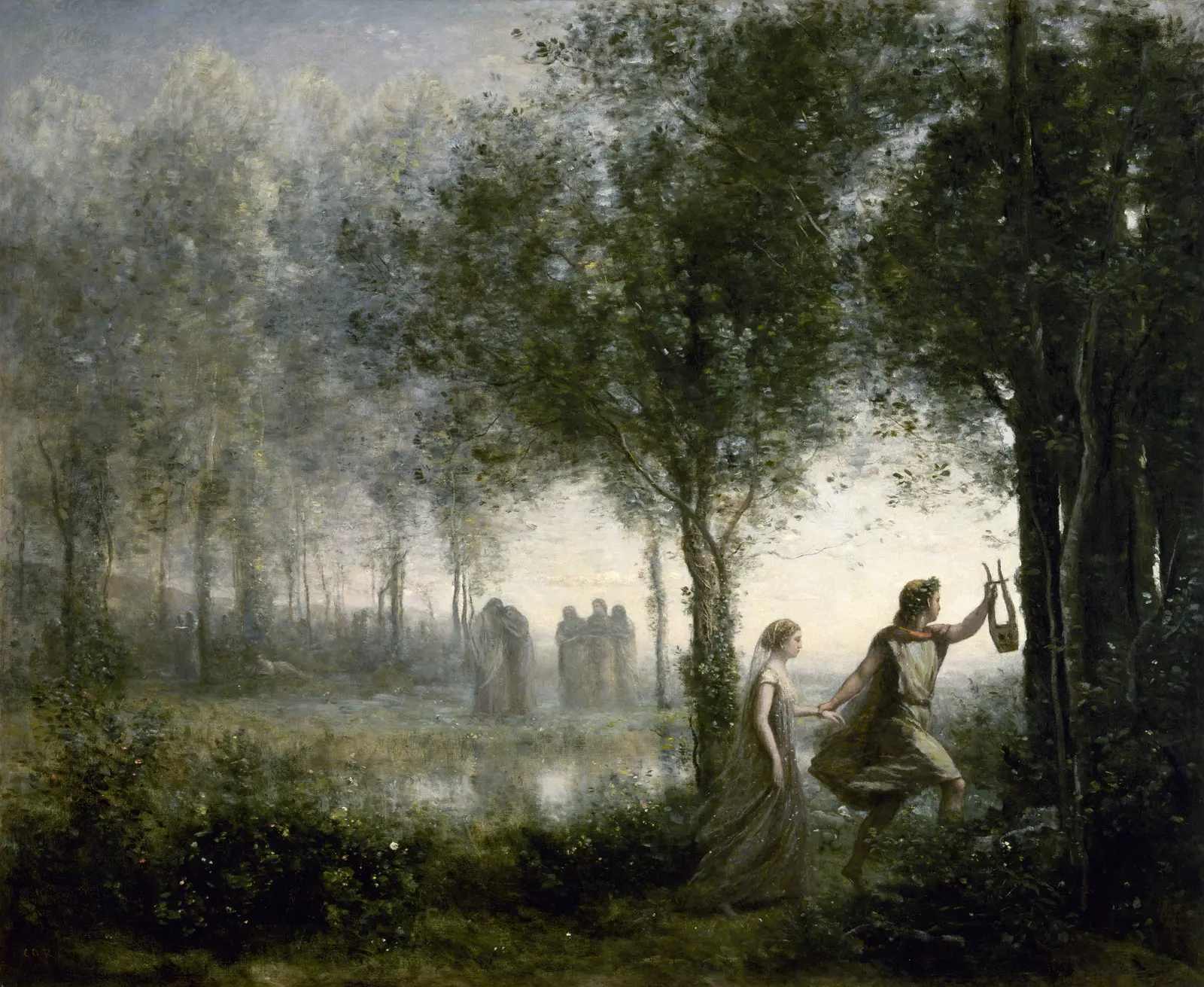
Orpheus leads Eurydice out of the underworld. Camille Corot, oil on canvas, 1861. Museum of Fine Arts, Houston, 87.190.
Full credit
"Orpheus Leading Eurydice from the Underworld" by Camille Corot — https://commons.wikimedia.org/wiki/File:Jean-Baptiste-Camille_Corot_-_Orpheus_Leading_Eurydice_from_the_Underworld_-_Google_Art_Project.jpg — Public domain in US (exhibited at the Salon of 1861; Corot d. 1875); DE/FR (Jean-Baptiste-Camille Corot d. 1875, life+70); faithful photograph of a two-dimensional painting (PD-Art; Google Arts & Culture photograph)
Who tells the story in Virgil’s Georgics?
In the fourth book of the Georgics, the story explains a punishment. Aristaeus, a beekeeper, has lost his bees to sickness and famine (4.317–318), and his mother Cyrene sends him to Proteus, a sea god and seer who will answer only when he is held fast. Proteus begins with the accusation: Orpheus, “unhappy by no fault of his,” is the one calling down the penalty (4.453–456).
Virgil is the only teller of the five who connects Eurydice’s death with another man. She was running from Aristaeus along a riverbank and did not notice a water-snake in the tall grass (4.457–459). Ovid also describes a snake bite (10.8–10), but his Eurydice is a new bride, walking in the grass with a band of Naiads.
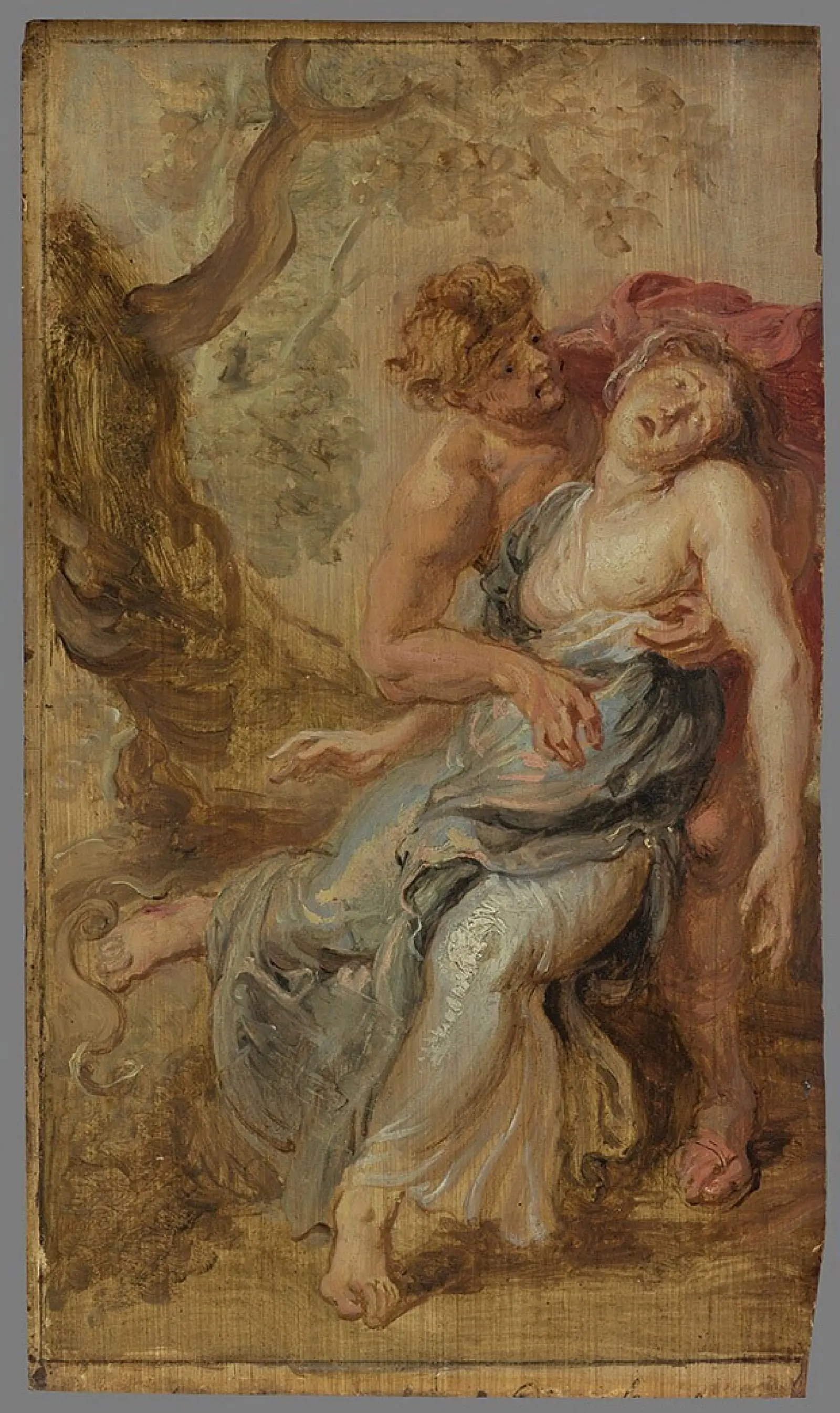
Eurydice dies of a snake bite, with the snake at her foot. Peter Paul Rubens, The Death of Eurydice, oil sketch on panel, 1636. Museum Boijmans Van Beuningen, St 30.
Full credit
"De dood van Eurydice" by Peter Paul Rubens — https://commons.wikimedia.org/wiki/File:Peter_Paul_Rubens_-_De_dood_van_Eurydice_-_St_30_-_Museum_Boijmans_Van_Beuningen.jpg — Public domain in US (painted 1636; Rubens d. 1640); DE/FR (Peter Paul Rubens d. 1640, life+70); faithful photograph of a two-dimensional painting (PD-Art; museum photograph, Museum Boijmans Van Beuningen)
Orpheus then sings his way into the underworld, and the shades come crowding to hear him (4.471–484). Virgil is also the only one of the four texts with a rule that introduces it after the fact. The condition appears as an aside, while Eurydice is already following him upward: namque hanc dederat Proserpina legem, “for Proserpina had given this law,” in this site’s rendering (4.487). The line ties the law to her walking behind him; that it also forbade looking becomes plain only when his look breaks the pact (4.491–493).
When she vanishes, Rhoades compares her to “smoke dissolving into empty air” (4.499–500). That is a simile for her disappearance, not a phantom offered in her place, so the grid records the phantom as absent from Virgil’s passage and keeps the two ideas apart.
Virgil also gives Eurydice a voice: before she fades she speaks for five lines, asking what madness has ruined them both and saying farewell (4.494–498). Ovid allows her a single word, vale, farewell (10.62), and in the other three texts she says nothing at all.
Four lines after the rule, he looks back (4.491). Orpheus mourns for seven months, the Ciconian women of Thrace tear him apart because he scorned them (4.520–522), and his severed head, carried down the river Hebrus, still calls “Eurydice” (4.523–527). Cyrene then tells Aristaeus that the nymphs who danced with Eurydice destroyed his bees (4.531–534).
Why does Orpheus look back?
Count the lines between the rule and the look, and the four texts with a rule resemble one another: the look, or in Seneca the hurry to see her, follows the rule within a dozen lines of verse. In Virgil the interval is four Latin lines (4.487 to 4.491), in Ovid seven (10.50 to 10.57) and in Seneca six (583 to 589).
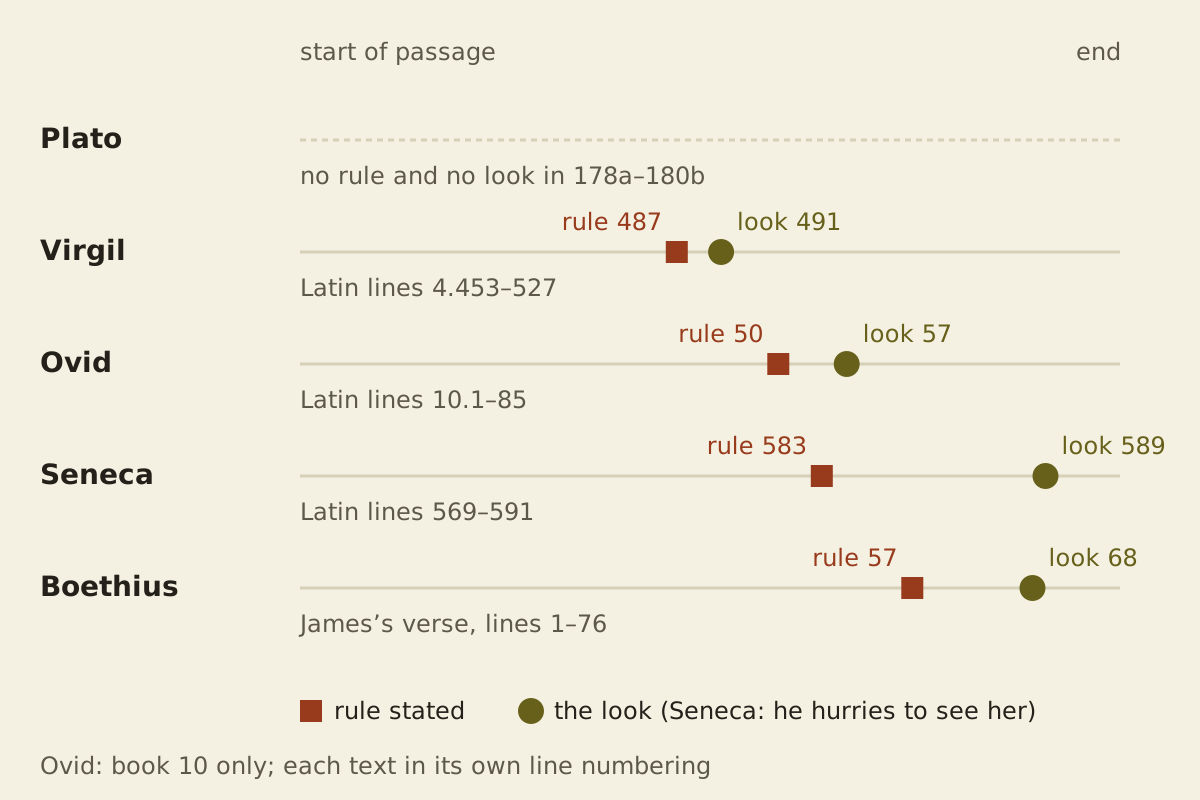
Where the rule is stated and where the look comes, as a share of each checked passage, in each text’s own line numbers; Ovid’s book 10 only.
Credit line for reuse
"Where the rule and the look fall in each passage" by Once Upon a Version — https://onceuponaversion.com/across-cultures/orpheus-eurydice-versions/ — licensed under CC BY 4.0 (https://creativecommons.org/licenses/by/4.0/)
Data: Perseus Digital Library Latin texts and James’s Boethius (Project Gutenberg 14328), line numbers only, retrieved 2026-11-03
| Text | Who sets the rule | Rule | Look | Lines counted in |
|---|---|---|---|---|
| Plato | no rule | n/a | n/a | Stephanus pages 178a–180b |
| Virgil | Proserpina | 487 | 491 | Latin lines 4.453–527 |
| Ovid | not named in the Latin | 50 | 57 | Latin lines 10.1–85 |
| Seneca | the arbiter of death | 583 | 589 | Latin lines 569–591 |
| Boethius | the shadowy king | 57 | 68 | James’s verse, lines 1–76 |
The moment itself is narrated differently, and each text supplies its own motive for the turn. Side by side, three of the passages give three distinct explanations.
Virgil · Georgics, book 4 (Rhoades)
For at the very threshold of the day, Heedless, alas! and vanquished of resolve, He stopped, turned, looked upon Eurydice His own once more.
translated by James Rhoades · Virgil, Georgics 4.490–491, Project Gutenberg 232
Ovid · Metamorphoses, book 10 (More, 1922)
when in fear he might again lose her, and anxious for another look at her, he turned his eyes so he could gaze upon her. Instantly she slipped away.
translated by Brookes More · Ovid, Metamorphoses 10.56–57, Boston 1922
Seneca · Hercules Furens (Miller, 1907)
Love hates delay, nor suffers it: He hasted to behold his wife-- And she again was lost to him.
translated by Frank Justus Miller · Seneca, Hercules Furens 588–589, Chicago 1907
What changed: Virgil calls the turn a sudden madness that seized him; Ovid gives fear of losing her and a longing to see her; Seneca’s chorus blames love’s impatience and does not describe a turn at all.
Boethius offers a fourth answer, phrased as a principle rather than a feeling. Immediately before the look, his Philosophy asks, “What law can lovers move? A higher law is love!” (James’s lines 63–64), so the turn becomes a contest between two laws instead of a lapse of attention.
Ovid then adds an ending that none of the others contains. After the Ciconian women kill Orpheus (11.1–43), his shade descends, finds Eurydice among the fields of the blessed and walks with her, sometimes in front of her. Now he can look back at her without danger: iam tutus respicit, “now safely looks back,” in this site’s rendering (11.66).
Who sets the rule?
The four texts with a rule disagree about who imposes it. In Virgil it is Proserpina, queen of the dead (4.487). Ovid’s Latin says only that Orpheus “receives” the law together with Eurydice (10.50); More’s 1922 English supplies a speaker, “Pluto told him,” which the Latin line does not contain.
Seneca gives the rule to the mortis arbiter, the “arbiter of death” in this site’s rendering (582), and half of it is addressed to Eurydice. She must walk behind her husband, and he must not look at her until they reach daylight.
But on this sole condition go: Do thou behind thy husband fare; And look thou not upon thy wife, Until the light of day thou see, And Spartan Taenarus appear.
translated by Frank Justus Miller · Seneca, Hercules Furens 583–587, Chicago 1907
The song begins with Hercules, who has gone down alive to bring Cerberus up, and the chorus asks with what hope he set out to see the kingdom of Proserpina (547–549). Orpheus enters the song as the earlier living visitor who moved the powers below.
The chorus sings all of this while it waits for Hercules to return, and it draws its own conclusion from the precedent: “So, then, the fortress that could yield to song, Be sure that fortress shall to strength belong” (590–591). For this teller, Orpheus matters because he proves that the kingdom of the dead can be defeated, not because he failed.
Boethius’s Song XII closes the third of the Consolation’s five books. In the prose just before it, Philosophy has been arguing about the nature of the highest good, so the story arrives as an illustration of an argument rather than as an episode told for its own sake.
In this song, “the shadowy king” pities Orpheus and announces the condition himself (James’s lines 51–62). Here the condition is framed as a limit on the gift, set on “the boon,” rather than as two instructions addressed to husband and wife, as in Seneca.
One sole condition yet Upon the boon is set: Let him not turn his eyes To view his hard-won prize, Till they securely pass The gates of Hell.
translated by H. R. James · Boethius, The Consolation of Philosophy, Book III, Song XII, lines 57–62, London 1897
Illustration of an empty throne below ground. The texts that have the rule disagree about who sets it.
Illustration: Once Upon a Version. Generated illustration — not a historical image, manuscript or record. © Once Upon a Version, all rights reserved; reuse by request.
Motif grid: what the five texts keep
Each motif was defined before any cell was filled: what counts as present, and which specific changes count as transformed. A cell marked absent means only that the checked passage does not contain the motif, not that it is missing from the author’s other works or from the wider tradition.
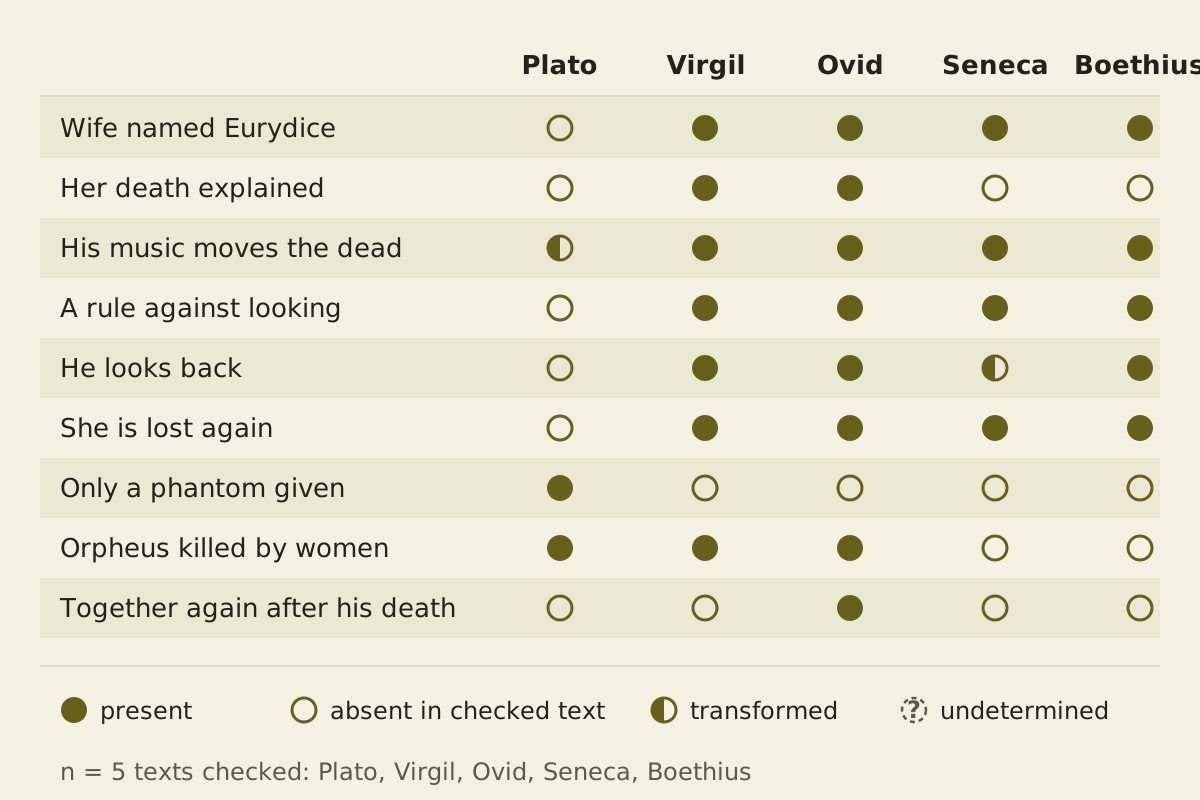
Nine motifs in five texts; n = 5 texts checked: Plato, Virgil, Ovid, Seneca, Boethius.
Credit line for reuse
"Motif grid: Orpheus and Eurydice in five texts" by Once Upon a Version — https://onceuponaversion.com/across-cultures/orpheus-eurydice-versions/ — licensed under CC BY 4.0 (https://creativecommons.org/licenses/by/4.0/)
Data: Five public-domain translations named on the page, with Greek and Latin line numbers from the Perseus Digital Library, retrieved 2026-11-03
The 45 cells, with line numbers and quotations, as CSV (where the data comes from) Data: Five public-domain translations named in the edition column, retrieved 2026-11-03
| Motif | Plato | Virgil | Ovid | Seneca | Boethius |
|---|---|---|---|---|---|
| Wife named Eurydice | absent in checked text | present | present | present | present |
| Her death explained | absent in checked text | present | present | absent in checked text | absent in checked text |
| His music moves the dead | transformed | present | present | present | present |
| A rule against looking | absent in checked text | present | present | present | present |
| He looks back | absent in checked text | present | present | transformed | present |
| She is lost again | absent in checked text | present | present | present | present |
| Only a phantom given | present | absent in checked text | absent in checked text | absent in checked text | absent in checked text |
| Orpheus killed by women | present | present | present | absent in checked text | absent in checked text |
| Together again after his death | absent in checked text | absent in checked text | present | absent in checked text | absent in checked text |
n = 5 texts checked: Plato, Symposium 178a–180b (Jowett); Virgil, Georgics 4.453–527 (Rhoades); Ovid, Metamorphoses 10.1–85 and 11.1–66 (More); Seneca, Hercules Furens 569–591 (Miller); Boethius, Consolation III, Song XII (James). Of the 45 cells, 26 are present, 17 absent in the checked text, 2 transformed and 0 undetermined. The definitions are a separate download: the nine motif definitions as CSV (where the data comes from) Data: Once Upon a Version, motif definitions, 2026-11-03.
No motif is present in all five texts. Four motifs are present in four: the wife’s name, the music that moves the dead, the rule and the second loss. In each of those rows the exception is Plato, whose speech has only two of the nine motifs present: the phantom and Orpheus’s death at the hands of women.
The two transformed cells follow the definitions table, which names in advance the only changes that can count. Plato’s music cell is transformed because his harp-playing is mentioned but counts against him with the gods. Seneca’s look cell is transformed because the chorus says he hurried to see her, which is the form the definition lists, without describing a turn.
What do the versions not share?
Read together, the five passages differ almost as much as they agree. The phantom occurs in Plato alone, and the reunion of the dead couple occurs in Ovid alone. Eurydice’s death is explained in only two texts, Virgil and Ovid, and they describe different scenes.
Even the name is handled unevenly. Plato never uses it, while Seneca’s chorus repeats it twice within five Latin lines, as the women of Thrace and then the judges of the dead weep for Eurydice (577–581); Miller’s English adds a third “Eurydice” for the weeping gods.
The death of Orpheus appears in three texts and receives two kinds of explanation. In Plato the gods arrange it as a punishment for cowardice (179d–e). In Virgil the Ciconian women tear him apart after he scorns them (4.520–522), and in Ovid they attack him while he is singing, the first of them calling him the man who scorns them (11.1–43). Seneca’s chorus and Boethius’s song both stop at the second loss.
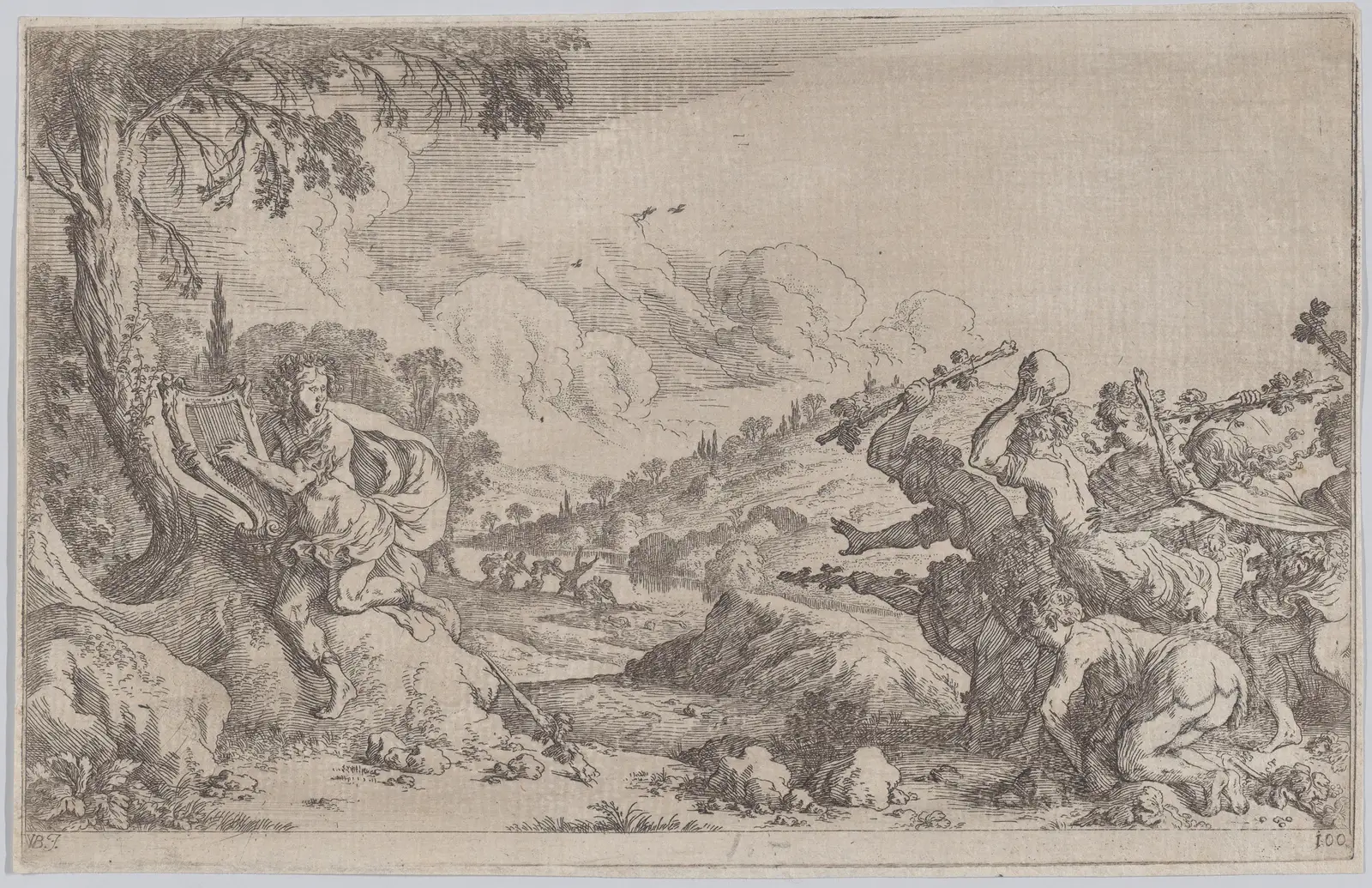
Women armed with branches and stones attack Orpheus, who still holds his lyre. Johann Wilhelm Baur, plate 100 of his etchings for Ovid’s Metamorphoses, 1641. Metropolitan Museum of Art, 62.635.621.
"Plate 100: The death of Orpheus, from Ovid's Metamorphoses" by Johann Wilhelm Baur — https://commons.wikimedia.org/wiki/File:Plate_100-_The_death_of_Orpheus,_from_Ovid%27s_Metamorphoses_MET_DP880635.jpg — CC0 1.0 (https://creativecommons.org/publicdomain/zero/1.0/)
Shared motifs here are counts, not a family tree. The grid records what each passage says; it does not establish who read whom, and no source consulted for this page traces a line of borrowing between them. The same caution applies to Pandora in Hesiod’s two poems, another myth in this section whose best-known detail depends on which text is opened.
Boethius turns the story into a lesson for his reader. His Philosophy ends the song by addressing everyone who seeks the light.
Ye who the light pursue, This story is for you, Who seek to find a way Unto the clearer day. If on the darkness past One backward look ye cast, Your weak and wandering eyes Have lost the matchless prize.
translated by H. R. James · Boethius, The Consolation of Philosophy, Book III, Song XII, lines 69–76, London 1897
Phaedrus, as Apollodorus remembers Aristodemus remembering him, drew no lesson about looking, because in his speech there is nothing to look back at. His gods show Orpheus a phantom and send him out of Hades without his wife, and the women who kill him later are the gods’ instrument, not women he had scorned.
Sources
Editions
- Plato, Symposium, translated by Benjamin Jowett, with Jowett’s introduction. Project Gutenberg ebook 1600. https://www.gutenberg.org/ebooks/1600 (full text, with the translator’s introduction)
- Plato, Symposium, Greek text in Platonis Opera, ed. John Burnet (Oxford, 1910), as encoded by the Perseus Digital Library (canonical-greekLit, tlg0059.tlg011.perseus-grc2). https://github.com/PerseusDL/canonical-greekLit/blob/master/data/tlg0059/tlg011/tlg0059.tlg011.perseus-grc2.xml (Stephanus pages 176d–180c)
- Virgil, The Georgics, translated by James Rhoades. Project Gutenberg ebook 232. https://www.gutenberg.org/ebooks/232 (full text of book 4)
- Virgil, Georgics, Latin text as encoded by the Perseus Digital Library (canonical-latinLit, phi0690.phi002.perseus-lat2). https://github.com/PerseusDL/canonical-latinLit/blob/master/data/phi0690/phi002/phi0690.phi002.perseus-lat2.xml (book 4, lines 315–536)
- Ovid, Metamorphoses, translated by Brookes More (Boston: Cornhill Publishing Co., 1922), as encoded by the Perseus Digital Library (canonical-latinLit, phi0959.phi006.perseus-eng3). https://github.com/PerseusDL/canonical-latinLit/blob/master/data/phi0959/phi006/phi0959.phi006.perseus-eng3.xml (book 10, lines 1–140, and book 11, lines 1–106 of the translation)
- Ovid, Metamorphoses, Latin text ed. Hugo Magnus (Gotha: F. A. Perthes, 1892–1919), as encoded by the Perseus Digital Library (canonical-latinLit, phi0959.phi006.perseus-lat2). https://github.com/PerseusDL/canonical-latinLit/blob/master/data/phi0959/phi006/phi0959.phi006.perseus-lat2.xml (book 10, lines 1–85, and book 11, lines 1–66)
- Seneca, The Tragedies of Seneca, translated into English verse by Frank Justus Miller (Chicago: University of Chicago Press, 1907). Project Gutenberg ebook 57999. https://www.gutenberg.org/ebooks/57999 (Hercules Furens, lines 524–600, and Hercules Oetaeus, lines 1031–1100; title page and preface)
- Seneca, Hercules Furens, Latin text in Tragoediae, ed. Rudolf Peiper and Gustav Richter (Leipzig: Teubner, 1921), as encoded by the Perseus Digital Library (canonical-latinLit, phi1017.phi001.perseus-lat2). https://github.com/PerseusDL/canonical-latinLit/blob/master/data/phi1017/phi001/phi1017.phi001.perseus-lat2.xml (lines 560–595)
- Boethius, The Consolation of Philosophy, translated into English prose and verse by H. R. James (London: Elliot Stock, 1897). Project Gutenberg ebook 14328. https://www.gutenberg.org/ebooks/14328 (Book III, Song XII in full; the translator’s introduction and epilogue)
Catalogues and databases
- Gemeinsame Normdatei (GND) authority records via lobid-gnd (hbz): Plato, 118594893; Vergilius Maro, Publius, 118626574; Ovidius Naso, Publius, 118590995; Seneca, Lucius Annaeus, Philosophus, 118613200; Boethius, Anicius Manlius Severinus, 11851282X. https://lobid.org/gnd/118594893 (five authority records) Text licence: CC0 1.0, https://creativecommons.org/publicdomain/zero/1.0/
Cite this page
Once Upon a Version. “Orpheus and Eurydice: In Plato, the Gods Show Him a Phantom.” Once Upon a Version. Published 2026-11-05. https://onceuponaversion.com/across-cultures/orpheus-eurydice-versions/ (accessed day month year).
Write in the date you read the page; the page has no DOI.
More from Motifs Across Cultures
Motifs Across Cultures
Anansi the Spider: In an Akan Tale, He Buys the Stories
Type Akan folktale, one of the Anansesem or Spider-stories (no ATU number cited)
In an Akan tale printed by R. S. Rattray in 1930, Anansi buys the Sky-god’s stories. Beside Hermes, Loki and Coyote, five texts share one motif in eight.
Picture credit
"SÁM 66, 79r, Loki" by Jakob Sigurðsson — https://commons.wikimedia.org/wiki/File:S%C3%81M_66,_79r,_Loki.jpg — Public domain in US (manuscript of 1765–66); DE/FR (Jakob Sigurðsson, 18th-century draughtsman, life+70); faithful reproduction of a two-dimensional manuscript page (PD-Art), digitized for the Árni Magnússon Institute’s Sagnanet; cropped, rotated and levelled by the Commons uploader
Motifs Across Cultures
Cupid and Psyche: In Apuleius, an Old Woman Tells the Tale
Type ATU 425B, as classified by D. L. Ashliman
In Apuleius’s Metamorphoses, Cupid and Psyche is told by an old woman in a robbers’ cave to a captive bride. Later tellers kept her, cut her or replaced her.
Picture credit
"Cupid and Psyche - Palace Green Murals - Psyche entering the Portals of Olympus" by Edward Burne-Jones — https://commons.wikimedia.org/wiki/File:Edward_Burne-Jones_-_Cupid_and_Psyche_-_Palace_Green_Murals_-_Psyche_entering_the_Portals_of_Olympus_-_Google_Art_Project.jpg — Public domain in US (painted 1872–1881, Burne-Jones d. 1898; Commons marks it published before 1931); DE/FR (Edward Burne-Jones d. 1898, life+70); faithful photograph of a two-dimensional painting (PD-Art; Google Arts & Culture photograph)
Motifs Across Cultures
Pandora’s Box: No Jar in the Theogony, One in Works and Days
Type Greek myth told in two didactic poems (no ATU number cited)
The Theogony’s woman has no jar and no name. Of the two Hesiodic poems, only Works and Days gives Pandora a jar; the box, by the Panofskys’ account, came later.
Picture credit
"Pandora" by Walter Crane — https://commons.wikimedia.org/wiki/File:Walter_Crane_-_Pandora_(1885).jpg — Public domain in US (painted 1885; Walter Crane d. 1915, so the work is public domain whether it counts as published before 1930 or as unpublished); DE/FR (Walter Crane d. 1915, life+70); faithful photograph of a two-dimensional watercolour (PD-Art; Sotheby’s sale photograph, New York, 20 April 2015, lot 165)