Pandora’s Box: No Jar in the Theogony, One in Works and Days
In the Theogony, the woman Zeus sends is made, dressed and handed over with no jar and no name; the jar belongs to the Works and Days, and the box to much later tellers.
By Once Upon a Version
Published
How a version is traced · Version history · Contact · Report an error (contact@onceuponaversion.com)
In short
- In the Theogony, in lines 507–616 as Hugh G. Evelyn-White’s 1914 translation numbers them, the woman Zeus sends is made and given to Epimetheus with no jar, box or casket, and she is never named.
- Of the two poems, only Hesiod’s Works and Days has the jar, a pithos in the Greek: she is named Pandora in lines 69–82, and in lines 90–105 she lifts its lid and Hope stays inside.
- The box came from later tellers: by Dora and Erwin Panofsky’s account (1956), it goes back to Erasmus, and Evelyn-White’s own 1914 note calls the container a “jar or casket.”
Telling card
- Tale
- Pandora and the jar (Works and Days, ll. 42–105); the unnamed woman of the Theogony, ll. 507–616
- Type
- Greek myth told in two didactic poems (no ATU number cited)
- Teller
- Hesiod (Works and Days); the Theogony comes down under his name, and Evelyn-White treats its author as a later poet
- Recorded by
- n/a (written poems; no collector)
5 more fields: edited by, told, published, this text, earliest known
- Edited by
- Greek text and English translation by Hugh G. Evelyn-White (1884–1924), 1914
- Told
- unrecorded; the poet’s father settled at Ascra in Boeotia (Works and Days 636 ff., as Evelyn-White reads it)
- Published
- Works and Days and Theogony; year of first publication not recorded on this page; for the composition, Evelyn-White put Works and Days about the middle of the ninth century BC and the Theogony perhaps a century later
- This text
- Evelyn-White’s English (Project Gutenberg 348), cited by the line ranges it prints; Greek (Perseus Digital Library) cited by line number only
- Earliest known
- not traced on this page; in Evelyn-White’s view Works and Days is the older of the two poems
This card as CSV · where these values come from
Data: Evelyn-White’s Hesiod (Project Gutenberg 348) and GND 124470416, retrieved 2026-11-04
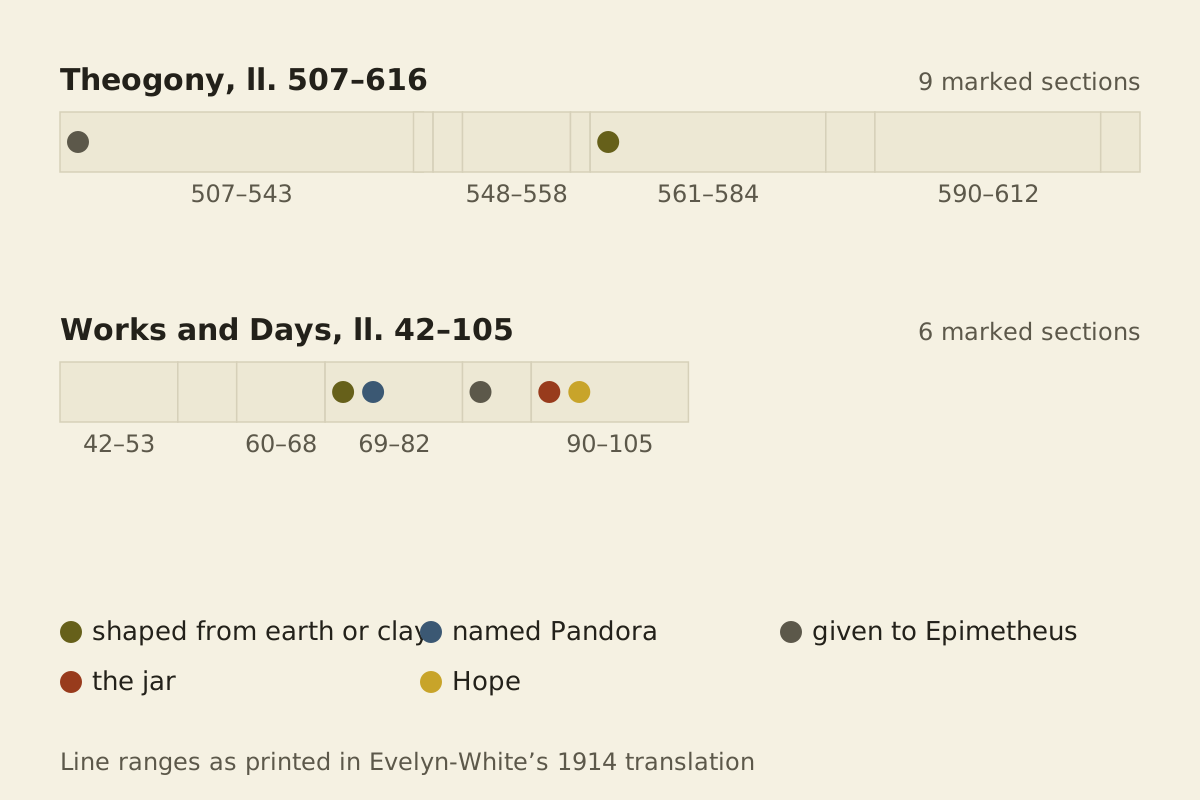
The two passages compared on this page, section by section as Evelyn-White’s 1914 translation numbers them, with the sections where the woman is shaped, named, given to Epimetheus, and where the jar and Hope appear.
Credit line for reuse
"Hesiod’s two Pandora passages, section by section" by Once Upon a Version — https://onceuponaversion.com/across-cultures/pandoras-box-jar/ — licensed under CC BY 4.0 (https://creativecommons.org/licenses/by/4.0/)
Data: Evelyn-White’s Hesiod, Project Gutenberg 348, retrieved 2026-11-04
In Hesiod’s Theogony, the Limping God shapes a maiden out of earth and Athena dresses her. Nobody hands her a jar, and nobody gives her a name. The poem comes down under Hesiod’s name, and his father, by the poet’s own account as Evelyn-White reads it, had settled at Ascra in Boeotia (Works and Days 636 ff.); no date of composition is recorded. She is the woman later readers know from Pandora’s box.
Hesiod’s other poem tells the story again, and only there does she get a name and a jar. In the Works and Days, Zeus has her made as the price of stolen fire, the gods each give her a gift, and the woman lifts the lid of a great jar, although neither poem gives her a box.
Which tellings are compared here?
The comparison takes two passages, both read in the English of Hugh G. Evelyn-White (1884–1924), whose Greek text and translation appeared in 1914; the translation is Project Gutenberg 348. His translation prints line ranges at the start of each section, and those ranges are the coordinates used on this page. Because both poems appear in one volume by one translator, no difference between the two passages comes from a change of translator. His English can still vary where the Greek does not.
- Hesiod, Theogony, lines 507–616. The section on the sons of Iapetus, Prometheus’s trick at Mecone, and the woman Zeus sends in return. Evelyn-White prints it as nine sections, from lines 507–543 to lines 613–616; the woman herself fills lines 561–612.
- Hesiod, Works and Days, lines 42–105. The story of fire and the jar, which Evelyn-White prints as six sections, from lines 42–53 to lines 90–105.
The diagram at the top of the page shows those 15 sections; the same information as a table follows, with a yes wherever a section mentions the detail in Evelyn-White’s English. The shaping column marks only the section where the god actually forms her, not Zeus’s order to do so in Works and Days 60–68.
| Poem | Section | Words | Shaped from earth or clay | Named Pandora | Epimetheus | Jar | Hope |
|---|---|---|---|---|---|---|---|
| Theogony | 507–543 | 357 | no | no | yes | no | no |
| Theogony | 543–544 | 17 | no | no | no | no | no |
| Theogony | 545–547 | 22 | no | no | no | no | no |
| Theogony | 548–558 | 117 | no | no | no | no | no |
| Theogony | 559–560 | 16 | no | no | no | no | no |
| Theogony | 561–584 | 236 | yes | no | no | no | no |
| Theogony | 585–589 | 69 | no | no | no | no | no |
| Theogony | 590–612 | 228 | no | no | no | no | no |
| Theogony | 613–616 | 40 | no | no | no | no | no |
| Works and Days | 42–53 | 123 | no | no | no | no | no |
| Works and Days | 54–59 | 57 | no | no | no | no | no |
| Works and Days | 60–68 | 100 | no | no | no | no | no |
| Works and Days | 69–82 | 135 | yes | yes | no | no | no |
| Works and Days | 83–89 | 81 | no | no | yes | no | no |
| Works and Days | 90–105 | 160 | no | no | no | yes | yes |
The 15 sections and what each mentions, as CSV (where the data comes from) Data: Evelyn-White’s Hesiod, Project Gutenberg 348, retrieved 2026-11-04
Each passage is what this site calls a one-evening text: a stretch of a named edition with line numbers, not the myth itself. Single Greek line numbers on this page come from Evelyn-White’s own Greek text as the Perseus Digital Library encodes it; the Greek words themselves are quoted only briefly.
The two brothers at the centre of both passages are introduced in the Theogony. Iapetus has four sons, among them “clever Prometheus, full of various wiles,” and “scatter-brained Epimetheus,” who “from the first was a mischief to men who eat bread,” because he was the first to accept the woman from Zeus (507–543). That clause is the only mention of Epimetheus in the Theogony section, and in the Greek it comes 60 lines before the woman is made, at line 511 against line 571.
Evelyn-White did not think both poems had the same author: in his introduction he calls the Works and Days the oldest of the Hesiodic poems, the “glorious song” the Muses taught Hesiod, puts it at about the middle of the ninth century BC, and places the Theogony perhaps a century later. He reads the Theogony’s lines about Hesiod and the Muses (22–23) as a later poet’s tradition about Hesiod. The title of this page follows the usual practice of calling both poems Hesiod’s.
What does the Theogony give her?
The Theogony reaches the woman through Prometheus. At Mecone he divides an ox so as to fool Zeus, Zeus withholds fire, Prometheus steals it in a hollow fennel stalk, and Zeus answers with something made “as the price of fire” (lines 561–584). The poem never names her: she is “the woman” and “the maiden,” first mentioned in passing as the gift Epimetheus took from Zeus (507–543).
Both poems describe her making in some of the same words. Evelyn-White’s English differs slightly between the two, yet the Greek behind his “shy maiden” and “modest maid” is one and the same line.
Theogony · lines 561–584 (Evelyn-White, 1914)
Forthwith he made an evil thing for men as the price of fire; for the very famous Limping God formed of earth the likeness of a shy maiden as the son of Cronos willed.
translated by Hugh G. Evelyn-White · Hesiod, Theogony, ll. 561–584, 1914, Project Gutenberg 348
Works and Days · lines 69–82 (Evelyn-White, 1914)
Forthwith the famous Lame God moulded clay in the likeness of a modest maid, as the son of Cronos purposed. And the goddess bright-eyed Athene girded and clothed her
translated by Hugh G. Evelyn-White · Hesiod, Works and Days, ll. 69–82, 1914, Project Gutenberg 348
What changed: The Theogony goes on to a gold crown and a veil and leaves her unnamed; the Works and Days adds gifts from the Graces, Persuasion, the Hours and Hermes, and then a name.
The name arrives at the end of that second passage, and the Works and Days explains it: “he called this woman Pandora, because all they who dwelt on Olympus gave each a gift, a plague to men who eat bread” (lines 69–82), and Evelyn-White’s note glosses the name as “The All-endowed.”
The Works and Days also gives Zeus a motive in his own voice. He laughs aloud after he speaks, and the gifts he orders are not all kind: Athene is to teach her needlework, Aphrodite to shed grace and “cruel longing” on her, and Hermes to put in her “a shameless mind and a deceitful nature” (60–68).
‘Son of Iapetus, surpassing all in cunning, you are glad that you have outwitted me and stolen fire—a great plague to you yourself and to men that shall be. But I will give men as the price for fire an evil thing in which they may all be glad of heart while they embrace their own destruction.’
translated by Hugh G. Evelyn-White · Hesiod, Works and Days, ll. 54–59, 1914, Project Gutenberg 348
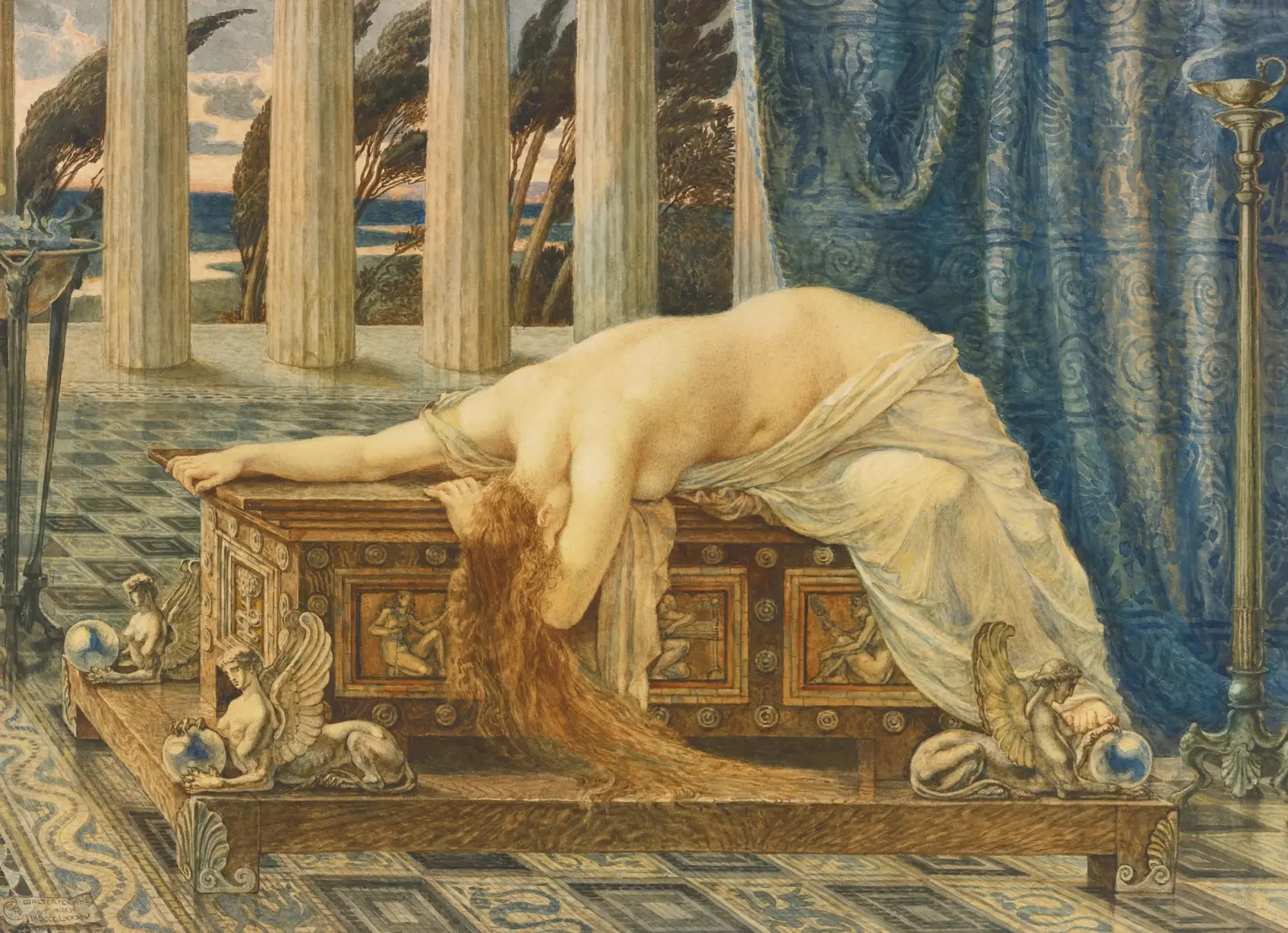
Pandora lies across a carved wooden chest, the kind of container later painters gave her in place of Hesiod’s jar. Walter Crane, Pandora, watercolour, 1885.
Full credit
"Pandora" by Walter Crane — https://commons.wikimedia.org/wiki/File:Walter_Crane_-_Pandora_(1885).jpg — Public domain in US (painted 1885; Walter Crane d. 1915, so the work is public domain whether it counts as published before 1930 or as unpublished); DE/FR (Walter Crane d. 1915, life+70); faithful photograph of a two-dimensional watercolour (PD-Art; Sotheby’s sale photograph, New York, 20 April 2015, lot 165)
In the Theogony there is nothing for her to open. When she is brought out, gods and men marvel at “that which was sheer guile” (585–589), and the poem moves straight on to what she means for men, with no jar, box or casket for her anywhere in the section.
Where does the jar appear?
The jar comes in the last section of the Works and Days passage. Epimetheus has forgotten Prometheus’s warning never to accept a gift from Zeus (83–89), and the next lines say what the woman does. Before this, the passage says, people “lived on earth remote and free from ills and hard toil and heavy sickness.”
But the woman took off the great lid of the jar with her hands and scattered all these and her thought caused sorrow and mischief to men. Only Hope remained there in an unbreakable home within under the rim of the great jar, and did not fly out at the door; for ere that, the lid of the jar stopped her, by the will of Aegis-holding Zeus who gathers the clouds.
translated by Hugh G. Evelyn-White · Hesiod, Works and Days, ll. 90–105, 1914, Project Gutenberg 348
The Greek word is pithos, a large storage jar.
In Evelyn-White’s Greek text it occurs three times in the passage, at lines 94, 97 and 98, and three more times later in the poem, at lines 368, 815 and 819, where it is simply the farm’s storage jar: “On the fourth day open a jar,” the calendar advises (819–821). The Theogony, across all 1,022 numbered lines, has no form of the word. The grid below counts a container only inside the checked passage, so those three farm jars do not change any of its cells.
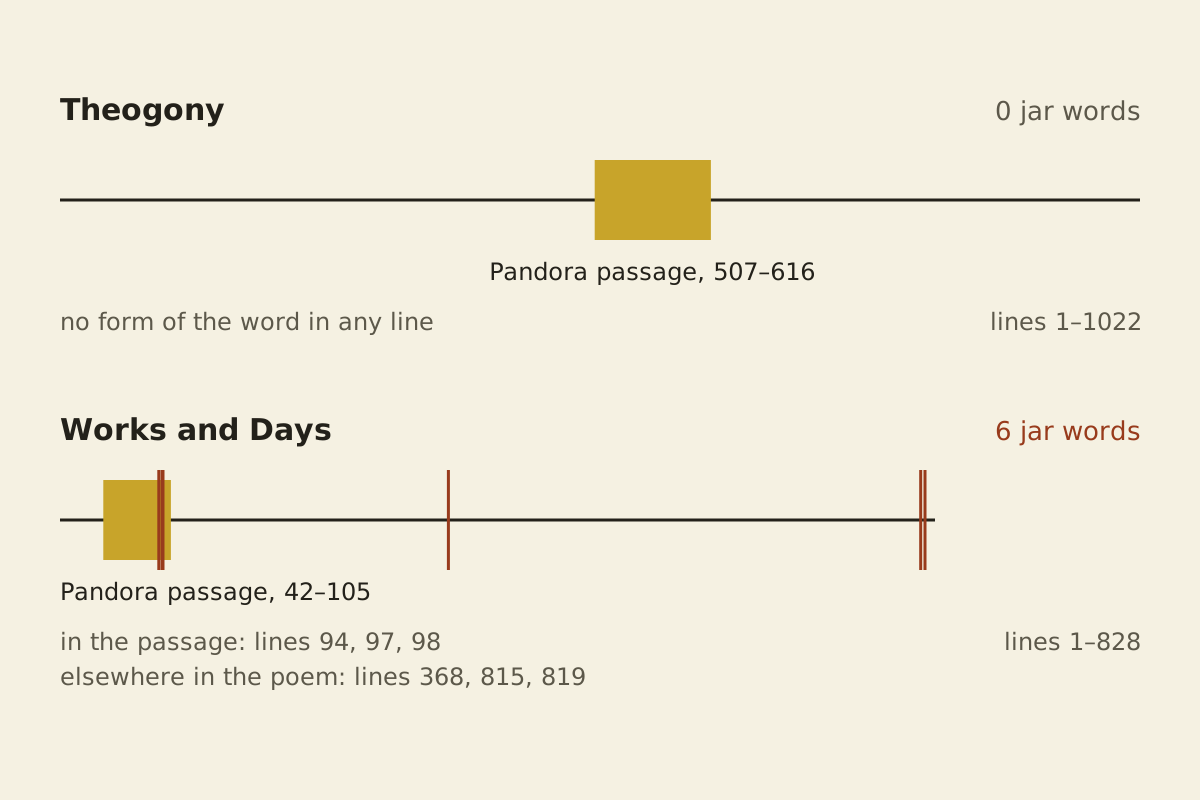
Where the Greek word for jar, pithos, falls in each poem, by line number in Evelyn-White’s Greek text; the shaded band marks the Pandora passage.
Credit line for reuse
"The Greek word for jar in Hesiod’s two poems, by line" by Once Upon a Version — https://onceuponaversion.com/across-cultures/pandoras-box-jar/ — licensed under CC BY 4.0 (https://creativecommons.org/licenses/by/4.0/)
Data: Perseus Digital Library Greek text of Hesiod (ed. Evelyn-White 1914), line numbers only, retrieved 2026-11-04
The six lines with the word for jar, as CSV (where the data comes from) Data: Perseus Digital Library Greek text of Hesiod (ed. Evelyn-White 1914), retrieved 2026-11-04
The poem never introduces the jar, saying nothing of where it came from, who filled it, or whether it arrived with her; the woman simply opens it. Evelyn-White’s footnote to the line fills that gap for the reader: “The jar or casket contained the gifts of the gods mentioned in l.82.” His gloss, not Hesiod’s text, is the one place in the volume where a casket appears.
What stays inside the jar?
In the Works and Days, one thing stays behind when the lid comes off. Hope, Elpis in the Greek, remains “under the rim of the great jar,” because the lid comes down before she can fly out (Greek lines 96–98). The rest, in Evelyn-White’s words, “countless plagues, wander amongst men,” and diseases come silently, “for wise Zeus took away speech from them” (90–105). The jar is how the poem explains why that earlier life ended.
The passage does not say whether Hope stays in to help people or is withheld from them. It says only that the lid of the jar stopped her “by the will of Aegis-holding Zeus,” and the grid below records her as present in the jar without deciding what her staying means.
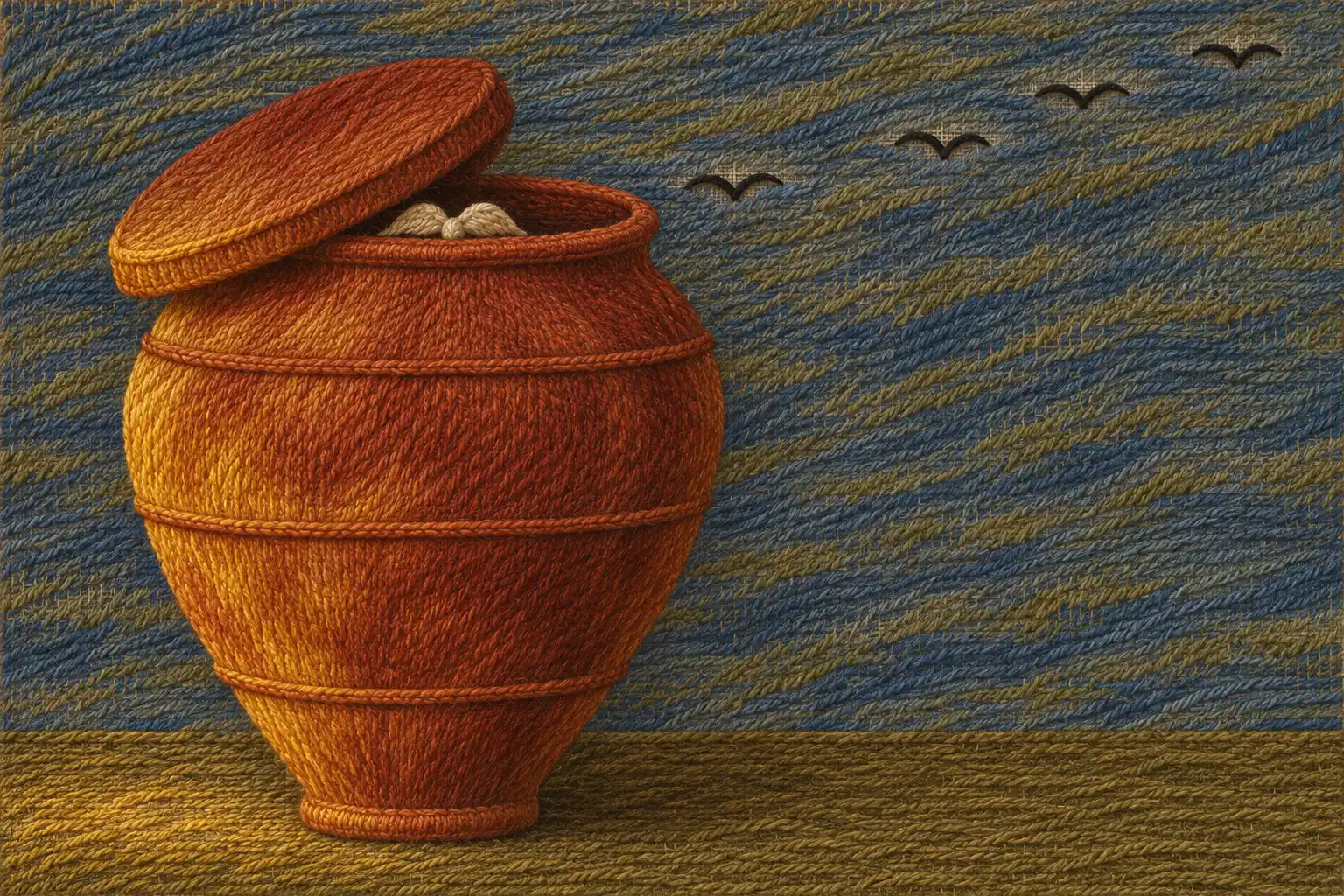
An illustration of a large storage jar with its lid lifted, as in the Works and Days; not a picture of any ancient object.
Illustration: Once Upon a Version. Generated illustration — not a historical image, manuscript or record. © Once Upon a Version, all rights reserved; reuse by request.
Motif grid: what Hesiod’s two poems keep
Each motif was defined before any cell was filled, with what counts as present and which specific changes count as transformed. A cell marked absent means only that the checked section does not contain the motif, not that it is missing from the rest of the poem or from Greek tradition.
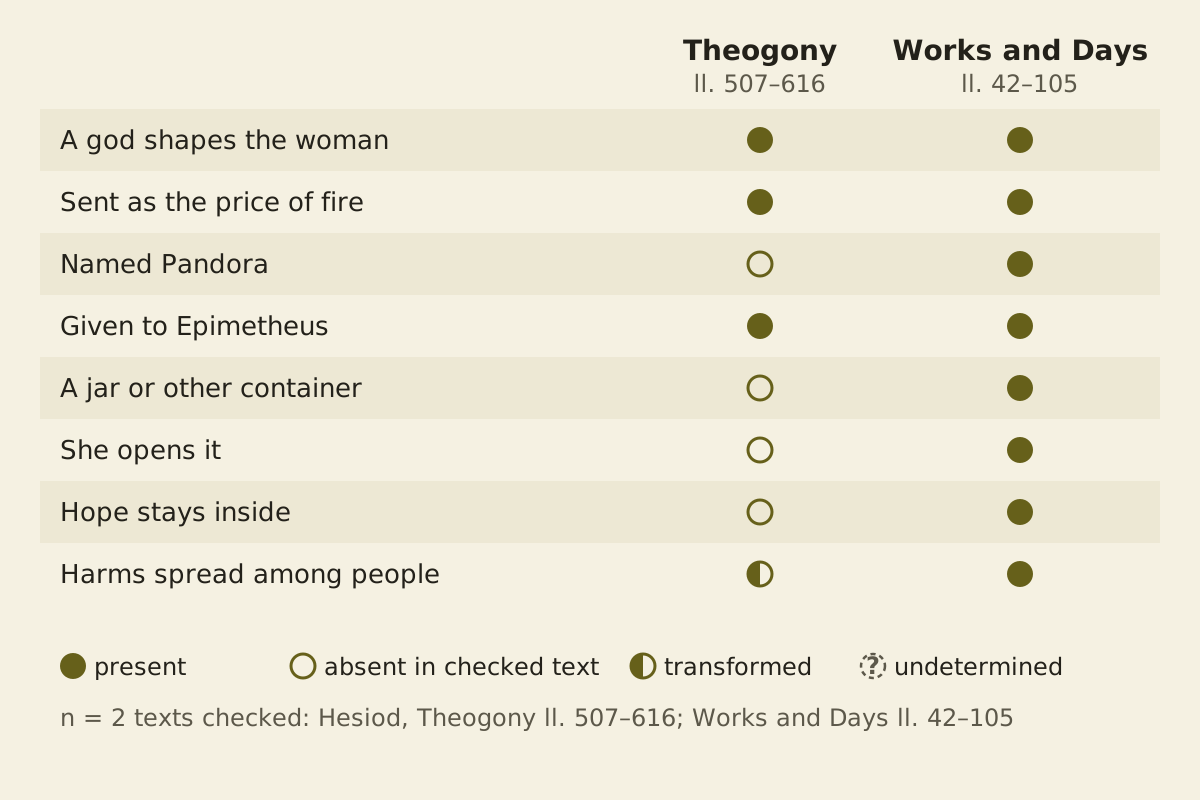
Eight motifs in Hesiod’s two passages; n = 2 texts checked: Theogony lines 507–616 and Works and Days lines 42–105, in Evelyn-White’s 1914 translation.
Credit line for reuse
"Motif grid: Pandora in Hesiod’s two poems" by Once Upon a Version — https://onceuponaversion.com/across-cultures/pandoras-box-jar/ — licensed under CC BY 4.0 (https://creativecommons.org/licenses/by/4.0/)
Data: Evelyn-White’s Hesiod (Project Gutenberg 348) and the Perseus Digital Library Greek text, retrieved 2026-11-04
The 16 cells, with line numbers and quotations, as CSV (where the data comes from) Data: Evelyn-White’s Hesiod (Project Gutenberg 348) and the Perseus Digital Library Greek text, retrieved 2026-11-04
| Motif | Theogony (ll. 507–616) | Works and Days (ll. 42–105) |
|---|---|---|
| A god shapes the woman | present | present |
| Sent as the price of fire | present | present |
| Named Pandora | absent in checked text | present |
| Given to Epimetheus | present | present |
| A jar or other container | absent in checked text | present |
| She opens it | absent in checked text | present |
| Hope stays inside | absent in checked text | present |
| Harms spread among people | transformed | present |
n = 2 texts checked: Hesiod, Theogony, lines 507–616, and Works and Days, lines 42–105, in Evelyn-White’s 1914 translation, with Greek line numbers from his Greek text. Of the 16 cells, 11 are present, 4 absent in the checked text, 1 transformed and 0 undetermined. The definitions are a separate download: the eight motif definitions as CSV (where the data comes from) Data: Once Upon a Version, motif definitions, 2026-11-04.
Three motifs are present in both passages: the god who shapes her, the fire she is the price of, and Epimetheus, who receives her. The Works and Days has all eight, while the four motifs missing from the Theogony are the name and everything to do with the jar.
The one transformed cell follows the definitions table: in the Theogony, the harm Zeus intends is not let out of anything; the poem makes the woman and the women descended from her the harm itself, comparing them to drones fed by working bees (590–612). That is the poem’s claim about the woman it invents, and the grid records where the poem places the harm, not whether the claim is fair.
Later ancient tellings are left out because no public-domain text of them could be read in full for this page, so the grid stops at Hesiod’s two passages.
How did the jar become a box?
Neither poem has a box, and neither does Evelyn-White’s Greek text, so the box belongs to later tellers. By Dora and Erwin Panofsky’s account in Pandora’s Box: The Changing Aspects of a Mythical Symbol (New York: Pantheon Books, 1956), the change goes back to the Dutch humanist Erasmus. This page has not read Erasmus’s text, so the claim stays theirs.
What the page can show is a box or casket in a few later works. Evelyn-White, translating the jar in 1914, still glossed it as a “jar or casket,” and two nineteenth-century painters shown on this page gave Pandora a casket or a chest. Dante Gabriel Rossetti painted her with a small box from which red smoke escapes, and Walter Crane laid her across a closed chest. Crane’s chest is shut and she lies over it, so the painting shows neither an opening nor anything escaping.
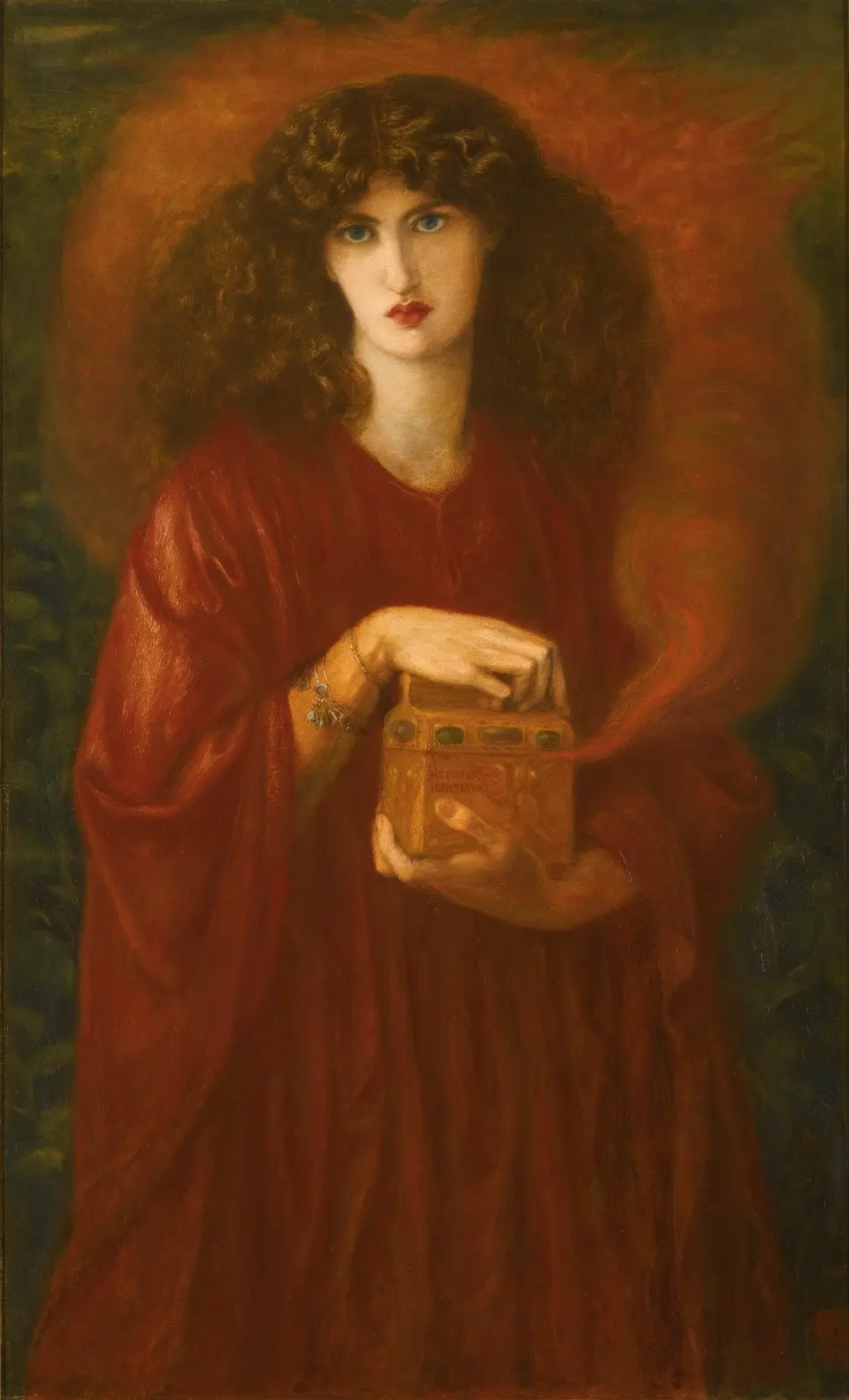
Pandora holds a small gold casket with red smoke rising from it. Dante Gabriel Rossetti, Pandora, oil on canvas, 1871.
Full credit
"Pandora" by Dante Gabriel Rossetti — https://commons.wikimedia.org/wiki/File:Dante_Gabriel_Rossetti_-_Pandora.jpg — Public domain in US (painted 1871; Dante Gabriel Rossetti d. 1882, so the work is public domain whether it counts as published before 1930 or as unpublished); DE/FR (Dante Gabriel Rossetti d. 1882, life+70); faithful photograph of a two-dimensional painting (PD-Art; Sotheby’s sale photograph, London, 22 May 2014, lot 207)
The box keeps the lid and the escape of the earlier story, but it changes the scale of the container. A pithos is the farm’s great storage jar, the kind Hesiod’s calendar tells farmers to open on the fourth day. A casket fits in her hands, as it does in Rossetti’s painting, and with it the story moves from the storeroom to her keeping.
What do the two poems not share?
Read together, the two passages part ways soon after the woman is made, although three Greek lines are word for word the same apart from punctuation: Zeus’s address to the son of Iapetus (Theogony 559, Works and Days 54), and two lines about the maiden’s likeness and Athena dressing her (572–573 and 71–72).
The three shared Greek lines, by line number, as CSV (where the data comes from) Data: Perseus Digital Library Greek text of Hesiod (ed. Evelyn-White 1914), retrieved 2026-11-04
Beyond those lines the passages diverge, because only the Works and Days names her, gives her a jar, lets her open it and keeps Hope inside. Only the Theogony turns from the woman to marriage, saying that a man who avoids it reaches old age with no one to tend him (590–612). The two poems agree on why Zeus sent her and on who received her, and on almost nothing that happened after she arrived.
The endings are the one other place where they agree, and they agree in wording as well as sense. The Theogony closes its section with “So it is not possible to deceive or go beyond the will of Zeus” (613–616), and the Works and Days closes the jar story with “So is there no way to escape the will of Zeus” (90–105). Both poems end the woman’s story as a lesson about the will of Zeus rather than about her.
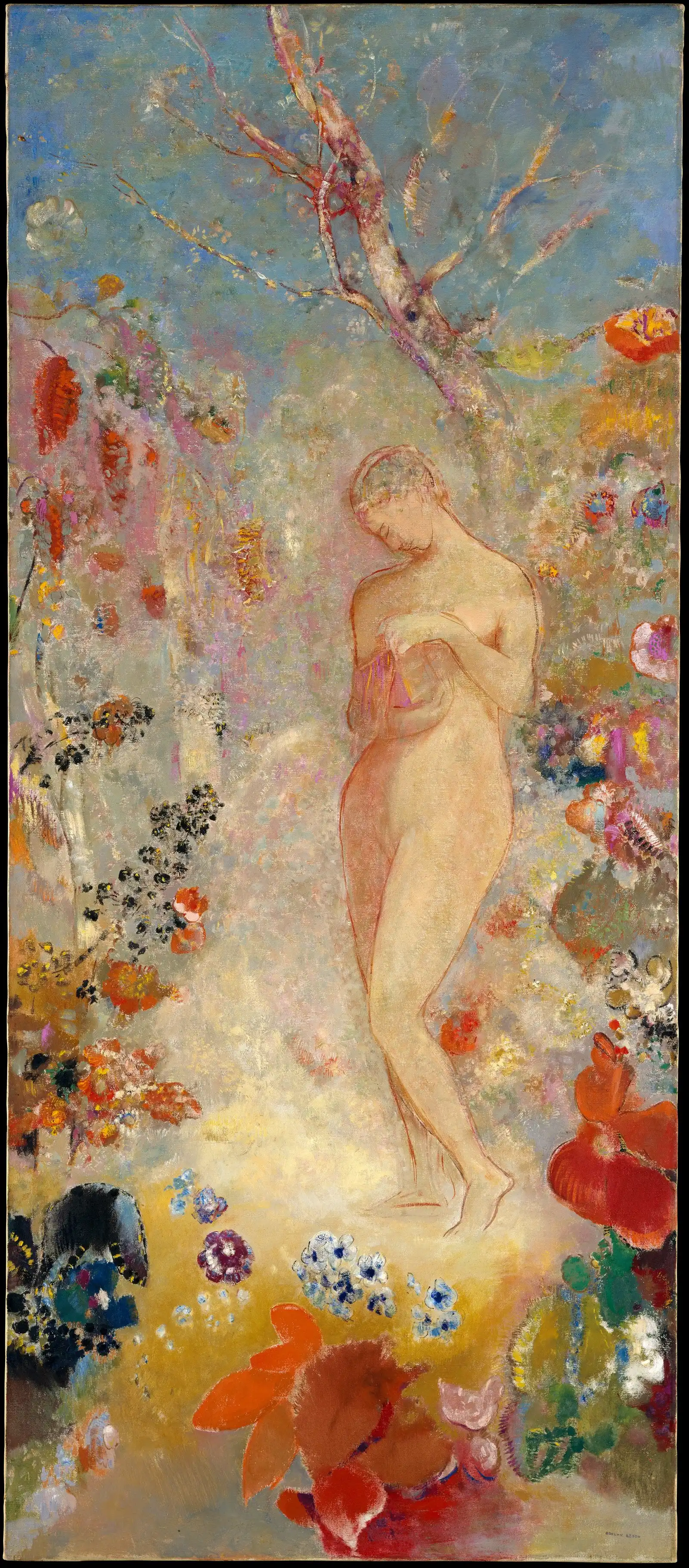
Pandora stands among flowers holding a small box. Odilon Redon, Pandora, oil on canvas, about 1914. The Metropolitan Museum of Art, 60.19.1.
"Pandora" by Odilon Redon — https://commons.wikimedia.org/wiki/File:Pandora_MET_DT2160.jpg — CC0 1.0 (https://creativecommons.org/publicdomain/zero/1.0/)
Shared lines and motifs are counted here, not traced to a common source. The same caution runs through Orpheus and Eurydice in five ancient texts, another myth in this section whose best-known detail depends on which text is opened. A similar motif, with no borrowing claimed, appears in Sleeping Beauty, where one of thirteen fairies at a feast for a newborn girl brings the harm.
Hesiod, in the poem Evelyn-White thought was his, tells the jar story in verses addressed to his brother Perses, as a reason why people must work for a living. In the Works and Days, the gods have hidden the means of life (42–53), and the jar explains what is loose in the world once the lid comes off.
Sources
Editions
- Hesiod, the Homeric Hymns, and Homerica, translated by Hugh G. Evelyn-White (preface dated 9 September 1914). Project Gutenberg ebook 348. https://www.gutenberg.org/ebooks/348 (the Hymn to Hermes in full (lines 1–580) and the introduction on the Homeric Hymns; the Theogony passages numbered lines 507–616 (Prometheus at Mecone in lines 507–558, then the first woman) and the Works and Days, lines 1–105 and 814–821, with the introduction on Hesiod’s life and the dates of the poems and the translator’s notes)
- Hesiod, Theogony and Works and Days, Greek text in Hesiod, the Homeric Hymns and Homerica, ed. Hugh G. Evelyn-White (London: William Heinemann; New York: The Macmillan Co., 1914), as encoded by the Perseus Digital Library (canonical-greekLit, tlg0020.tlg001 and tlg0020.tlg002, perseus-grc2). https://github.com/PerseusDL/canonical-greekLit/tree/master/data/tlg0020 (full Greek text of both poems, searched line by line; Theogony lines 507–616 and Works and Days lines 42–105 read closely)
- Nathaniel Hawthorne, “The Paradise of Children,” from A Wonder-Book for Girls and Boys (preface dated Lenox, July 15, 1851). Project Gutenberg ebook 9256; title page and preface read in the edition with 60 designs by Walter Crane (Boston: Houghton, Mifflin & Co., copyright 1892), Project Gutenberg ebook 32242. https://www.gutenberg.org/ebooks/9256 (“The Paradise of Children” in full, with its introductory frame; the title page and preface of the 1892 illustrated edition)
Research
- Dora Panofsky and Erwin Panofsky, Pandora’s Box: The Changing Aspects of a Mythical Symbol (New York: Pantheon Books, 1956). https://lobid.org/resources/990109737440206441 (bibliographic reference)
Catalogues and databases
- Gemeinsame Normdatei (GND) 124470416, “Evelyn-White, Hugh Gerard,” authority record, via lobid-gnd (hbz). https://lobid.org/gnd/124470416 (authority record) Text licence: CC0 1.0, https://creativecommons.org/publicdomain/zero/1.0/
- Gemeinsame Normdatei (GND) 118709305, “Hawthorne, Nathaniel,” authority record, via lobid-gnd (hbz). https://lobid.org/gnd/118709305 (authority record) Text licence: CC0 1.0, https://creativecommons.org/publicdomain/zero/1.0/
Cite this page
Once Upon a Version. “Pandora’s Box: No Jar in the Theogony, One in Works and Days.” Once Upon a Version. Published 2026-11-05. https://onceuponaversion.com/across-cultures/pandoras-box-jar/ (accessed day month year).
Write in the date you read the page; the page has no DOI.
More from Motifs Across Cultures
Motifs Across Cultures
Orpheus and Eurydice: In Plato, the Gods Show Him a Phantom
Type myth told inside a philosophical dialogue (no tale-type number cited)
In Plato’s Symposium, the speaker Phaedrus says the gods showed Orpheus only a phantom: no rule, no look back. Five ancient tellings, compared motif by motif.
Picture credit
"Orpheus Leading Eurydice from the Underworld" by Camille Corot — https://commons.wikimedia.org/wiki/File:Jean-Baptiste-Camille_Corot_-_Orpheus_Leading_Eurydice_from_the_Underworld_-_Google_Art_Project.jpg — Public domain in US (exhibited at the Salon of 1861; Corot d. 1875); DE/FR (Jean-Baptiste-Camille Corot d. 1875, life+70); faithful photograph of a two-dimensional painting (PD-Art; Google Arts & Culture photograph)
Motifs Across Cultures
Anansi the Spider: In an Akan Tale, He Buys the Stories
Type Akan folktale, one of the Anansesem or Spider-stories (no ATU number cited)
In an Akan tale printed by R. S. Rattray in 1930, Anansi buys the Sky-god’s stories. Beside Hermes, Loki and Coyote, five texts share one motif in eight.
Picture credit
"SÁM 66, 79r, Loki" by Jakob Sigurðsson — https://commons.wikimedia.org/wiki/File:S%C3%81M_66,_79r,_Loki.jpg — Public domain in US (manuscript of 1765–66); DE/FR (Jakob Sigurðsson, 18th-century draughtsman, life+70); faithful reproduction of a two-dimensional manuscript page (PD-Art), digitized for the Árni Magnússon Institute’s Sagnanet; cropped, rotated and levelled by the Commons uploader
Motifs Across Cultures
Cupid and Psyche: In Apuleius, an Old Woman Tells the Tale
Type ATU 425B, as classified by D. L. Ashliman
In Apuleius’s Metamorphoses, Cupid and Psyche is told by an old woman in a robbers’ cave to a captive bride. Later tellers kept her, cut her or replaced her.
Picture credit
"Cupid and Psyche - Palace Green Murals - Psyche entering the Portals of Olympus" by Edward Burne-Jones — https://commons.wikimedia.org/wiki/File:Edward_Burne-Jones_-_Cupid_and_Psyche_-_Palace_Green_Murals_-_Psyche_entering_the_Portals_of_Olympus_-_Google_Art_Project.jpg — Public domain in US (painted 1872–1881, Burne-Jones d. 1898; Commons marks it published before 1931); DE/FR (Edward Burne-Jones d. 1898, life+70); faithful photograph of a two-dimensional painting (PD-Art; Google Arts & Culture photograph)