Sleeping Beauty: In Basile and Perrault, No Kiss Wakes Her
In the two older of the four Sleeping Beauty texts compared here, nobody kisses her awake: newborn twins draw out a splinter in Basile, and the spell runs out in Perrault.
By Once Upon a Version
Published
How a version is traced · Version history · Contact · Report an error (contact@onceuponaversion.com)
In short
- In Basile’s “Sole, Luna e Talia” (printed 1636; read here in a 1788 reprint), Talia wakes when her newborn twins suck a flax splinter from her finger; in Perrault’s 1697 tale, the spell runs out as the prince kneels.
- Of the four texts compared here, only the two Grimm editions have the waking kiss: their 1812 “Dornröschen” and the 1857 text, which, unlike 1812, says that the hundred years had just passed.
- The two older texts go on after the waking to a queen who orders the sleeper’s children cooked, while both Grimm texts end with the wedding.
Telling card
- Tale
- Sleeping Beauty (Basile: Sole, Luna e Talia; Perrault: La Belle au bois dormant; Grimm: Dornröschen)
- Type
- ATU 410, as classified by D. L. Ashliman
- Teller
- Basile: told by Popa in the book’s frame; Perrault: written by Charles Perrault; Grimm 1812: Marie in the Wild household, Kassel (disputed)
- Recorded by
- n/a for Basile and Perrault; for the 1812 text, unrecorded
5 more fields: edited by, told, published, this text, earliest known
- Edited by
- Basile: unrecorded (day 5 printed after his death in 1632); Perrault: n/a; Grimm: Jacob and Wilhelm Grimm, 1812 to 1857
- Told
- Grimm 1812: in Kassel, date unrecorded; Basile and Perrault: n/a (written tales)
- Published
- Naples: Ottavio Beltrano, 1636, published by Gio. Antonio Farina (Bolte and Polívka give 1637); Paris: Claude Barbin, 1697, as a book (Deulin 1879 reports an anonymous printing a year earlier; Bolte and Polívka give 1696); Berlin: Realschulbuchhandlung, 1812
- This text
- Basile in the Naples reprint of 1788; Perrault 1697; Grimm 1812 and 1857 (Wikisource)
- Earliest known
- Not claimed. Bolte and Polívka (1913) set a fourteenth-century French romance, Perceforest, beside these tales; it is not compared here
This card as CSV · where these values come from
Data: Basile (1788 reprint, Project Gutenberg 77386), Perrault (1697, French Wikisource) and the Grimms (1812 and 1857, German Wikisource), retrieved 2026-11-03; Croce 1891; Bolte and Polívka 1913; Deulin 1879; Ashliman
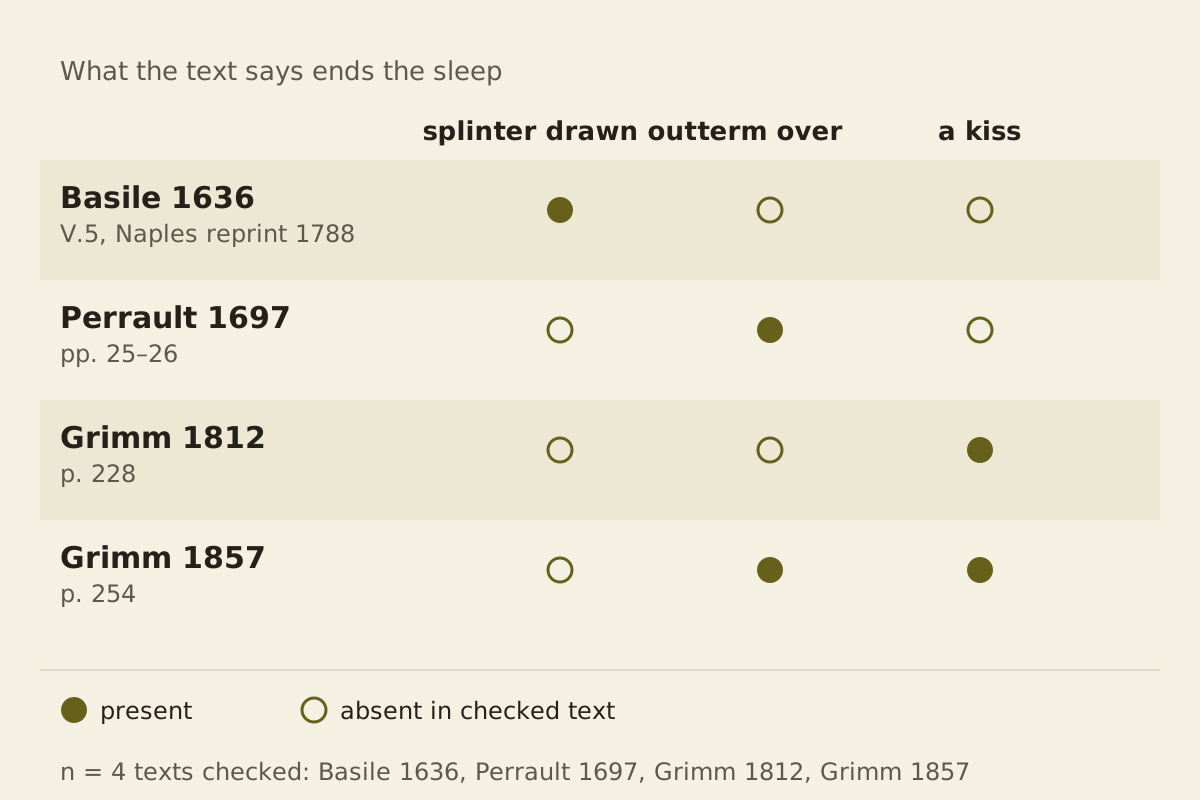
What each of the four texts says ends the sleep, with the page or tale where the waking is told.
Credit line for reuse
"What wakes the sleeper in four Sleeping Beauty texts" by Once Upon a Version — https://onceuponaversion.com/tellings/sleeping-beauty-basile-perrault-grimm/ — licensed under CC BY 4.0 (https://creativecommons.org/licenses/by/4.0/)
Data: Basile (1788 reprint, Project Gutenberg 77386), Perrault (1697, French Wikisource) and the Grimms (1812 and 1857, German Wikisource), retrieved 2026-11-03
Giambattista Basile died at Giugliano, near Naples, on 23 February 1632, with his book of tales still in manuscript. Four years later, in 1636, the Naples press of Ottavio Beltrano printed its fifth and last day, and the fifth tale of that day is “Sole, Luna e Talia,” or “Sun, Moon and Talia.” It is the oldest of the four Sleeping Beauty texts compared on this page, and no one in it wakes the sleeper with a kiss.
Neither does anyone in Charles Perrault’s “La Belle au bois dormant,” published in Paris in 1697 in a small collection of prose tales. The kiss belongs to the third book compared here, the Grimm brothers’ collection, whose “Dornröschen” appeared in their first volume of 1812. This page sets the three side by side, together with the Grimms’ revised text of 1857, and counts what each one keeps.
Which tellings are compared here?
Four texts from three books are compared, and each one is read in its own language from a named public-domain printing, with page numbers wherever the printing has them. The Neapolitan, French and German are quoted in the original, with this site’s English rendering beside them; the English of Andrew Lang’s Blue Fairy Book and of Margaret Hunt’s Grimm translation is quoted where it stays close to the printed text.
- Basile 1636. “Sole, Luna e Talia,” the fifth tale of the fifth day of Lo cunto de li cunti, also called the Pentamerone, the name on the title page of the 1788 reprint. The text used here is that Naples reprint of 1788, because the Italian Wikisource transcription of Benedetto Croce’s 1891 edition covers only the first two days.
- Perrault 1697. “La Belle au bois dormant,” the first tale in Histoires ou contes du temps passé (Paris: Claude Barbin, 1697), pages 1 to 46, read in the French Wikisource transcription of that printing.
- Grimm 1812. “Dornröschen,” no. 50 in the first volume of the Kinder- und Haus-Märchen (Berlin, 1812), pages 225 to 229, with the brothers’ note on page XXXI.
- Grimm 1857. The same tale in the seventh edition (Göttingen, 1857), pages 251 to 254.
Each of these is what this site calls a one-evening text: a single printing that can be pinned to a place, a year and a page, not the story itself. In this site’s studio terms, the 1857 text is a later pressing of the 1812 one, made by the same two editors.
The four texts, their tellers and printings, as CSV (where the data comes from) Data: Basile (1788 reprint, Project Gutenberg 77386), Perrault (1697, French Wikisource) and the Grimms (1812 and 1857, German Wikisource), retrieved 2026-11-03; Croce 1891; Bolte and Polívka 1913; Deulin 1879; GND via lobid-gnd
| Text | Teller | First printed | Text used here |
|---|---|---|---|
| Basile 1636 | Popa, the teller whose turn it is in the book’s frame; written by Giambattista Basile | Naples: Ottavio Beltrano, 1636 (day 5, published by Gio. Antonio Farina after Basile’s death in 1632; Bolte and Polívka give 1637) | Naples reprint, Giuseppe-Maria Porcelli, 1788, vol. 2 (Project Gutenberg 77386); Neapolitan |
| Perrault 1697 | Charles Perrault (written; the privilege of the book names P. Darmancour) | Paris: Claude Barbin, 1697, as a book (privilege dated 28 October 1696, registered 11 January 1697; Deulin 1879 reports an anonymous printing a year earlier, not read here; Bolte and Polívka date the tale 1696) | Barbin 1697 (French Wikisource); English quoted from The Blue Fairy Book, ed. Andrew Lang (Project Gutenberg 503) |
| Grimm 1812 | Marie in the Wild household, Kassel (Bolte and Polívka 1913; disputed) | Berlin: Realschulbuchhandlung, 1812 | first edition, 1812 (German Wikisource) |
| Grimm 1857 | the same tale, revised by the editors; no new teller is named in the text | Göttingen: Dieterich, 1857 | seventh edition, 1857 (German Wikisource); English quoted from Margaret Hunt (Project Gutenberg 5314) |
In the international index of folktale types, a catalogue that gives a number to each plot found in many tellings, the Grimms’ tale is ATU 410, as classified by D. L. Ashliman, whose list names the type “Sleeping Beauty.” The label groups similar plots for comparison; it does not say that one text was copied from another, and this page uses it only to identify the tale.
How does Talia wake in Basile’s 1636 text?
Basile did not see his tales in print. According to Benedetto Croce’s biographical introduction of 1891, his papers at his death held several unpublished works, among them a thick manuscript of the tales. Croce traces the printing day by day: Salvatore Scarano brought out the first day in 1634 through Ottavio Beltrano, and Gio. Antonio Farina published the fifth day through the same press in 1636, with a dedication dated 20 July 1636.
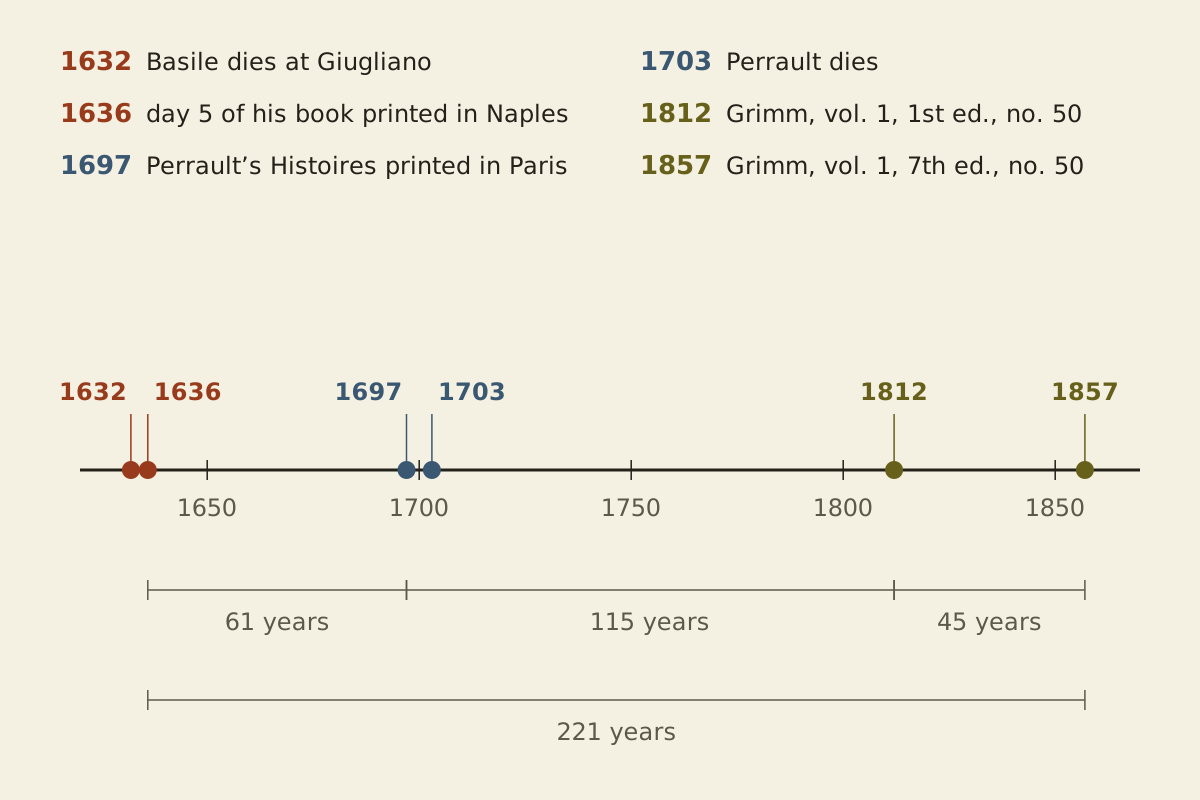
Basile, Perrault and the Grimms on one line: deaths and printings from 1632 to 1857, with the years between the printings compared here.
Credit line for reuse
"Sleeping Beauty: Basile, Perrault and the Grimms on one line, 1632 to 1857" by Once Upon a Version — https://onceuponaversion.com/tellings/sleeping-beauty-basile-perrault-grimm/ — licensed under CC BY 4.0 (https://creativecommons.org/licenses/by/4.0/)
Data: Croce 1891 (Italian Wikisource), Perrault 1697 (French Wikisource), Kinder- und Haus-Märchen (German Wikisource) and GND via lobid-gnd, retrieved 2026-11-03
From Basile’s printing of 1636 to Perrault’s of 1697 is 61 years, from Perrault to the Grimms’ first volume of 1812 is 115 years, and the Grimms’ own revisions run another 45 years to 1857. The whole span, from the first printing compared here to the last, is 221 years.
Who tells the tale inside Basile’s book?
Basile also gives the tale a teller inside the book. Lo cunto de li cunti is a frame story, a tale whose characters take turns telling the other tales, and the link before this one says it is now Popa’s turn to speak (“toccanno a Popa de ragionare”). So the Voice tag below names Popa as the teller and Basile as the writer.
How does Talia fall asleep?
The danger in Basile’s tale is foretold, not cursed. A great lord calls in the wise men and seers of his realm when his daughter Talia is born, and after consulting together they warn that she is in great danger from a splinter of flax, so he forbids flax and hemp in his house. When Talia is grown, she sees an old woman spinning in the street, takes the distaff, and a splinter of flax runs under her fingernail. She falls dead to the ground, as the text puts it.
Her grieving father seats her on a velvet chair in a country palace, shuts the doors and abandons the house permanently. A king out hunting, whose falcon has flown in through a window, climbs a ladder to retrieve it and discovers her. He calls to her without managing to wake her, carries her to a bed and lies with her while she sleeps, then returns to his kingdom and for a time forgets the episode. Nine months later, still unconscious, she gives birth to twins, a boy and a girl.
li quale na vota, volenno zucare, nè ttrovanno li capitielle, l’afferraro lo dito, e tanto zuccaro, che nne tiraro l’aresta: pe la quale cosa parze che se scetasse da no gran suonno
told by Popa · written by Giambattista Basile · Lo cunto de li cunti, day 5, tale 5 (Naples reprint, 1788, vol. 2)
In this site’s rendering: once, wanting to suck and not finding the nipple, they took hold of her finger and sucked so hard that they drew out the splinter, at which she seemed to wake from a great sleep.
Two fairies have been laying the babies at her breast, so the cure comes from the children themselves: the physical cause of the sleep is pulled out, and the sleep ends. Bolte and Polívka’s summary of the tale (vol. 1, p. 436) describes the same sequence, with Talia waking only once the twins have drawn the splinter out (“worauf Talia aus ihrem Schlafe erwachte”).
The children are named Sole and Luna, Sun and Moon, although the Neapolitan sentence leaves it ambiguous whether the king or Talia chose the names. No kiss wakes Talia, and no fixed term of years is ever attached to her sleep. Basile’s closing couplet draws the moral that good things rain on the lucky even while they sleep.
The sources differ on the year. Johannes Bolte and Jiří Polívka, in their annotations on the Grimms’ tales (1913, vol. 1, p. 435), cite Basile’s tale under the year 1637. The year 1636 used on this page comes from Croce’s bibliography of the first Naples printing of the fifth day.
Who wakes Perrault’s sleeper in 1697?
Perrault’s tale is the first in a small book of eight, printed by Claude Barbin in Paris in 1697. The book itself does not put Charles Perrault’s name forward: its royal privilege, dated at Fontainebleau on 28 October 1696 and registered on 11 January 1697, grants the right to print to “Sieur P. Darmancour.” French Wikisource and Bolte and Polívka attribute the tales to Charles Perrault, and this page follows them while keeping the privilege in view.
Bolte and Polívka write that Perrault told the tale “almost the same” way as the Grimms (“Fast ebenso erzählt Perrault 1696”), dating it to 1696, a year earlier than the Barbin book. Their summary also agrees on the waking: the prince kneels before the sleeper, whereupon she and her household wake (“er kniet vor der Schläferin, worauf sie und ihr Hofstaat erwachen,” p. 435).
Charles Deulin, in Les Contes de ma mère l’Oye avant Perrault (1879), says the tale first appeared without an author’s name in Moëtjens’ collection a year before it was put into a volume, and that Perrault corrected it in between. That earlier printing is not read here; the text compared here is the 1697 book, page by page.
How does the sleep come and go in 1697?
In Perrault, an old fairy who was left off the guest list at the christening pronounces that the princess will pierce her hand with a spindle and die. A young fairy, who has hidden so as to speak last, softens the sentence: the princess will sleep for a hundred years, at the end of which a king’s son will come to wake her (p. 8). At fifteen or sixteen she finds an old woman spinning in a tower room, takes the spindle and pierces her hand (p. 11).
Then comes a kiss that does not work.
The good fairy, anticipating that the princess would be embarrassed to wake alone in an old castle, touches the entire household with her wand and puts everyone to sleep except the king and queen, who take their leave. In the English of Andrew Lang’s Blue Fairy Book, “the King and the Queen, having kissed their dear child without waking her, went out of the palace” (p. 17 of the French). A wood of trees, brambles and thorns grows up round the park within a quarter of an hour (p. 18).
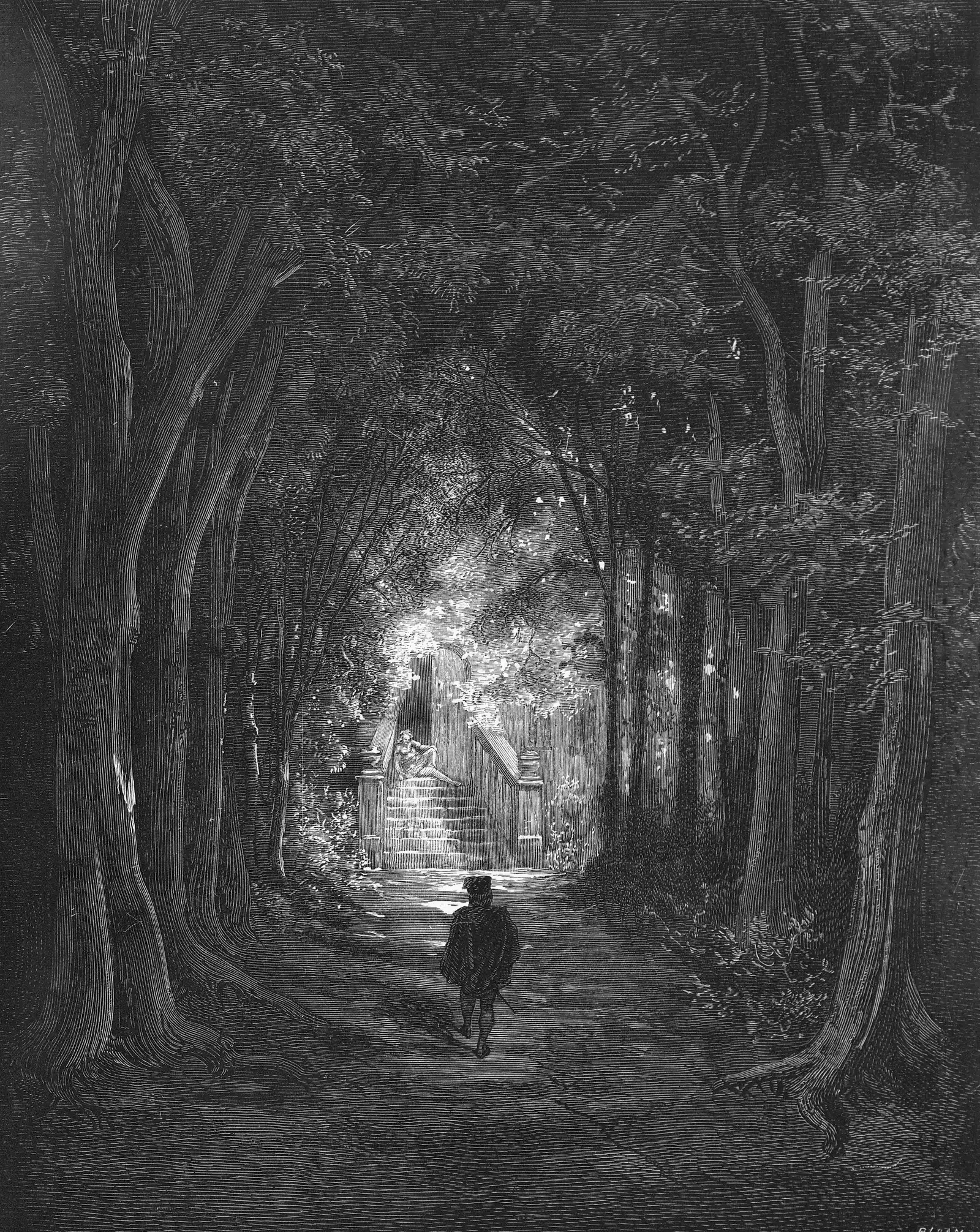
The prince walks toward the sleeping palace. Gustave Doré, Les Contes de Perrault (Paris: Hetzel), 1867 edition.
Full credit
"La Belle au Bois Dormant" by Gustave Doré — https://commons.wikimedia.org/wiki/File:La_Belle_au_Bois_Dormant_(136548149).jpg — Public domain in US (published 1867); DE/FR (Gustave Doré d. 1883, life+70); the wood engraver’s signature at lower right is not legible, and an engraver working on an 1867 edition is presumed not to have lived past 1955 (log, image ruling 10)
A hundred years later, the son of the king then reigning hears an old peasant’s story of the sleeping princess, and the trees part for him and close again behind him. He crosses the courtyards and the guardroom full of sleepers, finds the princess on a bed in a gilded room, and kneels beside her, trembling. Perrault’s next sentence gives the reason she wakes.
And now, as the enchantment was at an end, the Princess awaked, and looking on him with eyes more tender than the first view might seem to admit of:
edited by Andrew Lang · The Blue Fairy Book, “The Sleeping Beauty in the Wood,” Project Gutenberg 503 (Project Gutenberg text; the printed edition is not stated; no translator is named)
The French of 1697 says the same, on pages 25 and 26: “comme la fin de l’enchantement estoit venuë, la Princesse s’éveilla,” in this site’s rendering: the end of the enchantment had come, and the princess woke. Her first words are a mild reproach, in the Blue Fairy Book’s English: “Is it you, my Prince?” and then “You have waited a long while.” The prince does not kiss her; he arrives at the appointed hour, and the expiry of the fairy’s term does the rest.
Doré’s engraving, first published in 1862 and shown here from the Hetzel edition of 1867, shows the moment just before, with the prince walking down a dark avenue toward the palace steps, where a guard sleeps against the balustrade.
What do the Grimms’ 1812 text and note say?
In the Grimms’ first volume of 1812, no. 50 begins with a crab, not a frog, telling a queen in her bath that she will have a daughter. The king invites the fairies of the land to the feast, but he owns only twelve golden plates and there are thirteen fairies, so one stays uninvited.
She arrives regardless and announces that in her fifteenth year the princess will prick herself on a spindle and fall down dead. The twelfth fairy can only soften this: not death, but a deep sleep of a hundred years.
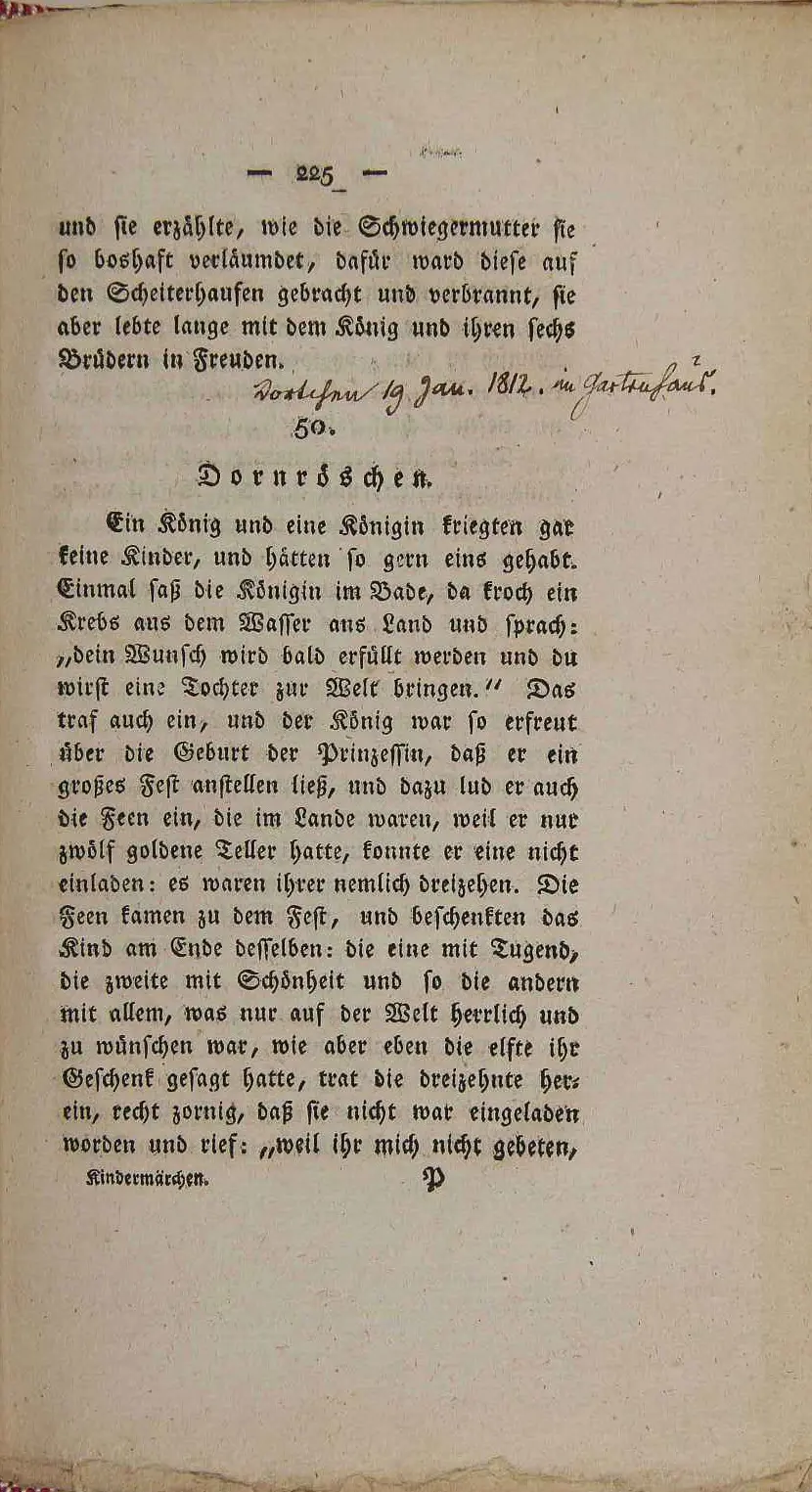
Page 225 of the brothers’ annotated copy of volume 1, where no. 50 begins; the handwritten line above the title belongs to the end of no. 49. Jacob and Wilhelm Grimm, Kinder- und Haus-Märchen, vol. 1, 1812.
Full credit
"Kinder- und Haus-Märchen, vol. 1 (1812), p. 225, the brothers’ annotated copy" by Jacob and Wilhelm Grimm — https://commons.wikimedia.org/wiki/File:Kinder_und_Hausm%C3%A4rchen_(Grimm)_1812_I_225.jpg — Public domain in US (published 1812); DE/FR (Jacob Grimm d. 1863, Wilhelm Grimm d. 1859, life+70); the handwritten notes are theirs; modified: cropped to the page; binding, headband, facing page and the edges of other leaves of the bound copy removed
The princess finds an old woman spinning flax in a tower, pricks herself and falls asleep, and the whole court falls asleep with her. A hedge of thorns grows round the castle, and the princes who try to force their way through it hang in the thorns and die. Then, after “lange, lange Jahre,” long, long years, a king’s son hears the story from an old man and walks through a hedge that has turned to flowers.
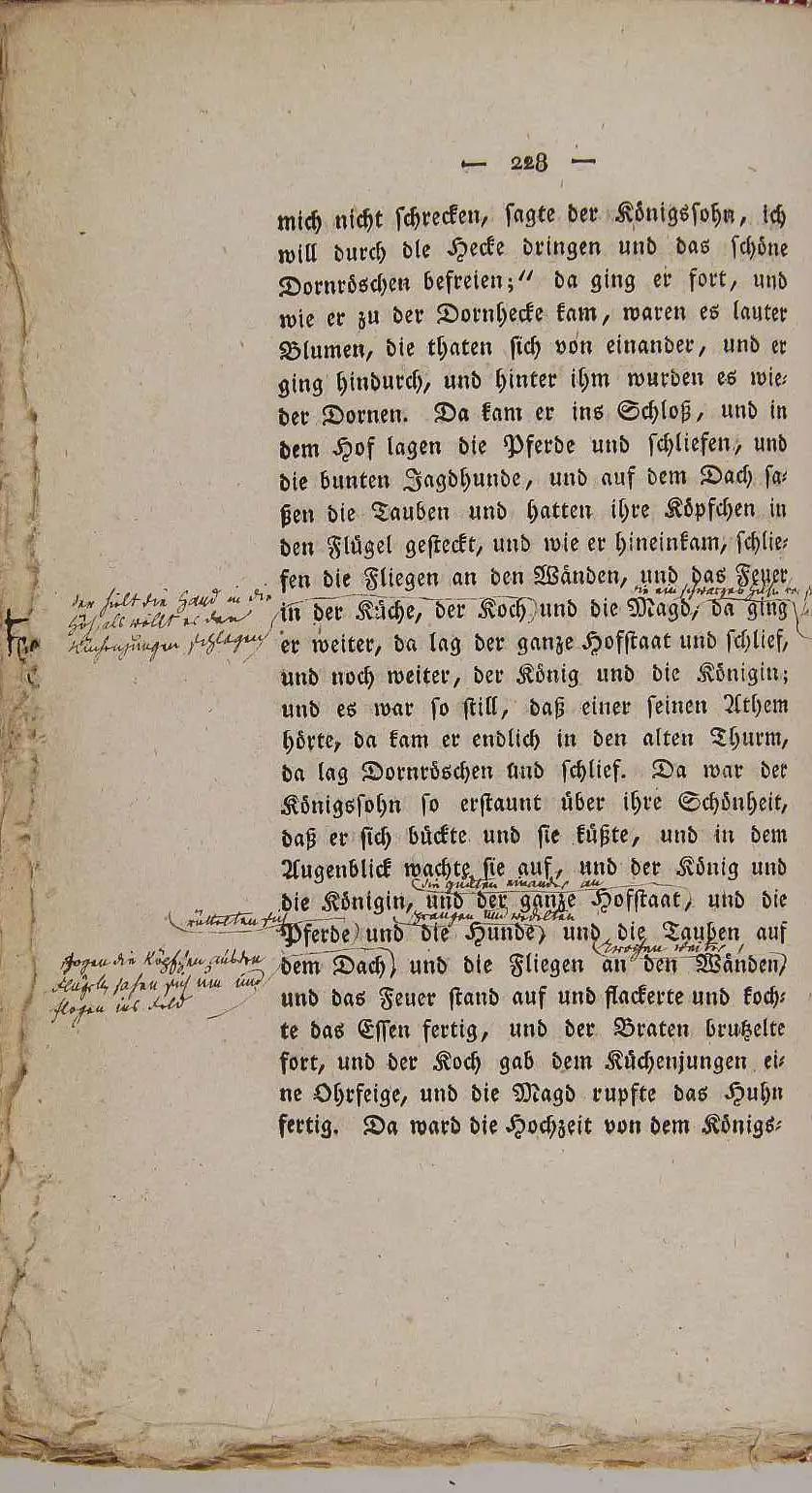
Page 228 of the brothers’ annotated copy of volume 1, where the king’s son kisses Dornröschen and she wakes; handwritten additions stand in the margins. Jacob and Wilhelm Grimm, Kinder- und Haus-Märchen, vol. 1, 1812.
Full credit
"Kinder- und Haus-Märchen, vol. 1 (1812), p. 228, the brothers’ annotated copy" by Jacob and Wilhelm Grimm — https://commons.wikimedia.org/wiki/File:Kinder_und_Hausm%C3%A4rchen_(Grimm)_1812_I_228.jpg — Public domain in US (published 1812); DE/FR (Jacob Grimm d. 1863, Wilhelm Grimm d. 1859, life+70); the handwritten notes are theirs; modified: cropped to the page; binding, headband, facing page and the edges of other leaves of the bound copy removed
The 1812 text never says that the hundred years are over when he arrives. He finds her asleep in the old tower, and she wakes at the moment he kisses her (p. 228). The page shown above comes from the brothers’ own annotated copy, and its margins carry handwritten additions beside the waking of the court, the passage that the 1857 text tells at greater length.
What does the 1812 note compare it with?
The brothers’ note on the tale, printed at the back of the volume on page XXXI, opens by naming its French counterpart, “Perraults belle au bois dormant.” It compares the sleeping maiden behind her wall of thorns with the sleeping Brynhild behind her wall of flame. It then points to Basile, though not to “Sole, Luna e Talia.”
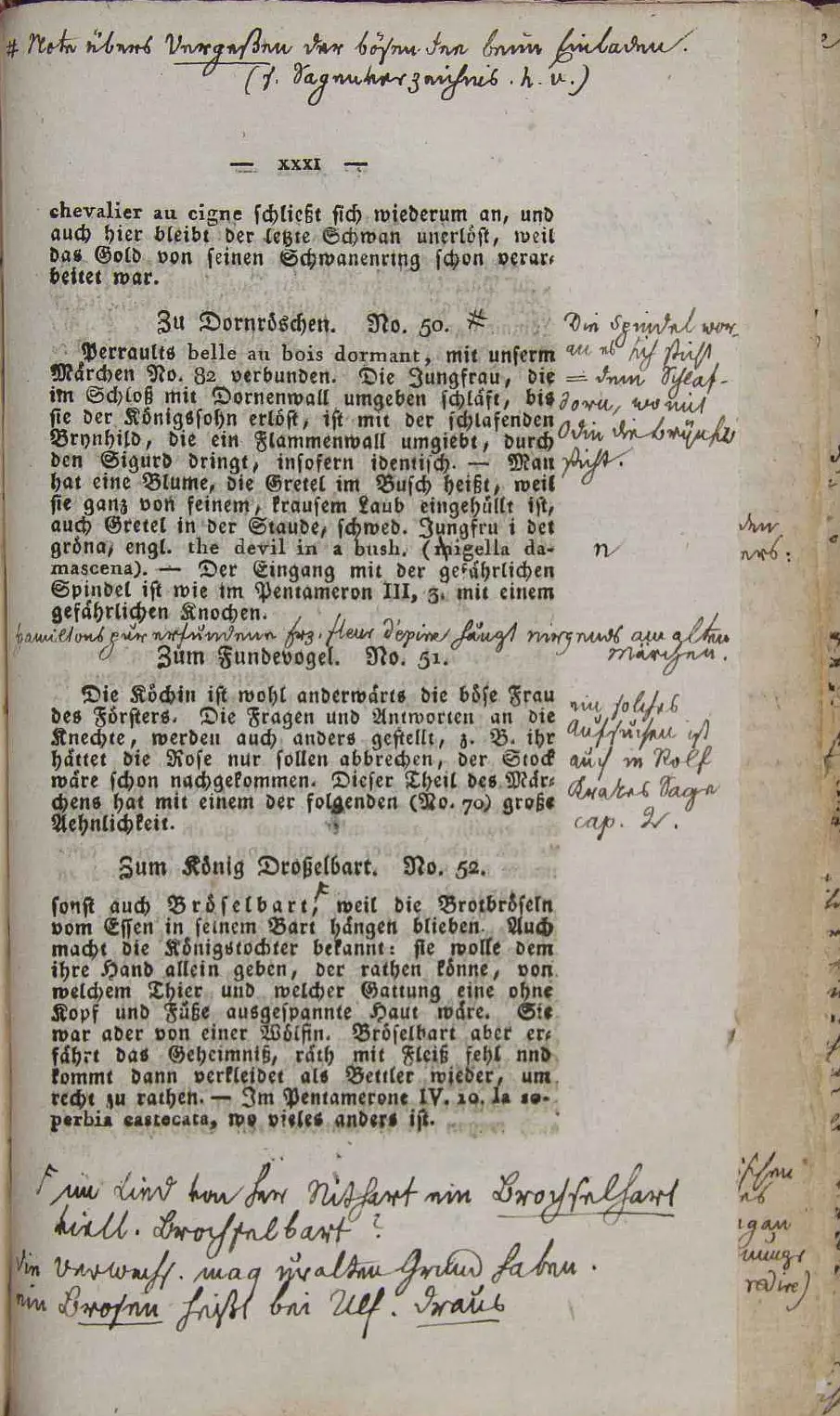
Page XXXI of the brothers’ annotated copy of volume 1, with the printed note on no. 50 and handwritten additions around it. Jacob and Wilhelm Grimm, Kinder- und Haus-Märchen, vol. 1, 1812.
Full credit
"Kinder- und Haus-Märchen, vol. 1 (1812), notes, p. XXXI, the brothers’ annotated copy" by Jacob and Wilhelm Grimm — https://commons.wikimedia.org/wiki/File:Kinder_und_Hausm%C3%A4rchen_(Grimm)_1812_I_419.jpg — Public domain in US (published 1812); DE/FR (Jacob Grimm d. 1863, Wilhelm Grimm d. 1859, life+70); the handwritten notes are theirs; modified: cropped to the page; binding, headband, facing page and the edges of other leaves of the bound copy removed
Der Eingang mit der gefährlichen Spindel ist wie im Pentameron III, 3. mit einem gefährlichen Knochen.
written by Jacob and Wilhelm Grimm · Kinder- und Haus-Märchen, vol. 1, 1812, note to no. 50, p. XXXI
In this site’s rendering: the opening with the dangerous spindle is like the one in the Pentamerone III.3, with a dangerous bone. The 1812 note sets the Grimms’ tale beside Perrault and beside a different Basile tale, the third of the third day; it does not mention the tale compared on this page.
Who told the Grimms this tale?
The printed tale names no teller. Bolte and Polívka, working from the brothers’ annotated personal copies, give the 1812 source as Marie in the Wild household in Kassel (“von der Marie im Wildschen Hause zu Kassel,” vol. 1, p. 434). That Marie’s identity is disputed, as the register of named tellers on this site sets out.
What changed between 1812 and 1857?
The 1857 printing is the seventh edition of the Grimms’ large collection. Set its text of “Dornröschen” next to the text of 1812 and six changes stand out, three of which concern the waking scene. The other three alter details of the opening, such as the creature that announces the birth and the name given to the thirteen guests.
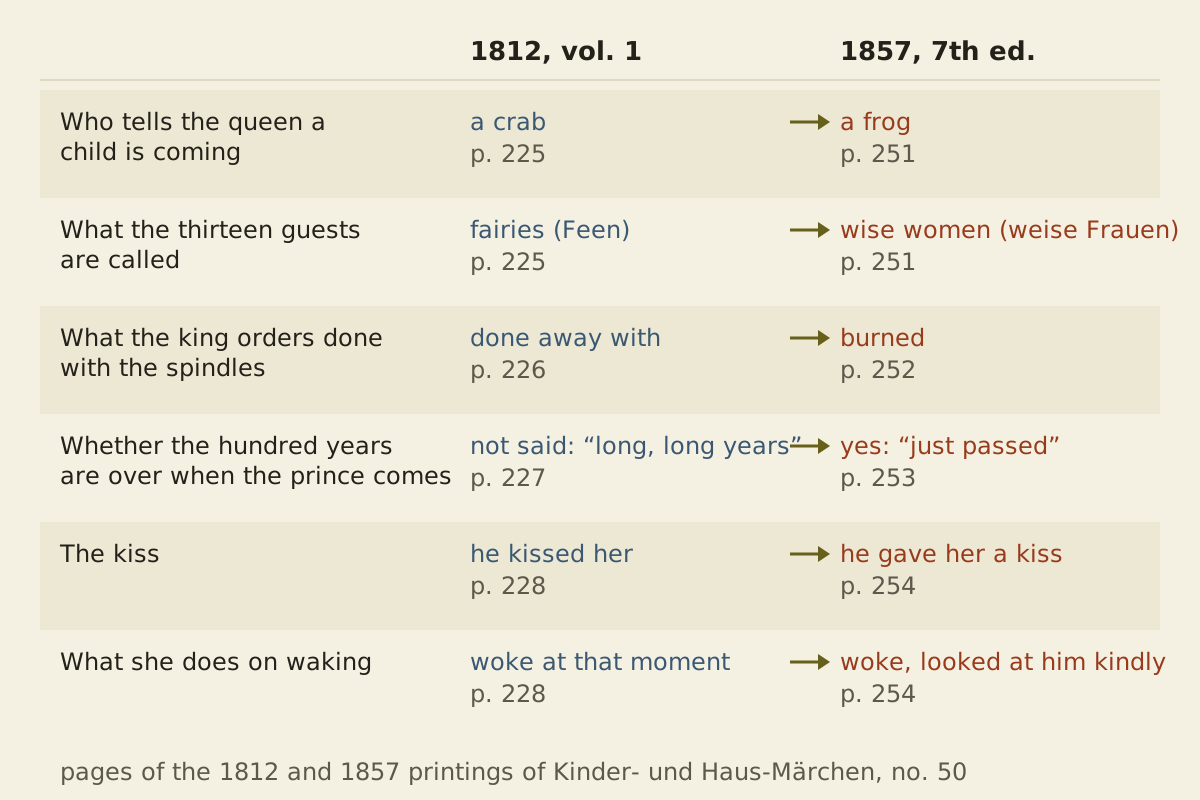
Six changes between the 1812 and 1857 texts of no. 50, each with the page in both printings.
Credit line for reuse
"Dornröschen: six changes between 1812 and 1857" by Once Upon a Version — https://onceuponaversion.com/tellings/sleeping-beauty-basile-perrault-grimm/ — licensed under CC BY 4.0 (https://creativecommons.org/licenses/by/4.0/)
Data: Kinder- und Haus-Märchen 1812 and 1857, German Wikisource, retrieved 2026-11-03
The six changes, with the German of both printings, as CSV (where the data comes from) Data: Kinder- und Haus-Märchen 1812 and 1857, German Wikisource, retrieved 2026-11-03
| What changed | 1812 | 1857 |
|---|---|---|
| Who tells the queen a child is coming | a crab (p. 225) | a frog (p. 251) |
| What the thirteen guests are called | fairies (Feen) (p. 225) | wise women (weise Frauen) (p. 251) |
| What the king orders done with the spindles | done away with (p. 226) | burned (p. 252) |
| Whether the hundred years are over when the prince comes | not said: “long, long years” (p. 227) | yes: “just passed” (p. 253) |
| The kiss | he kissed her (p. 228) | he gave her a kiss (p. 254) |
| What she does on waking | woke at that moment (p. 228) | woke, looked at him kindly (p. 254) |
The fourth change matters most for the question of what wakes her, because it adds another explanation. The 1857 text has a sentence, absent from the 1812 one, immediately before the prince reaches the hedge (the editions in between are not checked here): “Nun waren aber gerade die hundert Jahre verflossen, und der Tag war gekommen, wo Dornröschen wieder erwachen sollte” (pp. 253–254). Margaret Hunt’s English translation follows this later wording.
But by this time the hundred years had just passed, and the day had come when Briar-rose was to awake again.
translated by Margaret Hunt · Household Tales, no. 50, “Little Briar-Rose,” Project Gutenberg 5314 (Project Gutenberg text; the printed edition is not stated)
The kiss survives the revision of 1857 and still comes at the moment she opens her eyes. Side by side, the two printings differ in what surrounds the kiss rather than in the kiss itself.
1812 · Kinder- und Haus-Märchen, vol. 1, p. 228
Da war der Königssohn so erstaunt über ihre Schönheit, daß er sich bückte und sie küßte, und in dem Augenblick wachte sie auf, und der König und die Königin, und der ganze Hofstaat, und die Pferde und die Hunde, und die Tauben auf dem Dach, und die Fliegen an den Wänden, und das Feuer stand auf und flackerte und kochte das Essen fertig, und der Braten brutzelte fort, und der Koch gab dem Küchenjungen eine Ohrfeige, und die Magd rupfte das Huhn fertig.
edited by Jacob and Wilhelm Grimm · Kinder- und Haus-Märchen, vol. 1, Berlin 1812, p. 228
1857 · Kinder- und Haus-Märchen, vol. 1, 7th ed., p. 254
Da lag es und war so schön, daß er die Augen nicht abwenden konnte, und er bückte sich und gab ihm einen Kuß. Wie er es mit dem Kuß berührt hatte, schlug Dornröschen die Augen auf, erwachte, und blickte ihn ganz freundlich an.
edited by Jacob and Wilhelm Grimm · Kinder- und Haus-Märchen, vol. 1, 7th ed., Göttingen 1857, p. 254
What changed: In 1812 one long sentence carries the kiss, her waking and the waking of the whole court together. In 1857 the kiss gets a sentence of its own, she opens her eyes and looks at him kindly, and the court wakes only after they come down together.
In this site’s rendering of the 1812 sentence: the king’s son was so struck by her beauty that he bent down and kissed her, and at that moment she woke, and the king and queen, and the whole court, and the horses and the dogs, and the pigeons on the roof, and the flies on the walls; and the fire stood up and flickered and finished cooking the meal, and the roast sizzled on, and the cook boxed the kitchen boy’s ear, and the maid finished plucking the chicken.
The 1857 sentences, in this site’s rendering: there she lay, so beautiful that he could not turn his eyes away, and he bent down and gave her a kiss. As soon as he had touched her with the kiss, Dornröschen opened her eyes, woke, and looked at him very kindly. The 1857 text has both reasons at once. The hundred years have just run out, as in Perrault, and the kiss still comes at the moment of waking, as in 1812.
The same two editors changed the wording of another tale between their first printing and 1857: the same two editors’ Goose Girl, and the stove they changed by 1857.
What happens after the waking in Basile and Perrault?
Both older texts go on well past the waking, and in both a queen wants the sleeper’s children dead. The two Grimm texts end with the wedding and a contented life together.
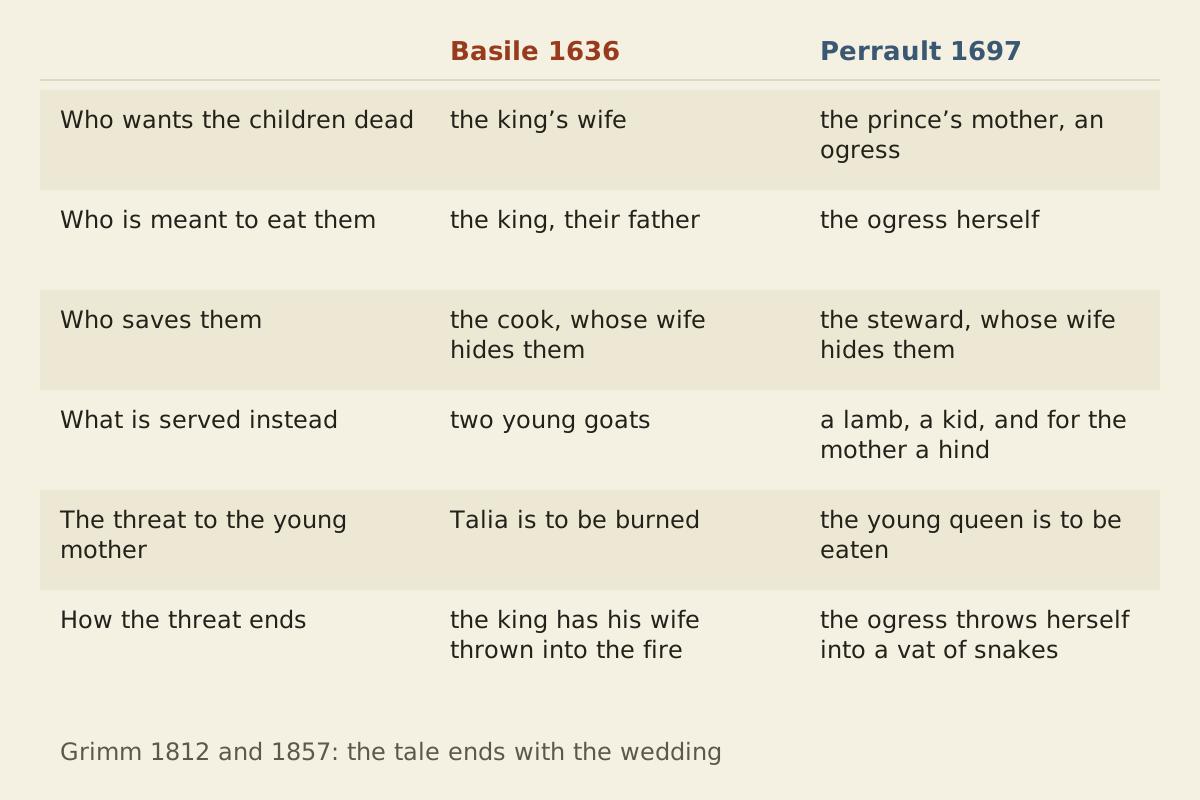
Six steps of the second half in Basile and in Perrault; the two Grimm texts have no second half.
Credit line for reuse
"After the waking: Basile 1636 and Perrault 1697" by Once Upon a Version — https://onceuponaversion.com/tellings/sleeping-beauty-basile-perrault-grimm/ — licensed under CC BY 4.0 (https://creativecommons.org/licenses/by/4.0/)
Data: Basile (1788 reprint, Project Gutenberg 77386) and Perrault (1697, French Wikisource), retrieved 2026-11-03
The six steps, with a short quotation from each text, as CSV (where the data comes from) Data: Basile (1788 reprint, Project Gutenberg 77386) and Perrault (1697, French Wikisource), retrieved 2026-11-03
| Basile 1636 | Perrault 1697 | |
|---|---|---|
| Who wants the children dead | the king’s wife | the prince’s mother, an ogress (p. 32) |
| Who is meant to eat them | the king, their father | the ogress herself (p. 35) |
| Who saves them | the cook, whose wife hides them | the steward, whose wife hides them (p. 36) |
| What is served instead | two young goats | a lamb, a kid, and for the mother a hind (pp. 36–41) |
| The threat to the young mother | Talia is to be burned | the young queen is to be eaten (p. 38) |
| How the threat ends | the king has his wife thrown into the fire | the ogress throws herself into a vat of snakes (p. 44) |
In Basile, the king is already married. His wife, suspicious of the names Talia, Sole and Luna that he repeats at every meal and at bedtime, extracts the truth from his secretary and summons the children in the king’s name.
She orders the cook to kill them and prepare them as dishes for their father, but the cook gives them to his own wife to hide and serves two young goats instead. The queen then has an enormous fire built in the palace courtyard for Talia, and the king arrives in time to have his wife thrown into it.
Perrault’s prince conceals his marriage from his mother for more than two years, because she comes of a race of ogres and, though he loves her, he fears her. The two children are a daughter, l’Aurore (Dawn), and a son, le Jour (Day).
When the prince succeeds his father and departs for war, his mother, left as regent, orders her steward to serve little Aurore for dinner with a sauce. The steward hides each intended victim in turn and puts a lamb, a kid and, for the young queen, a hind in their place. Found out, the ogress throws herself head first into the tub of toads and snakes she had prepared for them.
The two second halves agree on the general outline: a queen who orders the children killed and cooked, a household servant who hides the children, animals cooked in their place, and the destruction of the persecutor at the end. They differ on who the persecutor is and why. In Basile it is a betrayed wife, and the king is meant to eat his own children unknowing; in Perrault it is a mother-in-law who wants the meat for herself.
Perrault then adds a verse moral about marriage: waiting a while for a rich and charming husband is natural enough, but no woman now waits a hundred years, asleep. The English in Lang’s Blue Fairy Book ends instead with the king consoling himself with his wife and children, and prints no moral. Lang’s fairy books are the subject of another page here: Andrew Lang’s fairy books, which print Perrault’s tale in English without its verse moral.
Motif grid: what the four texts keep
Each motif, a recurring story element such as the spindle or the kiss, was defined before any cell was filled: what counts as present, and which specific changes count as transformed. A cell marked absent means only that the checked text does not contain the motif; it says nothing about other printings, other tellers or the tradition at large.
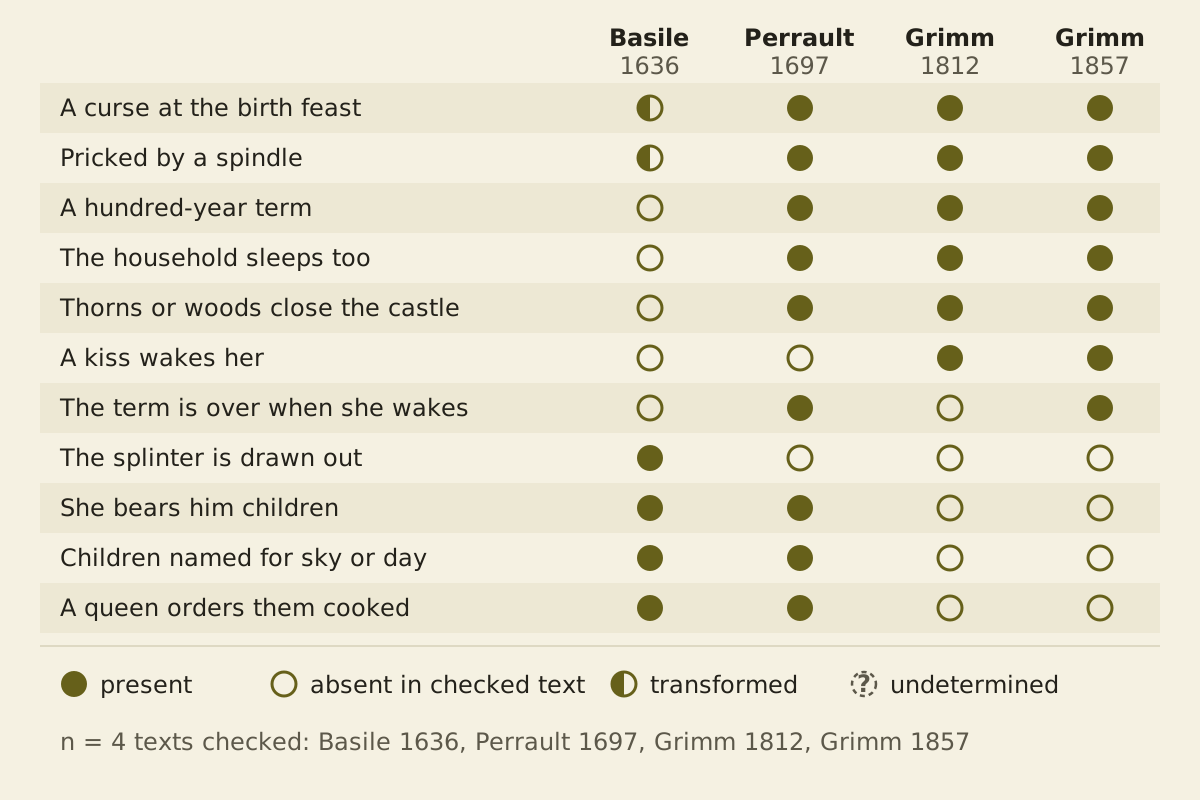
Eleven motifs in four texts; n = 4 texts checked: Basile 1636, Perrault 1697, Grimm 1812, Grimm 1857.
Credit line for reuse
"Motif grid: Sleeping Beauty in four texts" by Once Upon a Version — https://onceuponaversion.com/tellings/sleeping-beauty-basile-perrault-grimm/ — licensed under CC BY 4.0 (https://creativecommons.org/licenses/by/4.0/)
Data: Basile (1788 reprint, Project Gutenberg 77386), Perrault (1697, French Wikisource) and the Grimms (1812 and 1857, German Wikisource), retrieved 2026-11-03
The 44 cells, with page references and quotations, as CSV (where the data comes from) Data: Basile (1788 reprint, Project Gutenberg 77386), Perrault (1697, French Wikisource) and the Grimms (1812 and 1857, German Wikisource), retrieved 2026-11-03
| Motif | Basile 1636 | Perrault 1697 | Grimm 1812 | Grimm 1857 |
|---|---|---|---|---|
| A curse at the birth feast | transformed | present | present | present |
| Pricked by a spindle | transformed | present | present | present |
| A hundred-year term | absent in checked text | present | present | present |
| The household sleeps too | absent in checked text | present | present | present |
| Thorns or woods close the castle | absent in checked text | present | present | present |
| A kiss wakes her | absent in checked text | absent in checked text | present | present |
| The term is over when she wakes | absent in checked text | present | absent in checked text | present |
| The splinter is drawn out | present | absent in checked text | absent in checked text | absent in checked text |
| She bears him children | present | present | absent in checked text | absent in checked text |
| Children named for sky or day | present | present | absent in checked text | absent in checked text |
| A queen orders them cooked | present | present | absent in checked text | absent in checked text |
n = 4 texts checked: Basile, Lo cunto de li cunti V.5 (Naples reprint, 1788); Perrault, Histoires ou contes du temps passé (1697), pp. 1–46; Grimm, Kinder- und Haus-Märchen (1812), no. 50, pp. 225–229; Grimm, 7th ed. (1857), no. 50, pp. 251–254. Of the 44 cells, 26 are present, 16 absent in the checked text, 2 transformed and 0 undetermined. The definitions are a separate download: the eleven motif definitions as CSV (where the data comes from) Data: Once Upon a Version, motif definitions, 2026-11-03.
No motif is present in all four texts. Five motifs from the first half of the story are present in three of them: the curse at the feast, the spindle, the hundred years, the sleeping household and the hedge or wood. In each of those five rows the single exception is Basile, whose seers and flax splinter count as transformed and whose other three cells are absent.
The two transformed cells follow the definitions table, which names in advance the only changes that can count. Basile’s danger is foretold by seers after the birth, which is the form the definition lists, so that cell is transformed rather than absent. His flax splinter under the nail is likewise a listed form of the spindle prick.
The three waking motifs divide the texts without overlap in the two older printings. The kiss is present only in the two Grimm texts, the drawn-out splinter only in Basile, and the end of the term in Perrault and in the Grimms’ 1857 text, but not in their 1812 text. Perrault’s grid also records a kiss that does not count: the parents kiss her and she sleeps on (p. 17).
Why a spindle, or a splinter?
Each of the four texts eventually sends its heroine to an old woman at her spinning, after a parent has first tried to keep spinning out of her life. The bans differ in what they forbid, and so do the injuries.
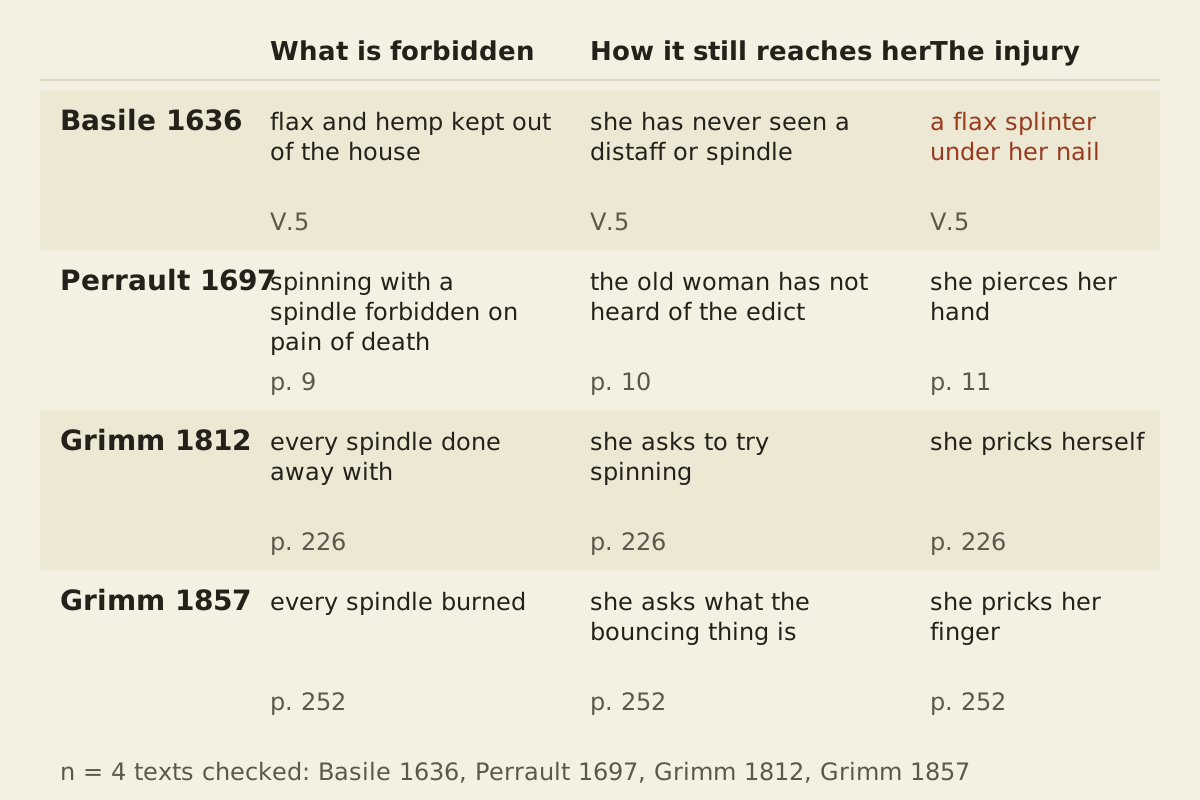
What each text forbids, how the spinning still reaches the girl, and the injury, with the page or tale.
Credit line for reuse
"The ban on spinning in four Sleeping Beauty texts" by Once Upon a Version — https://onceuponaversion.com/tellings/sleeping-beauty-basile-perrault-grimm/ — licensed under CC BY 4.0 (https://creativecommons.org/licenses/by/4.0/)
Data: Basile (1788 reprint, Project Gutenberg 77386), Perrault (1697, French Wikisource) and the Grimms (1812 and 1857, German Wikisource), retrieved 2026-11-03
The bans, the way the spindle reaches her and the injury, as CSV (where the data comes from) Data: Basile (1788 reprint, Project Gutenberg 77386), Perrault (1697, French Wikisource) and the Grimms (1812 and 1857, German Wikisource), retrieved 2026-11-03
| Text | What is forbidden | How it still reaches her | The injury |
|---|---|---|---|
| Basile 1636 | flax and hemp kept out of the house (V.5) | she has never seen a distaff or spindle (V.5) | a flax splinter under her nail (V.5) |
| Perrault 1697 | spinning with a spindle forbidden on pain of death (p. 9) | the old woman has not heard of the edict (p. 10) | she pierces her hand (p. 11) |
| Grimm 1812 | every spindle done away with (p. 226) | she asks to try spinning (p. 226) | she pricks herself (p. 226) |
| Grimm 1857 | every spindle burned (p. 252) | she asks what the bouncing thing is (p. 252) | she pricks her finger (p. 252) |
Basile’s lord prohibits flax, hemp and any similar material from entering his household (“che drinto la casa soja non ce trasesse nè lino, nè ccannavo”). Talia grows up never having seen a distaff or a spindle (“n’avea visto maie conocchia, nè ffuso”), so the twirling of the old woman’s spindle in the street delights her. She takes the distaff, and the splinter of flax that the seers warned about goes under her nail.
Perrault’s king publishes an edict that forbids anyone to spin with a spindle, or even to keep one at home, on pain of death (p. 9). The old woman in the tower garret has simply never heard of it (p. 10). The princess, “fort vive, un peu estourdie” (in this site’s rendering, lively and a little giddy) on page 11, grabs the spindle and pierces her hand.
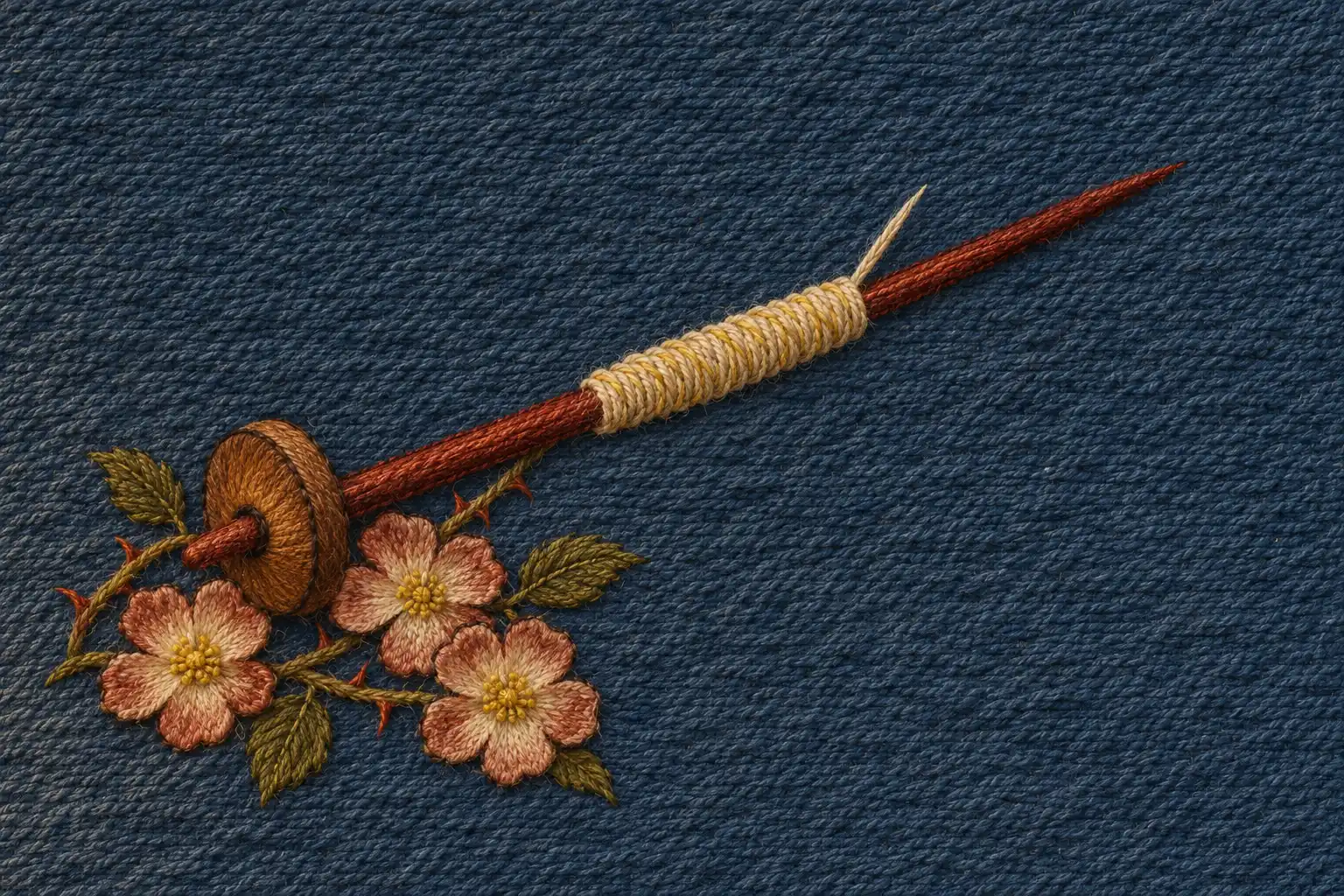
Illustration of a spindle wound with flax and a sprig of wild rose: the spindle of Perrault and the Grimms, and the flax splinter of Basile’s tale.
Illustration: Once Upon a Version. Generated illustration — not a historical image, manuscript or record. © Once Upon a Version, all rights reserved; reuse by request.
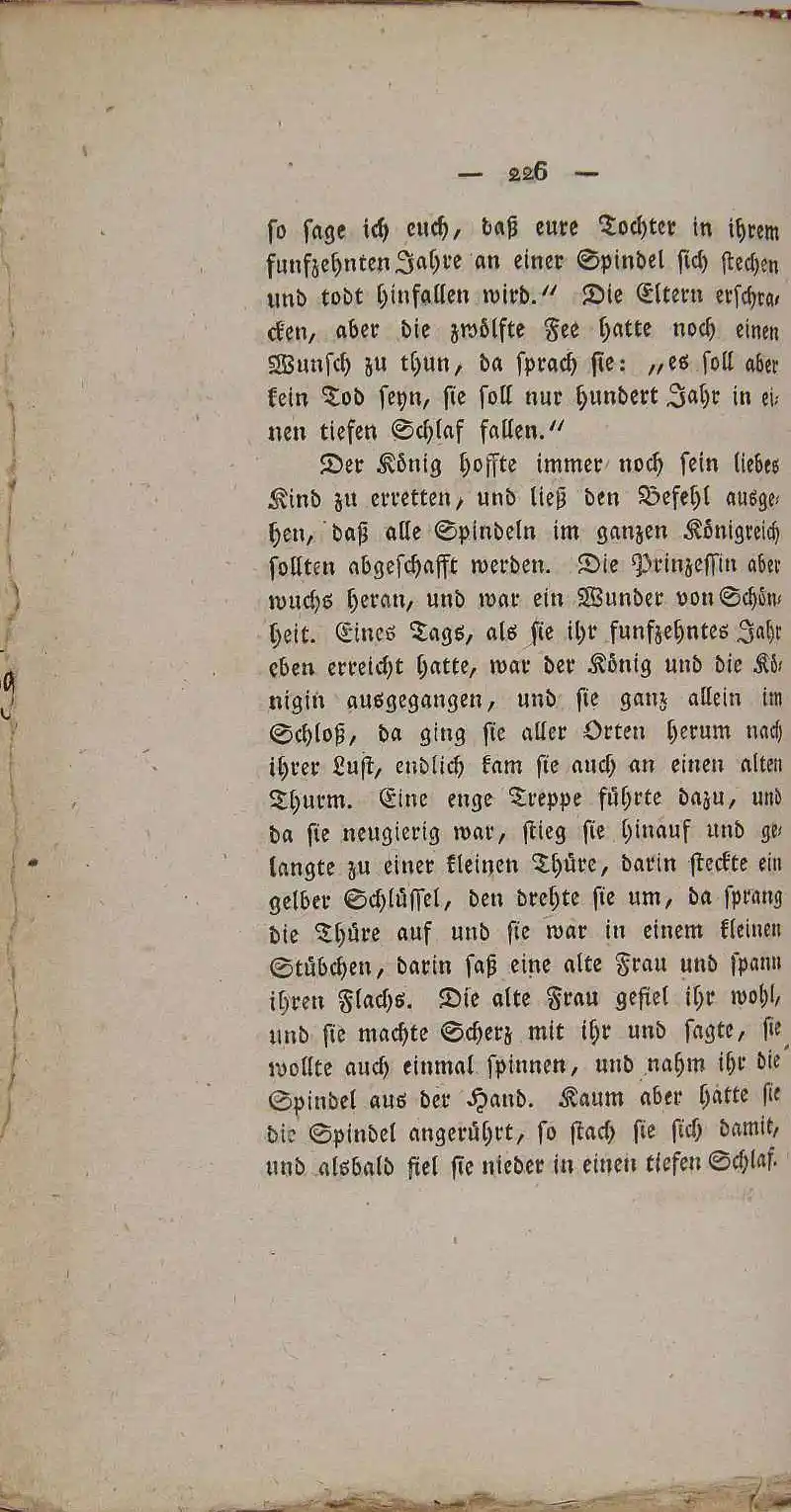
Page 226 of the brothers’ annotated copy of volume 1, with the softened sentence, the order to do away with every spindle, and the prick. Jacob and Wilhelm Grimm, Kinder- und Haus-Märchen, vol. 1, 1812.
Full credit
"Kinder- und Haus-Märchen, vol. 1 (1812), p. 226, the brothers’ annotated copy" by Jacob and Wilhelm Grimm — https://commons.wikimedia.org/wiki/File:Kinder_und_Hausm%C3%A4rchen_(Grimm)_1812_I_226.jpg — Public domain in US (published 1812); DE/FR (Jacob Grimm d. 1863, Wilhelm Grimm d. 1859, life+70); the handwritten notes are theirs; modified: cropped to the page; binding, headband, facing page and the edges of other leaves of the bound copy removed
In the Grimms’ 1812 text the king orders every spindle in the kingdom abolished, and in the 1857 revision destroyed by fire. The 1857 princess asks the old woman what the merry, bouncing thing in her hand might be: “Was ist das für ein Ding, das so lustig herumspringt?” (p. 252). In none of the four does the ban keep the spinning from her. Basile’s Talia and the 1857 princess do not know what they are looking at; Perrault’s princess and the 1812 one want to try it.
Across these four texts the injury and the cure line up, though none of them says that one causes the other. Basile’s Talia is harmed by a splinter that remains lodged in her finger, and that same splinter has to be extracted before she can wake. In Perrault and in both Grimm texts the harm is a puncture from a spindle, and nothing remains in her body to be removed. Their sleep is ended from outside, by the end of a term, by a kiss, or by both.
What do the versions not share?
The man who finds her differs in each telling, and so do what he does and when he comes.
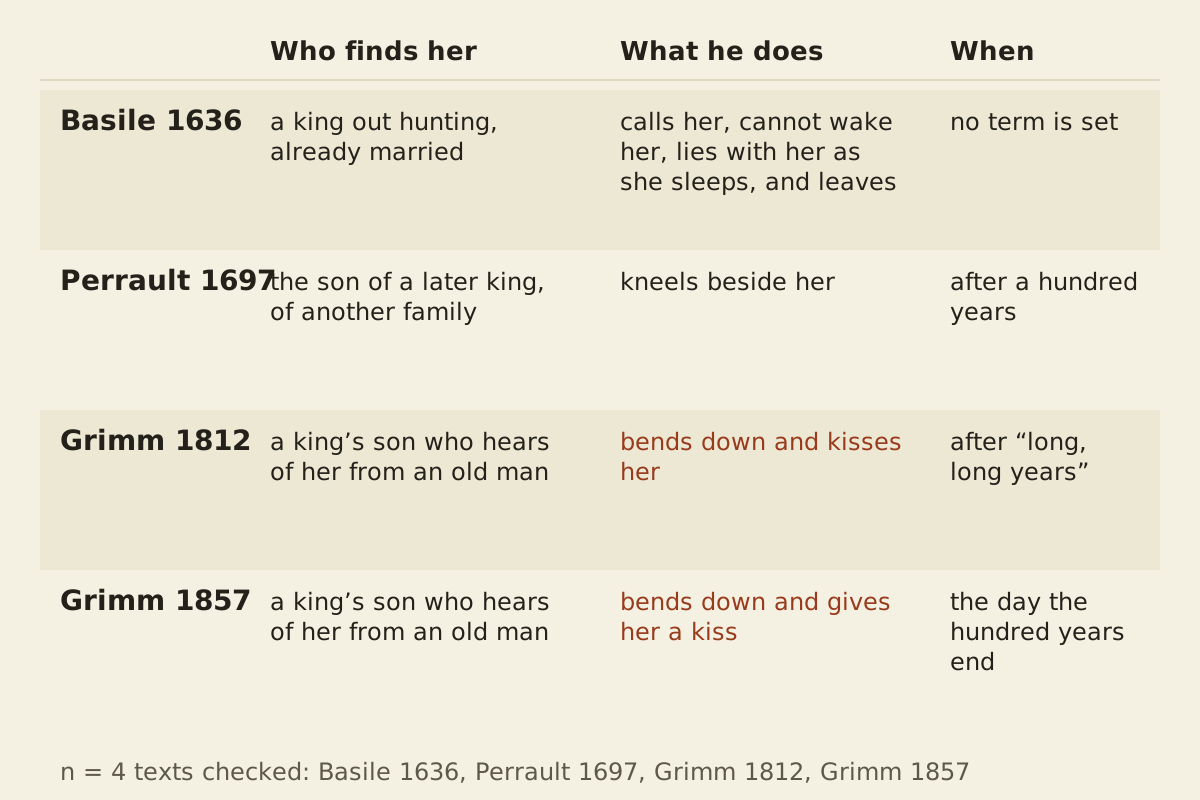
Who finds the sleeper in each of the four texts, what he does, and when he comes.
Credit line for reuse
"Who finds the sleeper in four Sleeping Beauty texts" by Once Upon a Version — https://onceuponaversion.com/tellings/sleeping-beauty-basile-perrault-grimm/ — licensed under CC BY 4.0 (https://creativecommons.org/licenses/by/4.0/)
Data: Basile (1788 reprint, Project Gutenberg 77386), Perrault (1697, French Wikisource) and the Grimms (1812 and 1857, German Wikisource), retrieved 2026-11-03
Who finds her, in the four texts, with quotations and pages, as CSV (where the data comes from) Data: Basile (1788 reprint, Project Gutenberg 77386), Perrault (1697, French Wikisource) and the Grimms (1812 and 1857, German Wikisource), retrieved 2026-11-03
| Text | Who finds her | What he does | When |
|---|---|---|---|
| Basile 1636 | a king out hunting, already married | calls her, cannot wake her, lies with her as she sleeps, and leaves | no term is set |
| Perrault 1697 | the son of a later king, of another family | kneels beside her | after a hundred years |
| Grimm 1812 | a king’s son who hears of her from an old man | bends down and kisses her | after “long, long years” |
| Grimm 1857 | a king’s son who hears of her from an old man | bends down and gives her a kiss | the day the hundred years end |
The tellers differ as well. Basile’s tale is spoken by Popa inside a frame of storytellers, and Perrault’s is printed under a privilege in the name of P. Darmancour and closed with a verse moral. The Grimms’ tale is credited by Bolte and Polívka to a single named woman in a Kassel household, and the printed book names none.
None of this shows who read whom. The grid records what each text says; it does not establish a line of borrowing, and no source read for this page traces one from Basile to Perrault. The Grimms’ 1812 note names Perrault’s tale as its counterpart and compares a different Basile tale, and that is as far as their own statement goes.
Is any of the four texts an ‘original’ Sleeping Beauty?
Not on the evidence of this page. Basile’s text, printed in 1636, is the earliest known of the four texts compared here, but earliest here is not the same as first. Bolte and Polívka (1913, vol. 1, pp. 436–437) set two medieval texts beside the tale: an episode of Perceforest, a French prose romance of the fourteenth century, and a Catalan poem of the same century that survives incomplete. Neither is compared here, so neither is placed in the grid.
What this page can say is narrower. The earliest known of the four printings compared here has no kiss, no hundred years and no curse, and the kiss is first found, among these four texts, in the Grimms’ text of 1812. Calling any one of them “the original” would hide the 221 years and the three different hands between the first printing and the last.
In Basile’s text, the tale belongs to Popa, the teller whose turn comes after the fourth tale of the fifth day. Her couplet at the end, “A chi ventura tene, / Quanno dorme, perzì chiove lo bene,” says that good fortune rains on the lucky even while they sleep, and in her telling it is two newborns, not a kiss, that bring Talia back.
Sources
Editions
- Giambattista Basile, Il Pentamerone, overo Lo cunto de li cunte, trattenemiento de li peccerille, vol. 2 (Naples: Giuseppe-Maria Porcelli, 1788): day 5, tale 5, “Sole, Luna e Talia.” Project Gutenberg ebook 77386. https://www.gutenberg.org/ebooks/77386 (full text of day 5, tale 5, with the passage that hands the tale to its teller)
- Charles Perrault, Histoires ou contes du temps passé, avec des moralitez (Paris: Claude Barbin, 1697): title page and contents; “La belle au bois dormant,” pp. 1–46; “Extrait du Privilége du Roy,” pp. 231–232. French Wikisource transcription of the 1697 printing. https://fr.wikisource.org/wiki/Histoires_ou_Contes_du_temps_pass%C3%A9_(1697)/Original/La_belle_au_bois_dormant (full text of the tale, the title page and contents, and the privilege)
- Brüder Grimm, Kinder- und Haus-Märchen, vol. 1, 1st ed. (Berlin: Realschulbuchhandlung, 1812): no. 50, “Dornröschen,” pp. 225–229, and the note “Zu Dornröschen. No. 50,” p. XXXI. German Wikisource transcription. https://de.wikisource.org/wiki/Dornr%C3%B6schen_(1812) (full text of the tale and its note)
- Brüder Grimm, Kinder- und Haus-Märchen, vol. 1, 7th ed. (Göttingen: Dieterich, 1857): no. 50, “Dornröschen,” pp. 251–254. German Wikisource transcription. https://de.wikisource.org/wiki/Dornr%C3%B6schen_(1857) (full text of the tale)
- Brothers Grimm, Household Tales, translated by Margaret Hunt: no. 50, “Little Briar-Rose,” and no. 89, “The Goose-Girl.” Project Gutenberg ebook 5314. https://www.gutenberg.org/ebooks/5314 (full text of nos. 50 and 89)
- Andrew Lang, ed., The Blue Fairy Book (London and New York: Longmans, Green, 1889). Project Gutenberg eBook 503. https://www.gutenberg.org/ebooks/503 (contents and the source note printed after each tale, with the whole book searched for named sources; full text of “Aladdin and the Wonderful Lamp,” “Beauty and the Beast” and “The Sleeping Beauty in the Wood”; the title and opening of “The Story of Pretty Goldilocks”)
Research
- Benedetto Croce, introduction to Giambattista Basile, Lo cunto de li cunti, vol. 1 (Naples, 1891): chapter I, life of Basile (his death, pp. lxi–lxii), and chapter II, the Neapolitan works and their printing (pp. lxxxvii–xciv, with notes). Italian Wikisource transcription. https://it.wikisource.org/wiki/Lo_cunto_de_li_cunti/Introduzione/II (chapters I, II and VI of the introduction, and documents F and H)
- Johannes Bolte and Jiří Polívka, Anmerkungen zu den Kinder- und Hausmärchen der Brüder Grimm, vol. 1 (Leipzig: Dieterich, 1913): no. 50, “Dornröschen,” pp. 434–437. German Wikisource transcription. https://de.wikisource.org/wiki/Anmerkungen_zu_den_Kinder-_und_Hausm%C3%A4rchen_der_Br%C3%BCder_Grimm_I/Dornr%C3%B6schen (full entry)
- Charles Deulin, Les Contes de ma mère l’Oye avant Perrault (Paris: E. Dentu, 1879): “La Belle au bois dormant,” pp. 127–143. French Wikisource transcription. https://fr.wikisource.org/wiki/Les_Contes_de_ma_m%C3%A8re_l%E2%80%99Oye_avant_Perrault/La_Belle_au_bois_dormant (full chapter)
Catalogues and databases
- D. L. Ashliman, The Grimm Brothers’ Children’s and Household Tales, list with tale-type numbers, Folklore and Mythology Electronic Texts (University of Pittsburgh): no. 50, “Little Brier-Rose,” type 410; no. 89, “The Goose Girl,” type 533. https://sites.pitt.edu/~dash/grimmtales.html (tale-type numbers only)
- Gemeinsame Normdatei (GND) authority records via lobid-gnd (hbz): 118657461 (Basile, Giambattista), 118740008 (Perrault, Charles), 118542257 (Grimm, Jacob), 118542265 (Grimm, Wilhelm). https://lobid.org/gnd/118657461 (authority records) Text licence: CC0 1.0, https://creativecommons.org/publicdomain/zero/1.0/
Cite this page
Once Upon a Version. “Sleeping Beauty: In Basile and Perrault, No Kiss Wakes Her.” Once Upon a Version. Published 2026-11-05. https://onceuponaversion.com/tellings/sleeping-beauty-basile-perrault-grimm/ (accessed day month year).
Write in the date you read the page; the page has no DOI.
More from One Tale, Many Tellers
One Tale, Many Tellers
Brothers Grimm: Their ‘Peasant Woman’ Was a Tailor’s Wife
Type ATU 533, as classified by D. L. Ashliman
The Grimms’ 1815 preface calls Dorothea Viehmann a peasant woman. Her biography records an innkeeper’s daughter who married a tailor. Both prefaces, compared.
Picture credit
"Portret van Jacob Ludwig Karl Grimm" by Ludwig Emil Grimm — https://commons.wikimedia.org/wiki/File:Portret_van_Jacob_Ludwig_Karl_Grimm,_RP-P-1907-1042.jpg — CC0 1.0 (https://creativecommons.org/publicdomain/zero/1.0/); modified: cropped to the plate (sheet margins removed)
One Tale, Many Tellers
Grimm Fairy Tales 1–60: Counted Here, 21 Named Tellers
Type collection of folktales (no single ATU number)
Bolte and Polívka’s 1913 notes on Grimm tales 1–60 name 21 tellers, 13 of them women, and 34 of 62 credits name Kassel. The register lists them entry by entry.
Picture credit
"Doppelportrait der Brüder Jacob und Wilhelm Grimm" by Elisabeth Jerichau-Baumann — https://commons.wikimedia.org/wiki/File:Alte_Nationalgalerie-Jerichau-Baumann-Gebr%C3%BCder_Grimm_DSC8174.jpg — CC0 1.0 (https://creativecommons.org/publicdomain/zero/1.0/); modified: cropped to the painted canvas; gilt frame and wall removed
One Tale, Many Tellers
Aladdin: A Syrian Teller Gave It to Galland in Paris, 1709
Type tale printed in Galland’s Thousand and One Nights (no ATU number cited)
In the sources checked here, Aladdin’s earliest known record is Galland’s diary for 5 May 1709: Hanna, a Maronite from Aleppo, had just told him the tale.
Picture credit
"The Blue Fairy Book (1889), p. 78: plate to “Aladdin and the Wonderful Lamp”" by H. J. Ford — https://commons.wikimedia.org/wiki/File:The_Blue_Fairy_Book-0112.jpg — Public domain in US (published London and New York 1889); DE/FR (Henry Justice Ford d. 1941, life+70, public domain from 1 January 2012); modified: Cropped to the plate and its ruled frame with a strip of paper around it; the page text above and below is left out