Grimm Fairy Tales 1–60: Counted Here, 21 Named Tellers
The Grimms’ 1812 preface named no one; Bolte and Polívka’s 1913 notes, drawn mostly from the brothers’ own copies, name 21 tellers for tales 1–60, and 13 were women.
By Once Upon a Version
Published
How a version is traced · Version history · Contact · Report an error (contact@onceuponaversion.com)
In short
- Bolte and Polívka’s 1913 notes on Grimm tales nos. 1–60 name 21 tellers, 13 of them women, and 34 of their 62 credits to those tellers name Kassel.
- The brothers’ 1812 preface names no teller; most of the names come from notes in the brothers’ own copies, which Herman Grimm handed to Johannes Bolte.
- Of the 66 entries, 46 name at least one teller; Dortchen Wild is credited 13 times and a “Marie” of the Wild household 11 times, and who Marie was is disputed.
Telling card
- Tale
- Kinder- und Haus-Märchen (Children’s and Household Tales); here the 66 entries of Bolte and Polívka’s notes on nos. 1–60
- Type
- collection of folktales (no single ATU number)
- Teller
- 21 named in Bolte and Polívka’s notes on nos. 1–60, 13 of them women; see the register
- Recorded by
- Jacob or Wilhelm Grimm (unrecorded which) for most of the oral texts; Philipp Otto Runge wrote down the dialect texts of nos. 19 and 47
5 more fields: edited by, told, published, this text, earliest known
- Edited by
- Jacob and Wilhelm Grimm; seven editions of the large collection, 1812 and 1815 to 1857
- Told
- Dated tellings in the register run from 1807 to 1813; Kassel is the place named most often
- Published
- vol. 1, Berlin: Realschulbuchhandlung, 1812; vol. 2, 1815
- This text
- Bolte and Polívka, Anmerkungen, vol. 1 (Leipzig, 1913); the 1812 preface; the 1856 notes
- Earliest known
- For the collection: a handwritten collection of 1810, known here only from a catalogue record, then the 1812 print and the brothers’ annotated copy of it; for single tales, the register’s dated tellings go back to 1807 and its printed sources to 1555
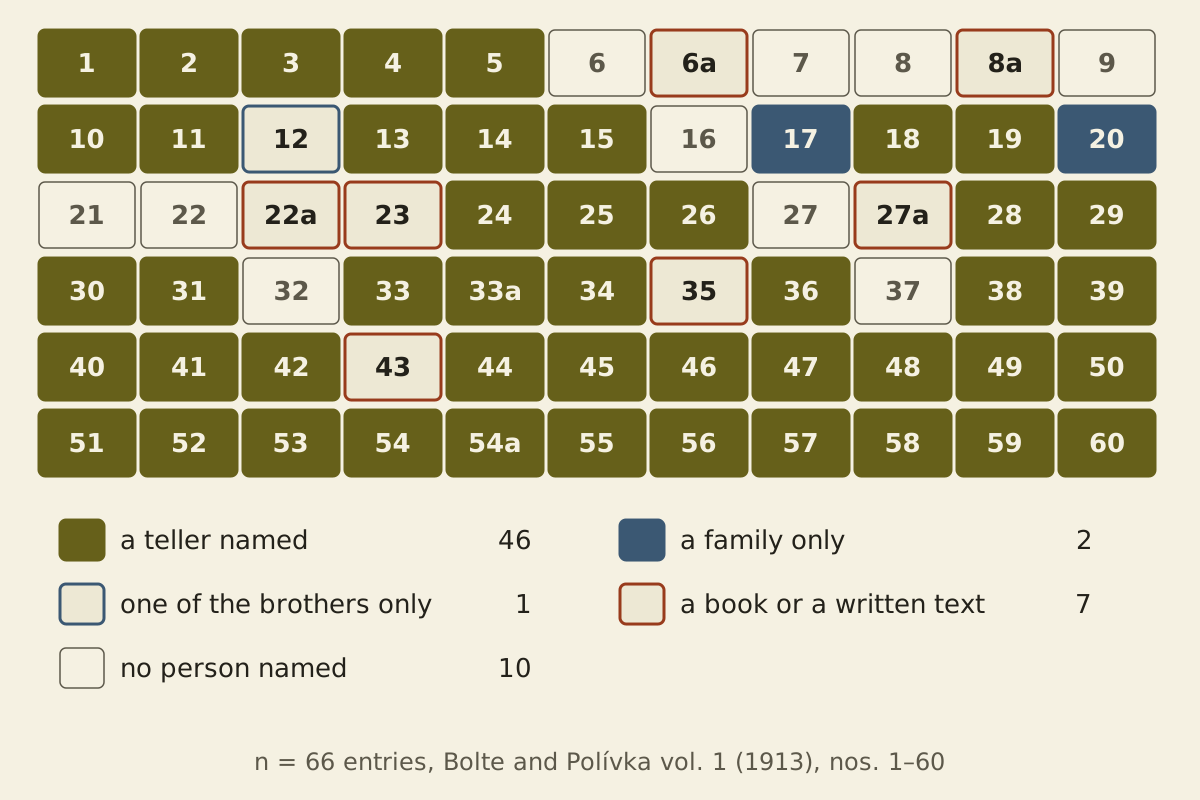
One cell per entry in volume 1 of Bolte and Polívka’s notes, in book order, shaded by what the entry names as the source; n = 66 entries for tales nos. 1–60.
Credit line for reuse
"What volume 1 of Bolte and Polívka’s notes names as the source of each of its 66 entries" by Once Upon a Version — https://onceuponaversion.com/tellings/grimm-informants/ — licensed under CC BY 4.0 (https://creativecommons.org/licenses/by/4.0/)
Data: Bolte and Polívka, Anmerkungen, vol. 1 (1913), German Wikisource transcription, retrieved 2026-11-03
Dortchen Wild told the Brothers Grimm “The Singing Bone” by the stove in a garden house. The date was 19 January 1812, the town was Kassel, and the record comes from the notes the brothers wrote into their own copies of the book. Those notes reached print a century later, when Johannes Bolte and Jiří Polívka put them into their commentary on Grimm Fairy Tales, the Kinder- und Hausmärchen.
Part of the answer to who told the Grimms their tales is on record. For the 60 tales that open the final edition, Bolte and Polívka’s first volume (1913) names 21 people as tellers, and 13 of them are women. The register on this page gathers every name the volume gives, entry by entry, with the German wording and the page it stands on.
Bolte and Polívka’s commentary, published in Leipzig from 1913 onward, gathers for each Grimm tale its sources, its printed history and comparable versions from other languages. Its first volume, the one used here, covers tales 1 to 60. German Wikisource has transcribed it in full and proofread it twice against the page scans.
The people who supplied tales are usually called informants in folklore study, the word for anyone who gives a collector material. This page calls them tellers, because the notes mostly record who told a tale, when, and sometimes where.
Where were the tellers’ names written down?
The brothers kept copies of their own first edition and wrote notes into them: corrections, additional passages, and short entries recording who had told a tale and when. German scholarship calls these copies the Handexemplare, the authors’ working copies. Johannes Bolte’s foreword, signed in Berlin in November 1912, says that Herman Grimm had given him “die Handexemplare seines Vaters und seines Oheims”, his father’s and his uncle’s copies, fourteen years earlier, and that one part of the work was easy.
“Zwar ließen sich ohne Mühe Notizen über die Gewährsmänner und die Zeit der einzelnen Aufzeichnungen in den Text einschalten”
written by Johannes Bolte · Anmerkungen zu den Kinder- und Hausmärchen der Brüder Grimm, vol. 1, 1913, Vorwort, p. V
In this site’s rendering, as with every English rendering of German on this page: notes on the informants and on the date of each recording could be inserted into the text without trouble.
Most of the names below come through that sentence: the brothers’ handwriting supplied them, and Bolte and Polívka put them in print beside each tale’s other versions. Some tales were written down even before the first print, in a handwritten collection of 1810 that Heinz Rölleke edited in 1975. This page knows that edition only from its catalogue record.
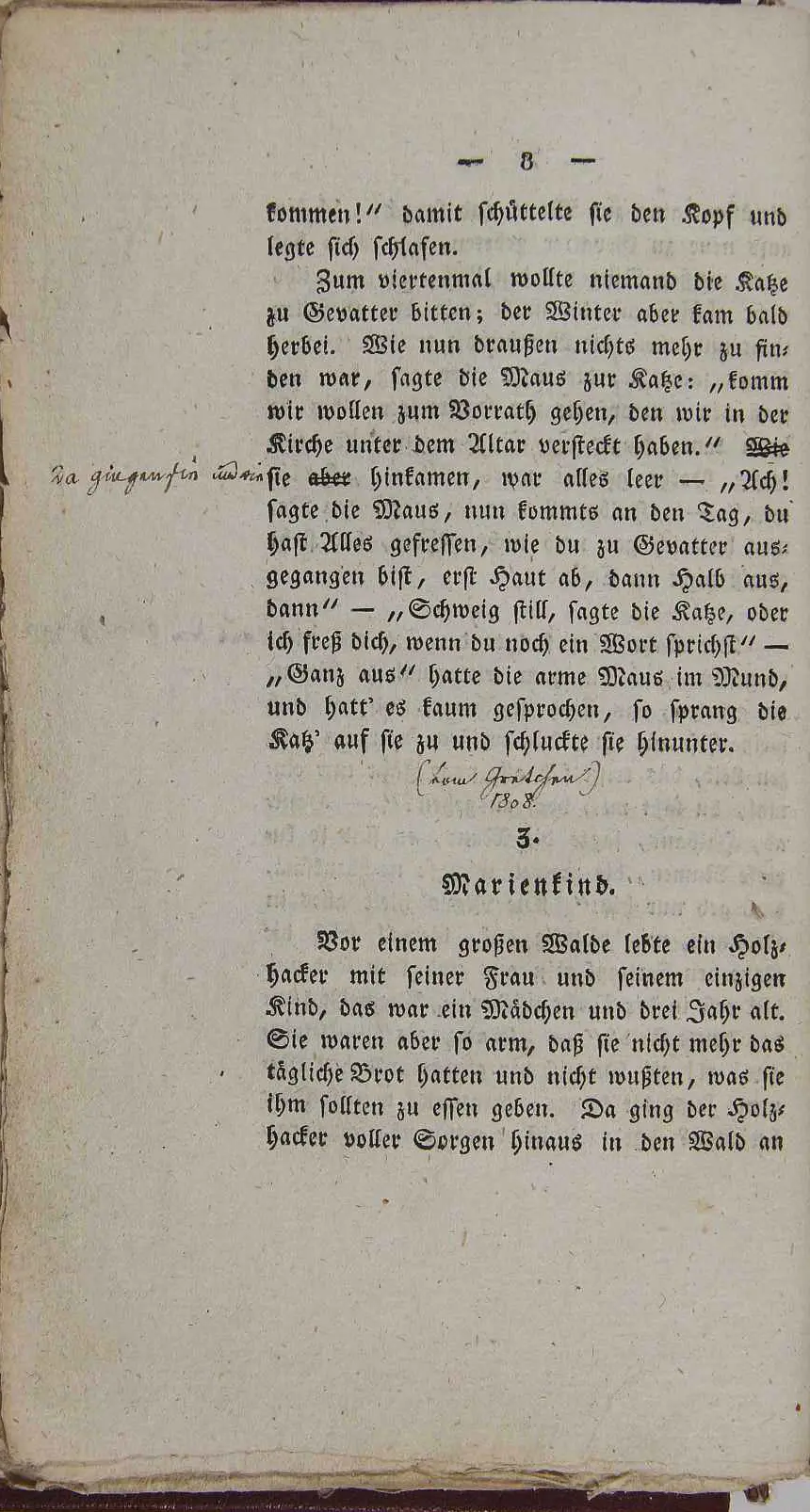
Page 8 of the brothers’ annotated copy of volume 1, with handwritten notes beside and below the end of tale no. 2. Jacob and Wilhelm Grimm, Kinder- und Haus-Märchen, vol. 1, 1812.
Full credit
"Kinder- und Haus-Märchen, vol. 1 (1812), p. 8, the brothers’ annotated copy" by Jacob and Wilhelm Grimm — https://commons.wikimedia.org/wiki/File:Kinder_und_Hausm%C3%A4rchen_(Grimm)_1812_I_008.jpg — Public domain in US (published 1812); DE/FR (Jacob Grimm d. 1863, Wilhelm Grimm d. 1859, life+70); the handwritten notes are theirs; modified: cropped to the page; binding and neighbouring leaves of the bound copy removed
The page above shows what such a note looks like: under the last line of tale no. 2, “Katz und Maus in Gesellschaft,” a short note in brackets ends in the year 1808. Bolte and Polívka print the source of that tale as “von Gretchen Wild in Kassel 1808” (p. 9).
How the register counts
Bolte and Polívka’s first volume has 66 entries: one for each of tales 1 to 60, plus six entries for texts that were printed in 1812 and later dropped, numbered 6a, 8a, 22a, 27a, 33a and 54a. Most entries open with the edition the tale first appeared in and where it came from.
Every name in those entries that is given as the source of a version became a row in the register CSV, and so did every entry that names no one: 104 rows in all. A row records the entry, the text it refers to, the person, the German words, the page, and how sure the attribution is.
- Counted as a named teller: a person named as the one a version came from, whether told, added, sent in, or reported. Mamsell Storch, named as the woman another teller heard a tale from, is counted too.
- Listed but not counted: families named without a person (“von Hassenpflugs”), the brothers themselves, authors of printed books, and Philipp Otto Runge, who wrote down two Low German tales; the two Swedish tellings that H. R. von Schröter wrote down are listed the same way.
- Recorded as unrecorded: entries that give only a place, such as “aus Zwehrn”, or no source at all.
The rows also differ in how sure they are: of the 62 rows that credit a counted teller, 47 state the name plainly, 4 rest on a name that Bolte and Polívka supply or hedge with “vermutlich” or “wohl”, and 11 are marked disputed, because they name the Marie discussed below.
Most credited rows point to what this site calls a one-evening text: one telling pinned to a person, a date or a place, not the tale as a whole. A few group more than one: a single row covers both of Marie’s tellings of no. 11, and another the three short tales of no. 39 from Dortchen Wild. The count of 21 named tellers is the number of different people in the counted rows; the 13 women are those whose names or titles, as printed, mark them as women.
| What Bolte and Polívka name | Entries | Entry numbers |
|---|---|---|
| A teller named | 46 | 1, 2, 3, 4, 5, 10, 11, 13, 14, 15, 18, 19, 24, 25, 26, 28, 29, 30, 31, 33, 33a, 34, 36, 38, 39, 40, 41, 42, 44, 45, 46, 47, 48, 49, 50, 51, 52, 53, 54, 54a, 55, 56, 57, 58, 59, 60 |
| A family only | 2 | 17, 20 |
| One of the brothers only | 1 | 12 |
| A book or a written text | 7 | 6a, 8a, 22a, 23, 27a, 35, 43 |
| No person named | 10 | 6, 7, 8, 9, 16, 21, 22, 27, 32, 37 |
The grid at the top of the page shows the same five groups, cell by cell.
The register of named Grimm tellers, 104 rows, as CSV (where the data comes from) Data: Bolte and Polívka, Anmerkungen, vol. 1 (1913), German Wikisource transcription, retrieved 2026-11-03; the questioning of the old-Marie reading from a catalogue record (hbz) only
What did the printed notes say instead?
The 1812 preface to volume 1 names none of these people. Printed in Berlin that year, it explains where the tales came from in one sentence about regions.
“Alles ist mit wenigen bemerkten Ausnahmen fast nur in Hessen und den Main- und Kinziggegenden in der Grafschaft Hanau, wo wir her sind, nach mündlicher Ueberlieferung gesammelt”
written by the Brothers Grimm · Kinder- und Haus-Märchen, vol. 1, 1st ed., 1812, Vorrede, p. VII
In this site’s rendering: everything, with a few noted exceptions, was collected from oral tradition almost entirely in Hesse and in the Main and Kinzig districts of the county of Hanau, where the brothers came from. The same page then offers “Allen Dank, die Theil daran haben,” thanks to all who had a share in it, and names none of them.
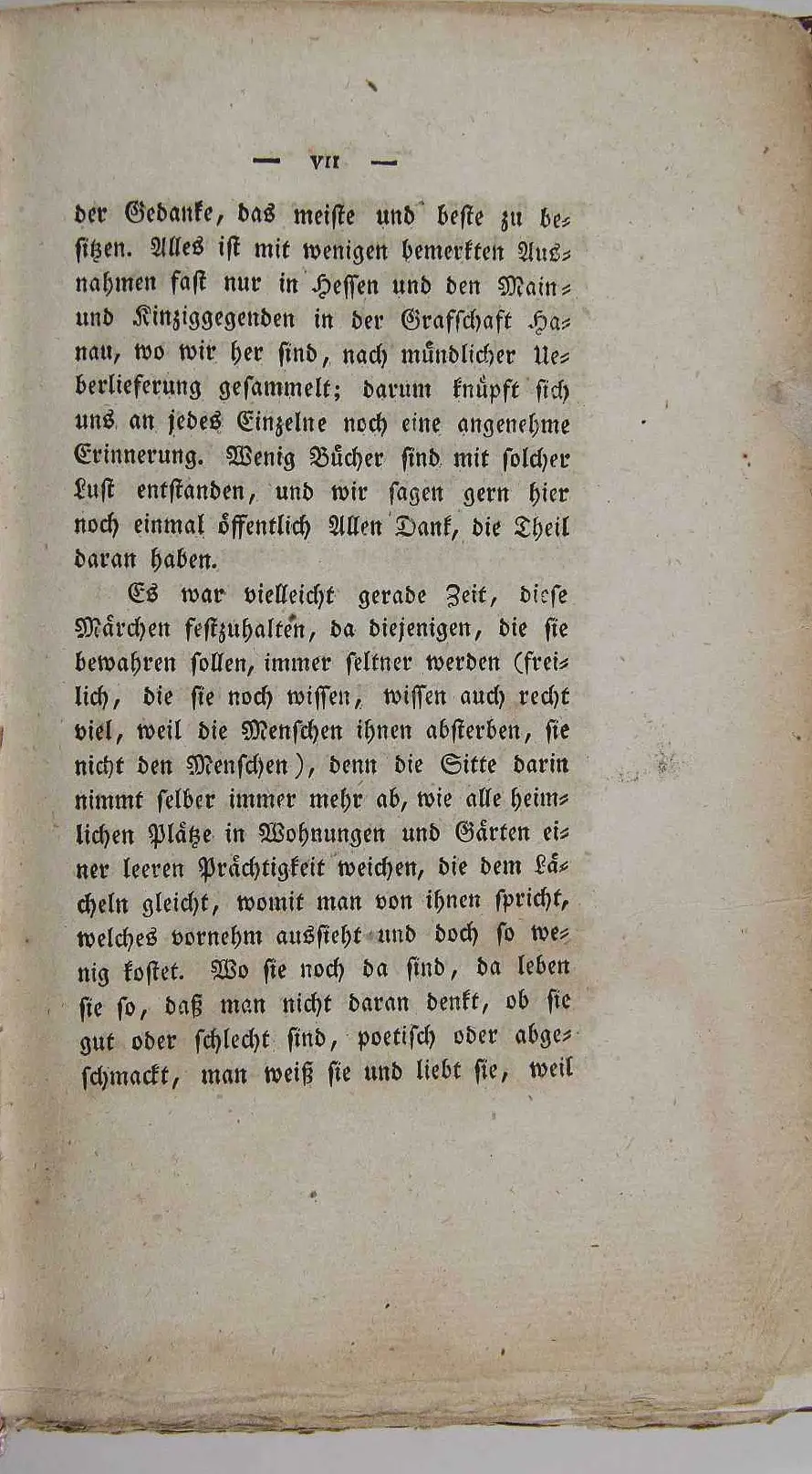
Page VII of the preface to volume 1, with the sentence on oral tradition in Hesse and the Main and Kinzig districts. Jacob and Wilhelm Grimm, Kinder- und Haus-Märchen, vol. 1, 1812.
Full credit
"Kinder- und Haus-Märchen, vol. 1 (1812), preface, p. VII" by Jacob and Wilhelm Grimm — https://commons.wikimedia.org/wiki/File:Kinder_und_Hausm%C3%A4rchen_(Grimm)_1812_I_p_007.jpg — Public domain in US (published 1812); DE/FR (Jacob Grimm d. 1863, Wilhelm Grimm d. 1859, life+70); modified: cropped to the page; binding and facing page of the bound copy removed
One page earlier the preface says where such tales had survived: “Die Plätze am Ofen, der Küchenheerd, Bodentreppen”, places by the stove, the kitchen hearth, the attic stairs (p. VI). Set that beside Bolte and Polívka’s entry for “The Singing Bone”: “am Ofen im Gartenhaus,” by the stove in a garden house, from Dortchen Wild in Kassel (p. 260).
This site calls that move the borrowed hearth: a preface presents specific tellers with names and lives of their own as the voice of a nameless folk tradition. Both pieces of evidence the label needs are here: the preface wording with its pages, and a record of who the tellers were, 21 names, most of them with a place or a date.
Apart from the reworkings that Bolte and Polívka themselves record, such as Marie’s text of no. 31, this page makes no claim about how the brothers changed any one teller’s wording, so no edition-by-edition comparison is needed for the label.
The printed notes kept to the same habit for decades. The notes volume of 1856, the last the brothers published, names only three of the 21 tellers, and none of the 13 women: H. R. von Schröter (p. 20), Hans Truffer (p. 63) and, spelled “Moné,” Mone (p. 77). For “Frau Holle” it gives regions where the brothers’ copy had a name and a date.
1856 · Kinder- und Haus-Märchen, vol. 3 (notes)
“Aus Hessen und Westphalen.”
written by the Brothers Grimm · Kinder- und Haus-Märchen, vol. 3, 1856, p. 40
1913 · Bolte and Polívka, notes, vol. 1
“1812 nr. 24: von Dortchen Wild in Kassel am 13. Oktober 1811 im Garten.”
written by Johannes Bolte and Jiří Polívka · Anmerkungen zu den Kinder- und Hausmärchen der Brüder Grimm, vol. 1, 1913, p. 207
What changed: The 1856 note names two regions. The 1913 entry, built from the brothers’ copy, names one teller, a town, a day and a garden.
In this site’s rendering, the 1856 note says the tale came from Hesse and Westphalia; the 1913 entry says that no. 24 of 1812 came from Dortchen Wild in Kassel on 13 October 1811, in the garden.
The 1815 second volume followed the same pattern in its notes: the 70 notes, counted note by note in the profile of the teller from Zwehrn, name places and printed books but no teller, although its preface names her once.
How did a teller become a region?
Bolte and Polívka often set the brothers’ handwritten source beside the label the printed notes gave the same tale. Seven entries in the first volume do this for a named teller or family, and in each the printed label is a region or a count of tellings, never the name.
| No. | Named in the brothers’ copy | Printed label, as Bolte and Polívka quote it | Page |
|---|---|---|---|
| 17 | “von Hassenpflugs in Kassel” | “aus dem Hanauischen” (1819) | 131 |
| 24 | Dortchen Wild | “aus Hessen und Westfalen” (1822) | 207 |
| 38 | Ludovica Jordis | “Wird vielfach in Hessen und in den Maingegenden erzählt” (1822) | 362 |
| 41 | Jeanette Hassenpflug | “aus den Maingegenden” (1822) | 375 |
| 42 | Amalie Hassenpflug | “aus den Maingegenden” (1822) | 375 |
| 48 | Friedrich Krause | “aus Niederhessen” and “aus dem Paderbörnischen” (1822) | 424 |
| 52 | the Hassenpflugs and Dortchen Wild | “aus Hessen, den Maingegenden und dem Paderbörnischen” (1822) | 443 |
Rendered into English, the printed labels read: from the Hanau region; from Hesse and Westphalia; told in many places in Hesse and in the Main districts; from the Main districts; from Lower Hesse, and from the Paderborn area; and from Hesse, the Main districts and the Paderborn area.
The clearest case is no. 17, “Die weiße Schlange.” Bolte and Polívka record that the brothers heard it from the Hassenpflugs in Kassel in autumn 1812, and that the 1819 edition labelled it “aus dem Hanauischen”, from the Hanau region, “denn von dort war die Familie Hassenpflug nach Kassel gekommen”, because the family had come to Kassel from there.
The label kept the family’s origin and dropped the family. A reader of 1819 saw a region. The brothers’ copy held a household in Kassel.
Who did the writing?
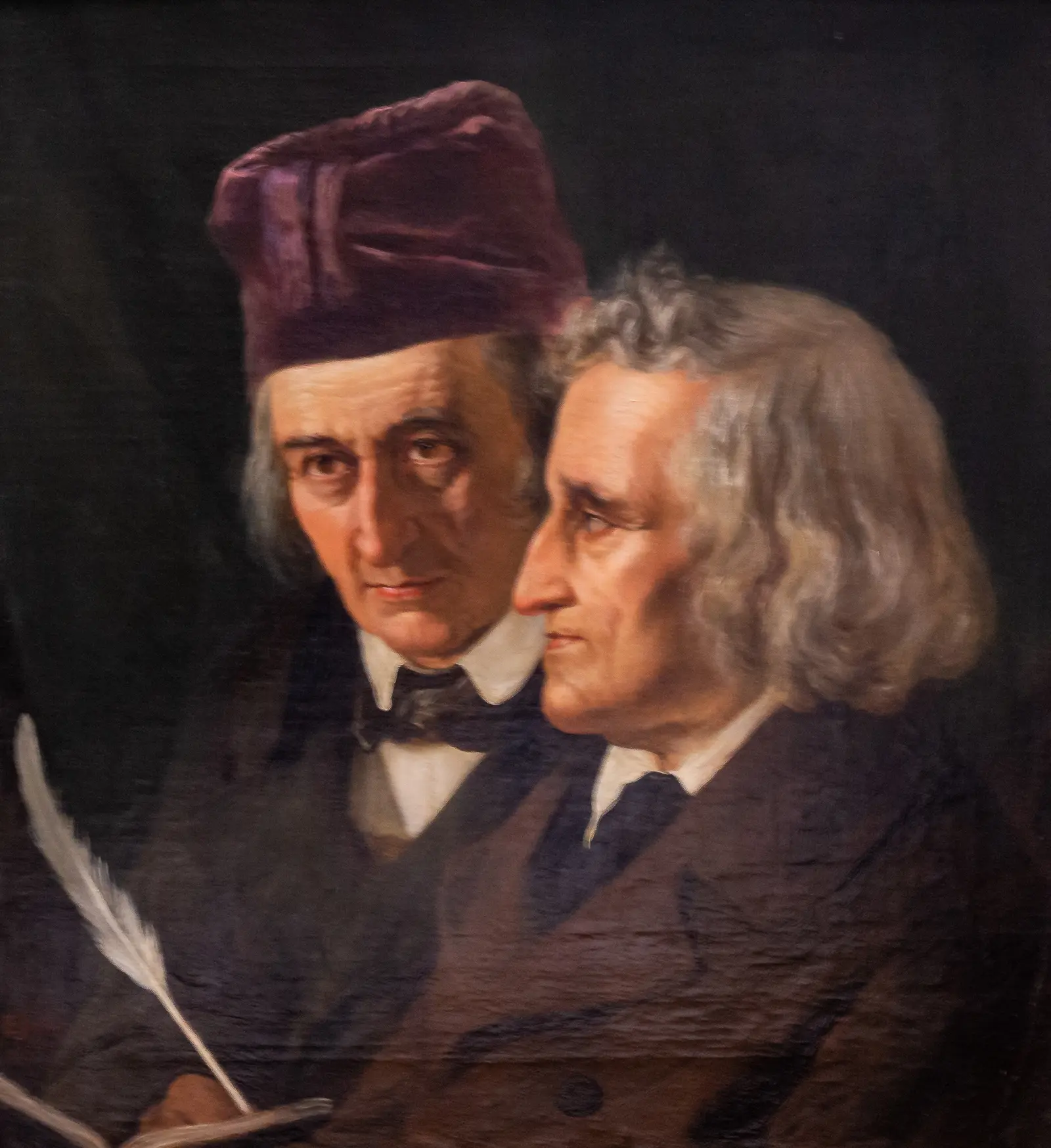
Jacob (right) and Wilhelm Grimm, oil painting by Elisabeth Jerichau-Baumann, 1855. Alte Nationalgalerie, Berlin, A I 663.
"Doppelportrait der Brüder Jacob und Wilhelm Grimm" by Elisabeth Jerichau-Baumann — https://commons.wikimedia.org/wiki/File:Alte_Nationalgalerie-Jerichau-Baumann-Gebr%C3%BCder_Grimm_DSC8174.jpg — CC0 1.0 (https://creativecommons.org/publicdomain/zero/1.0/); modified: cropped to the painted canvas; gilt frame and wall removed
The register counts tellers, not writers. In most entries Bolte and Polívka do not say which brother took a tale down, as the Telling card above notes.
Only two of the 66 entry openings name a brother at all. The 1818 magazine printing of tale no. 4 called it communicated from oral tradition by Wilhelm Grimm, and the entry for no. 12 opens “Von Jacob Grimm erzählt”, told by Jacob Grimm (pp. 22 and 97). The register keeps Jacob Grimm’s row for no. 12 but, following its own rule, does not count either brother as a teller.
Outside this register, Bolte and Polívka’s second volume does name a writer for “The Goose Girl”: its entry, no. 89, says the tale came from Zwehrn and that Jacob Grimm wrote it down (vol. 2, 1915, p. 273); that page names the village, not the teller.
The Telling card on this site keeps four roles apart: the teller who gave a version, the person who recorded it, the editor who revised it, and the publisher who printed it. In the Grimm collection one person could hold several of those roles. The register counts only the first, though it also lists the writers it names.
Some texts reached the brothers already written, two of them in Low German: Philipp Otto Runge, a painter born in Wolgast, wrote down “De Fischer un sine Fru” and “Van den Machandelboom” in Pomeranian dialect and sent them to a publisher in 1806 (pp. 138 and 412). Runge is listed in the register as the person who wrote them down. Whoever told them to him is unrecorded.
H. R. von Schröter appears twice in the same way, as the one who wrote down Swedish tellings for the brothers (pp. 16 and 86); those two rows are listed and not counted.
Did the brothers travel to collect the tales?
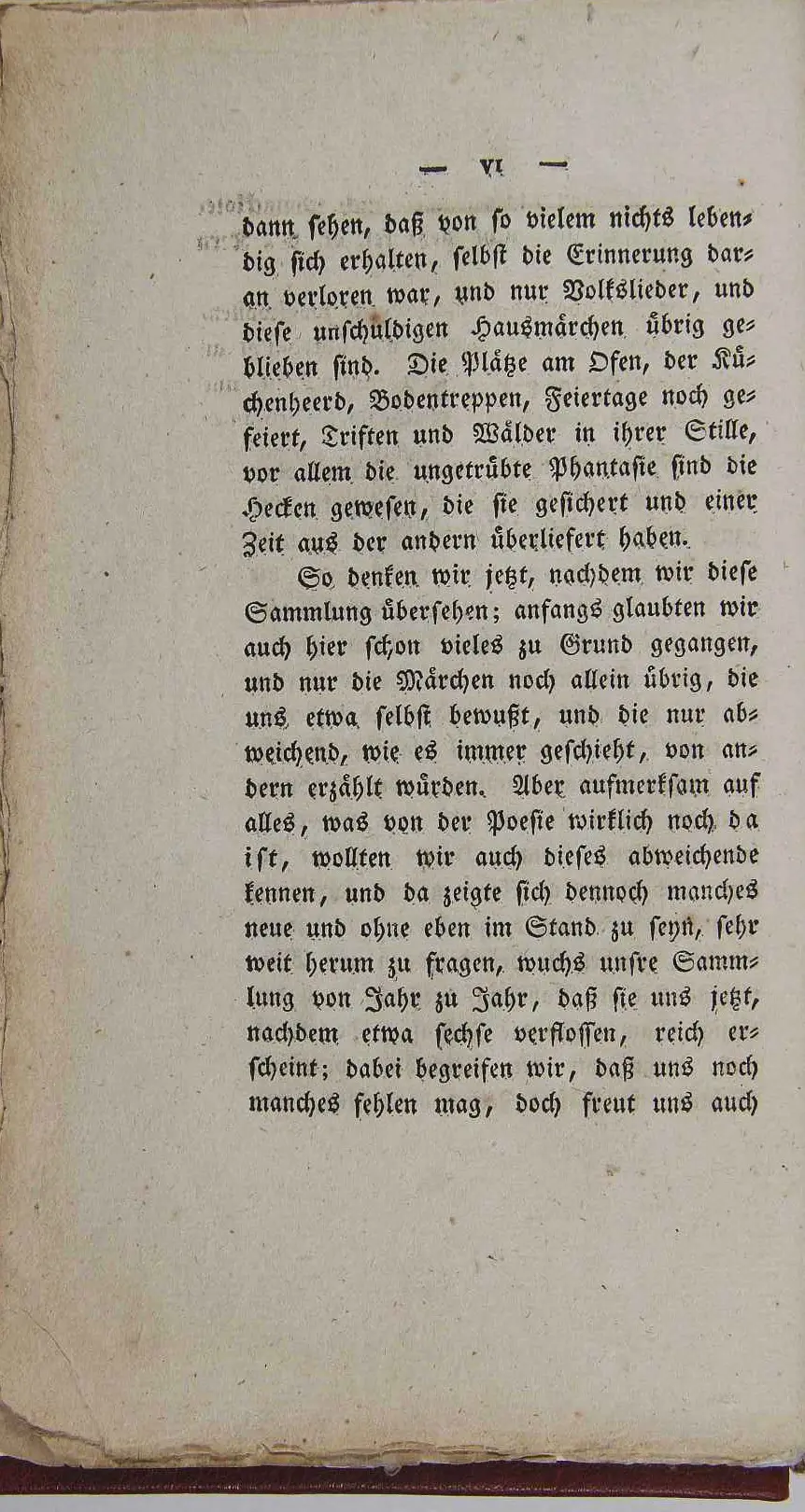
Page VI of the preface to volume 1, with the places by the stove and the line about not asking very far around. Jacob and Wilhelm Grimm, Kinder- und Haus-Märchen, vol. 1, 1812.
Full credit
"Kinder- und Haus-Märchen, vol. 1 (1812), preface, p. VI" by Jacob and Wilhelm Grimm — https://commons.wikimedia.org/wiki/File:Kinder_und_Hausm%C3%A4rchen_(Grimm)_1812_I_p_006.jpg — Public domain in US (published 1812); DE/FR (Jacob Grimm d. 1863, Wilhelm Grimm d. 1859, life+70); modified: cropped to the page; binding and facing page of the bound copy removed
The 1812 preface itself says they did not go far. The collection grew from year to year over about six years, it says, “ohne eben im Stand zu seyn, sehr weit herum zu fragen”, without being in a position to ask very far around (p. VI).
The register fits that statement: of the 62 credited rows, 34 name Kassel, and the dated tellings start in 1807, five years before the first volume appeared. The versions from farther away mostly reached the brothers in writing or through others: Runge’s two texts came through a publisher and Achim von Arnim, Schröter and Mone sent their versions in, and Hendel-Schütz and Dobrowsky gave reports.
In this site’s studio terms, the title page of 1812 credits two producers, “die Brüder Grimm,” and leaves every session player uncredited. The brothers’ copies kept the credits; the printed book did not.
Who were the 21 named tellers?
Two households dominate the register. Five people in the Wild household in Kassel account for 33 of the 62 credited rows, and the Hassenpflug sisters, Jeanette and Amalie, for 8 more, with another 7 rows that name only “Hassenpflugs.” The chart counts rows, so a tale credited to two people counts once for each.
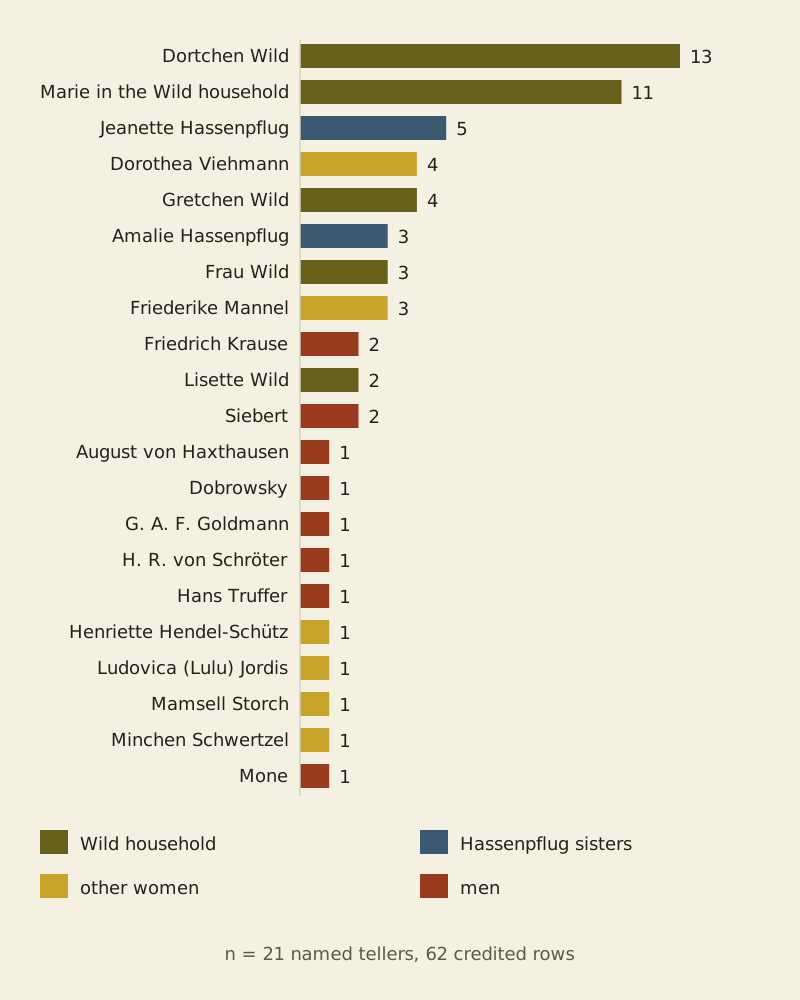
Credited rows per named teller in Bolte and Polívka’s notes on tales 1–60, shaded by household or group; n = 21 tellers, 62 rows.
Credit line for reuse
"Credited rows per named Grimm teller, Bolte and Polívka vol. 1" by Once Upon a Version — https://onceuponaversion.com/tellings/grimm-informants/ — licensed under CC BY 4.0 (https://creativecommons.org/licenses/by/4.0/)
Data: Bolte and Polívka, Anmerkungen, vol. 1 (1913), German Wikisource transcription, retrieved 2026-11-03
The 21 tellers, two families, one brother and one writer, with life dates, as CSV (where the data comes from) Data: Bolte and Polívka, vol. 1 (1913), German Wikisource; GND via lobid-gnd, retrieved 2026-11-03
| Teller | Name as Bolte and Polívka print it | Group | Rows | Born–died (GND) |
|---|---|---|---|---|
| Dortchen Wild | Dortchen Wild | Wild household | 13 | 1793–1867 |
| Marie in the Wild household | der alten Marie im Wildschen Hause; der Marie im Wildschen Hause; Marie | Wild household | 11 | unrecorded |
| Jeanette Hassenpflug | Jeanette Hassenpflug | Hassenpflug sisters | 5 | 1791–1860 |
| Dorothea Viehmann | Frau Viehmännin; Frau Viehmannin | other women | 4 | 1755–1815 |
| Gretchen Wild | Gretchen Wild | Wild household | 4 | 1787–1819 |
| Amalie Hassenpflug | Amelie Hassenpflug; Male (Amalie Hassenpflug); Male schnipp dich | Hassenpflug sisters | 3 | 1800–1871 |
| Frau Wild | Frau Wild | Wild household | 3 | unrecorded |
| Friederike Mannel | Friederike Mannel; Friedrike Mannel | other women | 3 | unrecorded |
| Friedrich Krause | Fr. Krause; pens. Dragonerwachtmeister Friedr. Krause aus Hof | men | 2 | 1747–1828 |
| Lisette Wild | Lisette, [Wild]; Lisette Wild | Wild household | 2 | 1782–1858 |
| Siebert | vom Siebert; Siebert in Kassel | men | 2 | unrecorded |
| August von Haxthausen | August v. Haxthausen | men | 1 | 1792–1866 |
| Dobrowsky | Dobrowsky | men | 1 | unrecorded |
| G. A. F. Goldmann | (Goldmann); dem hannoverschen Pfarrer G. A. F. Goldmann | men | 1 | 1785–1855 |
| H. R. von Schröter | H. R. v. Schröter | men | 1 | unrecorded |
| Hans Truffer | Hans Truffer aus Visp | men | 1 | unrecorded |
| Henriette Hendel-Schütz | Frau Henriette Hendel-Schütz | other women | 1 | 1772–1849 |
| Ludovica (Lulu) Jordis | Frau Lulu (Ludovica) Jordis | other women | 1 | 1787–1854 |
| Mamsell Storch | einer alten Mamsell Storch bei Henschel | other women | 1 | unrecorded |
| Minchen Schwertzel | Min [d. i. wohl Minchen Schwertzel] | other women | 1 | 1790–1849 |
| Mone | Mone | men | 1 | unrecorded |
Life dates come from the Gemeinsame Normdatei (GND), the authority file that German-speaking libraries use to identify people, and only where a record clearly matches the name through a variant spelling, a note or a family relation. Where no record does, as for Friederike Mannel and Frau Wild, the table says unrecorded rather than guessing. Of the 62 credited rows, 34 name Kassel or “Cassel” in the wording itself, and 3 name Zwehrn or Zwehren.
According to Jack Zipes, most of the brothers’ early informants were young women from educated middle-class families in and around Kassel. The register can test only part of that, since 13 of the 21 named tellers are women and the two biggest households are in Kassel, but it records neither ages nor class.
Who were the Hassenpflug sisters?
Two Hassenpflug sisters are named as tellers. Jeanette Hassenpflug, filed in the GND as Johanna (1791–1860), has five rows: “Herr Korbes,” heard in Kassel in 1810; “Von dem bösen Flachsspinnen,” printed in 1812 from her account of that year (p. 109); and three tales from the autumn of 1812, among them the first part of “Tischchen deck dich” (p. 346).
Amalie Hassenpflug (1800–1871 in the GND) appears under three name forms. Bolte and Polívka write “Amelie Hassenpflug” for a third version of “Die drei Männlein im Walde” and “Male (Amalie Hassenpflug)” for “Der Herr Gevatter.” For the 1812 text of no. 29 the copy has a nickname, “Male schnipp dich”, which they read as “vermutlich Amalie Hassenpflug”, probably Amalie (pp. 100, 375 and 277).
Seven more rows name only “Hassenpflugs”, the family, among them “Die weiße Schlange” and the first part of “König Drosselbart.” Those rows are kept in the register and left out of the count, because no single person is named.
Who were the other eight?
Friedrich Krause appears twice: as “Fr. Krause” for “Der alte Sultan,” no. 48, and as a pensioned dragoon sergeant from Hof for a tale told in 1811 and later replaced (pp. 424 and 464). His GND record gives 1747 to 1828 and calls him a dragoon sergeant who collected tales for the Grimms.
August von Haxthausen gave “Das Lumpengesindel,” no. 10, dated 19 May 1812, from the Paderborn area (p. 75). Hans Truffer of Visp, in the Upper Valais, is named for “Die drei Sprachen,” no. 33 (p. 322). Siebert, with no first name, is credited with the skittles game in no. 4 and, with the Hassenpflugs, with no. 53.
The next two are less certain: two sentences added by hand to “Frau Holle” are marked “(Goldmann),” and Bolte and Polívka think the second version “vermutlich”, probably, came from the Hanover pastor whom the GND lists as Georg August Friedrich Goldmann (p. 207). Schröter, named only by his initials, sent the brothers a third version of no. 11 before 1822 (p. 84).
Two more are known by surname alone, with no first name or title, and are counted with the men because the printed form does not mark them as women. Mone sent the brothers a telling of “Van den Machandelboom,” no. 47, from the Palatinate before 1822 (p. 413), and Dobrowsky reported to the brothers a tale from the region around Kraków, which Bolte and Polívka list under no. 57, “Der goldene Vogel” (p. 508).
Who were the other women?
Six women outside the two Kassel households are named. Dorothea Viehmann of Zwehren, a village near Kassel, appears four times, always for tellings of 1813 or for texts that entered later editions. Friederike Mannel is credited three times, once with a tale from the Schwalm district.
Viehmann’s four rows show how late she enters this part of the record. On 27 August 1813 she gave the brothers a telling of “Das Mädchen ohne Hände,” used to rework Marie’s text for 1819, and on 23 October 1813 “Die lange Nase,” printed in 1815 (pp. 295 and 470). Her other two rows are the 1819 replacements for nos. 34 and 59.
Ludovica Jordis, Clemens Brentano’s sister in Bolte and Polívka’s wording, gave the second piece of “Die Frau Füchsin,” no. 38, in autumn 1812 (p. 362). “Min” is read by the two scholars as “wohl”, probably, Minchen Schwertzel, for “Der Gevatter Tod,” no. 44, dated 20 October 1811 (p. 377).
Henriette Hendel-Schütz gave a report, probably received before 1815, of how no. 5 was told in Pomerania (p. 37). And Mamsell Storch is the one woman in the register whom Bolte and Polívka call old apart from Marie: Jeanette Hassenpflug had heard no. 36 from “einer alten Mamsell Storch bei Henschel” (p. 346).
That is as much as the register says about age. None of the credited rows calls a teller young, and only two call one old, so a claim about the tellers’ ages has to come from other records, such as the birth years in the GND. Those birth years run from 1747 for Friedrich Krause to 1800 for Amalie Hassenpflug.
What did the Wild household tell?
Illustration of an evening of telling by a stove in a Kassel household, the kind of setting the brothers’ notes record for some of these tales; not a picture of any named teller.
Illustration: Once Upon a Version. Generated illustration — not a historical image, manuscript or record. © Once Upon a Version, all rights reserved; reuse by request.
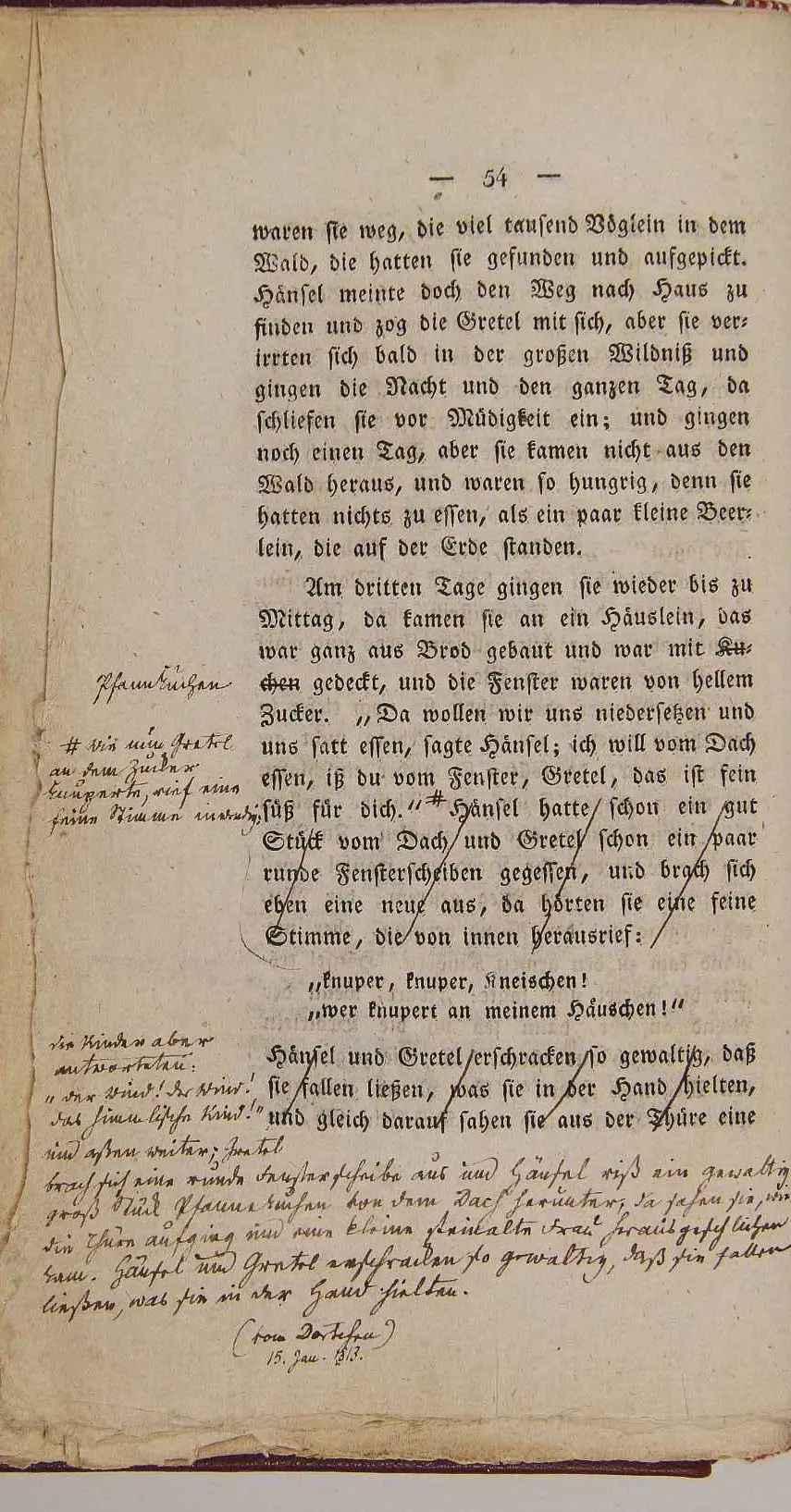
Page 54 of the brothers’ annotated copy, “Hänsel und Gretel,” with the added lines written into the margin and the foot of the page. Jacob and Wilhelm Grimm, Kinder- und Haus-Märchen, vol. 1, 1812.
Full credit
"Kinder- und Haus-Märchen, vol. 1 (1812), p. 54, the brothers’ annotated copy" by Jacob and Wilhelm Grimm — https://commons.wikimedia.org/wiki/File:Kinder_und_Hausm%C3%A4rchen_(Grimm)_1812_I_054.jpg — Public domain in US (published 1812); DE/FR (Jacob Grimm d. 1863, Wilhelm Grimm d. 1859, life+70); the handwritten additions are theirs; modified: cropped to the page; binding and neighbouring leaves of the bound copy removed
The Wild household is credited with 33 of the 62 rows, more than every other group together. Five people are named there: Dortchen, Gretchen, Lisette, a “Frau Wild,” and a Marie whom the notes place in the house.
Dortchen Wild alone has 13 rows, more than any other teller. The GND files her under her married name, Dorothea Grimm, with 1793 and 1867 as her years, Wilhelm Grimm as her husband and Herman Grimm among her children, so the copies that reached Bolte came from the son of the register’s most-credited teller. Her dated tellings run from 10 March 1811, “Rumpelstilzchen,” to 15 January 1813, and they place her in a garden and a garden house: “im Garten” for “Frau Holle,” “im Gartenhaus” for “Die sechs Schwäne.”
On 19 January 1812 the brothers’ copy records three tales from her: “Der singende Knochen” by the stove in the garden house, and “Die sechs Schwäne” and “Der liebste Roland” in the garden house (pp. 260, 427 and 498). In 1813 she supplied the children’s answer to the witch in “Hänsel und Gretel,” written into page 54 of the brothers’ copy.
The page is reproduced above. Beside the printed witch’s rhyme, a hand has written in the children’s reply and a longer passage that continues across the foot of the page; the last line is a bracketed note with the date 15 January 1813. Bolte and Polívka give the same date and credit the addition to Dortchen Wild in Kassel (p. 115).
Gretchen Wild has the earliest date in the register, 1807 for “Marienkind,” and three more tales dated 1808. Her GND record names her Margarete Marianne von Schmerfeld, née Wild, 1787 to 1819.
Frau Wild is credited with three tales, one of them dated 1808, and Lisette Wild with a variant of the verses in “Herr Korbes” and with tellings used for the 1819 “Rumpelstilzchen.” Frau Wild’s third row is a shorter Hessian telling of the fisherman and his wife, known as the tale of “Männchen Dominē” and his wife (p. 142); the printed text of no. 19 remained Runge’s Low German one.
Who was “old Marie”?
Eleven rows credit a Marie in the Wild household. Bolte and Polívka write “von der Marie im Wildschen Hause” in most of them; only once, in the entry for no. 1, do they call her “der alten Marie”, old Marie (p. 1). In one more row, no. 25, they infer her from the region alone, “also wohl”, so probably (p. 227).
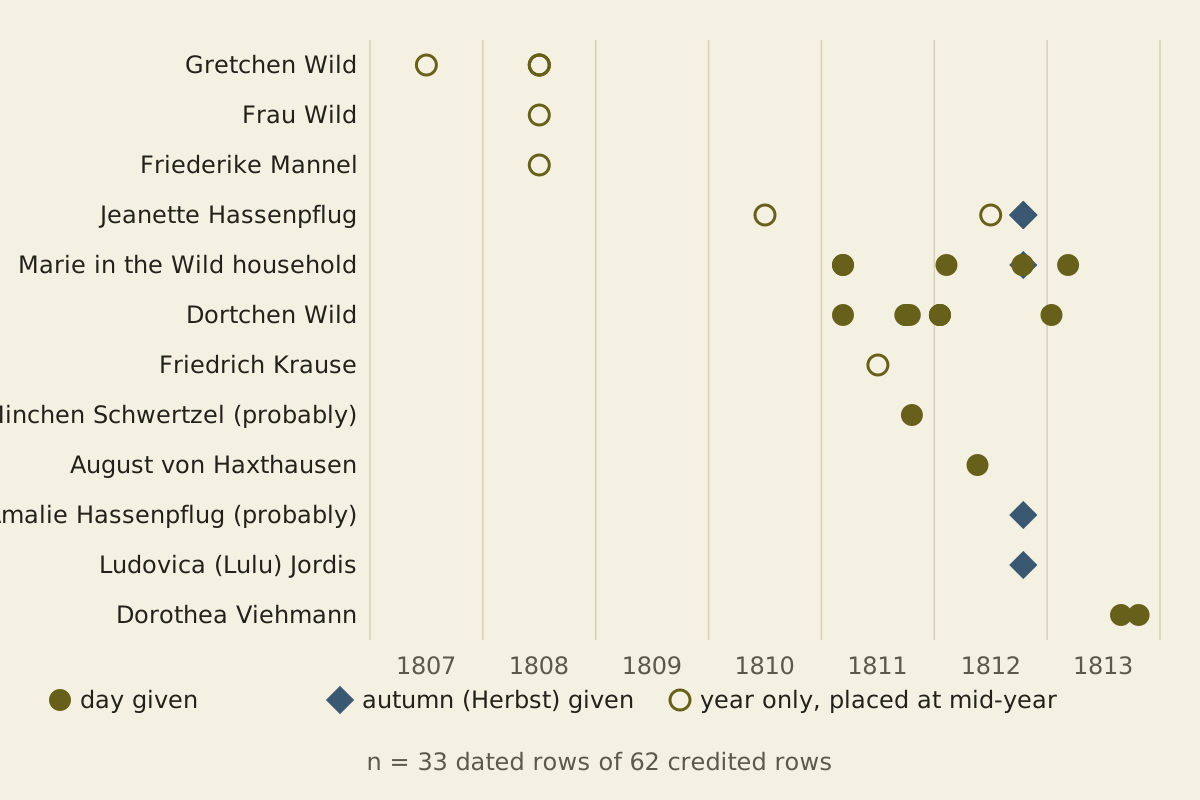
Dated tellings per teller, from the dates Bolte and Polívka print; filled marks give a day, diamonds an autumn, open circles a year only; n = 33 dated rows of 62.
Credit line for reuse
"Dated Grimm tellings, 1807–1813, from Bolte and Polívka vol. 1" by Once Upon a Version — https://onceuponaversion.com/tellings/grimm-informants/ — licensed under CC BY 4.0 (https://creativecommons.org/licenses/by/4.0/)
Data: Bolte and Polívka, Anmerkungen, vol. 1 (1913), German Wikisource transcription, retrieved 2026-11-03
The 66 entries, with each entry’s opening words and page, as CSV (where the data comes from) Data: Bolte and Polívka, Anmerkungen, vol. 1 (1913), German Wikisource transcription, retrieved 2026-11-03
| Teller | Dated tellings (Bolte and Polívka entry) |
|---|---|
| Gretchen Wild | 1807 (entry 3); 1808 (entry 2); 1808 (entry 57); 1808 (entry 58) |
| Frau Wild | 1808 (entry 30) |
| Friederike Mannel | 1808 (entry 60) |
| Jeanette Hassenpflug | 1810 (entry 41); 1812 (entry 14); autumn 1812 (entry 26); autumn 1812 (entry 33a); autumn 1812 (entry 36) |
| Marie in the Wild household | 10 Mar. 1811 (entry 11); 10 Mar. 1811 (entry 31); 10 Feb. 1812 (entry 29); 13 Oct. 1812 (entry 53); 13 Oct. 1812 (entry 54a); autumn 1812 (entry 26); 8 Mar. 1813 (entry 1) |
| Dortchen Wild | 10 Mar. 1811 (entry 55); 29 Sept. 1811 (entry 34); 1 Oct. 1811 (entry 36); 13 Oct. 1811 (entry 24); 19 Jan. 1812 (entry 28); 19 Jan. 1812 (entry 49); 19 Jan. 1812 (entry 56); 15 Jan. 1813 (entry 15) |
| Friedrich Krause | 1811 (entry 54) |
| Minchen Schwertzel (probably) | 20 Oct. 1811 (entry 44) |
| August von Haxthausen | 19 May 1812 (entry 10) |
| Amalie Hassenpflug (probably) | autumn 1812 (entry 29) |
| Ludovica (Lulu) Jordis | autumn 1812 (entry 38) |
| Dorothea Viehmann | 27 Aug. 1813 (entry 31); 23 Oct. 1813 (entry 54) |
Marie’s seven dated tellings run from 10 March 1811 to 8 March 1813, the same years as Dortchen Wild’s. On 10 March 1811 the copy records tales from both of them. Her rows include “Dornröschen,” no. 50, which the Sleeping Beauty versions compared on this site set beside the earlier texts of Basile and Perrault.
The tales credited to Marie include “Brüderchen und Schwesterchen,” “Das Mädchen ohne Hände,” “Des Schneiders Daumerling Wanderschaft” and the 1812 “Vogel Phönix.” Three times the copy records her as a further voice beside other tellers: a second version of no. 26, after Jeanette Hassenpflug’s, a fifth telling of no. 53, and another telling of the dropped no. 54a, after the Hassenpflugs’, the last two both dated 13 October 1812 (pp. 234, 450–451 and 487).
In four of the Marie entries, nos. 11, 25, 29 and 40, the same sentence also gives a region: “aus den Maingegenden,” from the Main districts, the label that the 1822 notes gave to two Hassenpflug tales. The register records that overlap in the CSV and draws no conclusion from it.
Later research does not agree on who this Marie was. Heinz Rölleke questions the old-Marie reading in an article whose subtitle announces the end of a myth about the brothers’ earliest written-down tales. This page knows that article only from its catalogue record, so it does not say whom he takes her to be; every Marie row in the CSV is marked disputed and cites his article in the same row.
The count follows the names as Bolte and Polívka print them. No other teller in the register is called Marie, so she counts once, as one of the 21 named tellers and one of the 13 women, and the household totals above place her where the notes do, in the Wild house.
Which tellers’ texts were replaced, 1812 to 1857?
The brothers revised the large collection through seven editions, from 1812 and 1815 to 1857, a span of 45 years. In the first 60 numbers, 19 had their earlier text replaced by another tale under the same number, 18 of them in 1819 and one in 1837.
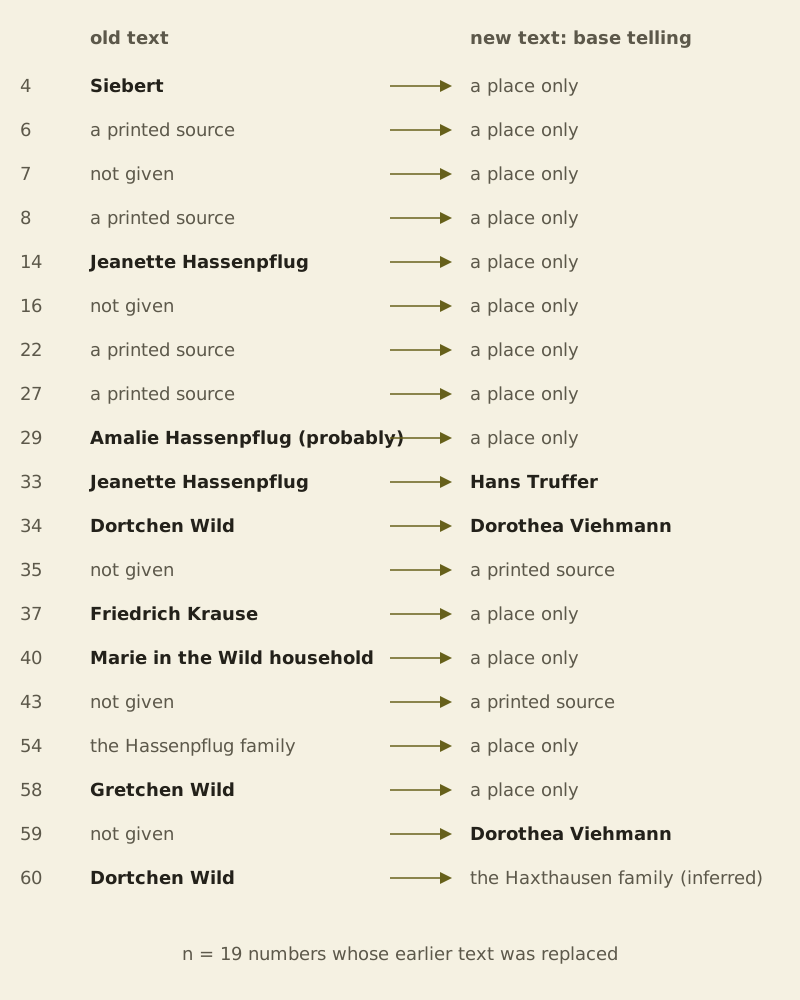
For each replaced number, who Bolte and Polívka name for the earlier text and for the base telling of the text that took its place; n = 19 numbers.
Credit line for reuse
"Replaced Grimm texts in nos. 1–60: who is named for the old text and for the new text’s base telling" by Once Upon a Version — https://onceuponaversion.com/tellings/grimm-informants/ — licensed under CC BY 4.0 (https://creativecommons.org/licenses/by/4.0/)
Data: Bolte and Polívka, Anmerkungen, vol. 1 (1913), German Wikisource transcription, retrieved 2026-11-03
The 66 entries with replaced texts and their sources, as CSV (where the data comes from) Data: Bolte and Polívka, Anmerkungen, vol. 1 (1913), German Wikisource transcription, retrieved 2026-11-03
| No. | Earlier text | Named for the earlier text | Replaced in | Named for the new text’s base telling |
|---|---|---|---|---|
| 4 | Gut Kegel- und Kartenspiel | Siebert | 1819 | a place only |
| 6 | Von der Nachtigall und der Blindschleiche | a printed source | 1819 | a place only |
| 7 | Von dem gestohlenen Heller | not given | 1819 | a place only |
| 8 | Die Hand mit dem Messer | a printed source | 1819 | a place only |
| 14 | Von dem bösen Flachsspinnen | Jeanette Hassenpflug | 1819 | a place only |
| 16 | Herr Fix und Fertig | not given | 1819 | a place only |
| 22 | Wie die Kinder Schlachtens miteinander gespielt haben | a printed source | 1819 | a place only |
| 27 | Der Tod und der Gänshirt | a printed source | 1819 | a place only |
| 29 | Der Teufel mit den drei goldenen Haaren (1812 text) | Amalie Hassenpflug (probably) | 1819 | a place only |
| 33 | Der gestiefelte Kater | Jeanette Hassenpflug | 1819 | Hans Truffer |
| 34 | Hansens Trine | Dortchen Wild | 1819 | Dorothea Viehmann |
| 35 | Der Sperling und seine vier Kinder | not given | 1819 | a printed source |
| 37 | Von der Serviette, dem Tornister, dem Kanonenhütlein und dem Horn | Friedrich Krause | 1819 | a place only |
| 40 | Der Räuberbräutigam (1812 text) | Marie in the Wild household | 1819 | a place only |
| 43 | Die wunderliche Gasterei | not given | 1837 | a printed source |
| 54 | Hans Dumm | the Hassenpflug family | 1819 | a place only |
| 58 | Vom treuen Gevatter Sperling | Gretchen Wild | 1819 | a place only |
| 59 | Prinz Schwan | not given | 1819 | Dorothea Viehmann |
| 60 | Das Goldei | Dortchen Wild | 1819 | the Haxthausen family (inferred) |
Nine of the 19 earlier texts have a named teller in Bolte and Polívka’s entries. Only three of the replacements have one for their base telling: two from Dorothea Viehmann and one from Hans Truffer. For 13 of the new texts the entry gives only a place for the base telling, four of them Zwehrn.
A replacement did not always mean that the earlier telling disappeared. The 1819 text of no. 4 took its game of skittles with dead men’s bones from Siebert’s telling (p. 22). For no. 14 Bolte and Polívka note that the 1819 text kept from Jeanette Hassenpflug’s version the detail that there are three spinning women, each disfigured in her own way by spinning (p. 109), and the 1819 text of no. 58 was assembled from three tellings, one of them Gretchen Wild’s text of 1812.
In those cases the teller’s contribution survived inside a text whose base telling the entry gives by place.
Number 60 shows the pattern at its widest. In 1812 it held “Das Goldei,” a fragment from Dortchen Wild, and the 1812 no. 74 was a tale from Friederike Mannel dated 1808; in 1819 both gave way to “Die zwei Brüder,” which the entry labels “aus dem Paderbörnischen” and assigns, by inference, to the Haxthausen family (p. 528).
The most direct exchange is no. 34. Dortchen Wild had told “Hansens Trine” to the brothers “zu Cassel im Garten” on 29 September 1811; in 1819 the number went to “Die kluge Else,” which the entry gives as “aus Zwehrn (von der Frau Viehmännin)” (p. 335).
Printed sources supplied the texts of seven entries, from a jest book of 1555 to a poem of 1823, and Runge’s written dialect texts two more, nos. 19 and 47. Bolte and Polívka name each of them, and the register lists them without counting them as tellers.
The names did not travel far into other languages either. In English, Andrew Lang’s Blue Fairy Book prints four tales from this register, nos. 4, 6, 15 and 55, and footnotes each of them with a single word: “Grimm.” For three of those numbers the brothers’ copies had recorded Siebert, Dortchen Wild, Lisette Wild and the Hassenpflugs, and for no. 6 only the village of Zwehrn; in Lang’s book the collectors’ surname stands in for all of them.
What does this register leave out?
The register covers Bolte and Polívka’s first volume only: tales 1 to 60 of the final numbering and six dropped texts. Their later volumes cover the rest of the collection, and only one page of them is read here, the entry for no. 89. The counts of 21 and 13 therefore describe nos. 1–60, not the whole of Grimm Fairy Tales.
It also records only what the brothers wrote into their copies and what Bolte and Polívka chose to print. A name is not proof that a tale came from that person alone, and a missing name is not proof that no one was there. Several entries say a text was combined from two or three tellings, and those rows name only some of the tellers.
Every German quotation in the register is taken from the Wikisource transcription and checked against it word for word, with the printed page number carried over from the transcription’s page markers. A reader who doubts a row can open the entry from the link in the CSV and compare the transcription with the page scan beside it.
It also says nothing about how much the brothers changed what they heard. That question can only be answered tale by tale, with the editions side by side. The register is a list of sources for doing so, not an answer.
On 15 January 1813, Dortchen Wild gave the brothers the line the children say when the witch asks who is nibbling at her house: “Der Wind, der Wind, das himmlische Kind”, the wind, the wind, the heavenly child. It went into page 54 of their copy, and Bolte and Polívka printed her name beside it a century later (p. 115).
Sources
Editions
- Brüder Grimm, Kinder- und Haus-Märchen, vol. 1, 1st ed. (Berlin: Realschulbuchhandlung, 1812): title page and preface (Vorrede, pp. V–IX). German Wikisource transcription; page scans of the brothers’ annotated copy (Grimm museum, Kassel) on Wikimedia Commons, pp. VI, VII, 8 and 54. https://de.wikisource.org/wiki/Kinder-_und_Haus-M%C3%A4rchen_Band_1_(1812) (title page and preface; page scans of pp. VI, VII, 8 and 54)
- Brüder Grimm, Kinder- und Haus-Märchen, vol. 2, 1st ed. (Berlin: Realschulbuchhandlung, 1815): title page, preface (Vorrede, pp. III–XII, dated Cassel, 30 September 1814) and contents. German Wikisource transcription. https://de.wikisource.org/wiki/Kinder-_und_Haus-M%C3%A4rchen_Band_2_(1815) (title page, full preface and contents)
- Brüder Grimm, Kinder- und Haus-Märchen, vol. 3, 3rd ed. (Göttingen: Dieterich, 1856): notes to the individual tales (Anmerkungen zu den einzelnen Märchen), with the note to no. 24, “Frau Holle,” on p. 40. German Wikisource transcription. https://de.wikisource.org/wiki/Kinder-_und_Haus-M%C3%A4rchen_Band_3_(1856)/Anmerkungen (all notes searched for the tellers’ names; the note to no. 24 read in full)
- German Wikisource, Kinder- und Hausmärchen: overview page listing the volumes of the editions of 1812/1815, 1819, 1837, 1840, 1843, 1850 and 1857, with the tale numbers in each. https://de.wikisource.org/wiki/Kinder-_und_Hausm%C3%A4rchen (list of editions and tale numbers)
- Andrew Lang, ed., The Blue Fairy Book (London and New York: Longmans, Green, 1889). Project Gutenberg eBook 503. https://www.gutenberg.org/ebooks/503 (contents and the source note printed after each tale, with the whole book searched for named sources; full text of “Aladdin and the Wonderful Lamp,” “Beauty and the Beast” and “The Sleeping Beauty in the Wood”; the title and opening of “The Story of Pretty Goldilocks”)
Research
- Johannes Bolte and Jiří Polívka, Anmerkungen zu den Kinder- und Hausmärchen der Brüder Grimm, vol. 1: nos. 1–60 (Leipzig: Dieterich, 1913): foreword (Vorwort, p. V, signed Berlin, November 1912) and the 66 entries. German Wikisource transcription (proofread twice against the page scans). https://de.wikisource.org/wiki/Anmerkungen_zu_den_Kinder-_und_Hausm%C3%A4rchen_der_Br%C3%BCder_Grimm_I (foreword and all 66 entries; every teller’s name and the opening of each entry quoted with its page; the passage on Southey’s Three Bears (p. 455, in the notes to no. 53) paraphrased, not quoted)
- Johannes Bolte and Jiří Polívka, Anmerkungen zu den Kinder- und Hausmärchen der Brüder Grimm, vol. 2: nos. 61–120 (Leipzig: Dieterich’sche Verlagsbuchhandlung Theodor Weicher, 1915), p. 273, entry for no. 89, “Die Gänsemagd.” Page scan on Wikimedia Commons. https://commons.wikimedia.org/wiki/File:Grimms_M%C3%A4rchen_Anmerkungen_(Bolte_Polivka)_II_273.jpg (one page, read from the page image; paraphrased, not quoted)
- Jack Zipes, introduction to Grimm Legacies: The Magic Spell of the Grimms’ Folk and Fairy Tales (Princeton: Princeton University Press, 2014). https://doi.org/10.23943/princeton/9780691160580.003.0001 (bibliographic reference)
- Heinz Rölleke, “Die ‘stockhessischen’ Märchen der ‘Alten Marie’: das Ende eines Mythos um die frühesten Märchenaufzeichnungen der Brüder Grimm” (journal article). Record in the hbz union catalogue. https://lobid.org/resources/991025975921906448 (bibliographic reference)
- Heinz Rölleke, ed., Die älteste Märchensammlung der Brüder Grimm: Synopse der handschriftlichen Urfassung von 1810 und der Erstdrucke von 1812 (Cologny-Genève: Fondation Bodmer, 1975), Bibliotheca Bodmeriana 1. https://lobid.org/resources/991000123519706483 (bibliographic reference)

Catalogues and databases
- Gemeinsame Normdatei (GND), authority records for eleven tellers in the register: 116842857 (Dortchen Wild, as Grimm, Dorothea), 1182942687 (Gretchen Wild, as Schmerfeld), 1259847004 (Lisette Wild), 1181208599 (Jeanette Hassenpflug), 101921373 (Amalie Hassenpflug), 121515796 (Johann Friedrich Krause), 118547305 (August von Haxthausen), 116754842 (G. A. F. Goldmann), 116700785 (Henriette Hendel-Schütz), 104139056 (Ludovica Jordis, as Des Bordes), 1058159801 (Wilhelmine von Schwertzell). Via lobid-gnd (hbz). https://lobid.org/gnd (authority records) Text licence: CC0 1.0, https://creativecommons.org/publicdomain/zero/1.0/
- Gemeinsame Normdatei (GND) 119383268, “Viehmann, Dorothea,” authority record, via lobid-gnd (hbz). https://lobid.org/gnd/119383268 (authority record) Text licence: CC0 1.0, https://creativecommons.org/publicdomain/zero/1.0/
Cite this page
Once Upon a Version. “Grimm Fairy Tales 1–60: Counted Here, 21 Named Tellers.” Once Upon a Version. Published 2026-11-05. https://onceuponaversion.com/tellings/grimm-informants/ (accessed day month year).
Write in the date you read the page; the page has no DOI.
More from One Tale, Many Tellers
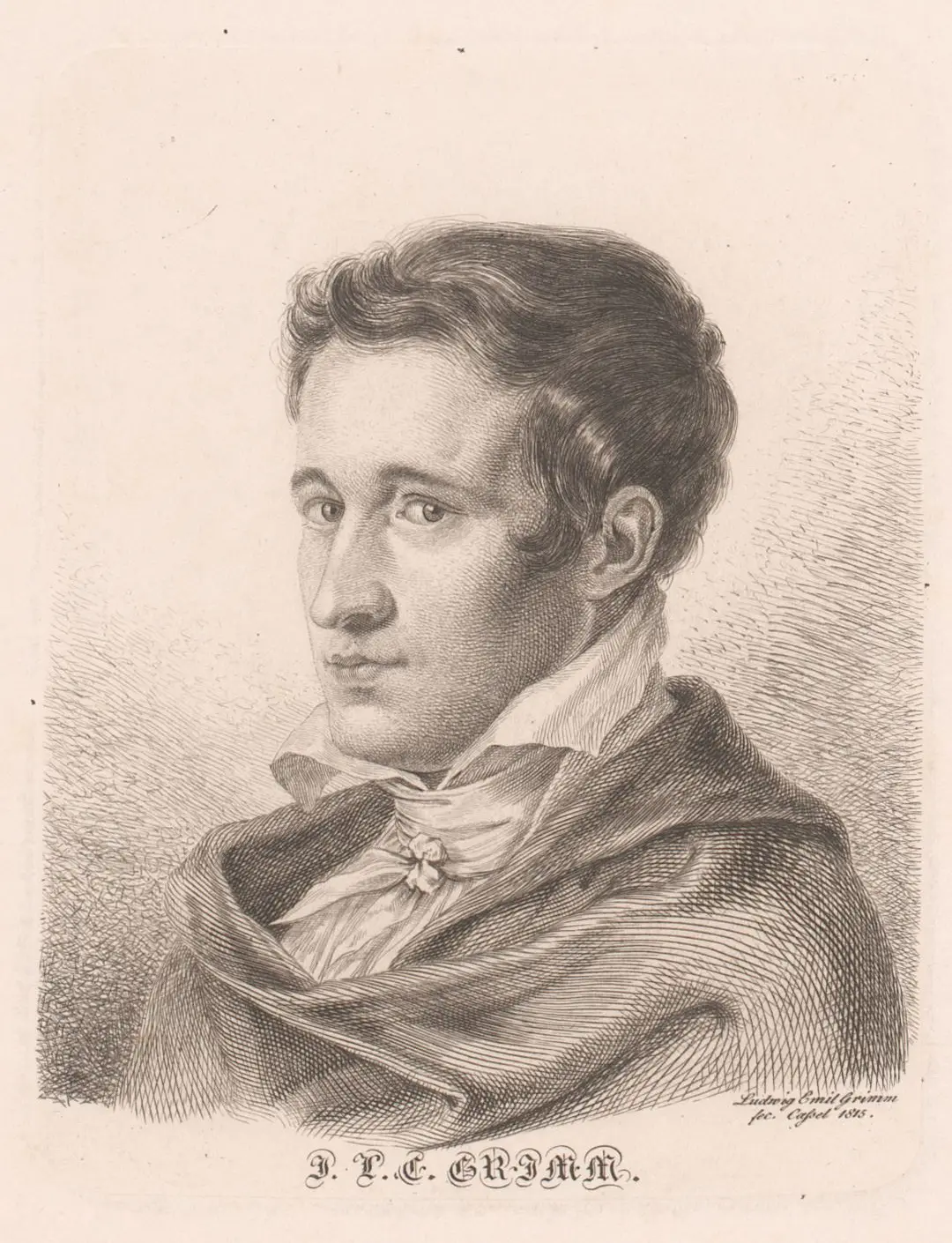
One Tale, Many Tellers
Brothers Grimm: Their ‘Peasant Woman’ Was a Tailor’s Wife
Type ATU 533, as classified by D. L. Ashliman
The Grimms’ 1815 preface calls Dorothea Viehmann a peasant woman. Her biography records an innkeeper’s daughter who married a tailor. Both prefaces, compared.
Picture credit
"Portret van Jacob Ludwig Karl Grimm" by Ludwig Emil Grimm — https://commons.wikimedia.org/wiki/File:Portret_van_Jacob_Ludwig_Karl_Grimm,_RP-P-1907-1042.jpg — CC0 1.0 (https://creativecommons.org/publicdomain/zero/1.0/); modified: cropped to the plate (sheet margins removed)
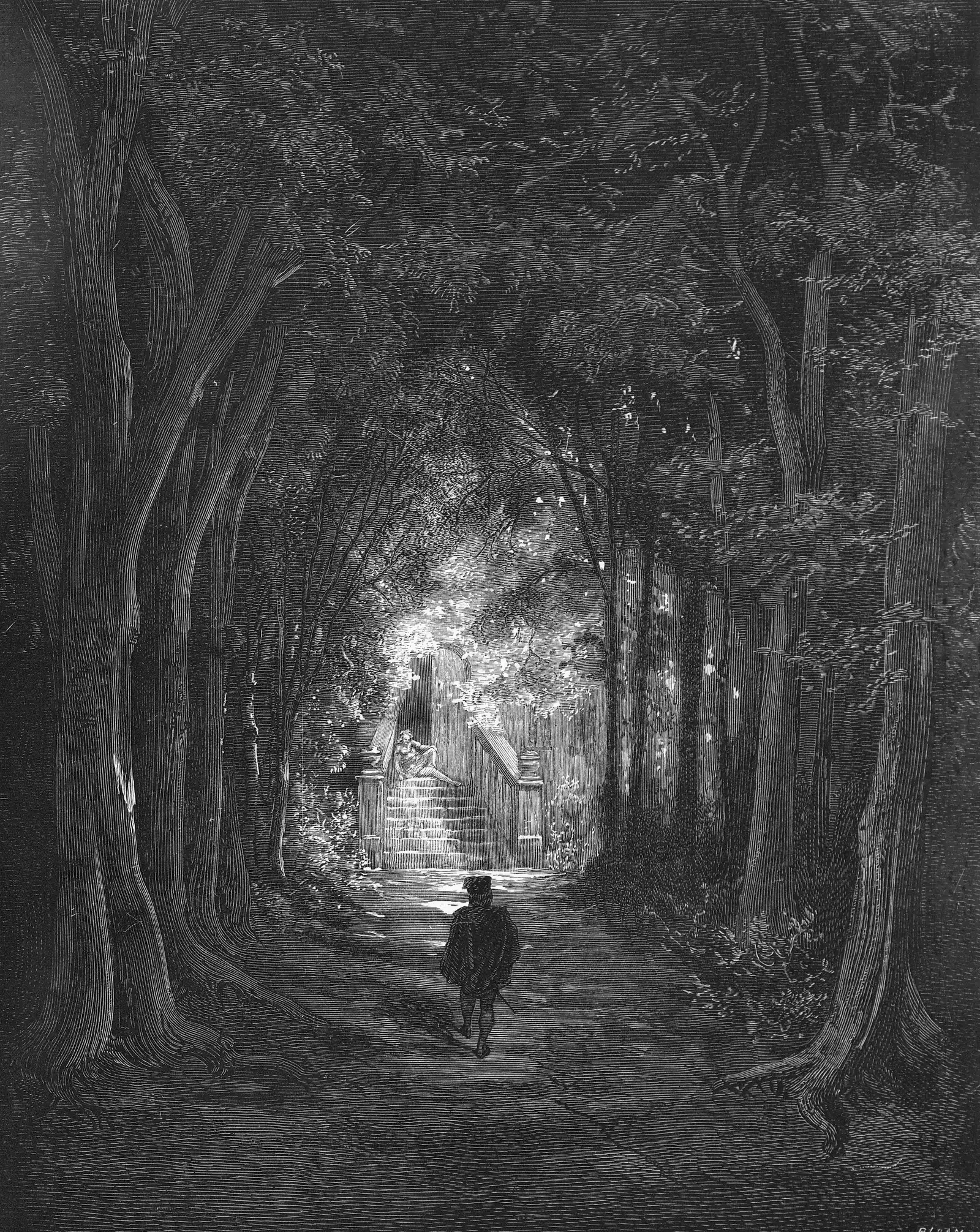
One Tale, Many Tellers
Sleeping Beauty: In Basile and Perrault, No Kiss Wakes Her
Type ATU 410, as classified by D. L. Ashliman
Sleeping Beauty in Basile (printed 1636): twins draw out a splinter. Perrault (1697): the spell ends. Of 4 texts compared here, only 2 Grimm texts use a kiss.
Picture credit
"La Belle au Bois Dormant" by Gustave Doré — https://commons.wikimedia.org/wiki/File:La_Belle_au_Bois_Dormant_(136548149).jpg — Public domain in US (published 1867); DE/FR (Gustave Doré d. 1883, life+70); the wood engraver’s signature at lower right is not legible, and an engraver working on an 1867 edition is presumed not to have lived past 1955 (log, image ruling 10)
One Tale, Many Tellers
Aladdin: A Syrian Teller Gave It to Galland in Paris, 1709
Type tale printed in Galland’s Thousand and One Nights (no ATU number cited)
In the sources checked here, Aladdin’s earliest known record is Galland’s diary for 5 May 1709: Hanna, a Maronite from Aleppo, had just told him the tale.
Picture credit
"The Blue Fairy Book (1889), p. 78: plate to “Aladdin and the Wonderful Lamp”" by H. J. Ford — https://commons.wikimedia.org/wiki/File:The_Blue_Fairy_Book-0112.jpg — Public domain in US (published London and New York 1889); DE/FR (Henry Justice Ford d. 1941, life+70, public domain from 1 January 2012); modified: Cropped to the plate and its ruled frame with a strip of paper around it; the page text above and below is left out