Andrew Lang’s Fairy Books: His First Preface Omits Mrs. Lang
Andrew Lang said in 1910 that his fairy books were almost wholly his wife’s work, yet his own preface to the Blue Fairy Book of 1889, which began the series, never names her.
By Once Upon a Version
Published
How a version is traced · Version history · Contact · Report an error (contact@onceuponaversion.com)
In short
- In The Lilac Fairy Book (1910), Andrew Lang wrote that the fairy books had been “almost wholly the work of Mrs. Lang,” who translated and adapted them, by his own account.
- Lang’s twelve prefaces, from 1889 to 1910, print 55 credits to named retellers, and Mrs. Lang is named in 11 of the 12, but not in The Blue Fairy Book of 1889.
- From The Violet Fairy Book of 1901 on, the prefaces give her the rest or most of each book: by the contents, 29 of 35 tales in the Violet, 27 of 32 in the Brown and 27 of 33 in the Lilac.
Telling card
- Tale
- Andrew Lang's coloured Fairy Books (12 volumes, 1889 to 1910)
- Type
- anthology series of retold tales (no ATU number)
- Teller
- unrecorded for most tales; the prefaces name printed sources and collectors, not tellers
- Recorded by
- unrecorded in the prefaces for most tales; a few name collectors (Major Campbell, Mr. Fairbridge)
5 more fields: edited by, told, published, this text, earliest known
- Edited by
- Andrew Lang (title pages); translated or adapted by Mrs. Lang (Leonora Blanche Lang) and others named in the prefaces
- Told
- unrecorded
- Published
- Longmans, Green, London and New York, 1889 to 1910
- This text
- The twelve prefaces: the Blue Fairy Book of 1889 from the Wikisource transcription of its scan, the other eleven from Project Gutenberg texts
- Earliest known
- The Blue Fairy Book, 1889, called the first of the series in the Green Fairy Book preface
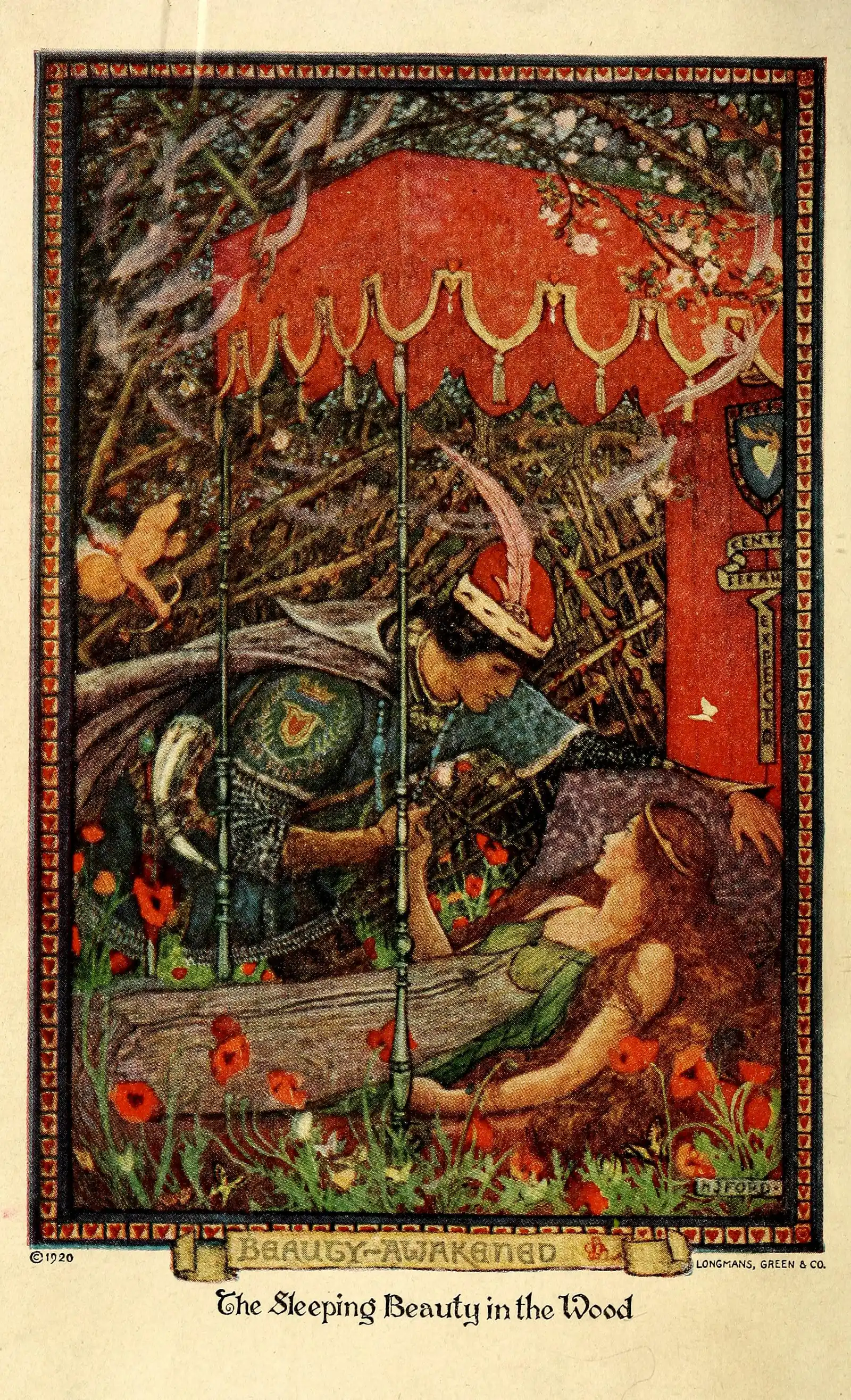
The prince finds the princess waking, a colour plate titled “Beauty Awakened.” H. J. Ford, The Blue Fairy Book (New York: Longmans, Green), 1920 edition.
Full credit
"Beauty Awakened (The Sleeping Beauty in the Wood), colour plate, The Blue Fairy Book, 1920 edition" by H. J. Ford — https://commons.wikimedia.org/wiki/File:Beauty_Awakened_(The_Sleeping_Beauty_in_the_Wood)_(HJ_Ford).jpg — Public domain in US (published New York 1920); DE/FR (Henry Justice Ford d. 1941, life+70, public domain from 1 January 2012)
In the preface to The Lilac Fairy Book, Andrew Lang wrote that he had never written the fairy books. The book came out in 1910 from Longmans, Green, with New York and London on its title page, as the twelfth of the coloured series that had begun with the Blue in 1889. In the same preface, after an opening about the questions put to him at dinner parties, Lang handed the credit for Andrew Lang’s Fairy Books to his wife.
The fairy books have been almost wholly the work of Mrs. Lang, who has translated and adapted them from the French, German, Portuguese, Italian, Spanish, Catalan, and other languages.
written by Andrew Lang · The Lilac Fairy Book (New York and London: Longmans, Green, 1910), Preface
What did Lang’s prefaces say about Mrs. Lang?
The Lilac preface goes on to describe Lang’s own part by way of Mark Twain’s Adam and Eve: “Eve worked, Adam superintended. I also superintend.” Then he spelled it out: “I find out where the stories are, and advise, and, in short, superintend,” adding in italics, “I do not write the stories out of my own head.”
He had said much the same in the Violet Fairy Book of 1901, where the Editor “is not the author of the stories in the Fairy Books,” and in the Crimson of 1903, where the found tales “are adapted to the needs of British children by various hands.”
A preface is not a work diary. It shows what its writer chose to say, so these sentences prove what Lang claimed rather than how the work was actually shared out. The twelve prefaces can still be set against each other, because Lang signed every one of them and each names, in its own words, the people he wished to thank for the translating.
1889 · The Blue Fairy Book, Preface, p. vii
The stories from Grimm are translated by Miss May Sellar; another from the German by Miss Sylvia Hunt; the Norse tales are a version by Mrs. Alfred Hunt
written by Andrew Lang · The Blue Fairy Book (London: Longmans, Green, 1889), Preface, p. vii
1910 · The Lilac Fairy Book, Preface
All the stories were translated or adapted by Mrs. Lang, except
written by Andrew Lang · The Lilac Fairy Book (New York and London: Longmans, Green, 1910), Preface
What changed: The 1889 preface names six retellers and gives Mrs. Lang no tale. The 1910 preface gives her every tale except six, which it lists by title.
The title page of 1889 names only the editor and the two artists: it reads “Edited by Andrew Lang,” with numerous illustrations “by H. J. Ford and G. P. Jacomb Hood,” and none of the six translators thanked in the preface appears there. The seven later title pages in the texts read here follow the same pattern, with Lang as editor and Ford as illustrator.
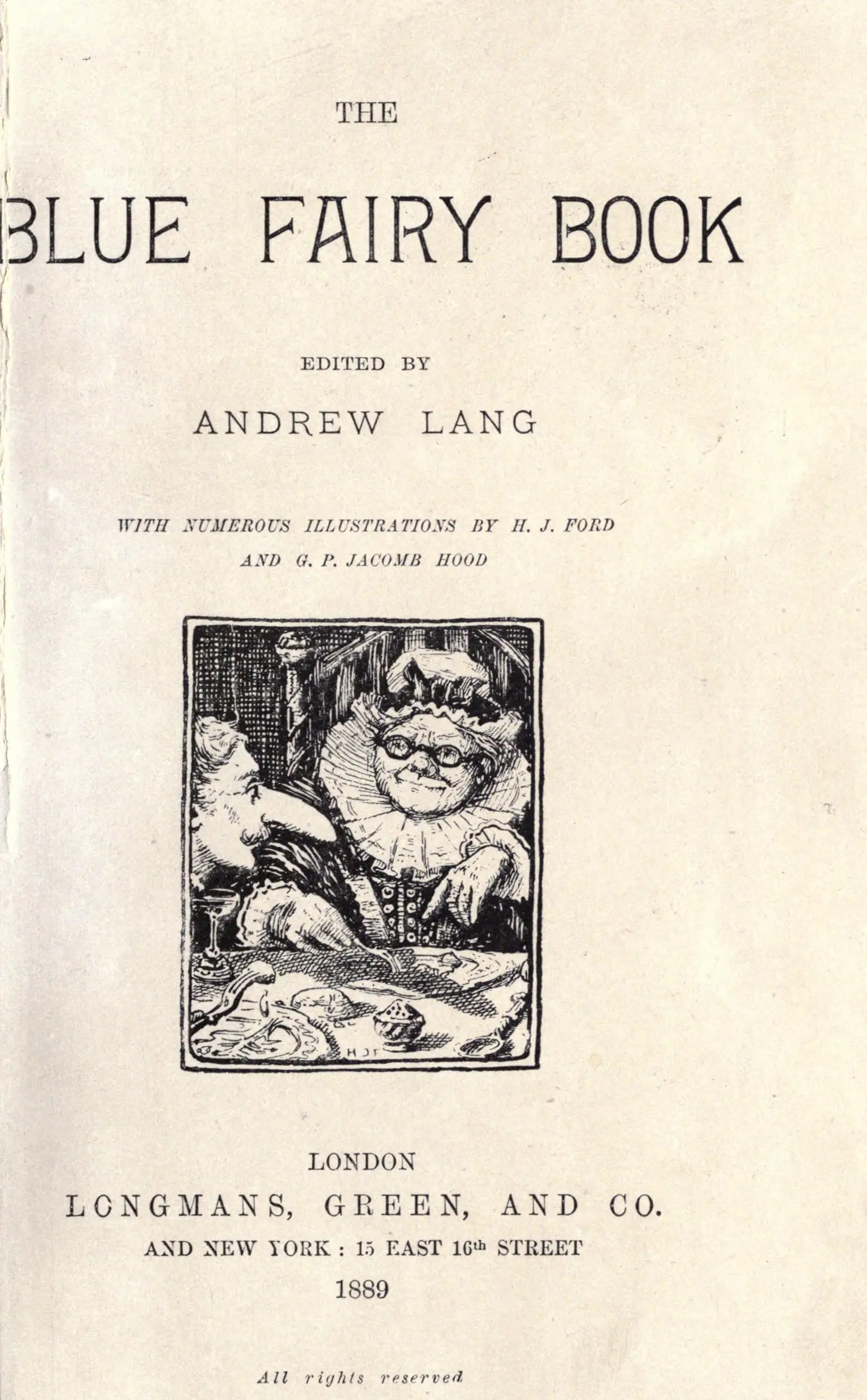
The title page of the book that opened the series. The Blue Fairy Book (London: Longmans, Green), 1889, title page.
Full credit
"The Blue Fairy Book (1889), title page with a vignette signed HJF (H. J. Ford)" by H. J. Ford — https://commons.wikimedia.org/wiki/File:The_Blue_Fairy_Book-0009.jpg — Public domain in US (published London and New York 1889); DE/FR (Andrew Lang d. 1912; title vignette by H. J. Ford, monogram HJF, d. 1941; life+70); modified: Cropped to the printed area with paper around it; the library number stamp and blind stamp below the imprint are left out
Who was Leonora Blanche Lang, and when did the books appear?
The prefaces never give Mrs. Lang a first name. The German national authority file, known as the GND, records her as Leonora Blanche Lang, 1851 to 1933, with the variant name Alleyne, Leonora Blanche, and one of its records adds that she translated and adapted stories for children together with her husband. The same authority file gives Andrew Lang the dates 1844 to 1912 and a birthplace in County Selkirk, in the Scottish Borders.
Mrs. Lang did appear as an author elsewhere. The advertisement pages of the 1910 Lilac list two titles in the same series as “By Mrs. Lang,” The Book of Princes and Princesses and The Red Book of Heroes. The prefaces also thank a Miss Alma Alleyne and a Miss Thyra Alleyne, and a “Miss Lang” appears in two of them, but the books do not say how any of these women were related to her, and this page does not guess.
Lang’s own name stood on other old tales too. In 1887 the title page of a London reprint of William Adlington’s Cupid and Psyche promised “a Discourse on the Fable By Andrew Lang.” That is the tale of Cupid and Psyche, which Lang introduced in that 1887 reprint.
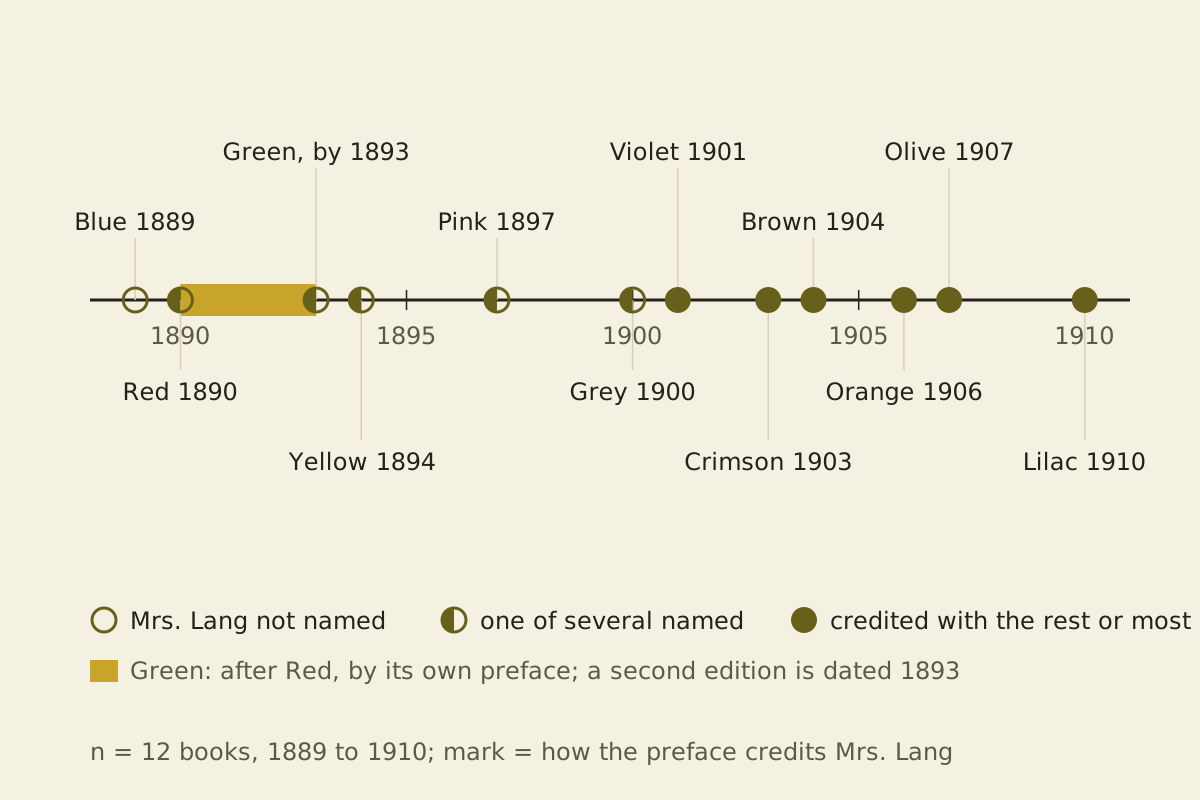
The twelve coloured Fairy Books by year, marked by how each preface credits Mrs. Lang. n = 12 books, 1889 to 1910.
Credit line for reuse
"Andrew Lang’s twelve Fairy Books and Mrs. Lang’s credit, 1889 to 1910" by Once Upon a Version — https://onceuponaversion.com/tellings/andrew-lang-fairy-books/ — licensed under CC BY 4.0 (https://creativecommons.org/licenses/by/4.0/)
Data: Prefaces and title pages of the twelve Fairy Books (Wikisource; Project Gutenberg); Internet Archive and hbz library records; retrieved 2026-11-04
The twelve books, with years, sources and Mrs. Lang’s credit, as CSV (where the data comes from) Data: Prefaces and title pages of the twelve Fairy Books (Wikisource; Project Gutenberg); Internet Archive and hbz library records; retrieved 2026-11-04
In words: Blue 1889, Red 1890, Green by 1893, Yellow 1894, Pink 1897, Grey 1900, Violet 1901, Crimson 1903, Brown 1904, Orange 1906, Olive 1907, Lilac 1910.
Seven of these years come from a title or copyright page in the texts read here, four from library records of early copies, and the Green from a later edition. The Green’s own preface puts it third, after the Blue and the Red, and the Yellow preface of 1894 counts “the Blue, the Red, the Green, and here is the Yellow.” No dated first edition of the Green was found, but a library record dates a second edition to 1893.
Whose names do the twelve prefaces print?
Each name below is one the preface gives as translating, adapting, condensing or otherwise doing tales for that particular book. Lang’s three mentions of himself as “the Editor” are left out of the count, and so are the collectors, authors and publishers whose versions a book used or who allowed it to use them, such as Robert Chambers, whose Popular Traditions of Scotland the Blue draws on, or Mr. Fairbridge, whose tales collected in Rhodesia are in the Orange.
Names are kept exactly as printed, so “Miss Wright” and “Miss Minnie Wright” stay apart, the Yellow’s “Miss Alma” is left without a surname, and “Mr. Craigie” is not merged with “Mr. W. A. Craigie.”
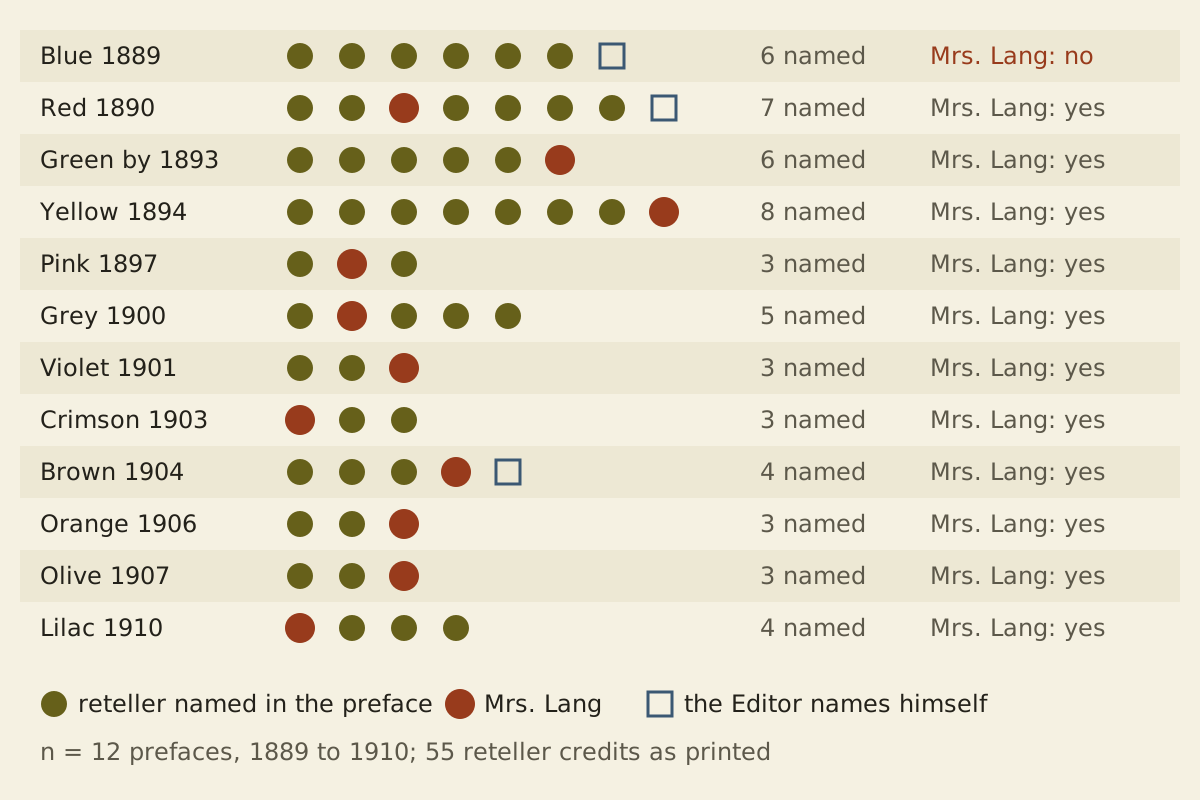
Retellers named in each preface, with Mrs. Lang marked. n = 12 prefaces, 1889 to 1910; 55 reteller credits as printed.
Credit line for reuse
"Retellers named in the twelve Fairy Book prefaces" by Once Upon a Version — https://onceuponaversion.com/tellings/andrew-lang-fairy-books/ — licensed under CC BY 4.0 (https://creativecommons.org/licenses/by/4.0/)
Data: Prefaces of the twelve Fairy Books, edited by Andrew Lang (Wikisource; Project Gutenberg), retrieved 2026-11-04
The retellers and other credits in the twelve prefaces, with the preface’s words, as CSV (where the data comes from) Data: Prefaces of the twelve Fairy Books, edited by Andrew Lang (Wikisource; Project Gutenberg), retrieved 2026-11-04
| Book | Year | Retellers named in the preface | Mrs. Lang named? |
|---|---|---|---|
| Blue Fairy Book | 1889 | Miss Minnie Wright, Miss May Sellar, Miss Sylvia Hunt, Mrs. Alfred Hunt, Miss Violet Hunt, Miss May Kendall | no |
| Red Fairy Book | 1890 | Mrs. Hunt, Miss Minnie Wright, Mrs. Lang, Miss Bruce, Miss May Sellar, Miss Farquharson, Miss Blackley | yes |
| Green Fairy Book | by 1893 | Miss Blackley, Miss Alma Alleyne, Miss Eleanor Sellar, Miss May Sellar, Miss Wright, Mrs. Lang | yes |
| Yellow Fairy Book | 1894 | Miss Cheape, Miss Alma, Miss Thyra Alleyne, Miss Sellar, Mr. Craigie, Miss Blackley, Mrs. Dent, Mrs. Lang | yes |
| Pink Fairy Book | 1897 | Mr. W. A. Craigie, Mrs. Lang, Miss Alma Alleyne | yes |
| Grey Fairy Book | 1900 | Mrs. Dent, Mrs. Lang, Miss Eleanor Sellar, Miss Blackley, Miss Lang | yes |
| Violet Fairy Book | 1901 | Miss Blackley, Mr. W. A. Craigie, Mrs. Lang | yes |
| Crimson Fairy Book | 1903 | Mrs. Lang, Miss Lang, Miss Blackley | yes |
| Brown Fairy Book | 1904 | Mrs. Beveridge, Miss Blackley, Major Campbell, Mrs. Lang | yes |
| Orange Fairy Book | 1906 | Major Campbell, Mrs. Pedersen, Mrs. Lang | yes |
| Olive Fairy Book | 1907 | Major Campbell, Mrs. Skovgaard-Pedersen, Mrs. Lang | yes |
| Lilac Fairy Book | 1910 | Mrs. Lang, Major Campbell, Miss Harding, Miss Christie | yes |
Of the 55 credits, 48 name a Miss or a Mrs., and only the Craigie credits (“Mr. Craigie” once, “Mr. W. A. Craigie” twice) and Major Campbell’s four break the pattern. Mrs. Lang is named in 11 prefaces and Miss Blackley in 7, more often than any other reteller. From the Red to the Grey, Mrs. Lang is one name in a list: the Green preface of the early 1890s thanks “the ladies,” six of them, who translated “many of the tales,” and she comes last of the six.
How much of the fairy books came from Mrs. Lang?
The wording changes with The Violet Fairy Book of 1901, whose preface names five tales by Miss Blackley and one by Mr. W. A. Craigie and then adds, “Mrs. Lang did the rest.” Every later preface gives her the rest, the bulk or most of the book, and names the exceptions in some form.
| Book | Year | How the preface words Mrs. Lang’s part | Tales in the contents | Credited to others by title |
|---|---|---|---|---|
| Violet Fairy Book | 1901 | “Mrs. Lang did the rest.” | 35 | 6 |
| Crimson Fairy Book | 1903 | “The stories have mainly been adapted or translated by Mrs. Lang” | 36 | not stated by title |
| Brown Fairy Book | 1904 | “all the rest are told by Mrs. Lang” | 32 | 5 |
| Orange Fairy Book | 1906 | “all the tales have been done, from various sources, by Mrs. Lang” | 33 | not stated by title |
| Olive Fairy Book | 1907 | “has translated and adapted to the conditions of young readers the bulk of the collection” | 29 | not stated by title |
| Lilac Fairy Book | 1910 | “All the stories were translated or adapted by Mrs. Lang, except” | 33 | 6 |
Three of these prefaces name every exception by title, so the remainder can be counted against the book’s own table of contents. The Violet leaves her 29 of its 35 tales, the Brown 27 of 32 and the Lilac 27 of 33. In the other three the exceptions are described as groups, such as the tales Major Campbell collected in India or the Rhodesian stories, so no count is given for them here.
The same prefaces say what that work involved. The Orange preface, read here in a reprint of 1937 or later, warns that the stories “are not literal, or word by word translations, but have been altered in many ways to make them suitable for children,” with cruel deeds “softened down as much as possible.”
The Brown preface of 1904 says Mrs. Lang does not give the tales exactly as they were told, “skipping the pieces” that its intended readers would not like. On Lang’s own description, the credit is for retelling, not for word-for-word translation.
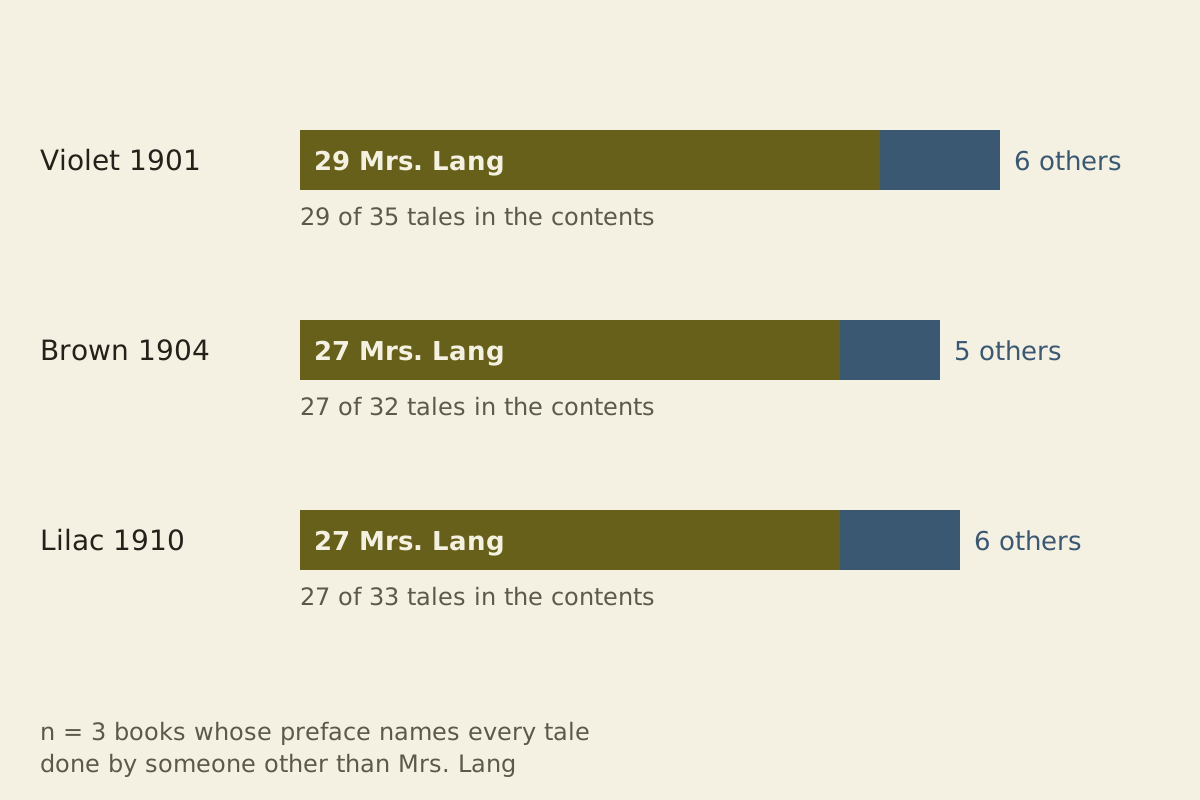
Tales left to Mrs. Lang once the preface’s named exceptions are taken out, against the contents. n = 3 books, 1901 to 1910.
Credit line for reuse
"Mrs. Lang’s share in the Violet, Brown and Lilac Fairy Books, by the prefaces" by Once Upon a Version — https://onceuponaversion.com/tellings/andrew-lang-fairy-books/ — licensed under CC BY 4.0 (https://creativecommons.org/licenses/by/4.0/)
Data: Prefaces and contents of the Violet, Brown and Lilac Fairy Books (Project Gutenberg), retrieved 2026-11-04
Counted this way, “almost wholly” fits the six books from 1901 to 1910 as Lang himself described them. It does not fit his own account of the first book, where she has no credit at all, or of the next five, where she is one translator in a list of three to eight.
Where did the Blue Fairy Book’s tales come from?
The 1889 preface credits whole groups of tales, while the Project Gutenberg text of the book prints a short source note after most of them, such as “Grimm” or “Madame d’Aulnoy.” Set side by side, the two show whom the preface names for each of the 37 tales.
For 20 it names who did the tale, either for the tale itself or for the group its note belongs to: a reteller for 19, and Lang himself, as “the Editor,” for “The Terrible Head.” For the other 17 neither leads to a name; five of those 17 carry no source note at all.
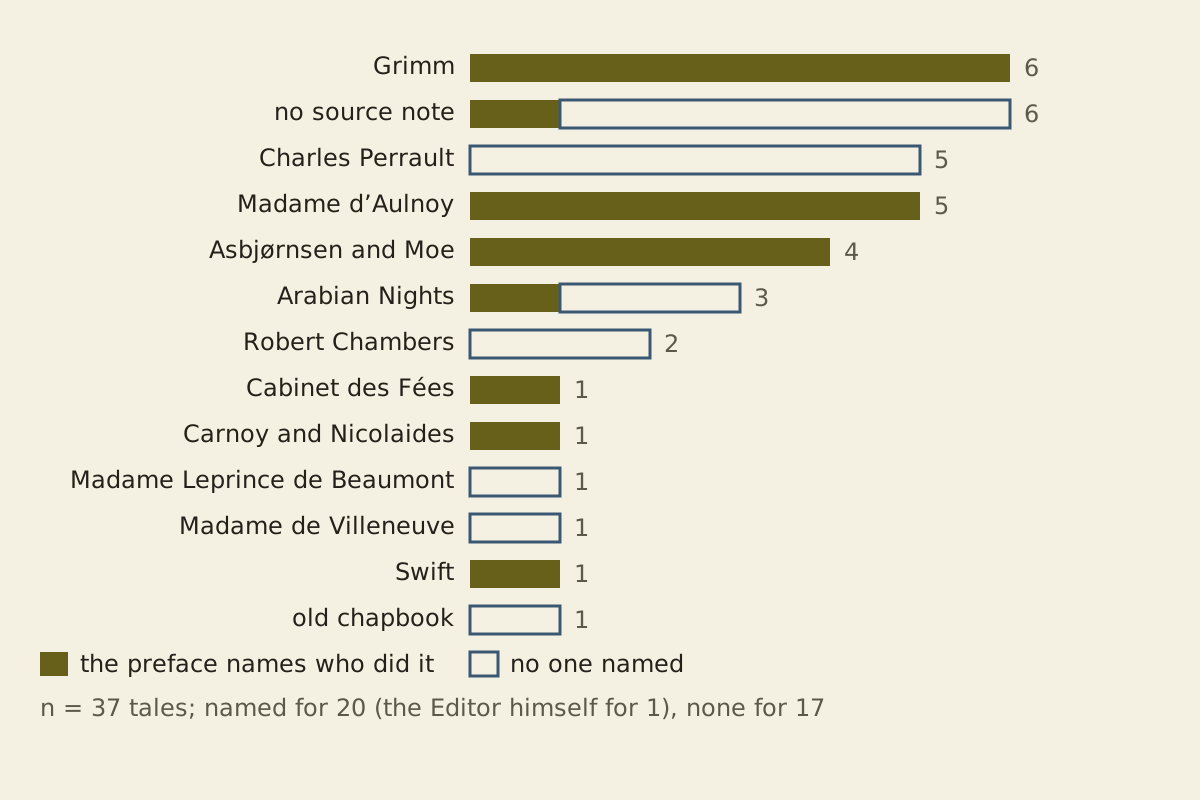
The Blue Fairy Book’s tales by the source note printed after each, and whether the preface names who did it. n = 37 tales.
Credit line for reuse
"Where the Blue Fairy Book’s 37 tales came from, by its own notes" by Once Upon a Version — https://onceuponaversion.com/tellings/andrew-lang-fairy-books/ — licensed under CC BY 4.0 (https://creativecommons.org/licenses/by/4.0/)
Data: The Blue Fairy Book, Project Gutenberg 503, and its 1889 preface (Wikisource), retrieved 2026-11-04
The 37 tales, with source notes and preface credits, as CSV (where the data comes from) Data: The Blue Fairy Book, Project Gutenberg 503, and its 1889 preface (Wikisource), retrieved 2026-11-04
| Source note in the Blue Fairy Book | Tales | Named in the preface as doing them (tales) |
|---|---|---|
| Grimm | 6 | Miss May Sellar (6 of 6) |
| no source note | 6 | the Editor (1 of 6) |
| Charles Perrault | 5 | none |
| Madame d’Aulnoy | 5 | Miss Minnie Wright (5 of 5) |
| Asbjørnsen and Moe | 4 | Mrs. Alfred Hunt (4 of 4) |
| Arabian Nights | 3 | Miss Violet Hunt (1 of 3) |
| Robert Chambers | 2 | none |
| Cabinet des Fées | 1 | Miss Minnie Wright (1 of 1) |
| Carnoy and Nicolaides | 1 | Miss Minnie Wright (1 of 1) |
| Madame Leprince de Beaumont | 1 | none |
| Madame de Villeneuve | 1 | none |
| Swift | 1 | Miss May Kendall (1 of 1) |
| old chapbook | 1 | none |
Group credits follow the preface’s wording: “The stories from Grimm are translated by Miss May Sellar,” though it also gives “another from the German” to Miss Sylvia Hunt without naming which. “The Goose-Girl” is one of the six noted “Grimm,” the tale behind the Grimms’ 1815 Goose Girl and its Zwehrn teller. “Aladdin” carries the note “Arabian Nights,” and the preface says that “Miss Violet Hunt condensed ‘Aladdin’,” the tale of the Aladdin that Hanna Diyab told Galland in 1709.
The five tales noted “Charles Perrault” have no named reteller, since the preface says only that “the tales of Perrault are printed from the old English version of the eighteenth century.” In this site’s studio terms, that eighteenth-century translator is an uncredited session player, heard on every Perrault tale in the book and named nowhere in it. “The Sleeping Beauty in the Wood,” the tale of the plate at the top of this page, carries no source note in this text at all; Sleeping Beauty, compared across Basile, Perrault and the Grimms traces its earlier tellings.
Does Lang’s credit hide a named teller?
This site uses the borrowed hearth for an editor who presents named tellers with known lives as the voice of a nameless folk tradition. Lang’s case is a different one: an editor’s name on the title page covers the retellers his own prefaces name, which is a question of credit, not a named teller turned into an anonymous folk voice.
The prefaces do speak of anonymous tellers, and the Green preface thanks the Brothers Grimm, “who took them down from the telling of old women.” But they never name a single teller and then fold her into that crowd, so the record of a named teller, which the label requires, is missing.
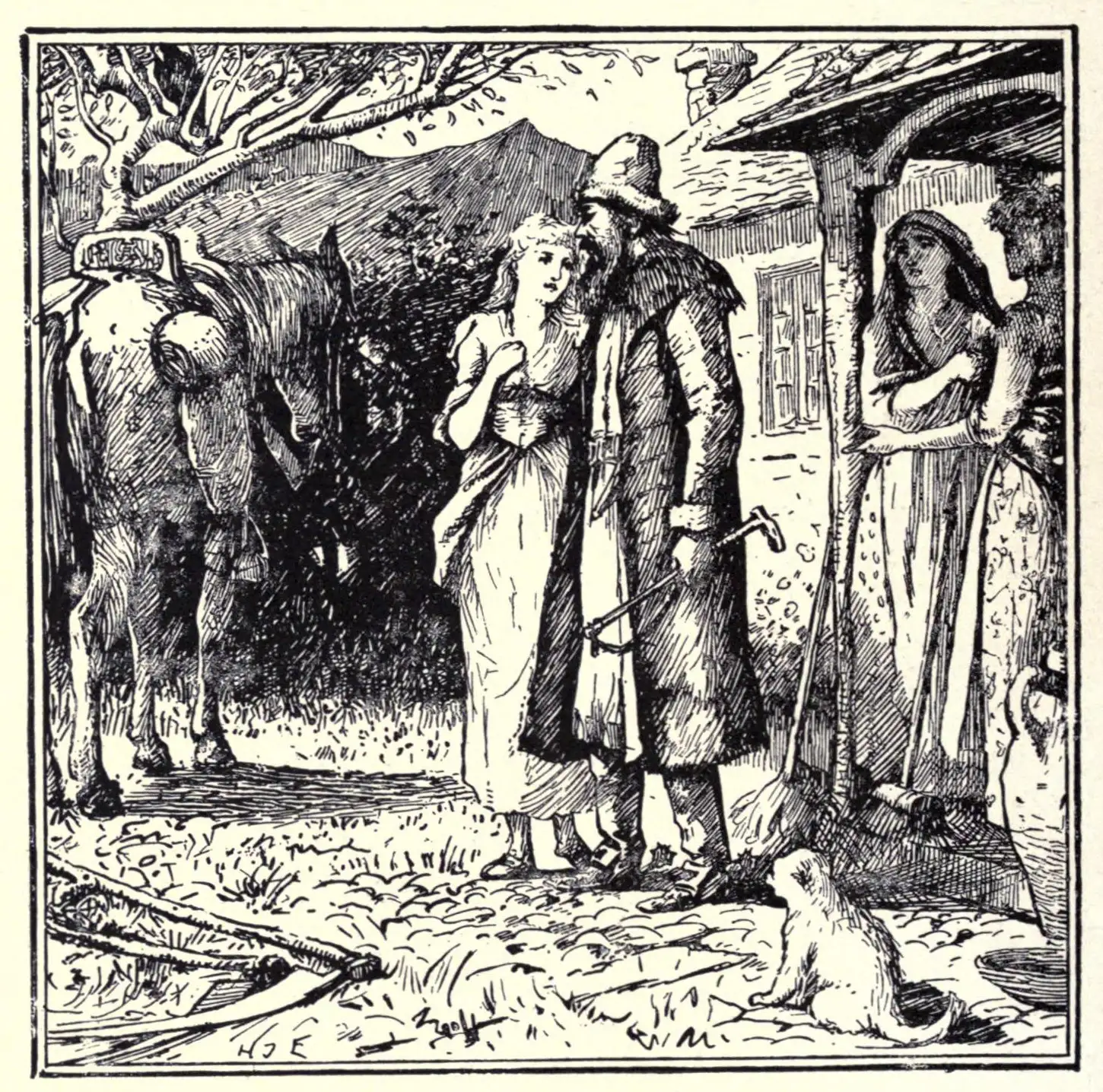
Beauty beside her father and his horse, from “Beauty and the Beast.” H. J. Ford, The Blue Fairy Book (Longmans, Green), 1889, p. 102.
Full credit
"The Blue Fairy Book (1889), p. 102: plate to “Beauty and the Beast”" by H. J. Ford — https://commons.wikimedia.org/wiki/File:The_Blue_Fairy_Book-0136.jpg — Public domain in US (published London and New York 1889); DE/FR (Henry Justice Ford d. 1941, life+70, public domain from 1 January 2012); modified: Cropped to the plate and its ruled frame with a strip of paper around it; the page text above and below is left out
The same book shows how easily credit could slip, even for the authors of the tales. Its “Beauty and the Beast” carries the note “La Belle et la Bete. Par Madame de Villeneuve.” In the Olive Fairy Book of 1907, Lang wrote of Madame d’Aulnoy, “To her we owe Beauty and the Beast and The Yellow Dwarf.” Both are Lang’s books, and the two notes name different French writers for the same tale.
By Andrew Lang’s account in 1910, he found the stories and Mrs. Lang wrote them out for the page. His preface of 1889, signed with the same name, thanked Miss Minnie Wright, Miss May Sellar and four other women for the first book of the series, and did not name her.
Sources
Editions
- Andrew Lang, ed., The Blue Fairy Book (London and New York: Longmans, Green, 1889), title page and Preface, p. vii. English Wikisource transcription of the University of California copy. https://en.wikisource.org/wiki/Page:Lange_-_The_Blue_Fairy_Book.djvu/13 (full text of the title page and the preface)
- Andrew Lang, ed., The Blue Fairy Book (London and New York: Longmans, Green, 1889). Project Gutenberg eBook 503. https://www.gutenberg.org/ebooks/503 (contents and the source note printed after each tale, with the whole book searched for named sources; full text of “Aladdin and the Wonderful Lamp,” “Beauty and the Beast” and “The Sleeping Beauty in the Wood”; the title and opening of “The Story of Pretty Goldilocks”)
- Andrew Lang, ed., The Red Fairy Book (London: Longmans, Green, 1890). Project Gutenberg eBook 540. https://www.gutenberg.org/ebooks/540 (preface, signed A. L., and contents)
- Andrew Lang, ed., The Green Fairy Book (London: Longmans, Green): preface “To the Friendly Reader,” contents and “The Story of the Three Bears,” signed “Southey.” Project Gutenberg eBooks 33571 (from the seventh impression, 1906, with H. J. Ford’s illustrations) and 7277. https://www.gutenberg.org/ebooks/33571 (full text of the preface and of the Three Bears; contents of the 1906 impression)
- Andrew Lang, ed., The Yellow Fairy Book (London: Longmans, Green, 1894). Project Gutenberg eBook 28314. https://www.gutenberg.org/ebooks/28314 (title page, preface and contents)
- Andrew Lang, ed., The Pink Fairy Book (London: Longmans, Green, 1897). Project Gutenberg eBook 5615. https://www.gutenberg.org/ebooks/5615 (preface and contents)
- Andrew Lang, ed., The Grey Fairy Book (New York: Longmans, Green, 1905 reprint of the first edition of October 1900). Project Gutenberg eBook 33547. https://www.gutenberg.org/ebooks/33547 (title and copyright pages, preface and contents)
- Andrew Lang, ed., The Violet Fairy Book (London: Longmans, Green, 1901). Project Gutenberg eBook 641. https://www.gutenberg.org/ebooks/641 (preface and contents)
- Andrew Lang, ed., The Crimson Fairy Book (London: Longmans, Green, 1903). Project Gutenberg eBook 2435. https://www.gutenberg.org/ebooks/2435 (preface and contents)
- Andrew Lang, ed., The Brown Fairy Book (London: Longmans, Green, 1904). Project Gutenberg eBook 31201. https://www.gutenberg.org/ebooks/31201 (title page, preface and contents)
- Andrew Lang, ed., The Orange Fairy Book (Longmans, Green; first edition August 1906, text of a later printing). Project Gutenberg eBook 36532. https://www.gutenberg.org/ebooks/36532 (copyright page, preface and contents)
- Andrew Lang, ed., The Olive Fairy Book (New York: Longmans, Green, 1907). Project Gutenberg eBook 27826. https://www.gutenberg.org/ebooks/27826 (title and copyright pages, preface and contents)
- Andrew Lang, ed., The Lilac Fairy Book (New York and London: Longmans, Green, 1910). Project Gutenberg eBook 28096. https://www.gutenberg.org/ebooks/28096 (title and copyright pages, advertisement pages, preface and contents)
- The Most Pleasant and Delectable Tale of the Marriage of Cupid and Psyche, done into English by William Adlington, with a discourse on the fable by Andrew Lang (London: David Nutt, 1887; Bibliothèque de Carabas): title page, preface (pp. xiii–xvi), discourse (pp. xvii–lxxxvi) and the reprinted tale (pp. 1–65). https://archive.org/details/cu31924026490213 (title page, preface and the opening, middle and closing pages of the discourse (among them p. l); the first and last pages of the reprinted tale; catalogue record)
Catalogues and databases
- Gemeinsame Normdatei (GND), via lobid-gnd: Lang, Leonora Blanche, GND 1055216049, 1145455417 and 1380718333; Lang, Andrew, GND 11877865X. CC0. https://lobid.org/gnd/1380718333 (full authority records)
- Internet Archive library records for early copies of The Red Fairy Book (redfairybook00langiala, University of California Libraries: London, Longmans, Green, 1890), The Pink Fairy Book (pinkfairybook00lang, New York Public Library, 1897), The Violet Fairy Book (violetfairybook00lang, New York Public Library: London and New York, Longmans, Green, 1901) and The Crimson Fairy Book (crimsonfairybook00lang, Boston Public Library: London and New York, Longmans, Green, 1903). https://archive.org/details/redfairybook00langiala (catalogue records)
- hbz union catalogue (via lobid resources): Andrew Lang, ed., The Green Fairy Book, “2. ed,” London, 1893; and BnF catalogue général: The Green Fairy Book, 4th edition (London: Longmans, Green, 1895). https://lobid.org/resources/990038242380206441 (catalogue records)
Cite this page
Once Upon a Version. “Andrew Lang’s Fairy Books: His First Preface Omits Mrs. Lang.” Once Upon a Version. Published 2026-11-05. https://onceuponaversion.com/tellings/andrew-lang-fairy-books/ (accessed day month year).
Write in the date you read the page; the page has no DOI.
More from One Tale, Many Tellers
One Tale, Many Tellers
Brothers Grimm: Their ‘Peasant Woman’ Was a Tailor’s Wife
Type ATU 533, as classified by D. L. Ashliman
The Grimms’ 1815 preface calls Dorothea Viehmann a peasant woman. Her biography records an innkeeper’s daughter who married a tailor. Both prefaces, compared.
Picture credit
"Portret van Jacob Ludwig Karl Grimm" by Ludwig Emil Grimm — https://commons.wikimedia.org/wiki/File:Portret_van_Jacob_Ludwig_Karl_Grimm,_RP-P-1907-1042.jpg — CC0 1.0 (https://creativecommons.org/publicdomain/zero/1.0/); modified: cropped to the plate (sheet margins removed)
One Tale, Many Tellers
Grimm Fairy Tales 1–60: Counted Here, 21 Named Tellers
Type collection of folktales (no single ATU number)
Bolte and Polívka’s 1913 notes on Grimm tales 1–60 name 21 tellers, 13 of them women, and 34 of 62 credits name Kassel. The register lists them entry by entry.
Picture credit
"Doppelportrait der Brüder Jacob und Wilhelm Grimm" by Elisabeth Jerichau-Baumann — https://commons.wikimedia.org/wiki/File:Alte_Nationalgalerie-Jerichau-Baumann-Gebr%C3%BCder_Grimm_DSC8174.jpg — CC0 1.0 (https://creativecommons.org/publicdomain/zero/1.0/); modified: cropped to the painted canvas; gilt frame and wall removed
One Tale, Many Tellers
Sleeping Beauty: In Basile and Perrault, No Kiss Wakes Her
Type ATU 410, as classified by D. L. Ashliman
Sleeping Beauty in Basile (printed 1636): twins draw out a splinter. Perrault (1697): the spell ends. Of 4 texts compared here, only 2 Grimm texts use a kiss.
Picture credit
"La Belle au Bois Dormant" by Gustave Doré — https://commons.wikimedia.org/wiki/File:La_Belle_au_Bois_Dormant_(136548149).jpg — Public domain in US (published 1867); DE/FR (Gustave Doré d. 1883, life+70); the wood engraver’s signature at lower right is not legible, and an engraver working on an 1867 edition is presumed not to have lived past 1955 (log, image ruling 10)