Aladdin: A Syrian Teller Gave It to Galland in Paris, 1709
In the sources checked here, the earliest known record of Aladdin is a line in Antoine Galland’s diary for 5 May 1709: a Maronite from Aleppo named Hanna had finished telling him the tale.
By Once Upon a Version
Published
How a version is traced · Version history · Contact · Report an error (contact@onceuponaversion.com)
In short
- In the sources checked for this page, Aladdin’s earliest known record is Antoine Galland’s diary for 5 May 1709, as Hermann Zotenberg printed it in 1888: “le Maronite Hanna de Alep” had finished telling him the tale of the Lamp.
- Hanna, a Maronite from Aleppo who had come to Paris with the traveller Paul Lucas, also wrote the tale out in Arabic; Galland began his French from that copy on 3 November 1710, and volume 9 of his Mille et une nuit came out in Paris in 1712.
- In Galland’s French, as reprinted in 1806, Scheherazade tells the tale and Hanna is not named; by Zotenberg’s 1888 account the Arabic copy Hanna wrote is lost, and the Arabic Aladdin he described is a Paris copy of the early 1800s.
Telling card
- Tale
- Aladdin, or the Wonderful Lamp (Histoire d’Aladdin, ou la Lampe merveilleuse)
- Type
- tale printed in Galland’s Thousand and One Nights (no ATU number cited)
- Teller
- Hanna, called Diab in Galland’s diary (Hanna Diyab), a Maronite from Aleppo
- Recorded by
- Antoine Galland, as a diary note only; Hanna wrote the Arabic text himself
5 more fields: edited by, told, published, this text, earliest known
- Edited by
- Antoine Galland, French version begun 3 November 1710 from Hanna’s Arabic copy
- Told
- Paris, spring 1709 (finished on 5 May 1709, by Galland’s diary)
- Published
- Les Mille et une nuit, vol. 9, Paris: F. Delaulne, 1712
- This text
- Galland’s diary as printed by Zotenberg (1888); Galland’s French as reprinted Paris: Le Normant, 1806, vols. 5–6
- Earliest known
- Galland’s diary entry of 5 May 1709, in the sources checked for this page; the Arabic copy Hanna wrote for Galland is lost, by Zotenberg’s account
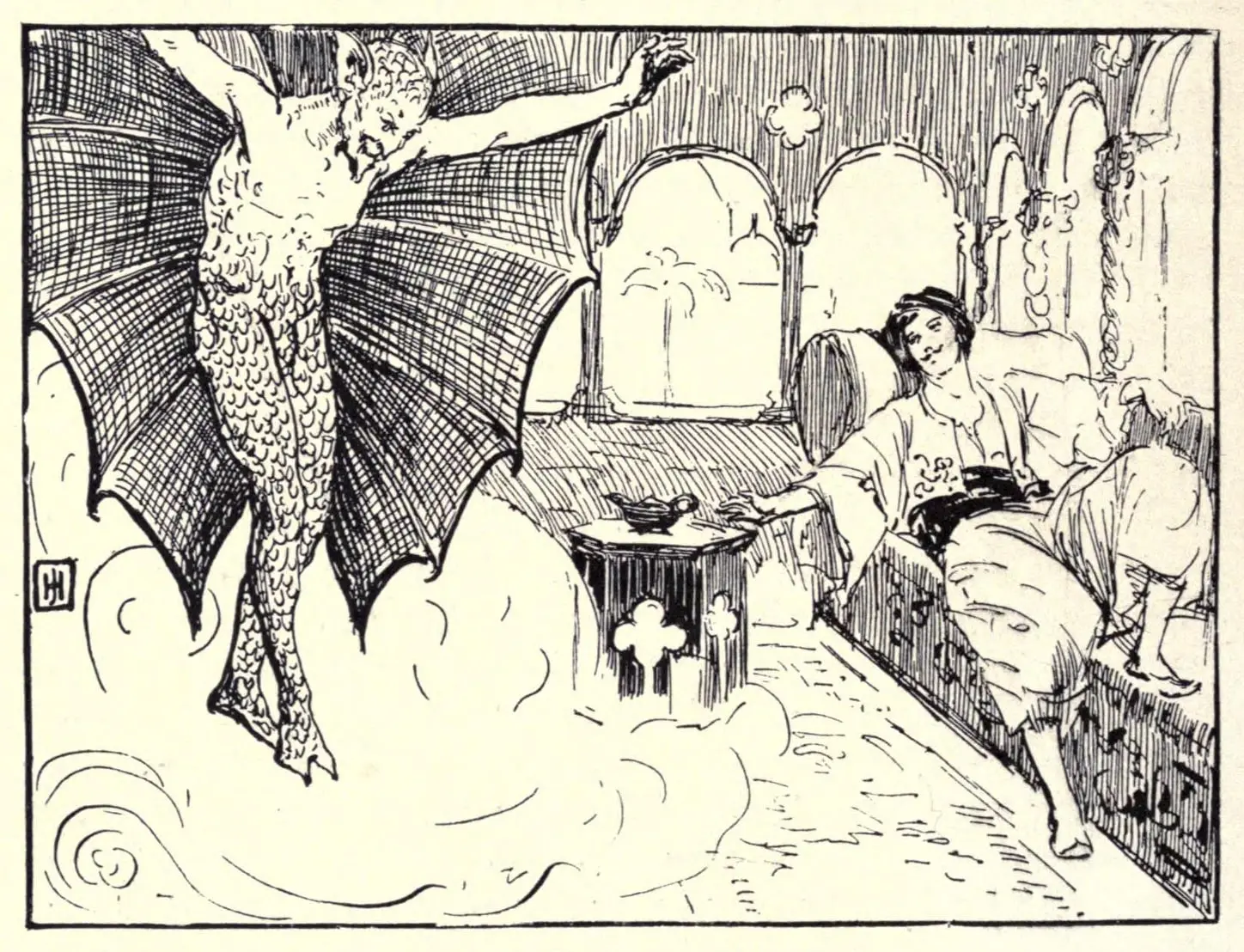
The genie of the lamp appears to Aladdin. H. J. Ford, The Blue Fairy Book (Longmans, Green), 1889.
Full credit
"The Blue Fairy Book (1889), p. 78: plate to “Aladdin and the Wonderful Lamp”" by H. J. Ford — https://commons.wikimedia.org/wiki/File:The_Blue_Fairy_Book-0112.jpg — Public domain in US (published London and New York 1889); DE/FR (Henry Justice Ford d. 1941, life+70, public domain from 1 January 2012); modified: Cropped to the plate and its ruled frame with a strip of paper around it; the page text above and below is left out
On 5 May 1709, Antoine Galland noted that a Maronite from Aleppo named Hanna had finished telling him a tale. Galland, the French translator of the Thousand and One Nights, was in Paris, and Hanna had come there with the traveller Paul Lucas. The diary calls it the tale of the Lamp, “conte de la Lampe,” and Galland would print it three years later as the story of Aladdin.
« Dimanche, 5 de may (1709). Le matin, le Maronite Hanna de Alep acheva de me faire le recit du conte de la Lampe. »
written by Antoine Galland · diary, Ms. français 15277, p. 84, as printed in Zotenberg, Histoire d’Alâ al-Dîn (Paris: Imprimerie nationale, 1888), p. 28
In this site’s English: on the morning of Sunday 5 May, the Maronite Hanna of Aleppo finished telling him the tale of the Lamp. The diary is a set of manuscripts in the Bibliothèque nationale in Paris (Zotenberg, p. 26). This page reads it only in the extracts Zotenberg printed. The weekday printed with each of the 17 dated extracts about Hanna matches the calendar for its year, 5 May 1709 included.
Who was Hanna Diyab?
Galland met him on 25 March 1709, when he called on Paul Lucas: “Je m’arrestai avec M. Hanna, Maronite d’Halep, qu’il avoit amené d’Halep” (Zotenberg, p. 28). In this site’s English, he stopped to talk with Hanna, a Maronite from Aleppo whom Lucas had brought from that city. Zotenberg calls him “un chrétien maronite d’Alep” (p. 33), a Maronite Christian of Aleppo, in Syria.
Lucas, in Zotenberg’s words, was “le célèbre voyageur” (p. 33), the celebrated traveller. The diary entry of 10 January 1711 says Lucas had brought Hanna to France “au retour de son dernier voiage en Levant” (p. 32), on his way home from his latest journey to the eastern Mediterranean.
The surname comes later, in a letter Galland received on 25 October 1709 “de Hanna, c’est-à-dire Jean-Baptiste, surnommé Diab, Maronite d’Halep, qui m’écrivit de Marseille” (p. 31). Hanna had written it in Arabic at Marseille on the 17th to say he had arrived safely. This page writes his name as Hanna Diyab; the diary spells it Diab.
The diary is not consistent about his name. It also writes it as Anna (6 May 1709), Hannah (24 August 1711) and “Hanna ou Jean Dipi” (10 January 1711), and once calls him “le Maronite de Damas,” a slip Zotenberg marks with “(sic).” The pages of Zotenberg read here give no birth or death dates for him, so this page gives none.
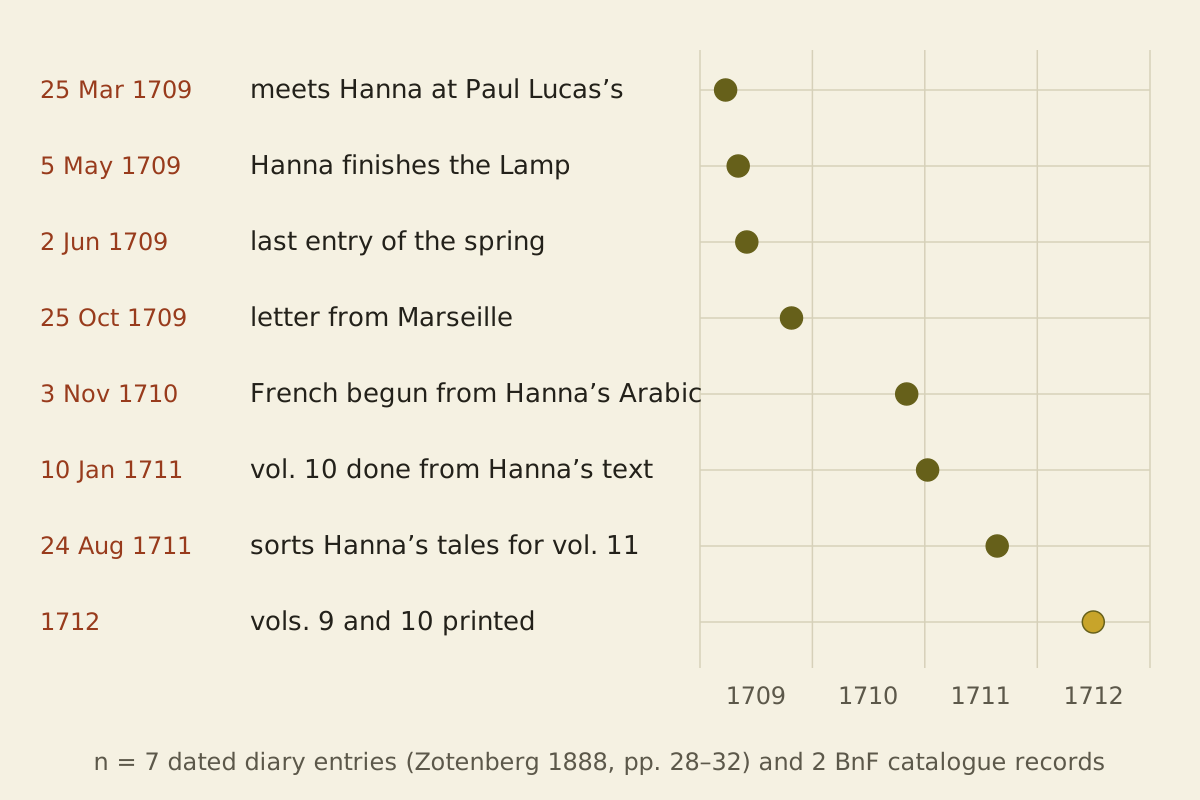
Hanna in Galland’s diary, from their meeting to the printed volumes. n = 7 dated diary entries and 2 BnF catalogue records, 1709 to 1712.
Credit line for reuse
"Hanna Diyab in Galland’s diary, 1709 to 1712" by Once Upon a Version — https://onceuponaversion.com/tellings/aladdin-hanna-diyab/ — licensed under CC BY 4.0 (https://creativecommons.org/licenses/by/4.0/)
Data: Hermann Zotenberg, Histoire d’Alâ al-Dîn, Paris, 1888, pp. 28–32, and BnF catalogue (Licence Ouverte), retrieved 2026-11-03
In words: 25 March 1709, Galland meets Hanna at Paul Lucas’s; 5 May 1709, Hanna finishes the Lamp; 2 June 1709, the last diary entry of that spring; 25 October 1709, a letter from Marseille; 3 November 1710, the French begun from Hanna’s Arabic; 10 January 1711, volume 10 done from Hanna’s text; 24 August 1711, Hanna’s tales sorted for volume 11; 1712, volumes 9 and 10 printed.
What did Galland’s diary record in spring 1709?
After the meeting on 25 March, Hanna promised to write his tales out: “me promit de les mettre par écrit, pour me les communiquer” (p. 28). Zotenberg adds that between 25 March and 5 May the diary says nothing of Hanna or of Arabic tales. From 5 May to 2 June 1709 it has 12 dated entries, most of them a tale Hanna told.
Hanna told the tales by word of mouth, “de vive voix” in Zotenberg’s phrase (p. 33). The one listener named is Galland. The place of telling moved: on 6 May Galland went to see Hanna, “j’allai voir le Maronite Anna,” and on 22 May Hanna came to him: “Hanna qui me vint voir l’après disné, m’entretint de ce conte” (p. 29).
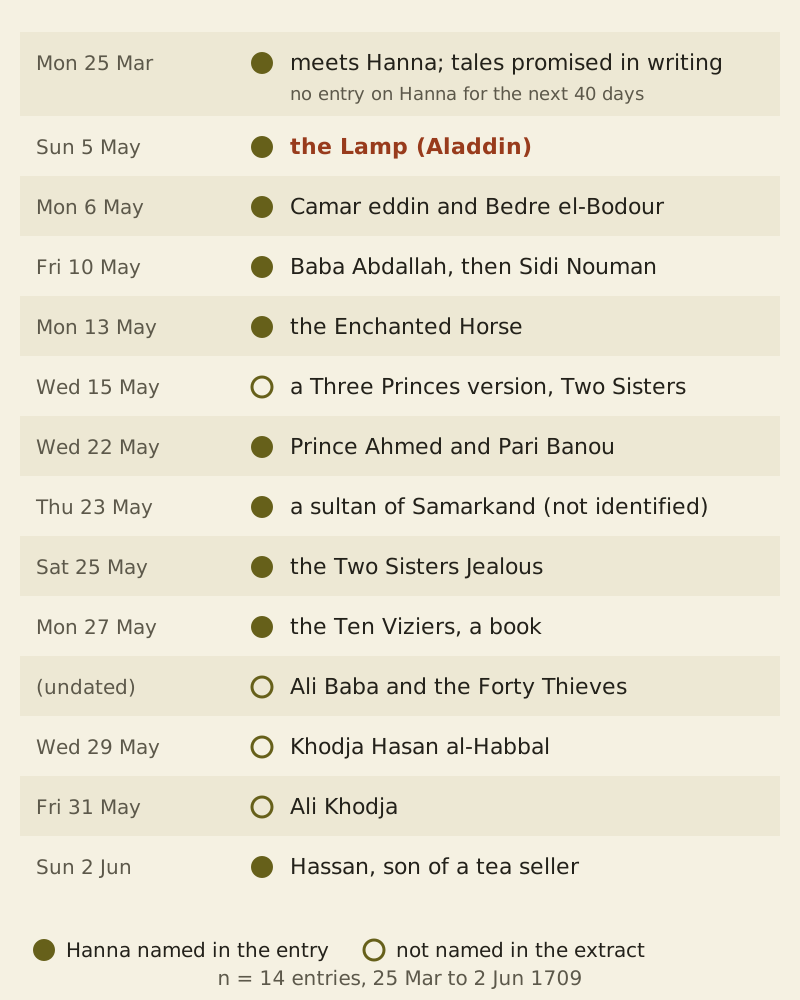
Diary entries of spring 1709 and the tale each one records, as Zotenberg identified them in 1888. n = 14 entries, 25 March to 2 June 1709.
Credit line for reuse
"Galland’s diary entries about Hanna, spring 1709" by Once Upon a Version — https://onceuponaversion.com/tellings/aladdin-hanna-diyab/ — licensed under CC BY 4.0 (https://creativecommons.org/licenses/by/4.0/)
Data: Hermann Zotenberg, Histoire d’Alâ al-Dîn, Paris, 1888, pp. 28–31, retrieved 2026-11-03
All 18 diary entries about Hanna, with dates, weekdays and pages, as CSV (where the data comes from) Data: Hermann Zotenberg, Histoire d’Alâ al-Dîn, Paris, Imprimerie nationale, 1888, pp. 28–32, retrieved 2026-11-03
| Date (1709) | Hanna named? | Tale, as Zotenberg identifies it |
|---|---|---|
| 25 March | yes | none; Hanna promises to write his tales out |
| 5 May | yes | the Lamp (Aladdin) |
| 6 May | yes | Camar eddin and Bedre el-Bodour |
| 10 May | yes | the blind Baba Abdallah, followed by Sidi Nouman |
| 13 May | yes | the Enchanted Horse |
| 15 May | no | a version of the Three Princes, in the Two Sisters |
| 22 May | yes | Prince Ahmed and the Fairy Pari Banou |
| 23 May | yes | a sultan of Samarkand and his sons (not identified) |
| 25 May | yes | the Two Sisters Jealous of their Younger Sister |
| 27 May | yes | the Ten Viziers, a book Hanna described |
| undated | no | Ali Baba and the Forty Thieves |
| 29 May | no | Khodja Hasan al-Habbal |
| 31 May | no | Ali Khodja |
| 2 June | yes | Hassan, son of a seller of herb tea |
n = 14 entries from 25 March to 2 June 1709, as printed in Zotenberg 1888, pp. 28–31. Across all 18 entries about him from 1709 to 1711, the diary names Hanna in 13, describes him without a name in 1 and leaves him unnamed in 4.
Hanna also passed on knowledge about Arabic books. On 27 May the diary notes, “comme je l’ai appris du Maronite Hanna,” that the Arabs have a book of tales called the Ten Viziers, and Galland then summarised its principal story (p. 30).
For most of the tales themselves the diary also gives a summary, but for the Lamp it gives none: Zotenberg says the diary summarises the tales “à l’exception de l’histoire de la Lampe merveilleuse” (p. 34). Like the 21 tellers the Grimms named, another collector’s record of who told what, the diary is a list of who told which tale and when, not a transcript of how it was told.
How did a spoken tale become Galland’s French?
The written Aladdin came from Hanna too. On 3 November 1710 Galland finished reading “le conte Arabe de la Lampe qui m’avoit esté écrit en Arabe plus d’un an auparavant” (p. 31), the Arabic tale of the Lamp written out for him more than a year before. He wrote down its title, “Histoire d’Aladdin, fils d’un Tailleur,” and began putting it into French that evening.
From the telling on 5 May 1709 to that evening is 547 days. On 21 November 1710 Galland agreed with a bookseller “pour l’impression de mon neuviéme volume des Mille et une Nuit” (p. 31). By Zotenberg’s reading, the ninth volume was already written in 1709, and Galland later changed it: “il y inséra l’histoire de la Lampe merveilleuse” (p. 34, note). The BnF catalogue dates volumes 9 and 10 to 1712, printed in Paris by F. Delaulne.
The title changed on the way. The heading Galland copied from Hanna’s Arabic in 1710 was “Histoire d’Aladdin, fils d’un Tailleur, et de ce qui lui arriva avec un Magicien Africain à l’occasion d’une Lampe” (p. 31): the story of Aladdin, son of a tailor, and what happened to him with an African magician over a lamp. The 1806 reprint heads the tale more briefly, “Histoire d’Aladdin, ou la Lampe merveilleuse” (vol. 5, p. 377), and keeps the tailor and the African magician inside the story.
5 May 1709 · Galland’s diary, as printed by Zotenberg (1888), p. 28
« Le matin, le Maronite Hanna de Alep acheva de me faire le recit du conte de la Lampe. »
written by Antoine Galland · diary, Ms. français 15277, p. 84, as printed in Zotenberg 1888, p. 28
1806 · Les Mille et Une Nuits, Le Normant reprint, vol. 5
« Sire, dans la capitale d’un royaume de la Chine, très-riche et d’une vaste étendue, dont le nom ne me vient pas présentement à la mémoire, il y avoit un tailleur nommé Mustafa »
translated by Antoine Galland · Scheherazade speaking, Hanna not named · Les Mille et Une Nuits (Paris: Le Normant, 1806), vol. 5, p. 377
What changed: In the diary the teller is Hanna. In the print the tale opens with “Sire,” so Scheherazade is telling it to the sultan, and she is the one who cannot recall the name of the Chinese kingdom.
The print opens, in this site’s paraphrase, by addressing the sultan as Sire and placing a tailor named Mustafa in the capital of a rich, vast Chinese kingdom whose name the speaker cannot recall.
In the 1806 reprint the tale runs from volume 5, page 377, to volume 6, page 190, and ends with “Sire, dit la sultane Scheherazade” handing the frame back to the sultan. Her closing words draw a lesson for her listener. A good and just king, she tells him, risks his throne when he condemns an innocent man without hearing his defence (vol. 6, pp. 190–191). The warning fits the sultan of the frame, who has had a new wife put to death each morning.
None of that frame comes from the diary, which records only who told the Lamp and when. Hanna’s name appears nowhere in the 1806 pages of the tale. In this site’s studio terms, Hanna is the uncredited session player on Galland’s Aladdin: the diary names him, and the printed tale, as reprinted in 1806, does not.
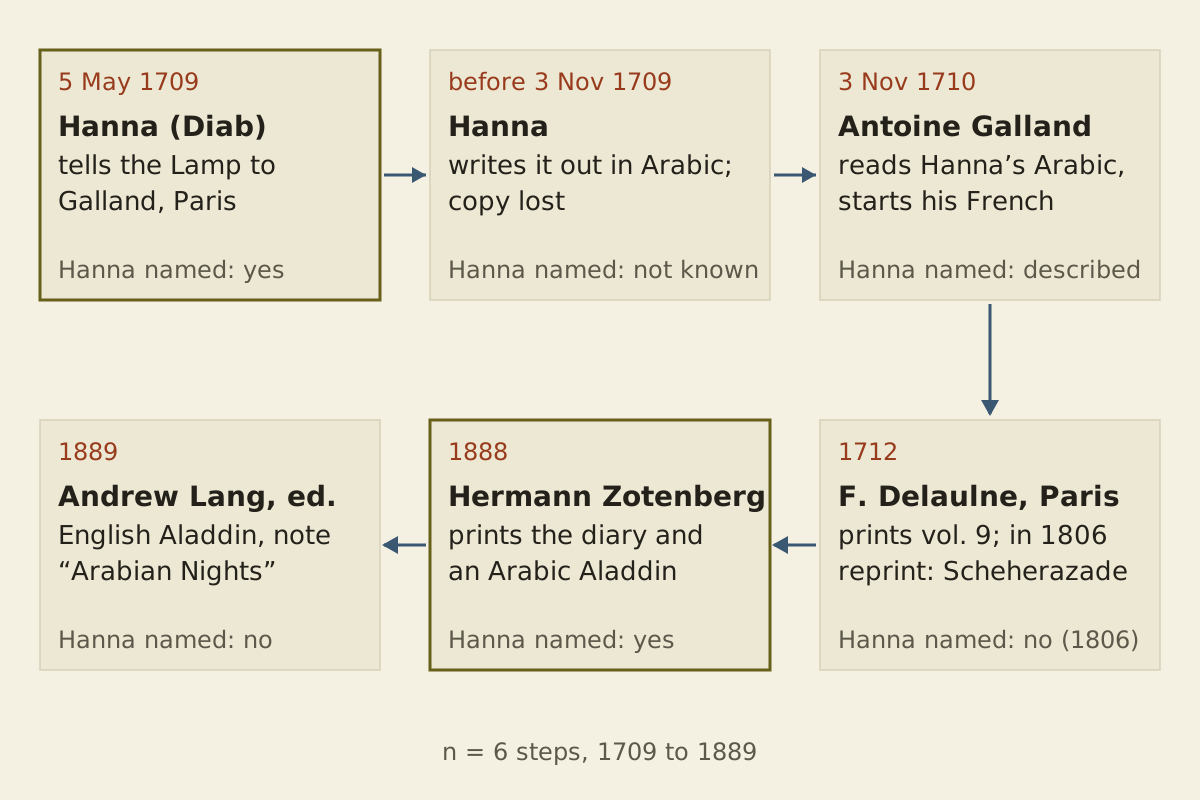
Who handled the tale, from Hanna’s telling to Lang’s English, and whether each step names Hanna. n = 6 steps, 1709 to 1889.
Credit line for reuse
"Who handled Aladdin, 1709 to 1889" by Once Upon a Version — https://onceuponaversion.com/tellings/aladdin-hanna-diyab/ — licensed under CC BY 4.0 (https://creativecommons.org/licenses/by/4.0/)
Data: Zotenberg 1888; Galland, Les Mille et Une Nuits, Le Normant 1806, French Wikisource; BnF catalogue; Lang, The Blue Fairy Book, Project Gutenberg, and its 1889 preface, English Wikisource; retrieved 2026-11-03 and 2026-11-04
The six steps, with sources, as CSV (where the data comes from) Data: Zotenberg 1888; Galland, Les Mille et Une Nuits, Le Normant 1806, French Wikisource; BnF catalogue; Lang, The Blue Fairy Book, Project Gutenberg, and its 1889 preface, English Wikisource; retrieved 2026-11-03 and 2026-11-04
Each of these steps left what this site calls a one-evening text: a diary line, a lost Arabic copy, a printed volume, each a fixed witness and none of them the tale itself. Of the surviving texts in this chain, only the diary and Zotenberg’s notice of 1888 put Hanna’s name next to the Lamp; whether the lost Arabic copy did is not known.
How much of Galland’s Nights came from Hanna?
Zotenberg names nine of the tales that Hanna told Galland “de vive voix” in 1709 (p. 33), and sorts them by what Galland had to work from (p. 34). For the Lamp, Galland received Hanna’s Arabic text. For the blind Baba Abdallah and Sidi Nouman he probably did, and for Khodja Hasan perhaps. Those four, Zotenberg says, stand in the second part of volume 9 and in volume 10.
The other five tales fill volumes 11 and 12, and for them Galland had no Arabic text: he wrote them up from Hanna’s tellings, which he had summarised in his diary. They are Ali Baba and the Forty Thieves, Ali Khodja, the Enchanted Horse, Prince Ahmed and the Fairy Pari Banou, and the Two Sisters Jealous of their Younger Sister. On 24 August 1711 the diary shows Galland going through “une partie des Contes Arabes que le Maronite Hannah m’avoit raconté[s]” (p. 32) to choose the tales for volume 11.
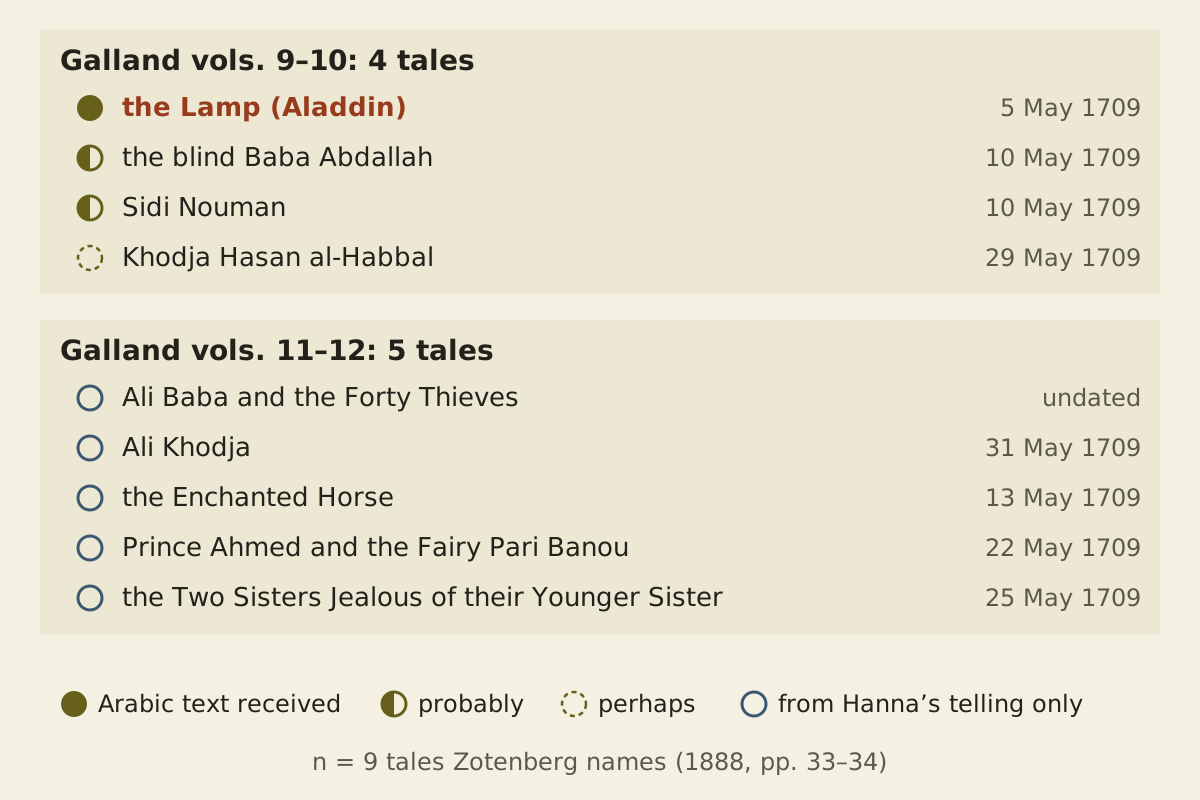
The nine tales Zotenberg says Hanna told Galland, by what Galland had to work from, with the diary date. n = 9 tales, Zotenberg 1888, pp. 33–34.
Credit line for reuse
"Hanna’s nine tales in Galland’s volumes 9 to 12" by Once Upon a Version — https://onceuponaversion.com/tellings/aladdin-hanna-diyab/ — licensed under CC BY 4.0 (https://creativecommons.org/licenses/by/4.0/)
Data: Hermann Zotenberg, Histoire d’Alâ al-Dîn, Paris, 1888, pp. 28–34, retrieved 2026-11-03
The nine tales, with Zotenberg’s words and the diary dates, as CSV (where the data comes from) Data: Hermann Zotenberg, Histoire d’Alâ al-Dîn, Paris, Imprimerie nationale, 1888, pp. 28–34, retrieved 2026-11-03
| Tale | What Galland had, by Zotenberg’s account | Galland’s volumes |
|---|---|---|
| the Lamp (Aladdin) | Arabic text received | 9–10 |
| the blind Baba Abdallah | Arabic text probably received | 9–10 |
| Sidi Nouman | Arabic text probably received | 9–10 |
| Khodja Hasan al-Habbal | Arabic text perhaps received | 9–10 |
| Ali Baba and the Forty Thieves | no Arabic text; written up from Hanna’s telling | 11–12 |
| Ali Khodja | no Arabic text; written up from Hanna’s telling | 11–12 |
| the Enchanted Horse | no Arabic text; written up from Hanna’s telling | 11–12 |
| Prince Ahmed and the Fairy Pari Banou | no Arabic text; written up from Hanna’s telling | 11–12 |
| the Two Sisters Jealous of their Younger Sister | no Arabic text; written up from Hanna’s telling | 11–12 |
n = 9 tales. Of the nine, Zotenberg is sure of a written Arabic text for one, the Lamp.
How did Aladdin reach English readers in the Blue Fairy Book?
Andrew Lang’s Blue Fairy Book, published by Longmans, Green in 1889, prints “Aladdin and the Wonderful Lamp” with no frame and no Scheherazade. In the Project Gutenberg text it opens “There once lived a poor tailor, who had a son called Aladdin,” and a footnote at the end gives its source as “Arabian Nights.” Neither Galland nor Hanna is named in that text of the book, which has no preface. The 1889 preface names who shortened it: “Miss Violet Hunt condensed ‘Aladdin’” (p. vii).
There once lived a poor tailor, who had a son called Aladdin, a careless, idle boy who would do nothing but play ball all day long in the streets with little idle boys like himself.
retold by Violet Hunt · edited by Andrew Lang · The Blue Fairy Book (London: Longmans, Green, 1889), “Aladdin and the Wonderful Lamp,” opening sentence
The English is much shorter. Lang’s chapter runs to about 5,300 words, against about 47,000 French words for the tale in Galland’s 1806 reprint, roughly 11 percent, though English and French word counts are not an exact match. Lang keeps the China setting and the African magician, and drops the teller’s voice.
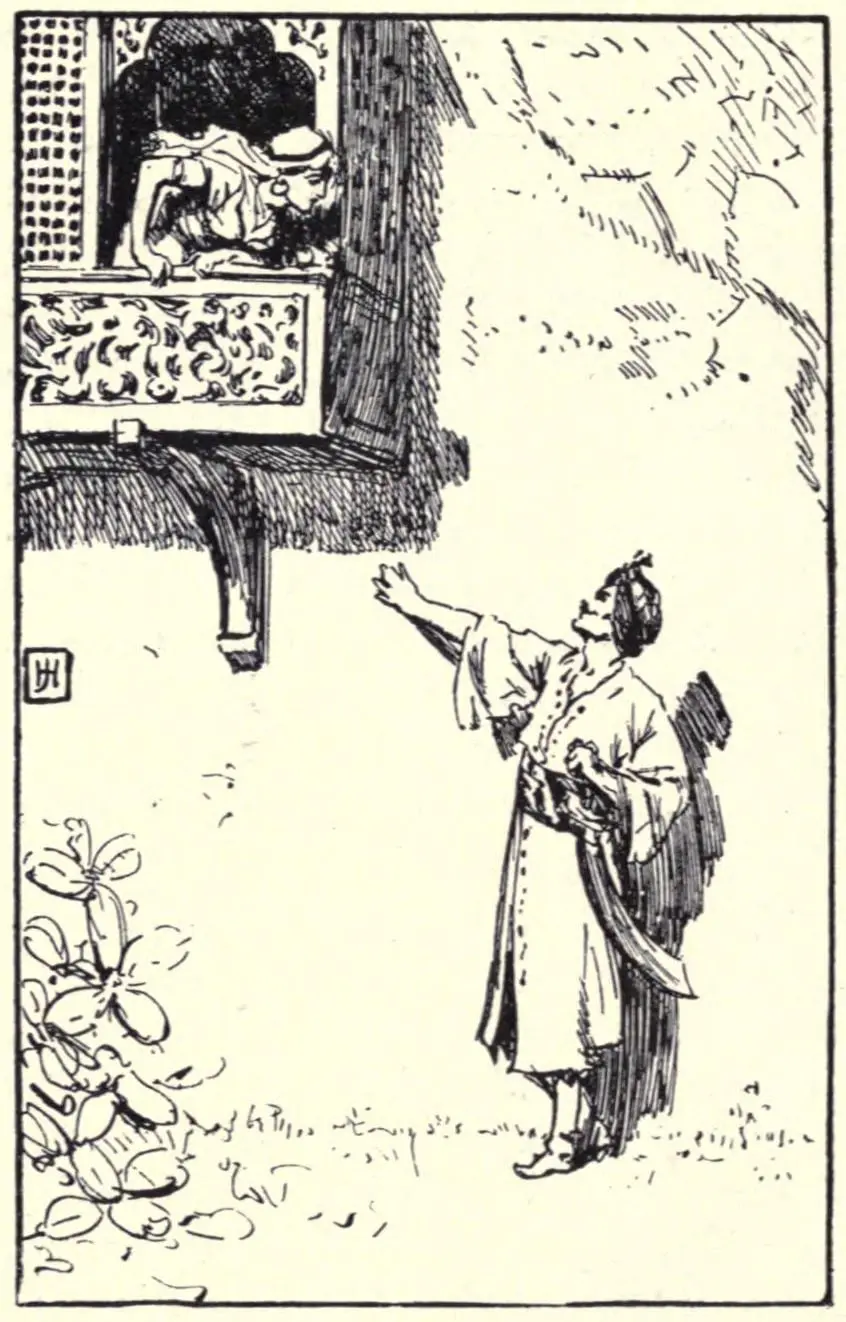
The princess sees Aladdin from her window. H. J. Ford, The Blue Fairy Book (Longmans, Green), 1889.
Full credit
"The Blue Fairy Book (1889), p. 82: plate to “Aladdin and the Wonderful Lamp”" by H. J. Ford — https://commons.wikimedia.org/wiki/File:The_Blue_Fairy_Book-0116.jpg — Public domain in US (published London and New York 1889); DE/FR (Henry Justice Ford d. 1941, life+70, public domain from 1 January 2012); modified: Cropped to the plate and its ruled frame with a strip of paper around it; the page text beside and below is left out
Was there an Arabic Aladdin before Galland’s French?
Zotenberg opens his notice by naming Aladdin among the tales in Galland’s Nights “dont le texte original est, jusqu’à présent, demeuré inconnu” (p. 1), whose original text had so far remained unknown. He adds at once that a copy of the Nights lately acquired by the Bibliothèque nationale “est venu, en partie, combler cette fâcheuse lacune” (p. 1), had partly filled that gap.
That copy is in the hand of Michel Sabbagh (p. 35), “Copié à Paris, sur papier européen, au commencement de ce siècle” (p. 36). In this site’s English: copied in Paris, on European paper, at the beginning of this century, Zotenberg writing in 1888. In it the tale of ʿAlâ al-Dîn runs from night 514 to night 591 (p. 38).
Illustration of a brass oil lamp of the kind the tale of the Lamp is named for.
Illustration: Once Upon a Version. Generated illustration — not a historical image, manuscript or record. © Once Upon a Version, all rights reserved; reuse by request.
« … il me paraît impossible d’admettre que la copie remise à Galland par le Maronite Ḥannâ ait été écrite de mémoire. »
written by Hermann Zotenberg · Histoire d’Alâ al-Dîn ou la lampe merveilleuse (Paris: Imprimerie nationale, 1888), p. 39
In this site’s English: it seems to him impossible to accept that the copy the Maronite Hanna gave Galland had been written from memory. His reason, on pp. 38–39, is that the Lamp, apart from a few details, is reproduced so faithfully in Galland’s translation. He took it as evident that Hanna had not invented his tales, and thought he probably owned a text, of which he gave Galland a partial copy “qui a disparu” (p. 34), which has since disappeared.
By Zotenberg’s account, a note at the end of the Sabbagh copy shows it to be an exact reproduction of a manuscript of Baghdad (p. 36). The note, printed there in Arabic, is dated in the Muslim calendar to the first days of Jumada II 1115, which fell in October 1703, but Zotenberg could not say where that Baghdad manuscript was (p. 37).
These are Zotenberg’s judgments of 1888. The Sabbagh copy itself was made in Paris about a century after Galland’s volume, so on the pages read here no surviving Arabic Aladdin is dated before 1709. This page has not read later studies of Hanna, of the diary or of the Sabbagh copy, and it does not say whether Zotenberg’s view still stands.
The diary does show who handed the tale over. On 24 August 1711, more than two years after the telling, Galland was still sorting through the tales that “le Maronite Hannah” had told him, and the Lamp is the one tale of them that Zotenberg is sure Galland had in Hanna’s own Arabic.
Sources
Editions
- “Histoire d’Aladdin, ou la Lampe merveilleuse,” in Les Mille et Une Nuits, contes arabes, translated by Antoine Galland (Paris: Le Normant, 1806), vol. 5, pp. 377–466, and vol. 6, pp. 1–193. French Wikisource transcription of the University of Toronto copy. https://fr.wikisource.org/wiki/Les_Mille_et_Une_Nuits/Histoire_d%E2%80%99Aladdin (full text of the tale and the frame passage that closes it)
- Andrew Lang, ed., The Blue Fairy Book (London and New York: Longmans, Green, 1889). Project Gutenberg eBook 503. https://www.gutenberg.org/ebooks/503 (contents and the source note printed after each tale, with the whole book searched for named sources; full text of “Aladdin and the Wonderful Lamp,” “Beauty and the Beast” and “The Sleeping Beauty in the Wood”; the title and opening of “The Story of Pretty Goldilocks”)
- Andrew Lang, ed., The Blue Fairy Book (London and New York: Longmans, Green, 1889), title page and Preface, p. vii. English Wikisource transcription of the University of California copy. https://en.wikisource.org/wiki/Page:Lange_-_The_Blue_Fairy_Book.djvu/13 (full text of the title page and the preface)
Research
- Hermann Zotenberg, “Notice sur quelques manuscrits des Mille et une Nuits et la traduction de Galland,” in Histoire d’Alâ al-Dîn ou la lampe merveilleuse: texte arabe (Paris: Imprimerie nationale, 1888), pp. 1–6 and 25–39 used, including the extracts from Antoine Galland’s diary (Bibliothèque nationale, Mss. français 15277–15280) on pp. 26–33. https://archive.org/details/histoiredalald00zote (pp. 1–6 and 25–39 of the French notice, from the page images)
Catalogues and databases
- Bibliothèque nationale de France, catalogue général: Les mille et une nuit. Tome neuvième: contes arabes, trad. par M. Galland (Paris: F. Delaulne, 1712), notice FRBNF36063750; Tome dixième (Paris: F. Delaulne, 1712), notice FRBNF36063751. Licence Ouverte. https://catalogue.bnf.fr/ark:/12148/cb36063750n (full catalogue records for volumes 9 and 10)
Cite this page
Once Upon a Version. “Aladdin: A Syrian Teller Gave It to Galland in Paris, 1709.” Once Upon a Version. Published 2026-11-05. https://onceuponaversion.com/tellings/aladdin-hanna-diyab/ (accessed day month year).
Write in the date you read the page; the page has no DOI.
More from One Tale, Many Tellers
One Tale, Many Tellers
Brothers Grimm: Their ‘Peasant Woman’ Was a Tailor’s Wife
Type ATU 533, as classified by D. L. Ashliman
The Grimms’ 1815 preface calls Dorothea Viehmann a peasant woman. Her biography records an innkeeper’s daughter who married a tailor. Both prefaces, compared.
Picture credit
"Portret van Jacob Ludwig Karl Grimm" by Ludwig Emil Grimm — https://commons.wikimedia.org/wiki/File:Portret_van_Jacob_Ludwig_Karl_Grimm,_RP-P-1907-1042.jpg — CC0 1.0 (https://creativecommons.org/publicdomain/zero/1.0/); modified: cropped to the plate (sheet margins removed)
One Tale, Many Tellers
Grimm Fairy Tales 1–60: Counted Here, 21 Named Tellers
Type collection of folktales (no single ATU number)
Bolte and Polívka’s 1913 notes on Grimm tales 1–60 name 21 tellers, 13 of them women, and 34 of 62 credits name Kassel. The register lists them entry by entry.
Picture credit
"Doppelportrait der Brüder Jacob und Wilhelm Grimm" by Elisabeth Jerichau-Baumann — https://commons.wikimedia.org/wiki/File:Alte_Nationalgalerie-Jerichau-Baumann-Gebr%C3%BCder_Grimm_DSC8174.jpg — CC0 1.0 (https://creativecommons.org/publicdomain/zero/1.0/); modified: cropped to the painted canvas; gilt frame and wall removed
One Tale, Many Tellers
Sleeping Beauty: In Basile and Perrault, No Kiss Wakes Her
Type ATU 410, as classified by D. L. Ashliman
Sleeping Beauty in Basile (printed 1636): twins draw out a splinter. Perrault (1697): the spell ends. Of 4 texts compared here, only 2 Grimm texts use a kiss.
Picture credit
"La Belle au Bois Dormant" by Gustave Doré — https://commons.wikimedia.org/wiki/File:La_Belle_au_Bois_Dormant_(136548149).jpg — Public domain in US (published 1867); DE/FR (Gustave Doré d. 1883, life+70); the wood engraver’s signature at lower right is not legible, and an engraver working on an 1867 edition is presumed not to have lived past 1955 (log, image ruling 10)