Brothers Grimm: Their ‘Peasant Woman’ Was a Tailor’s Wife
Dorothea Viehmann, the face of Grimms' Fairy Tales, was an innkeeper's daughter of Huguenot descent, and by her biographer's account the brothers took down her tales mainly in their own flat in Kassel.
By Once Upon a Version
Published
How a version is traced · Version history · Contact · Report an error (contact@onceuponaversion.com)
In short
- The Grimms' 1815 preface calls Dorothea Viehmann a Bäuerin, a peasant woman; Germany's national biography records an innkeeper's daughter who married a tailor in 1777.
- By that biography's account the brothers took down her tales mainly in their own Kassel flat; in the 1815 volume, 15 of 70 notes credit her village, Zwehrn, and none names her.
- The 1819 preface raised her share from “a considerable part” to “most and the finest” of volume 2 and named an etching of her as its frontispiece.
Telling card
- Tale
- The Goose Girl (Die Gänsemagd; “Das Gänsmädchen” in the 1815 note)
- Type
- ATU 533, as classified by D. L. Ashliman
- Teller
- the Zwehrn teller (the 1815 preface names her Viehmännin)
- Recorded by
- Jacob Grimm
5 more fields: edited by, told, published, this text, earliest known
- Edited by
- Jacob and Wilhelm Grimm; vol. 2 no. 3 (1815), no. 89 (1819 on)
- Told
- Date and place unrecorded; the 1815 note gives only her village, Zwehrn
- Published
- Kinder- und Haus-Märchen, vol. 2 (Berlin: Realschulbuchhandlung, 1815), pp. 16–25
- This text
- 1815 first edition, Wikisource transcription; note “(Aus Zwehrn)”, p. V
- Earliest known
- The 1815 print; no manuscript write-up in the sources read
This card as CSV · where these values come from
Data: Kinder- und Haus-Märchen, vol. 2 (1815 and 1819), German Wikisource transcriptions; Bolte and Polívka, vol. 2 (1915), p. 273, Wikimedia Commons scan; D. L. Ashliman's tale-type list; retrieved 2026-11-03
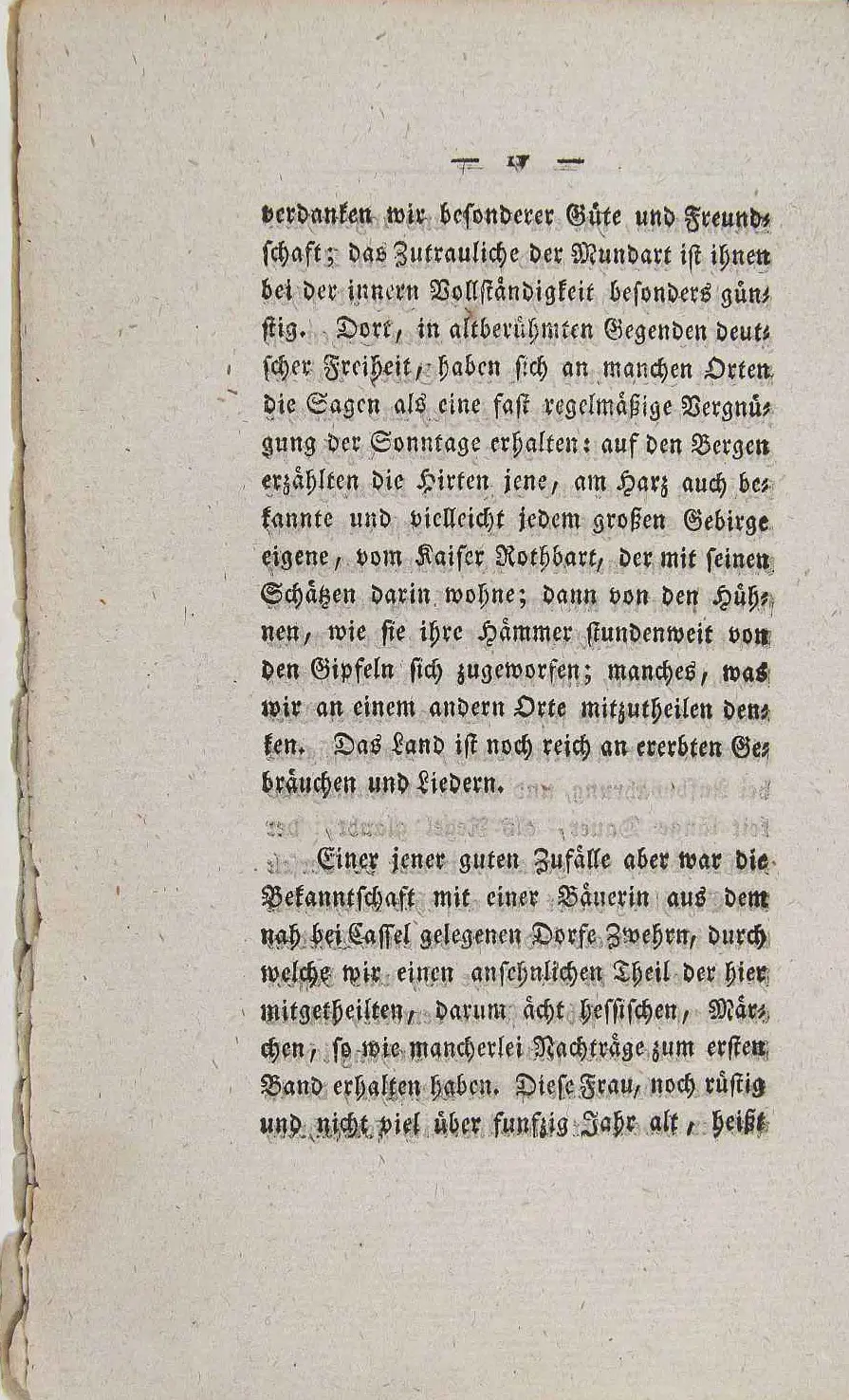
Page IV of the preface, where the sentence about the peasant woman from Zwehrn begins. Jacob and Wilhelm Grimm, Kinder- und Haus-Märchen, vol. 2, 1815.
Full credit
"Kinder- und Haus-Märchen, vol. 2 (1815), preface, p. IV" by Jacob and Wilhelm Grimm — https://commons.wikimedia.org/wiki/File:Kinder_und_Hausm%C3%A4rchen_(Grimm)_1812_II_p_004.jpg — Public domain in US (published 1815); DE/FR (Jacob Grimm d. 1863, Wilhelm Grimm d. 1859, life+70); modified: cropped to the page, binding of the bound copy removed
By her biography's account, Dorothea Viehmann told the Brothers Grimm most of her tales in their Kassel flat. Between 1813 and 1815 she came in from Zwehren, then a village just outside the city gates, and the brothers wrote down about forty tales, plus variants, from her. In the 1815 volume, “The Goose Girl,” which her biography lists among her tales, stands third.
According to the folklorist Jack Zipes, most of the early informants who told the Brothers Grimm their stories were young women from educated middle-class or noble families living in or near Kassel or on a family estate in Westphalia. Viehmann was one of the exceptions. She became the one the brothers put on display. The full list of named tellers belongs in the register of named Grimm tellers.
Who was Dorothea Viehmann?
Bernhard Lauer's entry in the Neue Deutsche Biographie (NDB), Germany's national biography, gives her birth as Catharina Dorothea Pierson on 8 November 1755 at the Knallhütte, an inn near Rengershausen kept by her father, Johann Friedrich Isaak Pierson. Her paternal great-grandfather, Isaak Pierson, was a Huguenot, a French Protestant refugee, who had come from Metz and settled in Hesse in 1686.
In 1777 she married Nikolaus Viehmann, a tailor, and ten years later the couple moved to Zwehren; they had at least seven children, two of whom died young. Lauer suggests that she probably gathered material for her repertoire in her youth at the inn, from carters and farmers who stopped there and from soldiers during the Seven Years' War. Some of her stories, he adds, probably came from her Huguenot family.
Zipes calls her lower-class and poor, whereas the NDB describes a family of innkeepers and a tailor's household. This profile keeps that question of class apart from its own: how two editors presented one named woman in print.
Illustration of an inn's common room of the kind where, by her biography's account, she probably gathered stories in her youth. Not a portrait of her.
Illustration: Once Upon a Version. Generated illustration — not a historical image, manuscript or record. © Once Upon a Version, all rights reserved; reuse by request.
What did the Grimms' preface say about her?
The second volume of Kinder- und Haus-Märchen (Children's and Household Tales) appeared in Berlin in 1815, with a preface dated Kassel, 30 September 1814. On page IV the brothers describe a stroke of luck.
„Einer jener guten Zufälle aber war die Bekanntschaft mit einer Bäuerin aus dem nah bei Cassel gelegenen Dorfe Zwehrn, durch welche wir einen ansehnlichen Theil der hier mitgetheilten, darum ächt hessischen, Märchen, so wie mancherlei Nachträge zum ersten Band erhalten haben.“
written by the Brothers Grimm · Kinder- und Haus-Märchen, vol. 2, 1st ed., 1815, Vorrede, p. IV
In our paraphrase, as with every English rendering of the German on this page, they met a peasant woman from Zwehrn near Kassel, and through her they received a considerable part of this volume's tales, “therefore genuinely Hessian,” along with various additions to volume 1. The word “therefore” carries the argument. It makes the tales Hessian by virtue of the woman who told them.
The preface then gives her age as “nicht viel über funfzig Jahr alt,” not much over fifty, although a woman born in November 1755 was 58 on the date the preface bears. It praises her for telling each tale freely, then again slowly enough to copy, and says that she “niemals ändert ... etwas in der Sache ab,” never changes anything of substance when she repeats it.
On pages V and VI the preface takes one more step. Attachment to tradition, it says, is stronger among people “die in gleicher Lebensart unabänderlich fortfahren,” who carry on unchanged in the same way of life, so one named teller becomes proof for a whole way of life.
This site calls that move the borrowed hearth: an editor's promotional text presents a specific teller, with a documented life of her own, as the voice of a nameless folk tradition. Of the label’s three conditions, this case needs two, and both are here: the preface wording quoted above and the NDB record of who she was. The third, editions compared tale by tale, applies only to a claim that the brothers rewrote one of her tales, and no such claim is made here.
The same preface also claims, on page XI, that everything collected from oral tradition in the book is “rein deutsch und nirgends her erborgt,” purely German and borrowed from nowhere, with Puss in Boots as the possible exception. The teller it singles out had a Huguenot great-grandfather from Metz. Where each of her tales came from remains a question for tale-by-tale study, and the NDB says only that some probably came from her family.
1815
„Einer jener guten Zufälle aber war die Bekanntschaft mit einer Bäuerin aus dem nah bei Cassel gelegenen Dorfe Zwehrn, durch welche wir einen ansehnlichen Theil der hier mitgetheilten, darum ächt hessischen, Märchen, so wie mancherlei Nachträge zum ersten Band erhalten haben.“
written by the Brothers Grimm · Kinder- und Haus-Märchen, vol. 2, 1st ed., 1815, Vorrede, p. IV
1819
„Einer jener guten Zufälle aber war es, daß wir aus dem bei Cassel gelegenen Dorfe Nieder-Zwehrn eine Bäuerin kennen lernten, die uns die meisten und schönsten Märchen des zweiten Bandes erzählte.“
written by the Brothers Grimm · Kinder- und Haus-Märchen, vol. 1, 2nd ed., 1819, Vorrede, p. XI
What changed: “a considerable part” became “the most and the finest” of volume 2, “therefore genuinely Hessian” left this sentence, and Zwehrn became Nieder-Zwehrn. Both keep “Bäuerin.”
The 1819 sentence, in our rendering, says they came to know a peasant woman from the village of Nieder-Zwehrn near Kassel, who told them most and the finest tales of the second volume.
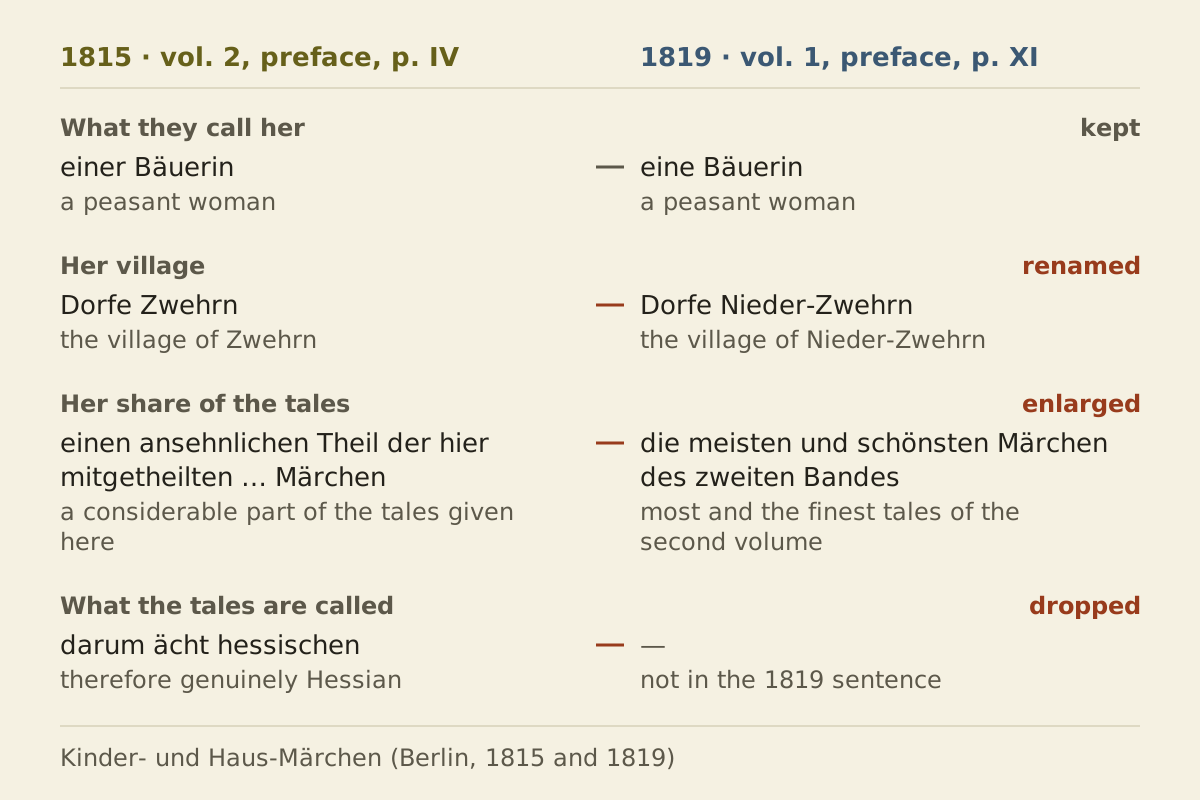
The sentence that introduces the Zwehrn teller, in four parts: one kept, three changed. Preface to vol. 2, p. IV (1815), and to vol. 1, p. XI (1819).
Credit line for reuse
"One preface sentence about the Zwehrn teller, 1815 and 1819" by Once Upon a Version — https://onceuponaversion.com/tellings/dorothea-viehmann-brothers-grimm/ — licensed under CC BY 4.0 (https://creativecommons.org/licenses/by/4.0/)
Data: Kinder- und Haus-Märchen, prefaces of vol. 2 (1815) and vol. 1 (1819), German Wikisource transcriptions, retrieved 2026-11-03
The two prefaces on the teller from Zwehrn, topic by topic, as CSV (where the data comes from) Data: Kinder- und Haus-Märchen, prefaces of vol. 2 (1815) and vol. 1 (1819), German Wikisource transcriptions, retrieved 2026-11-03
In this site's studio terms, the 1819 edition is a new pressing of the preface, and her credit line grew on it. Its footnote on page XII names a reduced copy of Ludwig Grimm's etching of her as the frontispiece (“Titelkupfer”) of volume 2 and dates her death to 17 November 1816; the NDB gives 17 November 1815.
Where did she tell the Grimms her tales?
According to the NDB, Viehmann reached the brothers through Julia and Charlotte Ramus, daughters of Charles François Ramus, second preacher of the French congregation in Kassel, and the two sisters contributed tales of their own. The brothers then took down Viehmann's contributions mainly in their flat on the Marktgasse in Kassel.
A later picture moved the scene to her village. In 1892 the magazine Die Gartenlaube printed a picture captioned “Die Brüder Jakob und Wilhelm Grimm bei der Märchenerzählerin Frau Viehmann in Niederzwehren,” the brothers Jakob and Wilhelm Grimm with the storyteller Frau Viehmann in Niederzwehren. Lauer writes that Louis Katzenstein's oil painting of the brothers with her, from the same year and composed as a peasant idyll, fixed her image as a simple woman of the people.
The earlier image came from inside the family. Ludwig Emil Grimm, the brothers' younger brother, drew her in 1814, and the NDB notes that the etching made from it has appeared in many editions since 1819. Zipes reads the 1819 frontispiece as the Grimms' attempt to vouch for their tales by presenting her as an almost legendary peasant woman.
The 1819 preface also explains why Hesse kept its tales, describing it as a mountainous land “von großen Heerstraßen abseits,” away from the great highways and mostly given to farming (p. XIII). Her biographer's suggestion points somewhere else: to an inn where carters stopped, and to soldiers in wartime.
Neither picture is reproduced on this page: the engraver of the 1892 print is not identified, and the scans of her portrait on Wikimedia Commons are later re-engravings or crops of uncertain edition, not Ludwig Emil Grimm's 1814 drawing or the 1819 etching. His own hand in those years can be shown. The etching below is his portrait of his brother Jacob, signed at Kassel in 1815, the year volume 2 appeared.
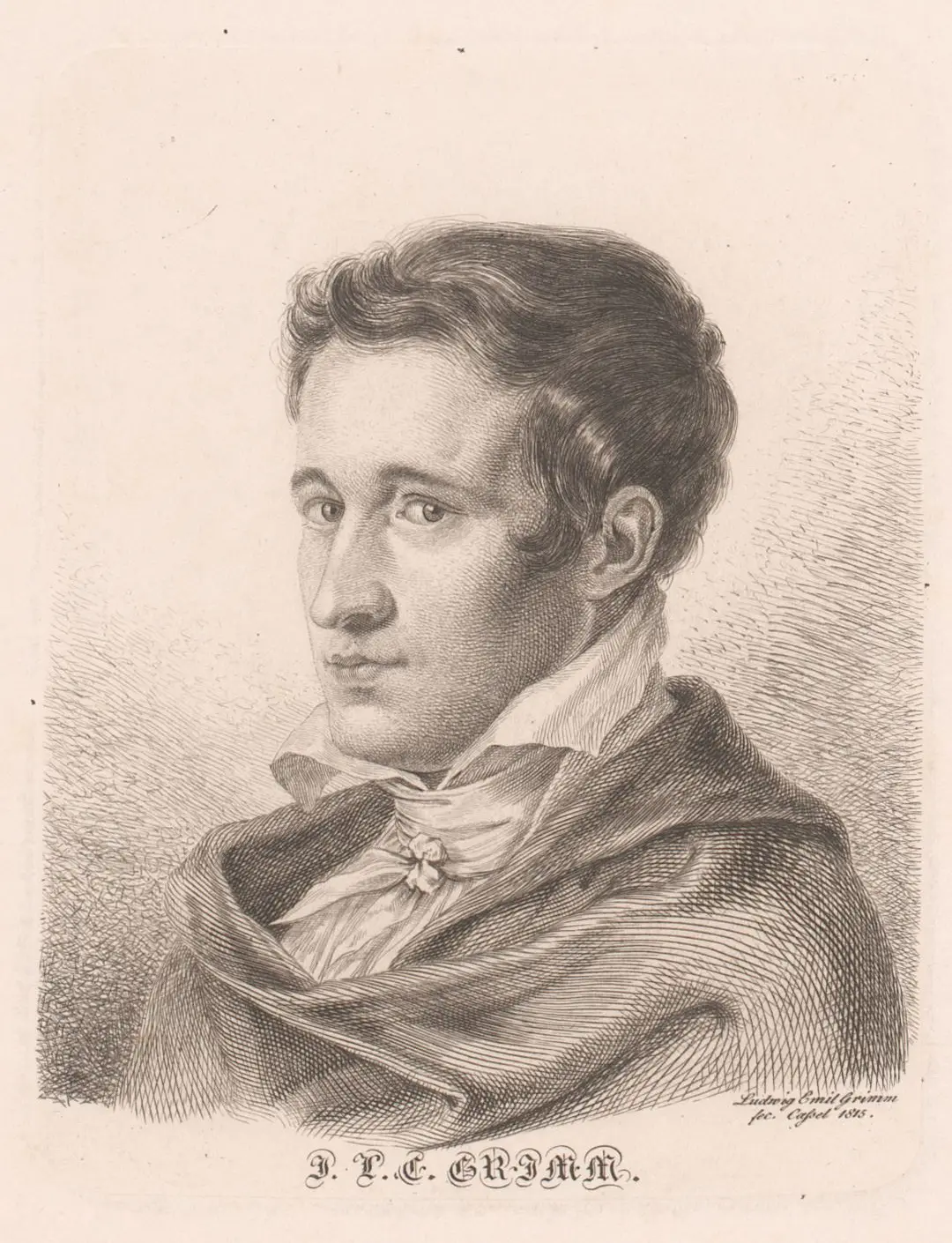
Jacob Grimm, etching by Ludwig Emil Grimm, 1815. Rijksmuseum, RP-P-1907-1042.
"Portret van Jacob Ludwig Karl Grimm" by Ludwig Emil Grimm — https://commons.wikimedia.org/wiki/File:Portret_van_Jacob_Ludwig_Karl_Grimm,_RP-P-1907-1042.jpg — CC0 1.0 (https://creativecommons.org/publicdomain/zero/1.0/); modified: cropped to the plate (sheet margins removed)
How much of volume 2 came from Zwehrn?
Each of the 70 numbered tales in the 1815 volume has a note. The count below sorts every tale by the first source statement in its note, using the Wikisource transcription of the first edition. Because the notes credit places rather than named tellers, and name authors only for some of the written sources, this count measures the label “Zwehrn,” not Viehmann herself.
- 15 notes name Zwehrn: 14 alone, and one, no. 34 “Die drei Handwerkspurschen,” together with a telling from the Leine region.
- 40 name another place, most often the Paderborn and Münster areas or districts of Hesse.
- 13 tales, nos. 57–69, came from written sources, as the note to no. 57 states.
- 2 give no place: no. 6 says only that a soldier told it, and no. 24 places only its variants.
Not one of the 70 notes uses her name. In the whole volume she is named once, in the preface, as “Viehmännin.”
Fifteen of seventy is about one tale in five, which fits the 1815 wording, “a considerable part.” The 1819 volume 2 is not counted here: it was renumbered from 87 onward and partly changed, and its notes came out as a separate third volume in 1822, so this count cannot test the later “most.”
The label also misses part of her work. The NDB lists her versions of “Aschenputtel” (Cinderella) and “Der Teufel mit den drei goldenen Haaren” (The Devil with the Three Golden Hairs), and neither is among the 70 tales counted here; the register of named Grimm tellers lists both.
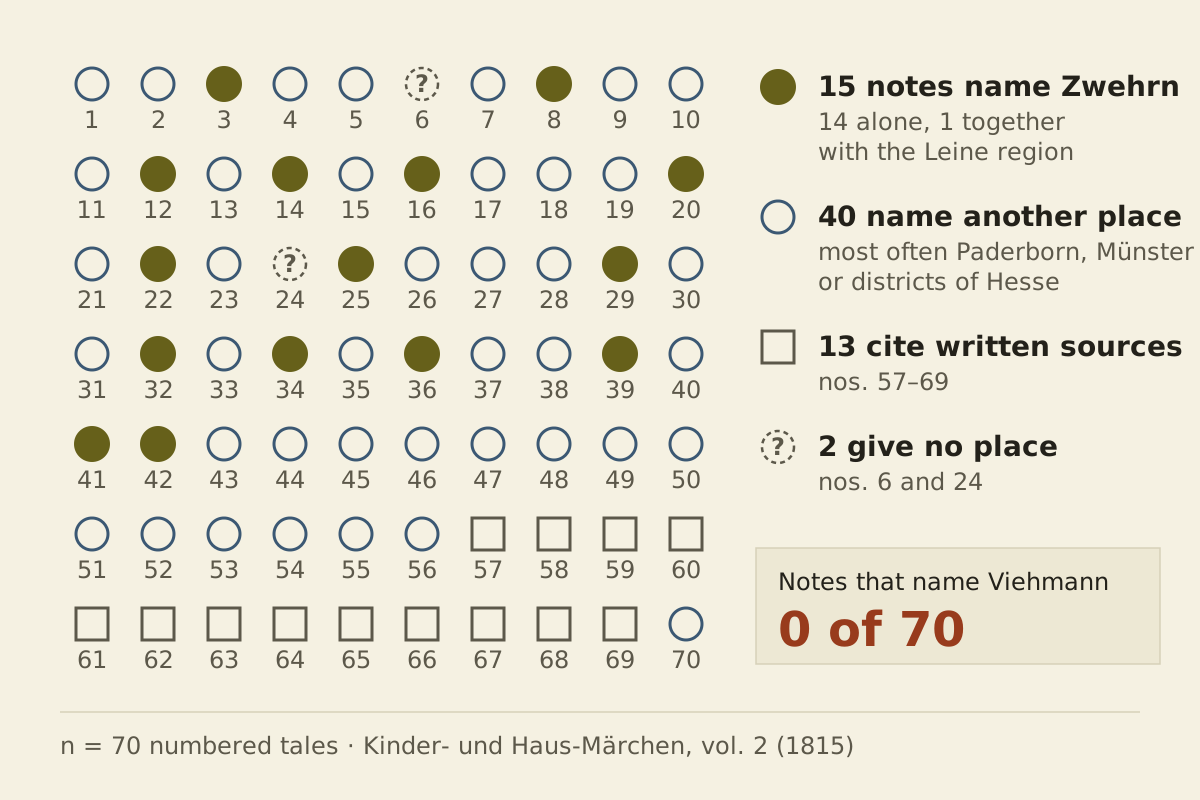
One mark per tale, in book order; n = 70 notes in Kinder- und Haus-Märchen, vol. 2, 1815.
Credit line for reuse
"Where the Grimms' 1815 notes place the 70 tales of volume 2" by Once Upon a Version — https://onceuponaversion.com/tellings/dorothea-viehmann-brothers-grimm/ — licensed under CC BY 4.0 (https://creativecommons.org/licenses/by/4.0/)
Data: Kinder- und Haus-Märchen, vol. 2 (1815), notes to the 70 numbered tales, German Wikisource transcription, retrieved 2026-10-07
The 70 notes as CSV (where the data comes from) Data: Kinder- und Haus-Märchen, vol. 2 (1815), notes to the 70 numbered tales, German Wikisource transcription, retrieved 2026-10-07
| Note names | Tales | Numbers in the 1815 volume |
|---|---|---|
| Zwehrn | 15 | 3, 8, 12, 14, 16, 20, 22, 25, 29, 32, 34, 36, 39, 41, 42 |
| Another place | 40 | 1, 2, 4, 5, 7, 9, 10, 11, 13, 15, 17, 18, 19, 21, 23, 26, 27, 28, 30, 31, 33, 35, 37, 38, 40, 43, 44, 45, 46, 47, 48, 49, 50, 51, 52, 53, 54, 55, 56, 70 |
| Written source | 13 | 57–69 |
| No place given | 2 | 6, 24 |
Was she a typical Grimm storyteller?
Zipes's answer is no. In his account, Viehmann was unlike most of the brothers' informants, who were young women from educated middle-class or aristocratic families. In the house of Rudolf Wild, a pharmacist, the daughters told about forty tales in all, by Zipes's estimate.
The three Hassenpflug sisters, Marie, Jeanette and Amalie, spoke French at home and gave more than thirty stories, Zipes writes.
Zipes singles out two exceptional tellers from the lower classes: Viehmann and Johann Friedrich Krause, a poor retired soldier from the village of Hoof, who gave seven texts, of which four were printed. Of the two, it was Viehmann whose portrait faced volume 2.
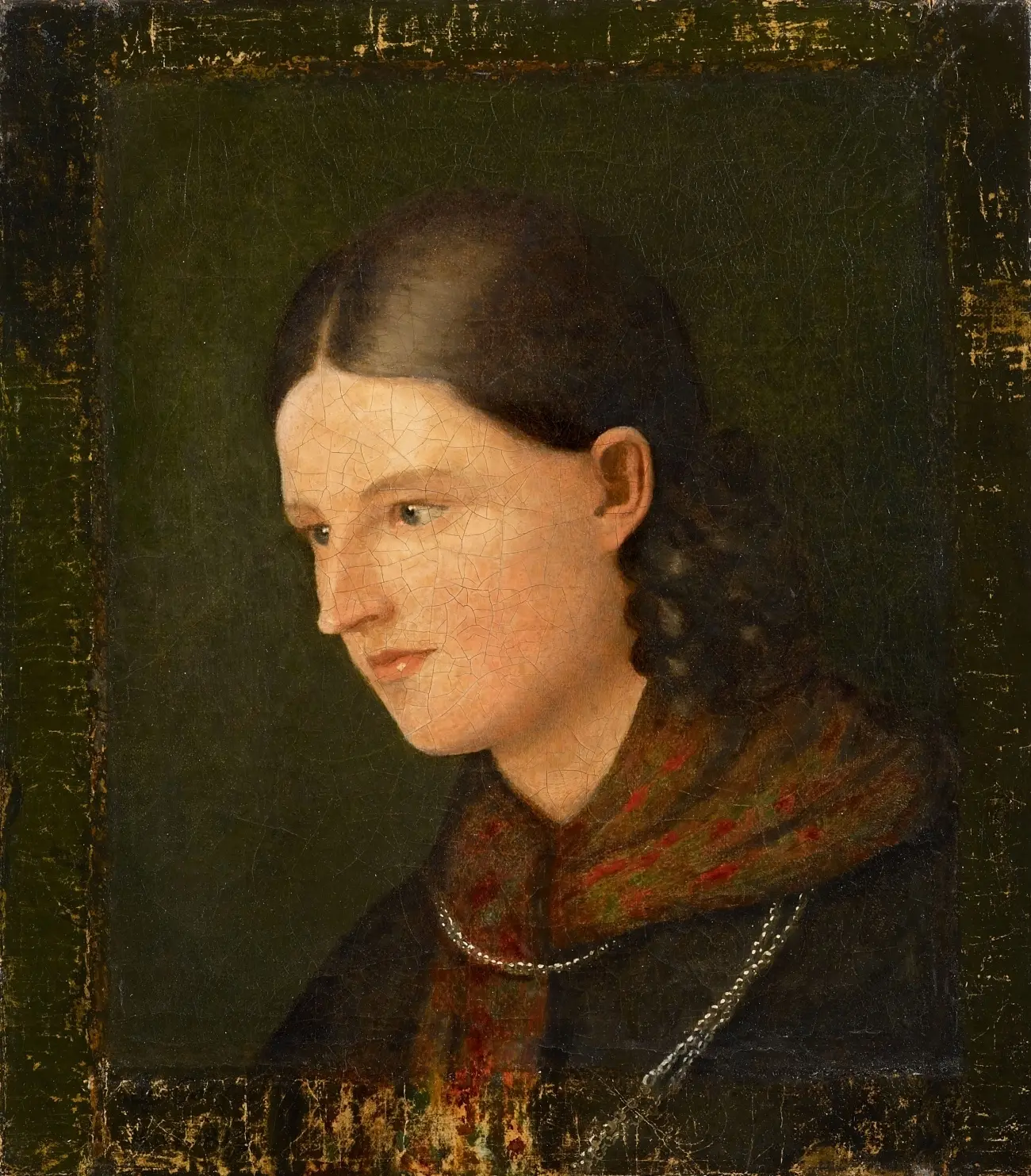
Amalie Hassenpflug, one of the three sisters named above. Ludwig Emil Grimm, oil on canvas, 1818.
"Portrait der Amalie Hassenpflug" by Ludwig Emil Grimm — https://commons.wikimedia.org/wiki/File:Ludwig_Emil_Grimm_Portrait_Amalie_Hassenpflug_1818.jpg — Public domain in US (painted 1818; Ludwig Emil Grimm d. 1863); DE/FR (Ludwig Emil Grimm d. 1863, life+70); faithful photograph of a two-dimensional painting (PD-Art; auction-house photograph, Kunsthaus Lempertz)
What did the Grimms say about their own wording?
The 1819 preface keeps the line that some of what she told was kept “wörtlich,” word for word (p. XII). Three pages later, describing their method, the brothers write “daß der Ausdruck großentheils von uns herrührt, versteht sich von selbst,” which we paraphrase as: it goes without saying that the wording comes largely from us (p. XV).
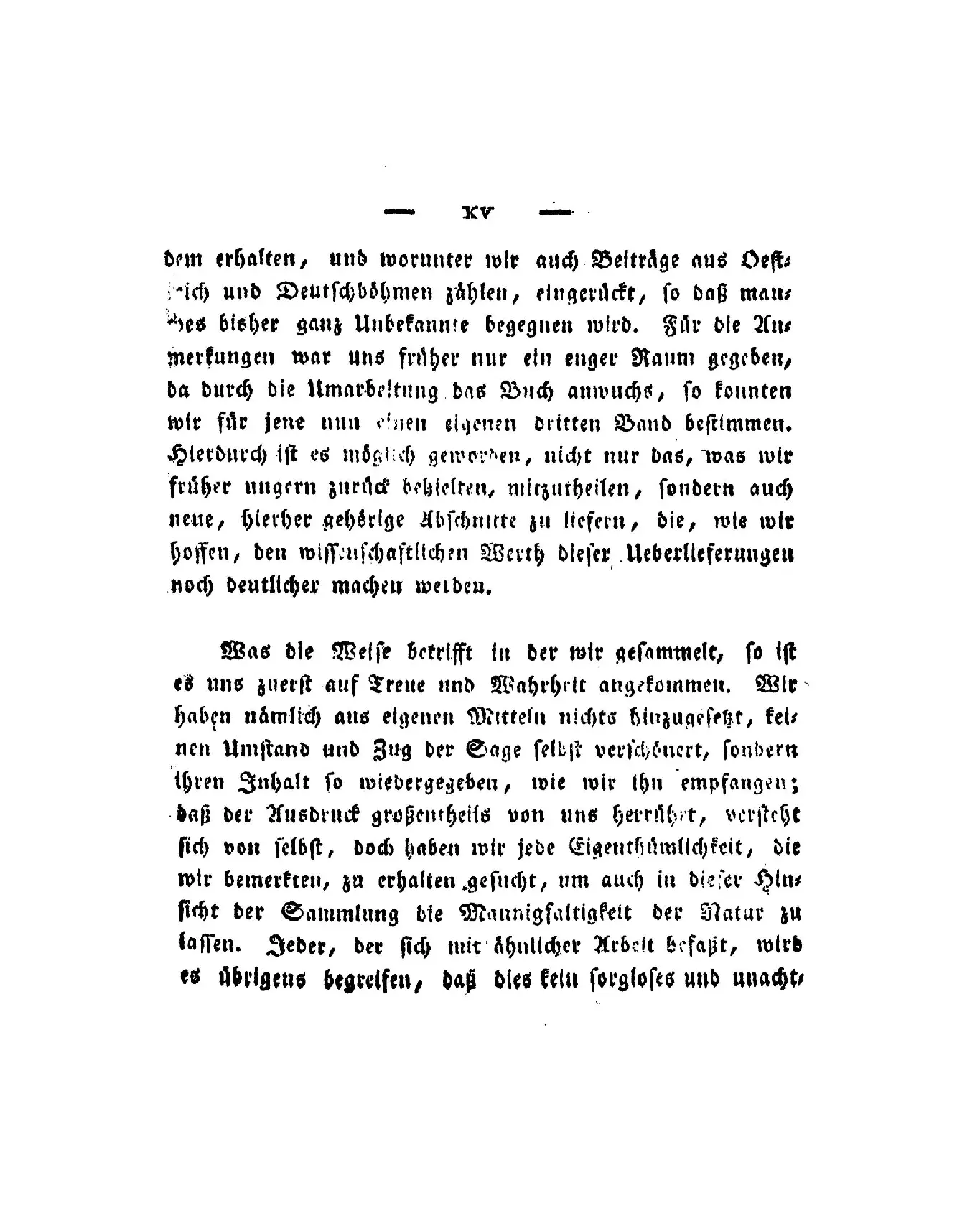
Page XV of the 1819 preface, where the brothers write that the wording comes largely from them. Jacob and Wilhelm Grimm, Kinder- und Haus-Märchen, vol. 1, 2nd ed., 1819.
Full credit
"Kinder- und Haus-Märchen, vol. 1 (1819), preface, p. XV" by Jacob and Wilhelm Grimm — https://commons.wikimedia.org/wiki/File:De_Kinder_und_Hausm%C3%A4rchen_Grimm_1819_V1_v_015.jpg — Public domain in US (published 1819); DE/FR (Jacob Grimm d. 1863, Wilhelm Grimm d. 1859, life+70)
Both statements stand in the same preface, so they show what the Grimms said about their method, not how much any single tale changed. That can only be shown tale by tale, with the editions set side by side.
On the record, Dorothea Viehmann was an innkeeper's daughter from the Knallhütte and a tailor's wife in Zwehren, introduced by two preacher's daughters. Between 1813 and 1815 she came into Kassel and told the brothers her tales, by their account slowly enough to copy. The note to “The Goose Girl” credits her village, not her: “(Aus Zwehrn).” A century later, Bolte and Polívka's commentary on the tale states that Jacob Grimm wrote it down (vol. 2, 1915, p. 273).
Sources
Editions
- Brüder Grimm, Kinder- und Haus-Märchen, vol. 2, 1st ed. (Berlin: Realschulbuchhandlung, 1815): title page, preface (Vorrede, pp. III–XII, dated Cassel, 30 September 1814) and contents. German Wikisource transcription. https://de.wikisource.org/wiki/Kinder-_und_Haus-M%C3%A4rchen_Band_2_(1815) (title page, full preface and contents)
- Brüder Grimm, Kinder- und Haus-Märchen, vol. 2 (1815): the 70 numbered tales and their notes (Anhang), among them no. 3, “Die Gänsemagd,” pp. 16–25, with its note “Das Gänsmädchen,” pp. V–VI (page numbers as printed; the Wikisource tale pages mark them VI–VII). German Wikisource transcription; the address of every tale page is in the CSV of the notes. https://de.wikisource.org/wiki/Die_G%C3%A4nsemagd_(1815) (all 70 notes, and the full text of no. 3 with its note)
- Brüder Grimm, Kinder- und Haus-Märchen, vol. 1, 2nd ed. (Berlin: G. Reimer, 1819): preface (Vorrede), pp. X–XVIII, with footnote 3 (Wikisource numbering), anchored on p. XII. German Wikisource transcription. https://de.wikisource.org/wiki/Kinder-_und_Haus-M%C3%A4rchen_Band_1_(1819) (preface, pp. X–XVIII, with its footnotes)
- Brüder Grimm, Kinder- und Haus-Märchen, vol. 2, 2nd ed. (Berlin: G. Reimer, 1819): title page (“Mit zwei Kupfern”) and contents, where “Die Gänsemagd” is no. 89. German Wikisource transcription. https://de.wikisource.org/wiki/Kinder-_und_Haus-M%C3%A4rchen_Band_2_(1819) (title page and contents)
- Die Gartenlaube, 1892 volume: list of pictures, entry “Die Brüder Jakob und Wilhelm Grimm bei der Märchenerzählerin Frau Viehmann in Niederzwehren.” German Wikisource index of the volume. https://de.wikisource.org/wiki/Die_Gartenlaube_(1892) (list of pictures)
- Giambattista Basile, Lo cunto de li cunti (Il pentamerone), “testo conforme alla prima stampa del MDCXXXIV-VI,” ed. Benedetto Croce, vol. 1 (Naples, 1891). Italian Wikisource transcription. https://it.wikisource.org/wiki/Lo_cunto_de_li_cunti (title page and contents of vol. 1)
Research
- Bernhard Lauer, “Viehmann, Catharina Dorothea, geborene Pierson,” Neue Deutsche Biographie 26 (2016), pp. 791–792. Deutsche Biographie online edition. https://www.deutsche-biographie.de/119383268.html (full entry; paraphrased, not quoted) Text licence: CC BY-NC-ND 4.0, https://creativecommons.org/licenses/by-nc-nd/4.0/
- Jack Zipes, introduction to Grimm Legacies: The Magic Spell of the Grimms’ Folk and Fairy Tales (Princeton: Princeton University Press, 2014). https://doi.org/10.23943/princeton/9780691160580.003.0001 (bibliographic reference)
- Johannes Bolte and Jiří Polívka, Anmerkungen zu den Kinder- und Hausmärchen der Brüder Grimm, vol. 2: nos. 61–120 (Leipzig: Dieterich’sche Verlagsbuchhandlung Theodor Weicher, 1915), p. 273, entry for no. 89, “Die Gänsemagd.” Page scan on Wikimedia Commons. https://commons.wikimedia.org/wiki/File:Grimms_M%C3%A4rchen_Anmerkungen_(Bolte_Polivka)_II_273.jpg (one page, read from the page image; paraphrased, not quoted)

Catalogues and databases
- Gemeinsame Normdatei (GND) 119383268, “Viehmann, Dorothea,” authority record, via lobid-gnd (hbz). https://lobid.org/gnd/119383268 (authority record) Text licence: CC0 1.0, https://creativecommons.org/publicdomain/zero/1.0/
- D. L. Ashliman, The Grimm Brothers’ Children’s and Household Tales, list with tale-type numbers, Folklore and Mythology Electronic Texts (University of Pittsburgh): no. 50, “Little Brier-Rose,” type 410; no. 89, “The Goose Girl,” type 533. https://sites.pitt.edu/~dash/grimmtales.html (tale-type numbers only)
Cite this page
Once Upon a Version. “Brothers Grimm: Their ‘Peasant Woman’ Was a Tailor’s Wife.” Once Upon a Version. Published 2026-11-05. https://onceuponaversion.com/tellings/dorothea-viehmann-brothers-grimm/ (accessed day month year).
Write in the date you read the page; the page has no DOI.
More from One Tale, Many Tellers
One Tale, Many Tellers
Grimm Fairy Tales 1–60: Counted Here, 21 Named Tellers
Type collection of folktales (no single ATU number)
Bolte and Polívka’s 1913 notes on Grimm tales 1–60 name 21 tellers, 13 of them women, and 34 of 62 credits name Kassel. The register lists them entry by entry.
Picture credit
"Doppelportrait der Brüder Jacob und Wilhelm Grimm" by Elisabeth Jerichau-Baumann — https://commons.wikimedia.org/wiki/File:Alte_Nationalgalerie-Jerichau-Baumann-Gebr%C3%BCder_Grimm_DSC8174.jpg — CC0 1.0 (https://creativecommons.org/publicdomain/zero/1.0/); modified: cropped to the painted canvas; gilt frame and wall removed
One Tale, Many Tellers
Sleeping Beauty: In Basile and Perrault, No Kiss Wakes Her
Type ATU 410, as classified by D. L. Ashliman
Sleeping Beauty in Basile (printed 1636): twins draw out a splinter. Perrault (1697): the spell ends. Of 4 texts compared here, only 2 Grimm texts use a kiss.
Picture credit
"La Belle au Bois Dormant" by Gustave Doré — https://commons.wikimedia.org/wiki/File:La_Belle_au_Bois_Dormant_(136548149).jpg — Public domain in US (published 1867); DE/FR (Gustave Doré d. 1883, life+70); the wood engraver’s signature at lower right is not legible, and an engraver working on an 1867 edition is presumed not to have lived past 1955 (log, image ruling 10)
One Tale, Many Tellers
Aladdin: A Syrian Teller Gave It to Galland in Paris, 1709
Type tale printed in Galland’s Thousand and One Nights (no ATU number cited)
In the sources checked here, Aladdin’s earliest known record is Galland’s diary for 5 May 1709: Hanna, a Maronite from Aleppo, had just told him the tale.
Picture credit
"The Blue Fairy Book (1889), p. 78: plate to “Aladdin and the Wonderful Lamp”" by H. J. Ford — https://commons.wikimedia.org/wiki/File:The_Blue_Fairy_Book-0112.jpg — Public domain in US (published London and New York 1889); DE/FR (Henry Justice Ford d. 1941, life+70, public domain from 1 January 2012); modified: Cropped to the plate and its ruled frame with a strip of paper around it; the page text above and below is left out