The Goose Girl: Of 7 Editions Checked, Iron Stove From 1840
In the Grimms’ Goose Girl the princess pours out her story to a stove, and between the 1815 and 1857 texts the stove itself was swapped.
By Once Upon a Version
Published
How a version is traced · Version history · Contact · Report an error (contact@onceuponaversion.com)
In short
- In the Grimms’ 1815 “The Goose Girl,” the king tells the princess to tell her story to a Kachelofen, a tiled stove; the 1857 text makes it an Eisenofen, an iron stove.
- Of the seven editions checked here, the 1815, 1819 and 1837 texts keep the tiled stove and the 1840, 1843, 1850 and 1857 texts have the iron one.
- The refrain, rendered on this page as if your mother knew, is printed 5 times in the 1815 text and 6 times in the 1857 text, where the princess finally says it herself, inside the stove.
Telling card
- Tale
- The Goose Girl (Die Gänsemagd; “Das Gänsmädchen” in the 1815 note)
- Type
- ATU 533, as classified by D. L. Ashliman
- Teller
- the Zwehrn teller (the 1815 preface names her Viehmännin)
- Recorded by
- Jacob Grimm
5 more fields: edited by, told, published, this text, earliest known
- Edited by
- Jacob and Wilhelm Grimm; vol. 2 no. 3 (1815), no. 89 (1819 on)
- Told
- Date and place unrecorded; the 1815 note gives only her village, Zwehrn
- Published
- Kinder- und Haus-Märchen, vol. 2 (Berlin: Realschulbuchhandlung, 1815), pp. 16–25
- This text
- The 1815 and 1857 texts, Wikisource transcriptions; the stove passage also read in 1819, 1837, 1840, 1843 and 1850
- Earliest known
- The 1815 print; no manuscript write-up in the sources read
This card as CSV · where these values come from
Data: Kinder- und Haus-Märchen, vol. 2 (1815): tale no. 3, its note and the preface; vol. 2 (1819): contents; Bolte and Polívka, Anmerkungen, vol. 2 (Leipzig, 1915), p. 273; D. L. Ashliman’s list of Grimm tales with type numbers, https://sites.pitt.edu/~dash/grimmtales.html; Die Gänsemagd, seven editions, retrieved 2026-11-04
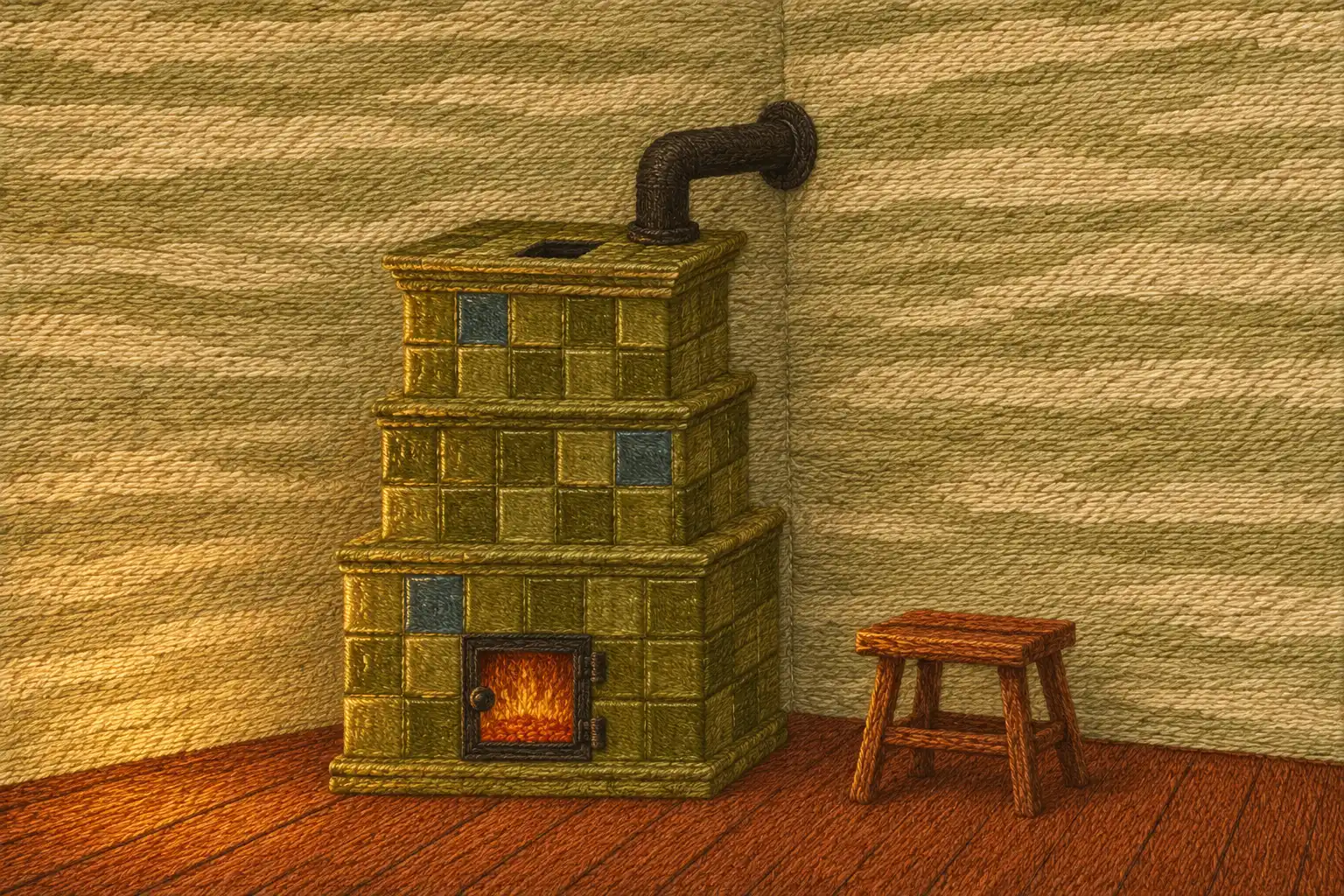
Illustration of a tiled stove of the kind the 1815 text names, a Kachelofen with an opening in the top. Not a picture of any stove in the tale’s sources.
Illustration: Once Upon a Version. Generated illustration — not a historical image, manuscript or record. © Once Upon a Version, all rights reserved; reuse by request.
In the Grimms’ 1815 text, a princess crawls into a tiled stove to say what she swore to keep secret. The tale stands third in the second volume of Kinder- und Haus-Märchen, printed in Berlin in 1815, and the old king listens through a hole in the top of the stove. The tale is “The Goose Girl,” Die Gänsemagd, and the stove is where its secret finally comes out.
The scene works only because of a promise and a loophole: on the road, the maid forces the princess to swear that she will tell no human being what happened; at the palace, the king does not argue with the oath but gives her a listener that is not a person. Every repeated line in the tale leads up to that evening, which is why the stove is the most revealing place to begin reading it.
Why can she not simply tell the king?
The 1815 text gives the oath on page 18. After the princess loses the cloth with her mother’s three drops of blood, the maid takes her horse and clothes, and the princess must swear under the open sky „daß sie am königlichen Hof keinem Menschen nichts davon sprechen wollte“: in this site’s rendering, as with every English rendering of German on this page, that at the royal court she would speak of it to no human being.
Had she refused, the text says, she would have been killed on the spot. The oath names people, not things, and when the king finally asks her why she behaves as she does, she repeats it in exactly those terms, saying she may not tell him or any other human being. Nothing in it forbids speaking to an object, and the whole stove scene depends on that gap.
In the 1857 text her answer adds a phrase, „darf auch keinem Menschen mein Leid klagen“: in this site’s rendering, she may not lament her sorrow to any human being. The king’s reply uses her own words, „so klag dem Eisenofen da dein Leid“, then lament your sorrow to the iron stove there. He takes the verb directly from her answer and changes only the listener.
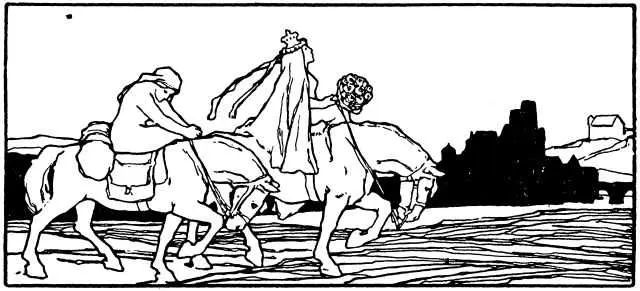
Two riders on the road, one in a crown and veil, a walled town ahead. Otto Ubbelohde, illustration to Die Gänsemagd, 1909.
"Otto Ubbelohde - Die Gänsemagd" by Otto Ubbelohde — https://commons.wikimedia.org/wiki/File:Otto_Ubbelohde_-_Die_G%C3%A4nsemagd.jpg — Public domain in US (published 1909, per the file page); DE/FR (Otto Ubbelohde d. 1922, life+70; GND 118624946 via lobid-gnd)
The tale is ATU 533, as classified by D. L. Ashliman. A type number places the tale among others but says nothing about the stove, which is the detail this page follows from edition to edition.
How often do Falada’s head and the wind rhyme speak?
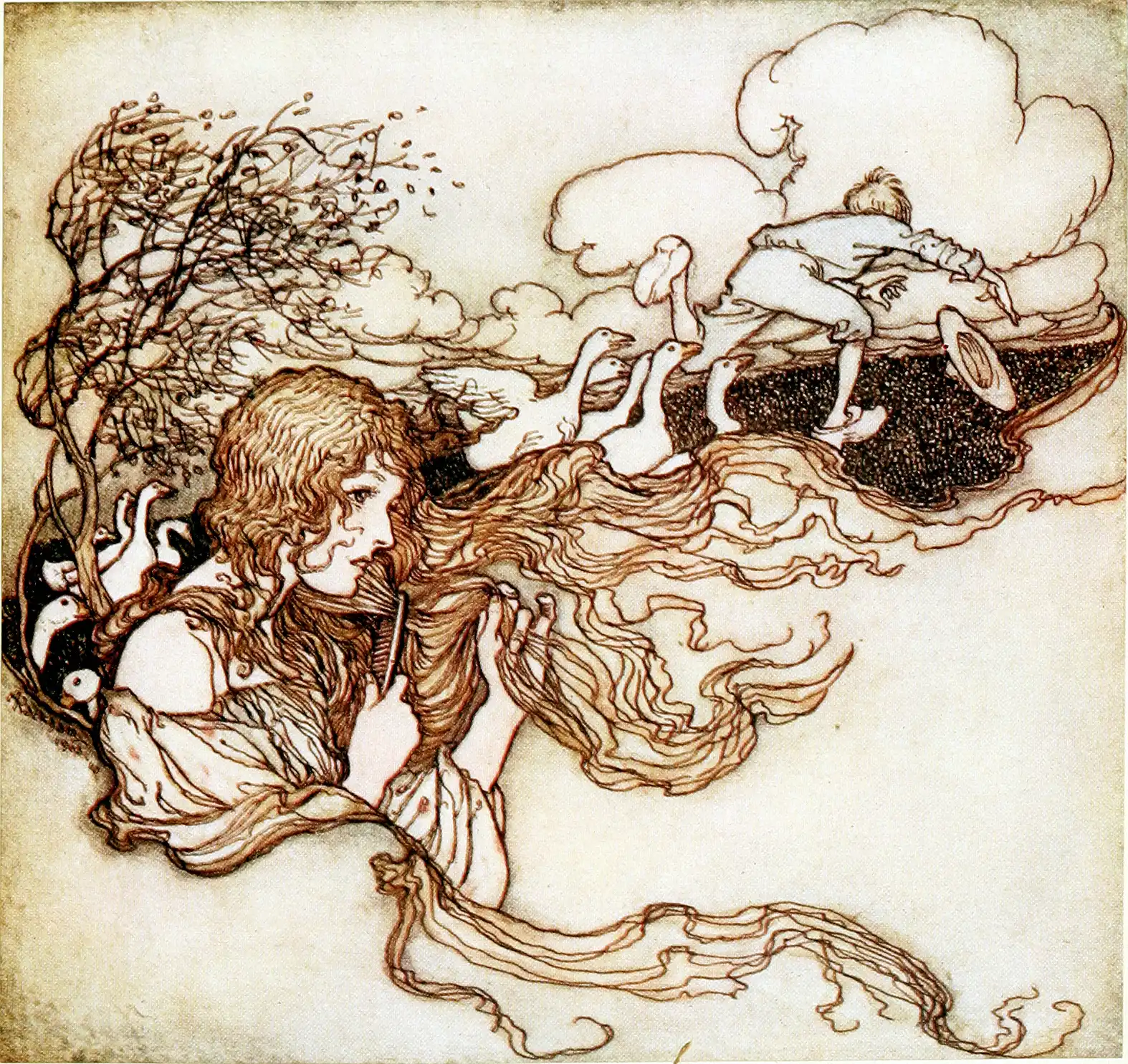
The goose girl combs her hair while the wind carries off Kürdchen’s hat. Arthur Rackham, Snowdrop & Other Tales (Dutton), 1920.
"The Goosegirl" by Arthur Rackham — https://commons.wikimedia.org/wiki/File:Snowdrop-Rackham-135.jpg — Public domain in US (published New York: Dutton, 1920, per the Internet Archive record of the scanned copy; the plates first appeared in 1909); DE/FR (Arthur Rackham d. 1939, life+70)
Before the stove, the truth is said aloud many times, but only to listeners who cannot or will not act on it. Falada, the princess’s talking horse, is killed at the false bride’s request, and its head is nailed under the dark town gate. Each morning the princess greets it, and the head answers with the same refrain the drops of blood spoke on the road: if your mother knew, her heart would break.
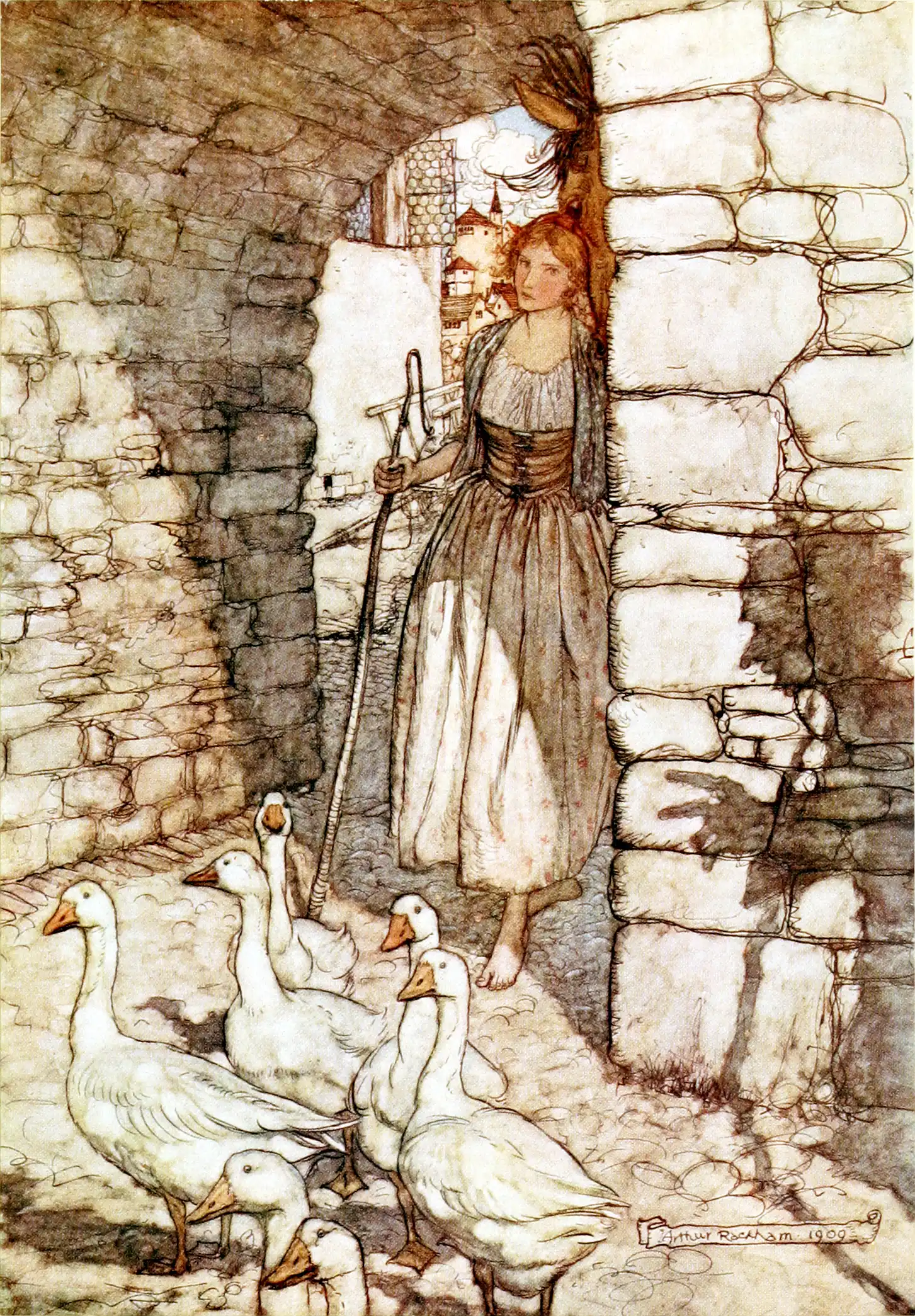
The goose girl at the dark gate, Falada’s head nailed to the wall above her. Arthur Rackham, Snowdrop & Other Tales (Dutton), 1920.
Full credit
"Snowdrop & Other Tales, plate facing p. 129" by Arthur Rackham — https://commons.wikimedia.org/wiki/File:Snowdrop-Rackham-129.jpg — Public domain in US (published New York: Dutton, 1920, per the Internet Archive record of the scanned copy; the plate is signed 1909); DE/FR (Arthur Rackham d. 1939, life+70)
Counting every printed occurrence of the three repeated lines gives 11 in the 1815 text and 12 in the 1857 text. The refrain itself comes 5 times in 1815: twice from the drops of blood, twice from Falada’s head, and once in Kürdchen’s report, where the goose boy quotes the head to the old king. The greeting “Falada, da du hangest,” Falada, there you hang, is printed 3 times, and the wind rhyme 3 times.
Kürdchen is the boy who herds the geese with her; on the meadow she lets down her hair, he tries to pull some of it out, and she calls up a wind to blow his hat away, „weh’! weh’! Windchen“, blow, blow, little wind, in the 1815 spelling. On the third morning the old king sits behind the gate and hears her speak with the head, but neither text prints those words again, so the reader is told only that he heard them.
The rhyme is not quite fixed even inside a single text, as a comparison of the three days shows. On the first day of the 1815 text she says „nimm Kürdchen sein Hütchen“, take Kürdchen’s little hat; on the second, „nimm dem Kürdchen sein Hütchen“, the same words with an article before his name; on the third, with the king hidden in a bush, „Faß Kürdchen sein Hütchen“, seize Kürdchen’s little hat. The 1857 text keeps the third-day „faß“ and makes the first two days match.
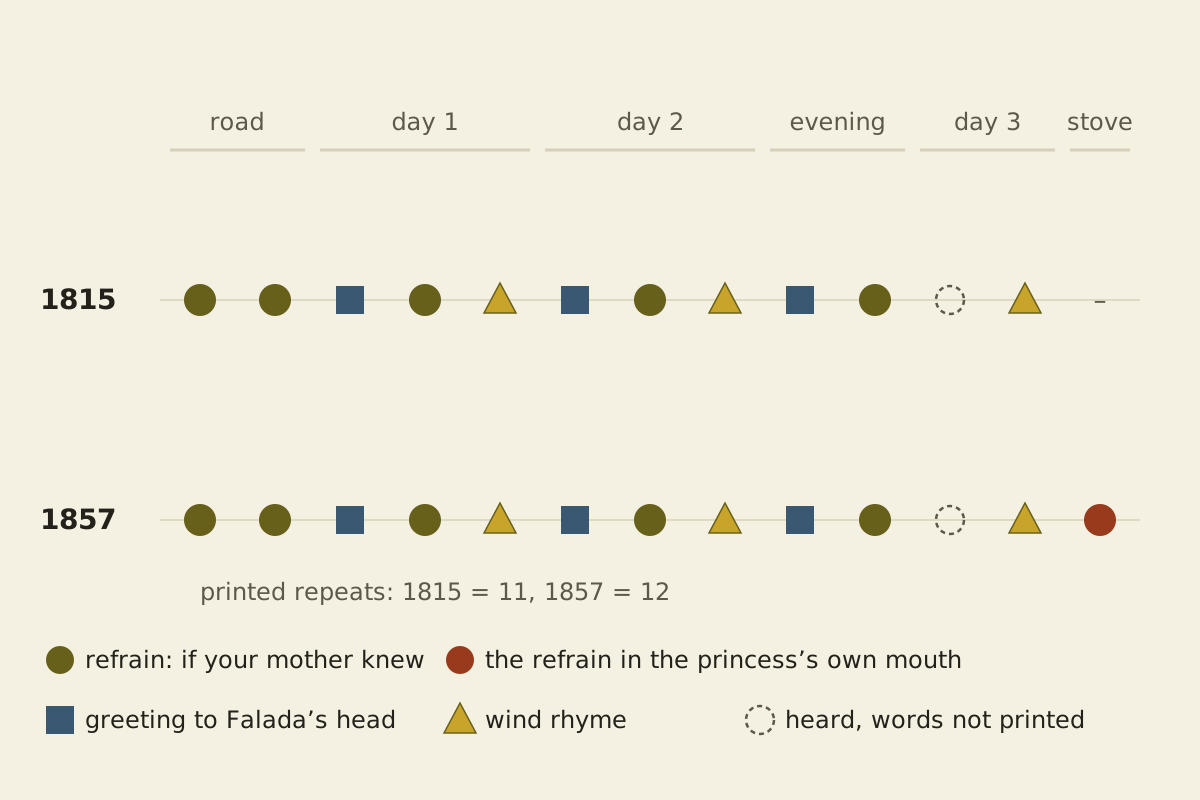
Each printed repeat of the refrain, the greeting to Falada and the wind rhyme, in text order; the dashed circle is the third morning, when the words are not printed. Die Gänsemagd, 1815 and 1857.
Credit line for reuse
"Repeated lines in the Grimms’ Goose Girl, 1815 and 1857" by Once Upon a Version — https://onceuponaversion.com/craft/goose-girl-falada/ — licensed under CC BY 4.0 (https://creativecommons.org/licenses/by/4.0/)
Data: Die Gänsemagd, Kinder- und Haus-Märchen, vol. 2, 1815 (pp. 16–25) and 1857 (pp. 13–19), German Wikisource, retrieved 2026-11-04
Every repeated line, 1815 and 1857, as CSV (where the data comes from) Data: Die Gänsemagd, Kinder- und Haus-Märchen, vol. 2, 1815 (pp. 16–25) and 1857 (pp. 13–19), retrieved 2026-11-04
| Day | Scene | Line | Spoken by | 1815 page | 1857 page |
|---|---|---|---|---|---|
| journey | road, first stream | refrain: if your mother knew | the three drops of blood | 17 | 14 |
| journey | road, second stream | refrain: if your mother knew | the three drops of blood | 18 | 14 |
| day 1 | gate, morning 1 | greeting to Falada’s head | the princess | 20 | 16 |
| day 1 | gate, morning 1 | refrain: if your mother knew | Falada’s head | 20 | 16 |
| day 1 | meadow, day 1 | wind rhyme | the princess | 21 | 16 |
| day 2 | gate, morning 2 | greeting to Falada’s head | the princess | 21 | 16 |
| day 2 | gate, morning 2 | refrain: if your mother knew | Falada’s head | 21 | 17 |
| day 2 | meadow, day 2 | wind rhyme | the princess | 21 | 17 |
| day 2 evening | evening report to the old king | greeting to Falada’s head | Kürdchen, quoting the princess | 22 | 17 |
| day 2 evening | evening report to the old king | refrain: if your mother knew | Kürdchen, quoting the head | 22 | 17 |
| day 3 | gate, morning 3, the old king listening | greeting and answer (not printed) | the princess and Falada’s head | 23 | 18 |
| day 3 | meadow, day 3, the old king hidden in a bush | wind rhyme | the princess | 23 | 18 |
| day 3 evening | inside the stove, evening of day 3 | refrain: if your mother knew | the princess, of her own mother | not in 1815 | 18 |
Read as a sequence, the repeats move the secret one listener closer to someone who can act. The drops of blood speak to the princess alone; the head speaks in front of Kürdchen; Kürdchen carries the words to the old king; the king hears the exchange himself and then watches the wind rhyme from a bush. The count shows how the repeats hand the story on, not why tellers or editors favoured threes, and this page makes no claim about that.
How did the stove change between editions?
The tiled stove and the iron stove are not the only difference between the two texts. In 1815 the princess answers the king, „Ja, das will ich wohl“, agreeing that she will, then crawls into the stove, and the narrator summarizes what she said: her whole heart, how things had gone for her, how the wicked maid had deceived her. In 1857 she gives no answer at all; the king walks away, and she climbs into the iron stove, weeps, and speaks a lament in her own voice.
1815 · Kinder- und Haus-Märchen, vol. 2, 1st ed., pp. 23–24
„so darfst du’s doch dem Kachelofen erzählen.“ … „Aber der Ofen hatte oben ein Loch, da lauerte ihr der alte König zu“
edited by Jacob and Wilhelm Grimm · Kinder- und Haus-Märchen, vol. 2, 1815, pp. 23–24
1857 · Kinder- und Haus-Märchen, vol. 2, 7th ed., pp. 18–19
„so klag dem Eisenofen da dein Leid,“ … „Der alte König stand aber außen an der Ofenröhre, lauerte ihr zu und hörte was sie sprach.“
edited by Jacob and Wilhelm Grimm · Kinder- und Haus-Märchen, vol. 2, 1857, pp. 18–19
What changed: the tiled stove became an iron one, and the king moved from a hole in the top of the stove to the stove pipe outside.
In this site’s rendering, the 1815 king says she may at least tell it to the tiled stove, and the stove has a hole in the top where he lies in wait. The 1857 king tells her to lament her sorrow to the iron stove, and he stands outside by the stove pipe and hears what she says.
The 1857 lament ends on the tale’s refrain, turned into the first person: „Wenn das meine Mutter wüßte, das Herz im Leib thät ihr zerspringen“. Rendered here, it says that if her own mother knew, her heart would break. That is the sixth refrain in the count above, the only one spoken by the princess, whereas in the 1815 text the refrain never comes from her at all.
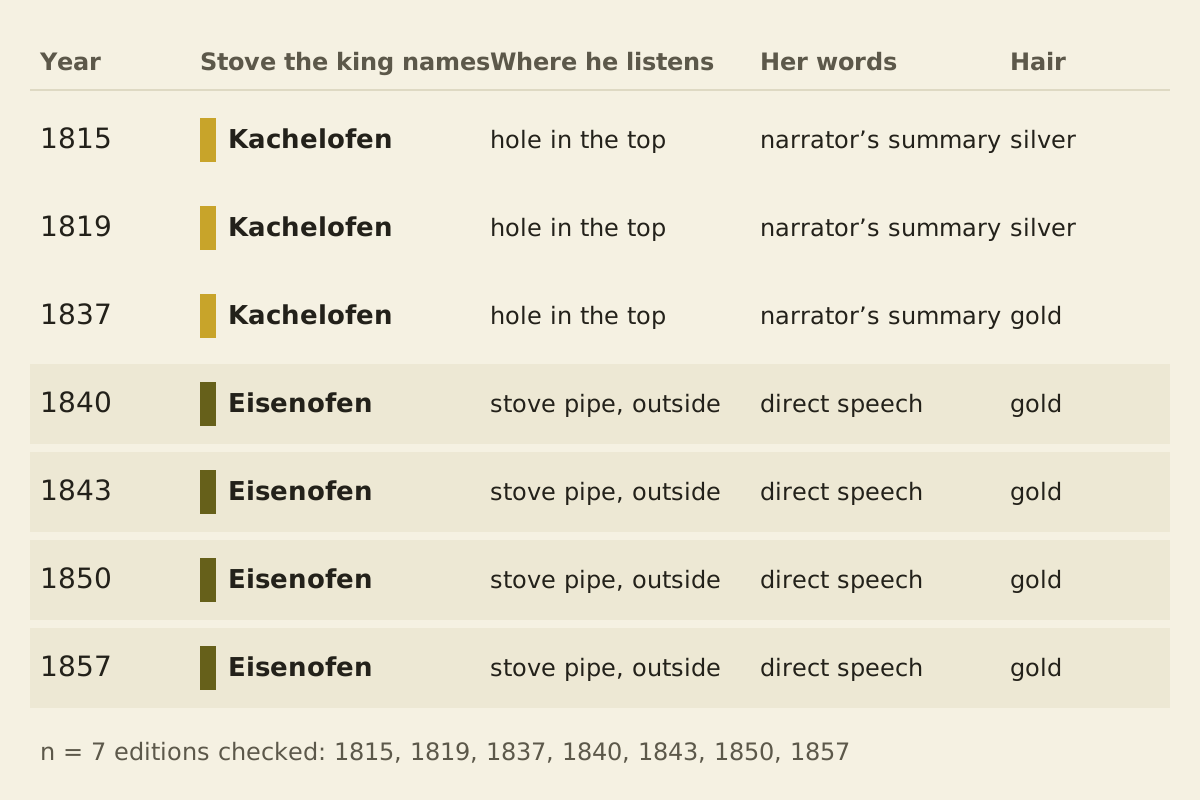
The stove scene in each edition of Die Gänsemagd on German Wikisource; n = 7 editions checked: 1815, 1819, 1837, 1840, 1843, 1850, 1857.
Credit line for reuse
"The stove scene in seven editions of the Grimms’ Goose Girl, 1815–1857" by Once Upon a Version — https://onceuponaversion.com/craft/goose-girl-falada/ — licensed under CC BY 4.0 (https://creativecommons.org/licenses/by/4.0/)
Data: Die Gänsemagd in seven editions of Kinder- und Haus-Märchen, vol. 2 (1815, 1819, 1837, 1840, 1843, 1850, 1857), German Wikisource, retrieved 2026-11-04
The seven editions compared, as CSV (where the data comes from) Data: Die Gänsemagd in seven editions of Kinder- und Haus-Märchen, vol. 2 (1815, 1819, 1837, 1840, 1843, 1850, 1857), retrieved 2026-11-04
| Edition | Stove the king names | Where he listens | Her words at the stove | Hair |
|---|---|---|---|---|
| 1815 (1st edition) | Kachelofen, p. 23 | hole in the top | summary by the narrator | silver |
| 1819 (2nd edition) | Kachelofen, p. 20 | hole in the top | summary by the narrator | silver |
| 1837 (3rd edition) | Kachelofen, p. 22 | hole in the top | summary by the narrator | gold |
| 1840 (4th edition) | Eisenofen, p. 22 | stove pipe, outside | direct speech | gold |
| 1843 (5th edition) | Eisenofen, p. 21 | stove pipe, outside | direct speech | gold |
| 1850 (6th edition) | Eisenofen, p. 21 | stove pipe, outside | direct speech | gold |
| 1857 (7th edition) | Eisenofen, p. 18 | stove pipe, outside | direct speech | gold |
The table dates the change, at least as far as these transcriptions go. In the seven editions checked here, the stove is tiled through the 3rd edition of 1837 and iron from the 4th edition of 1840, 25 years after the first printing; the lament in direct speech and the stove pipe arrive in the same edition.
The hair changes separately: “eitel Silber,” pure silver, in 1815 and 1819, and “eitel Gold,” pure gold, from 1837. The stove sentences of 1815 were also read on the page scans; those of 1840 and 1857 were read in the transcriptions only.
Each of these printings is a one-evening text: one dated witness of the tale, not the tale itself. In this site’s studio terms, the 1840 edition is a new pressing, and on it the stove scene gives the princess her own lines.
What Margaret Hunt’s English matches
Margaret Hunt’s English translation in Household Tales has the king say:
“If thou wilt not tell me anything, tell thy sorrows to the iron-stove there,”
translated by Margaret Hunt · Household Tales, no. 89, Project Gutenberg text; the printed edition is not stated
Her text also gives the lament in direct speech, ending “If my mother did but know that, her heart would break,” and puts the king “standing outside by the pipe of the stove.” All three details match the editions from 1840 on, not the 1815 text, so Hunt’s English cannot stand in for the tiled stove. Her goose boy is called Conrad, which matches the German texts’ own gloss of Kürdchen as „Conrädchen“, little Conrad, printed in both 1815 and 1857.
Who knows what, and when?
The reader is never in the dark, since from page 18 of the 1815 text onward the reader knows the bride at court is the maid; the suspense is about who else will find out, and how. The chart follows four characters through seven steps of the tale, and the same steps hold in the 1815 and 1857 texts. A craft reading of a different kind of withholding, where the narrator himself knows the answer, is the Rue Morgue narrator, who tells a case he has already seen solved.
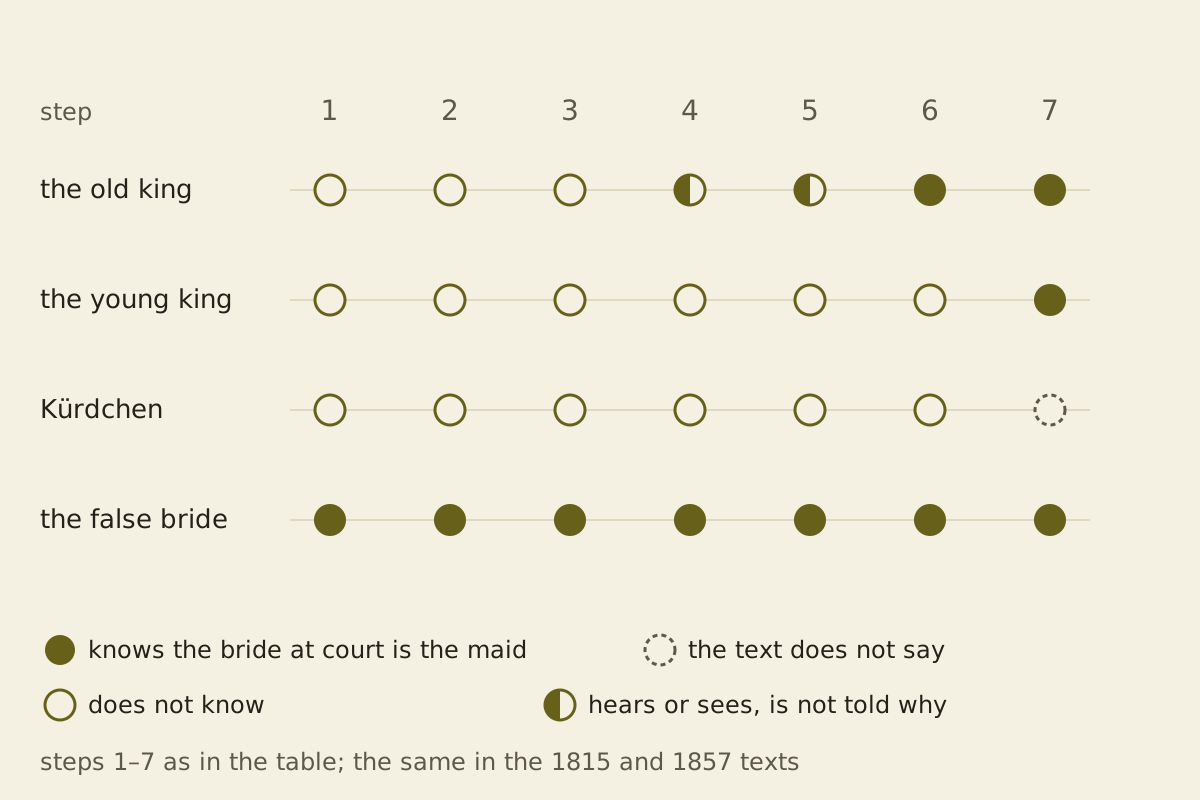
Who knows that the bride at court is the maid, step by step. Die Gänsemagd, 1815 and 1857; the reader knows from the oath on.
Credit line for reuse
"Who knows what in the Grimms’ Goose Girl" by Once Upon a Version — https://onceuponaversion.com/craft/goose-girl-falada/ — licensed under CC BY 4.0 (https://creativecommons.org/licenses/by/4.0/)
Data: Die Gänsemagd, Kinder- und Haus-Märchen, vol. 2, 1815 (pp. 16–25) and 1857 (pp. 13–19), German Wikisource, retrieved 2026-11-04
Who knows what, step by step, as CSV (where the data comes from) Data: Die Gänsemagd, Kinder- und Haus-Märchen, vol. 2, 1815 (pp. 16–25) and 1857 (pp. 13–19), retrieved 2026-11-04
| Step | Scene | The old king | The young king | Kürdchen | The false bride |
|---|---|---|---|---|---|
| 1 | the oath on the road | does not know | does not know | does not know | knows |
| 2 | arrival at the palace | does not know | does not know | does not know | knows |
| 3 | mornings at the gate, days 1–2 | does not know | does not know | does not know | knows |
| 4 | Kürdchen’s complaint, evening of day 2 | hears the report, not the cause | does not know | does not know | knows |
| 5 | the old king watches, day 3 | watches, is not told why | does not know | does not know | knows |
| 6 | the stove, evening of day 3 | knows | does not know | does not know | knows |
| 7 | the feast and the riddle | knows | knows (told by his father) | not stated | knows |
After the stove the story is told twice more. The old king first explains everything to his son, and then, at the feast, he tells the whole course of events to the false bride as a riddle and asks what such a woman deserves; she does not recognise the princess and names her own sentence, a nail-studded barrel dragged through the streets by two white horses.
Kürdchen is not mentioned after the stove; the feast is for all the people and good friends, so the texts leave open whether he hears the riddle.
This is a plot device in a tale, printed in both texts, not a record of any real punishment. The page reads it only for how the story is passed on: the false bride hears her own deeds told back to her and does not see that they are hers.
What the stove scene does not prove
The editions show when the wording changed in print, but they do not show why it changed. Nothing on these pages says who chose the iron stove, whether a second teller supplied it, or whether the change was meant to make the scene clearer, and this page does not guess. A stove that hears a confession is not unique to this tale, as the 1815 note itself points out.
That note, on pages V and VI of the 1815 volume, is headed “Das Gänsmädchen” and credits the tale “(Aus Zwehrn).” It ends: „Auch im Erdmänneken Nr. 5, wird die Erzählung an den Ofen gerichtet“, in “Dat Erdmänneken,” no. 5, the telling is also addressed to the stove. The note points to a parallel inside the same book; it does not say where either stove came from.
The same note remarks that „die Erzählerin“, the woman who told the tale, used the word Räthsel, riddle, as feminine. The 1815 preface names the woman from Zwehrn “Viehmännin,” and her story is followed in the profile of the teller the note credits only as Zwehrn; the brothers’ other named sources are in the register of named Grimm tellers, where she is one of many.
Bolte and Polívka’s commentary states that Jacob Grimm wrote the tale down (vol. 2, 1915, p. 273). The 1815 text is a telling from Zwehrn as Jacob wrote it down and the brothers printed it, and the tiled stove is the one in that print. The iron stove first appears, in the texts checked here, in the brothers’ edition of 1840.
Sources
Editions
- Brüder Grimm, Kinder- und Haus-Märchen, vol. 2 (1815): the 70 numbered tales and their notes (Anhang), among them no. 3, “Die Gänsemagd,” pp. 16–25, with its note “Das Gänsmädchen,” pp. V–VI (page numbers as printed; the Wikisource tale pages mark them VI–VII). German Wikisource transcription; the address of every tale page is in the CSV of the notes. https://de.wikisource.org/wiki/Die_G%C3%A4nsemagd_(1815) (all 70 notes, and the full text of no. 3 with its note)
- Brüder Grimm, Kinder- und Haus-Märchen, vol. 2, 1st ed. (Berlin: Realschulbuchhandlung, 1815): title page, preface (Vorrede, pp. III–XII, dated Cassel, 30 September 1814) and contents. German Wikisource transcription. https://de.wikisource.org/wiki/Kinder-_und_Haus-M%C3%A4rchen_Band_2_(1815) (title page, full preface and contents)
- Brüder Grimm, Kinder- und Haus-Märchen, vol. 2, 2nd ed. (Berlin: G. Reimer, 1819): title page (“Mit zwei Kupfern”) and contents, where “Die Gänsemagd” is no. 89. German Wikisource transcription. https://de.wikisource.org/wiki/Kinder-_und_Haus-M%C3%A4rchen_Band_2_(1819) (title page and contents)
- Brüder Grimm, “Die Gänsemagd,” no. 89 in Kinder- und Hausmärchen, vol. 2: 2nd ed. (Berlin: G. Reimer, 1819), pp. 14–21; 3rd ed. (Göttingen: Dieterichische Buchhandlung, 1837), pp. 15–23; 4th ed. (1840), pp. 15–23; 5th ed. (1843), pp. 15–22; 6th ed. (1850), pp. 15–22. German Wikisource transcriptions, listed on the page “Die Gänsemagd.” https://de.wikisource.org/wiki/Die_G%C3%A4nsemagd (the full text of the tale in each of the five editions; transcriptions only, page scans not checked)
- Brüder Grimm, “Die Gänsemagd,” no. 89 in Kinder- und Hausmärchen, vol. 2, 7th ed. (Göttingen: Dieterichische Buchhandlung, 1857), pp. 13–19. German Wikisource transcription. https://de.wikisource.org/wiki/Die_G%C3%A4nsemagd_(1857) (full text of the tale (transcription))
- Brüder Grimm, “Dat Erdmänneken,” no. 5 in Kinder- und Haus-Märchen, vol. 2, 1st ed. (Berlin: Realschulbuchhandlung, 1815), pp. 37–44, with its note in the Anhang. German Wikisource transcription. https://de.wikisource.org/wiki/Dat_Erdm%C3%A4nneken_(1815) (full text of the tale and its note)
- Brothers Grimm, Household Tales, translated by Margaret Hunt: no. 50, “Little Briar-Rose,” and no. 89, “The Goose-Girl.” Project Gutenberg ebook 5314. https://www.gutenberg.org/ebooks/5314 (full text of nos. 50 and 89)
Research
- Johannes Bolte and Jiří Polívka, Anmerkungen zu den Kinder- und Hausmärchen der Brüder Grimm, vol. 2: nos. 61–120 (Leipzig: Dieterich’sche Verlagsbuchhandlung Theodor Weicher, 1915), p. 273, entry for no. 89, “Die Gänsemagd.” Page scan on Wikimedia Commons. https://commons.wikimedia.org/wiki/File:Grimms_M%C3%A4rchen_Anmerkungen_(Bolte_Polivka)_II_273.jpg (one page, read from the page image; paraphrased, not quoted)

Catalogues and databases
- D. L. Ashliman, The Grimm Brothers’ Children’s and Household Tales, list with tale-type numbers, Folklore and Mythology Electronic Texts (University of Pittsburgh): no. 50, “Little Brier-Rose,” type 410; no. 89, “The Goose Girl,” type 533. https://sites.pitt.edu/~dash/grimmtales.html (tale-type numbers only)
Cite this page
Once Upon a Version. “The Goose Girl: Of 7 Editions Checked, Iron Stove From 1840.” Once Upon a Version. Published 2026-11-05. https://onceuponaversion.com/craft/goose-girl-falada/ (accessed day month year).
Write in the date you read the page; the page has no DOI.
More from The Teller's Craft
The Teller's Craft
The Murders in the Rue Morgue: Its Narrator Knows the End
Type detective short story (no tale-type number)
Poe’s narrator tells the Rue Morgue case once it is closed, yet gives its facts in the order he met them. Of 16 facts traced in the 1841 text, Dupin gives 12.
Picture credit
"The Murders in the Rue Morgue, for Edgar Allan Poe’s “Tales of Mystery and the Imagination,” Chicago, 1895-96" by Aubrey Beardsley — https://commons.wikimedia.org/wiki/File:The_Murders_in_the_Rue_Morgue,_for_Edgar_Allan_Poe%E2%80%99s_%E2%80%9CTales_of_Mystery_and_the_Imagination,%E2%80%9D_Chicago,_1895-96_MET_DP-21095-001.jpg — CC0 1.0 (https://creativecommons.org/publicdomain/zero/1.0/)
The Teller's Craft
Arabian Nights: Per Zotenberg, Galland’s Copy Ends Mid-Story
Type frame story, a story that holds other stories (no tale-type number cited)
By Zotenberg’s 1888 account, the copyist of the manuscript Galland translated stopped in night 281, with Scheherazade still telling; her pardon is not in it.
Picture credit
"Stories from the Arabian Nights (1907), colour plate of a rider on a flying horse" by Edmund Dulac — https://commons.wikimedia.org/wiki/File:'As_he_descended,_the_daylight_in_which_hitherto_he_had_been_travelling_faded_from_view.'_(18412346383).jpg — Public domain in US (published London 1907); DE/FR (Edmund Dulac d. 1953, life+70, public domain from 1 January 2024)
The Teller's Craft
Goldilocks and the Three Bears: Southey’s Intruder Was Old
Type nursery tale printed by an author (no tale-type number cited)
Southey’s 1837 intruder is an unnamed old woman. Cundall’s 1849 preface says he made her a girl; of four texts checked, only Steel’s 1918 calls her Goldilocks.
Picture credit
"De drie beren (titel op object)" by Anonymous — https://commons.wikimedia.org/wiki/File:De_drie_beren_(titel_op_object),_RP-P-OB-205.807.jpg — CC0 1.0 (https://creativecommons.org/publicdomain/zero/1.0/); modified: Cropped to the last of the eight panels (bottom right), keeping the picture and a margin of paper; the printed verse above and below is left out