The Murders in the Rue Morgue: Its Narrator Knows the End
Poe’s narrator already knows who did it; he tells the case in the order he found things out, and leaves most of the answers to Dupin.
By Once Upon a Version
Published
How a version is traced · Version history · Contact · Report an error (contact@onceuponaversion.com)
In short
- Poe’s narrator in “The Murders in the Rue Morgue” (Graham’s Magazine, April 1841) tells the case after it is closed, so he knows the answer from his opening sentence about Paris.
- Of the 16 facts about the case traced on this page in the 1841 text, 14 are held back until the point where he learned them, 2 stay guesses, and Dupin hands over 12.
- Poe’s 1845 Tales text cut the narrator’s line about not following the sailor’s story, and moved the hair Dupin produces from the dead woman’s head to her clutched fingers.
Telling card
- Tale
- The Murders in the Rue Morgue
- Type
- detective short story (no tale-type number)
- Teller
- An unnamed first-person narrator (fictional); written by Edgar Allan Poe
- Recorded by
- n/a
5 more fields: edited by, told, published, this text, earliest known
- Edited by
- Poe’s own revisions for Tales (New York: Wiley and Putnam, 1845), pp. 116–150
- Told
- n/a (written work); the narrator looks back on “the spring and part of the summer of 18—”
- Published
- Graham’s Magazine (Philadelphia), vol. XVIII, no. 4, April 1841, pp. 166–179
- This text
- The 1841 Graham’s Magazine text, E. A. Poe Society of Baltimore transcription
- Earliest known
- Poe’s fair-copy manuscript of early 1841 (the “Johnston” manuscript), listed by the E. A. Poe Society; first printed April 1841
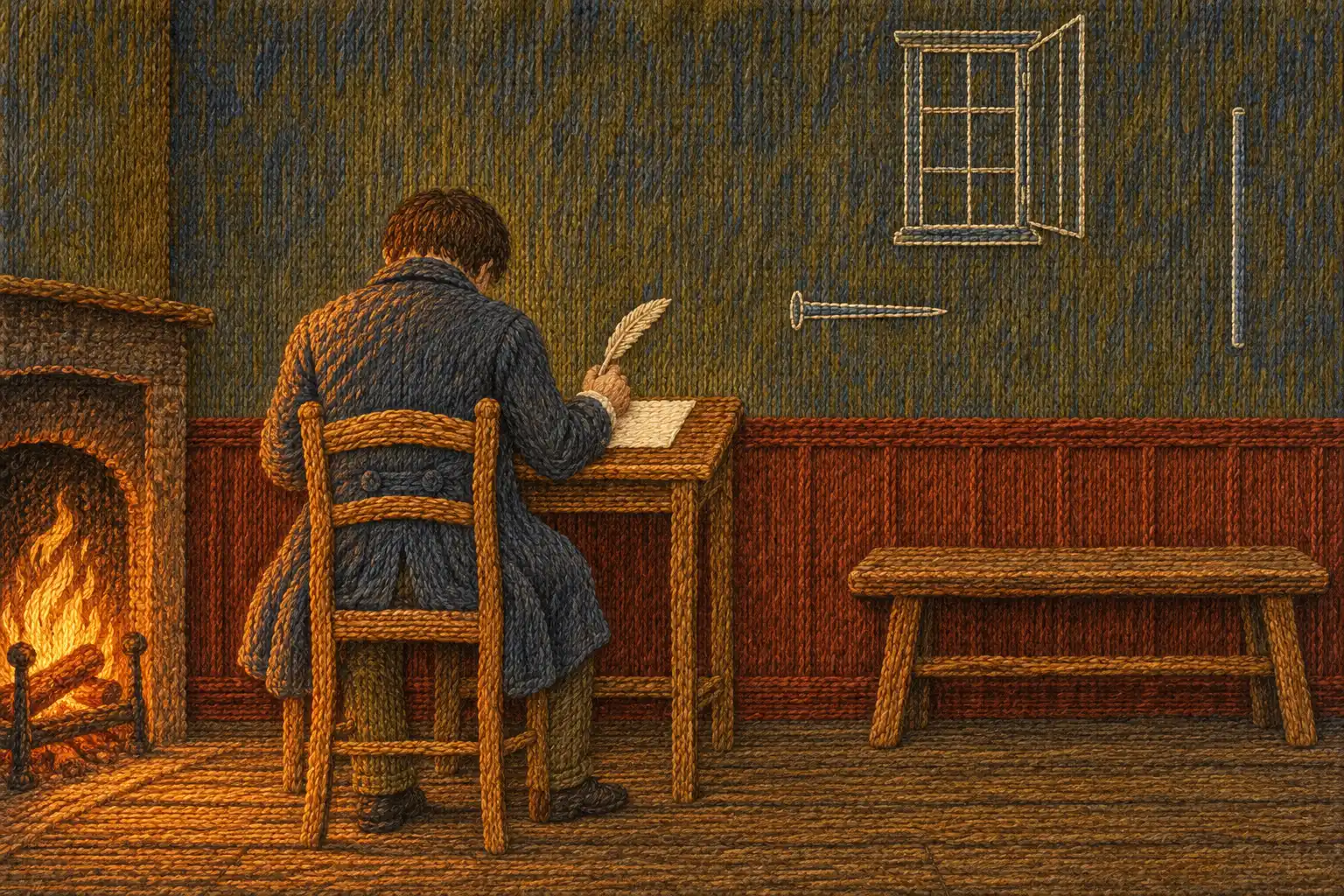
Illustration of a narrator writing after the event, with the window, the nail and the lightning-rod that the story leaves for Dupin to explain.
Illustration: Once Upon a Version. Generated illustration — not a historical image, manuscript or record. © Once Upon a Version, all rights reserved; reuse by request.
Edgar Allan Poe’s tale does not reach Paris for 1,367 words. That is the count for its first printing, in Graham’s Magazine of Philadelphia, April 1841, which opens with an essay on analysis, phrenology, draughts, chess and whist. Only after that essay does the unnamed narrator of “The Murders in the Rue Morgue” say where he was living, and his opening words about Paris already look back on it.
The essay ends by telling the reader how to take what follows: “The narrative which follows will appear to the reader somewhat in the light of a commentary upon the propositions just advanced” (p. 167). The teller announces, before the story proper starts, that he already knows what it illustrates. This page follows that backward look through the whole 1841 text, fact by fact, and asks where each piece of information is kept until it reaches the reader.
What does the narrator know, and when?
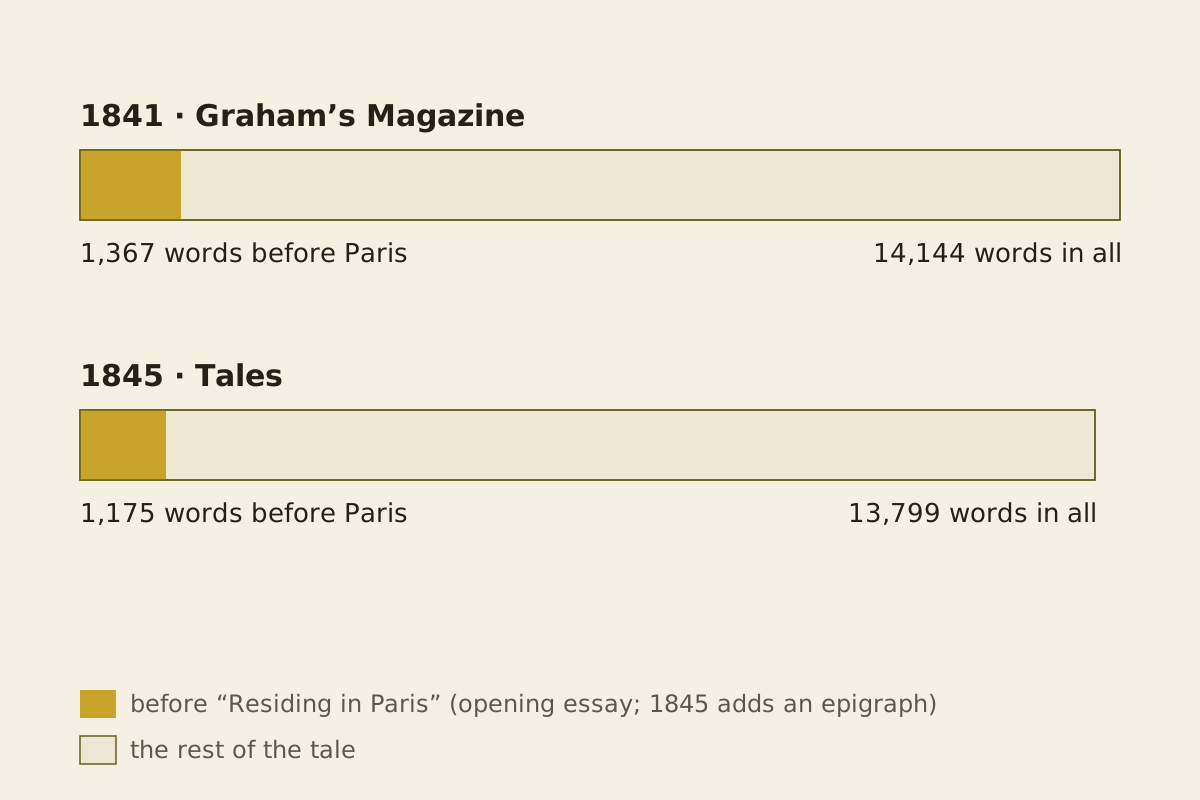
Words before “Residing in Paris,” the narrator’s opening sentence about the city, in the 1841 and 1845 printings, counted in the E. A. Poe Society transcriptions.
Credit line for reuse
"Words before Paris in ‘The Murders in the Rue Morgue,’ 1841 and 1845" by Once Upon a Version — https://onceuponaversion.com/craft/rue-morgue-narrator/ — licensed under CC BY 4.0 (https://creativecommons.org/licenses/by/4.0/)
Data: The Murders in the Rue Morgue, Graham’s Magazine (1841) and Tales (1845) texts, E. A. Poe Society of Baltimore transcriptions, retrieved 2026-11-03
This site calls whatever a story has not yet handed to the reader at a given point the narrator’s pocket, and sorts each item into one of three kinds. A not-yet-known item is information the narrator does not have at that point either. A delayed item is information he possesses as he tells the story but saves for the place where he originally learned it. A concealed item is information he possesses and ought to give at that point, but deliberately keeps back.
The 1841 text identifies its narrator as someone recounting events that are already finished. His account of Paris opens in the past tense, on page 167:
“Residing in Paris during the spring and part of the summer of 18—, I there contracted an intimacy with a Monsieur C. Auguste Dupin.”
written by Edgar A. Poe · Graham’s Magazine, April 1841, p. 167
Near the end, after the sailor’s account, he writes “I have scarcely anything to add” (p. 178) and then reports how the case was settled. A narrator who can say that has the whole solution in hand, so almost every fact the reader still lacks at a given page is, for him, information he already possesses.
This page traces 16 facts about the case through the 1841 text. The narrator possesses 14 of them as he tells the story, while the other 2 he never learns for certain, and the text presents them only as probable guesses.
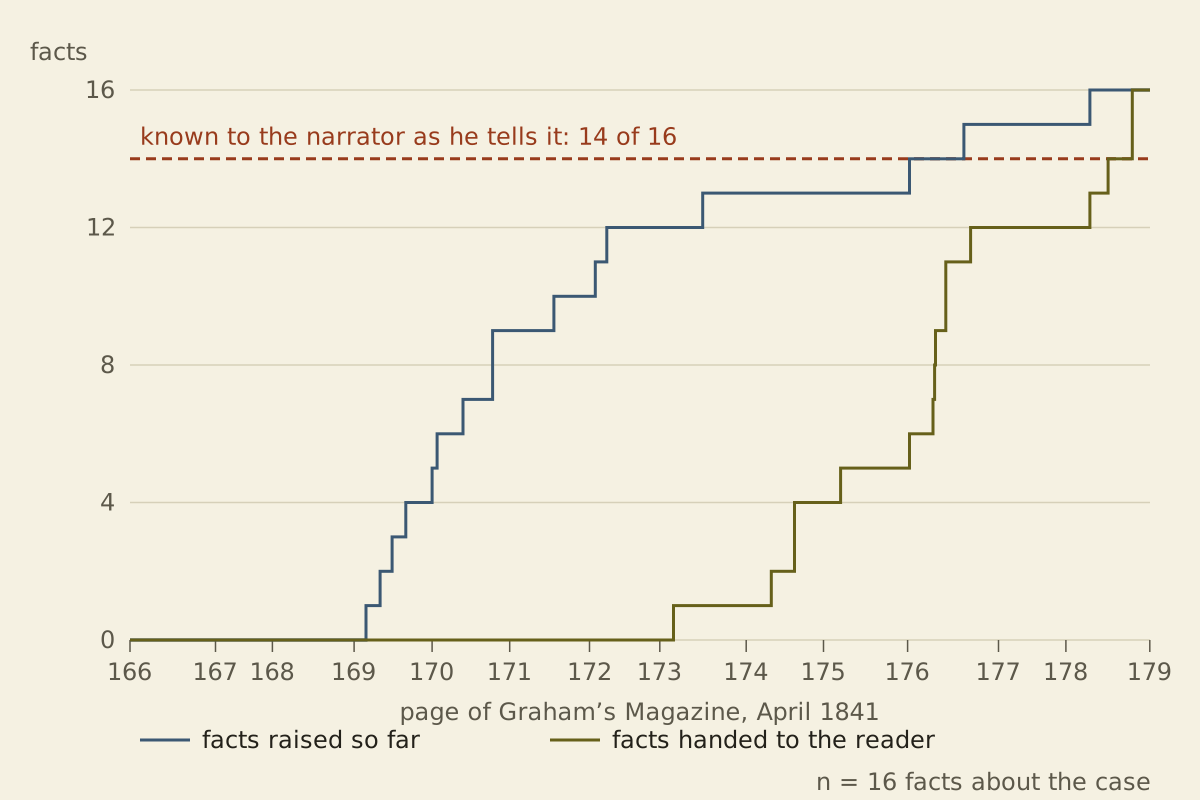
Facts raised and facts handed to the reader, page by page, against the 14 the narrator knows as he tells it. n = 16 facts, Graham’s Magazine, April 1841.
Credit line for reuse
"What the reader has and what the narrator knows, ‘The Murders in the Rue Morgue,’ 1841" by Once Upon a Version — https://onceuponaversion.com/craft/rue-morgue-narrator/ — licensed under CC BY 4.0 (https://creativecommons.org/licenses/by/4.0/)
Data: The Murders in the Rue Morgue, Graham’s Magazine (1841) text, E. A. Poe Society of Baltimore transcription, retrieved 2026-11-03
The chart shows the distance between the two lines. Facts begin to arrive on page 169, but the earliest explanation comes on page 173, and 11 of the 16 facts are handed over on pages 176 to 178, close to the end of the tale.
The same shape appears in miniature before the crime. On a night walk Dupin answers a thought the narrator has not spoken aloud, and only afterwards explains the chain behind it, which runs “Chantilly, Orion, Dr. Nichol, Epicurus, Stereotomy, the street stones, the fruiterer” (p. 168). Conclusion first, reasoning after: the murder case will take the same order.
Who is the narrator?
The text says little about him beyond his role. He is never named. He paid for the house because his circumstances were “somewhat less embarrassed” than Dupin’s (p. 167), and he explains that the word “affaire” lacks in France the lightness “which it conveys with us” (p. 169), which places him, and his readers, outside France without saying where.
What do the newspapers give him?
Neither man witnesses the crime. The case reaches them in print. The first report comes in an evening edition of a paper the 1841 text calls “Le Tribunal” (p. 169). Then “The next day’s paper” prints the statements of a laundress, a gendarme, several neighbours, a banker and his clerk, and two doctors.
A later evening edition adds that the clerk, Adolphe Le Bon, has been arrested (p. 171). The pocket fills up here: 10 of the 16 facts are first mentioned inside the newspaper pages, 169 to 171. They include the gold left on the floor, the marks on the daughter’s throat, the windows fastened from within, and a shrill voice that each witness assigns to a language he does not speak.
The narrator passes these reports on without saying which details will matter. Even at the house, after a visit that lasts until dark, he sees nothing the newspaper had not already printed:
“I saw nothing beyond what had been stated in the ‘Tribunal.’”
written by Edgar A. Poe · Graham’s Magazine, April 1841, p. 172
Dupin, by contrast, examines the whole neighbourhood and the house “with a minuteness of attention for which I could see no possible object” (p. 172). The next day he dismisses the paper itself, saying that “Le Tribunal” “has not entered, I fear, into the unusual horror of the thing” (p. 172). Earlier he had dismissed the Paris police as well, naming one real officer: “Vidocq, for example, was a good guesser, and a persevering man” (p. 171). The Vidocq whom Dupin names in this tale had four volumes of memoirs published under his own name.
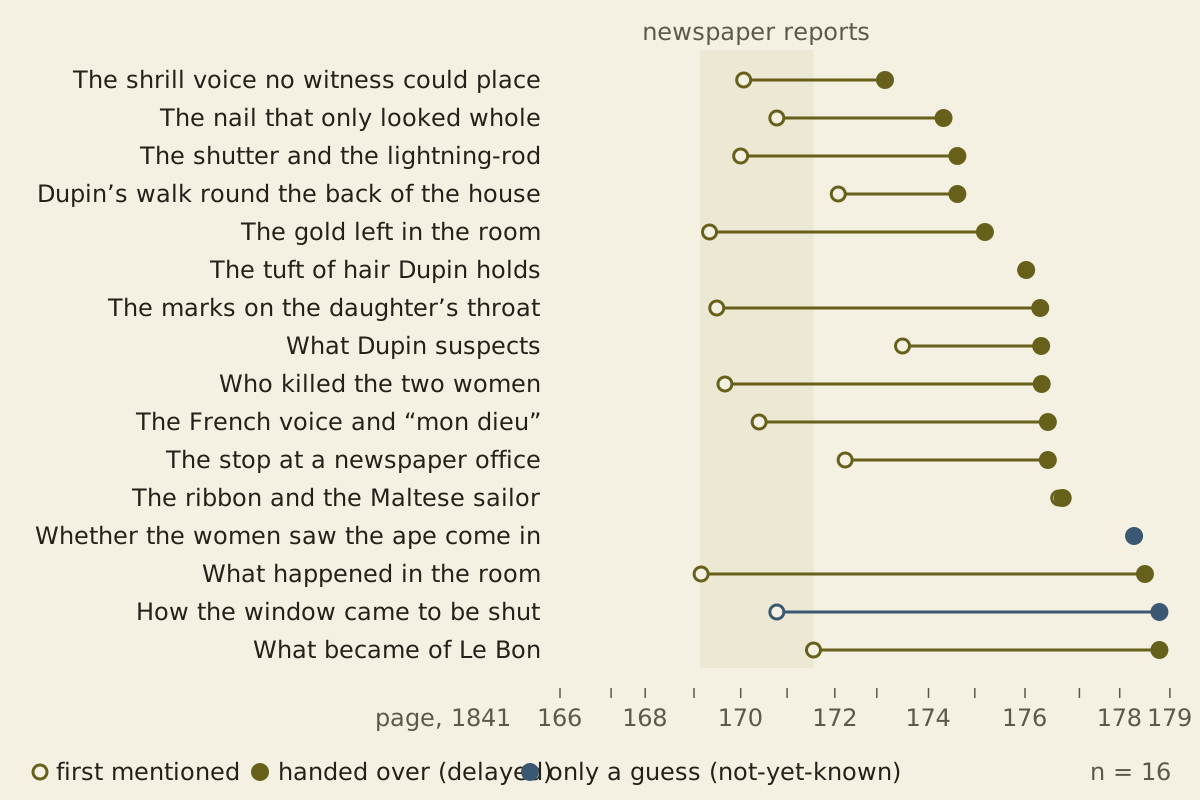
Each fact from the page where it is raised to the page where it is handed over; 14 delayed, 2 given only as guesses. n = 16 facts, Graham’s Magazine, April 1841.
Credit line for reuse
"Sixteen facts from first mention to hand-over, ‘The Murders in the Rue Morgue,’ 1841" by Once Upon a Version — https://onceuponaversion.com/craft/rue-morgue-narrator/ — licensed under CC BY 4.0 (https://creativecommons.org/licenses/by/4.0/)
Data: The Murders in the Rue Morgue, Graham’s Magazine (1841) text, E. A. Poe Society of Baltimore transcription, retrieved 2026-11-03
The 16 facts, with pages, paragraphs and quotations, as CSV (where the data comes from) Data: The Murders in the Rue Morgue, Graham’s Magazine (1841) text, E. A. Poe Society of Baltimore transcription, retrieved 2026-11-03
| # | Fact | First mentioned | Handed over | By | Kind |
|---|---|---|---|---|---|
| 1 | The shrill voice no witness could place | p. 170 | p. 173 | Dupin | delayed |
| 2 | The nail that only looked whole | p. 170 | p. 174 | Dupin | delayed |
| 3 | The shutter and the lightning-rod | p. 170 | p. 174 | Dupin | delayed |
| 4 | Dupin’s walk round the back of the house | p. 172 | p. 174 | Dupin | delayed |
| 5 | The gold left in the room | p. 169 | p. 175 | Dupin | delayed |
| 6 | The tuft of hair Dupin holds | p. 176 | p. 176 | Dupin | delayed |
| 7 | The marks on the daughter’s throat | p. 169 | p. 176 | Dupin | delayed |
| 8 | What Dupin suspects | p. 173 | p. 176 | Dupin | delayed |
| 9 | Who killed the two women | p. 169 | p. 176 | Dupin | delayed |
| 10 | The French voice and “mon dieu” | p. 170 | p. 176 | Dupin | delayed |
| 11 | The stop at a newspaper office | p. 172 | p. 176 | Dupin | delayed |
| 12 | The ribbon and the Maltese sailor | p. 176 | p. 176 | Dupin | delayed |
| 13 | Whether the women saw the ape come in | p. 178 | p. 178 | the narrator | not-yet-known |
| 14 | What happened in the room | p. 169 | p. 178 | the sailor | delayed |
| 15 | How the window came to be shut | p. 170 | p. 178 | the narrator | not-yet-known |
| 16 | What became of Le Bon | p. 171 | p. 178 | the narrator | delayed |
n = 16 facts about the case, each placed by the page of the 1841 Graham’s Magazine printing where it is first mentioned and the page where it is handed to the reader. The CSV adds paragraph numbers and the quotation for each hand-over.
Where does Dupin open the pocket?
The plainest delayed fact is a short stop on the way home from the house. On page 172 the narrator records it and nothing more:
“On our way home my companion stepped in for a moment at the office of one of the daily papers.”
written by Edgar A. Poe · Graham’s Magazine, April 1841, p. 172
Four pages later Dupin explains that he had left an advertisement “at the office of ‘Le Monde,’” a shipping paper, to draw the ape’s owner to their door (p. 176). At the moment of the stop the narrator did not know why Dupin went in. By the time he writes, he does, and he still places the reason where he learned it.
The nail in the back window works the same way. The narrator stood in that room on page 172, yet the broken nail appears only when Dupin describes his own test: “I touched it; and the head, with about the eighth of an inch of the shank, came off in my fingers” (p. 174). The narrator reports the discovery in Dupin’s words, at the point in the conversation where Dupin chose to reveal it.
Some of the waiting belongs to Dupin himself. On page 173 he tells his friend, “What the suspicion is, however, I will not say just yet,” and the suspicion comes out three pages later, when he hands over a passage from Cuvier describing the orang-outang (p. 176). Here the holding back happens inside the story, and the narrator, telling it later, simply keeps to the same order.
These items count as delayed rather than concealed because at every point the narrator reports what he believed at the time, and he never claims to have known more. When he writes “I could merely agree with all Paris in considering it an insoluble mystery” (p. 171), he is describing his view after the newspaper reports, not hiding the answer he holds as he writes.
Count who hands each fact over. Dupin hands over 12 of the 16 facts, all between pages 173 and 176. The narrator hands over three (the release of Le Bon and the two guesses), and the sailor supplies one delayed fact, what happened in the room.
A storyteller can hold back an ending for very different reasons, and another craft reading, where Galland’s manuscript of the Nights stops before the ending finds the holding back in a manuscript rather than a narrator.
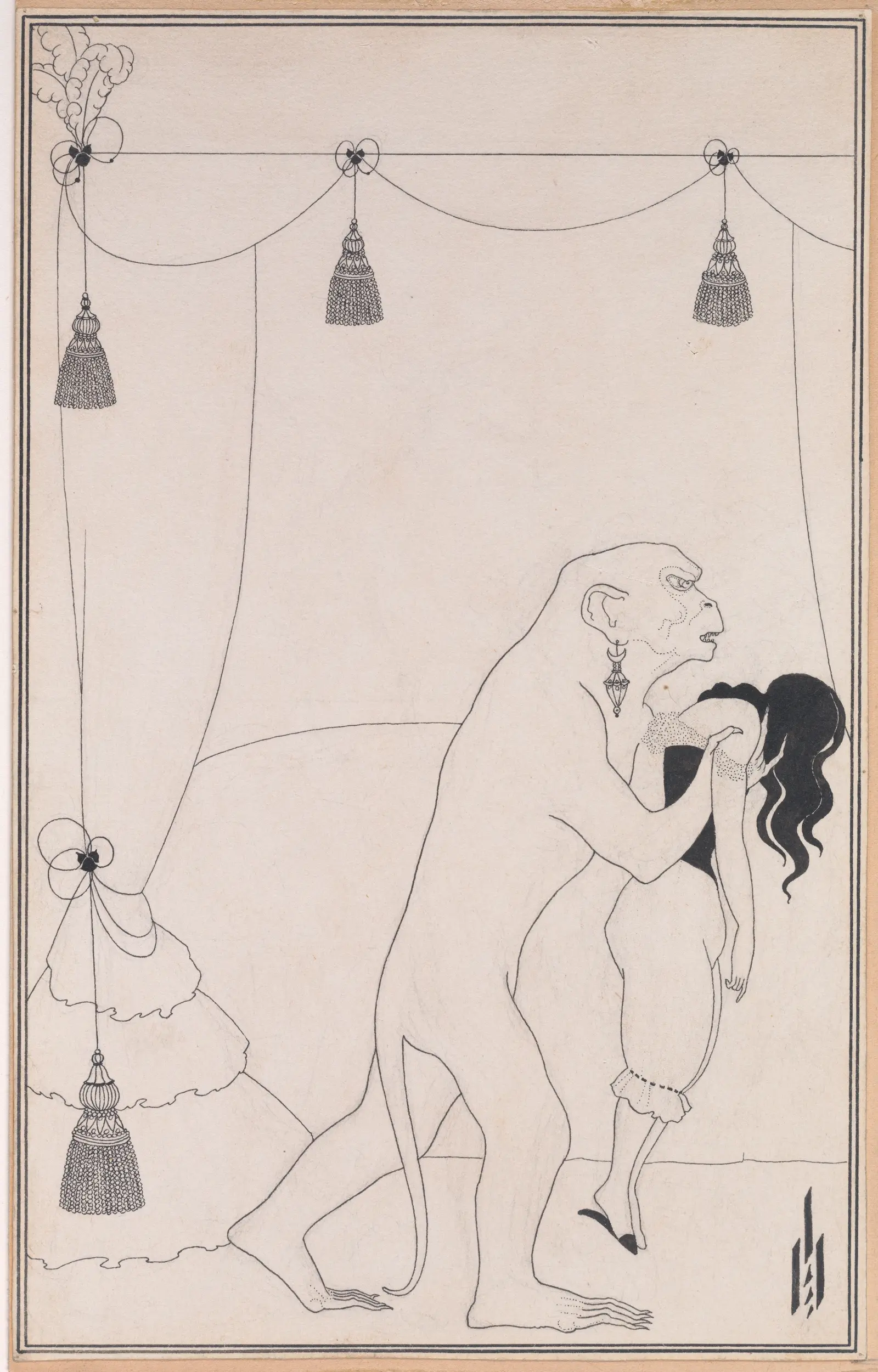
An ape carries a woman away between bed curtains. Aubrey Beardsley, drawing for Poe’s Tales of Mystery and the Imagination (Chicago, 1895–96), 1894. The Metropolitan Museum of Art, 2021.16.14.
"The Murders in the Rue Morgue, for Edgar Allan Poe’s “Tales of Mystery and the Imagination,” Chicago, 1895-96" by Aubrey Beardsley — https://commons.wikimedia.org/wiki/File:The_Murders_in_the_Rue_Morgue,_for_Edgar_Allan_Poe%E2%80%99s_%E2%80%9CTales_of_Mystery_and_the_Imagination,%E2%80%9D_Chicago,_1895-96_MET_DP-21095-001.jpg — CC0 1.0 (https://creativecommons.org/publicdomain/zero/1.0/)
Who tells what happened in the room?
The largest delayed fact is the night itself, and the narrator passes it to someone else. The sailor who owns the ape answers Dupin’s advertisement, and his story fills pages 177 and 178, but the narrator does not give it in the sailor’s words. In 1841 he says so directly:
“I do not propose to follow the man in the circumstantial narrative which he now detailed. What he stated was, in substance, this.”
written by Edgar A. Poe · Graham’s Magazine, April 1841, p. 177
The one eyewitness account in the tale therefore reaches the reader as a summary, and the summary marks its own gaps. Two facts remain guesses. One is whether the women noticed the ape climbing in, of which the text says only that “it seems probable that he was not immediately perceived” (p. 178).
The other is how the window came to be shut behind the escaping animal: “He must have closed the window as he passed through it” (p. 178). These are the two not-yet-known items, because the narrator does not possess them as he tells the story, and no one in the text supplies them. Clarke’s 1919 plate below draws the moment the sailor saw, a scene the text gives only through that summary.
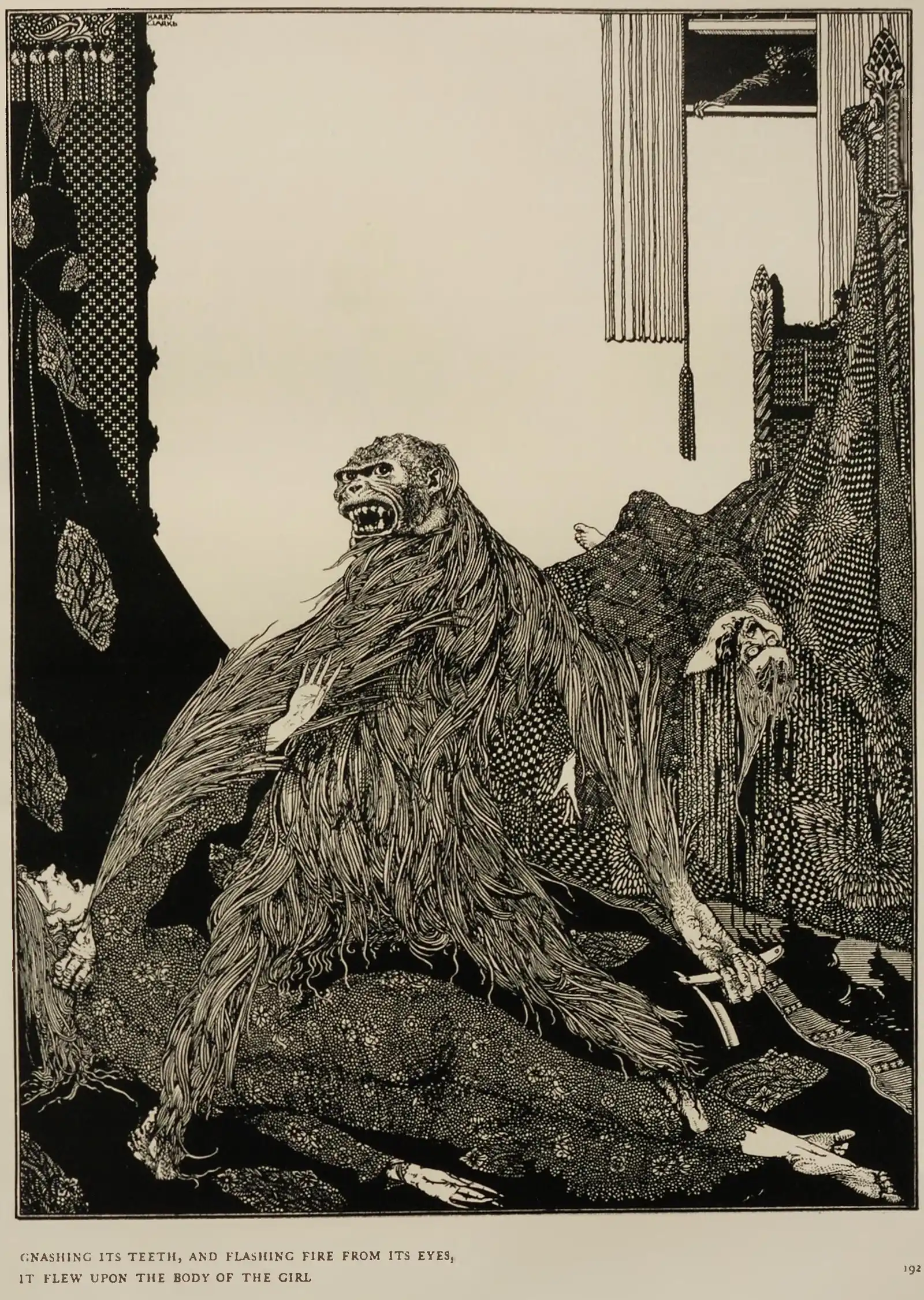
The ape in the room, with a face at the window, upper right, where the sailor looked in. Harry Clarke, Tales of Mystery and Imagination (London: Harrap), 1919.
Full credit
"Tales of Mystery and Imagination (1919), plate for ‘The Murders in the Rue Morgue’" by Harry Clarke — https://commons.wikimedia.org/wiki/File:MU_KPB_036_Tales_of_Mystery_and_Imagination_by_Edgar_Allan_Poe_(page_211_crop).jpg — Public domain in US (published London 1919); DE/FR (Harry Clarke d. 1931, life+70)
What did Poe change for the 1845 Tales?
Poe reprinted the tale in Tales (New York: Wiley and Putnam, 1845), pp. 116–150. Each printing is what this site calls a one-evening text, a single fixed witness among several, and the E. A. Poe Society also lists Poe’s fair-copy manuscript of early 1841, the “Johnston” manuscript, and an 1843 reprint. In this site’s studio terms, the 1845 Tales is a second pressing, and not an exact copy of the first.
Comparing the two printings paragraph by paragraph, 67 of the 128 paragraphs in the 1841 text have different words or spelling in 1845, another 33 differ only in punctuation, and 26 are unchanged. Two are dropped entirely: the opening paragraph on phrenology and the closing line, “Philadelphia, March, 1841.”
One paragraph is added at the head, an epigraph from Sir Thomas Browne that begins “What song the Syrens sang.” With the phrenology paragraph gone, the essay before Paris shrinks from 1,367 words to 1,175, epigraph included, and the whole tale from 14,144 words to 13,799.
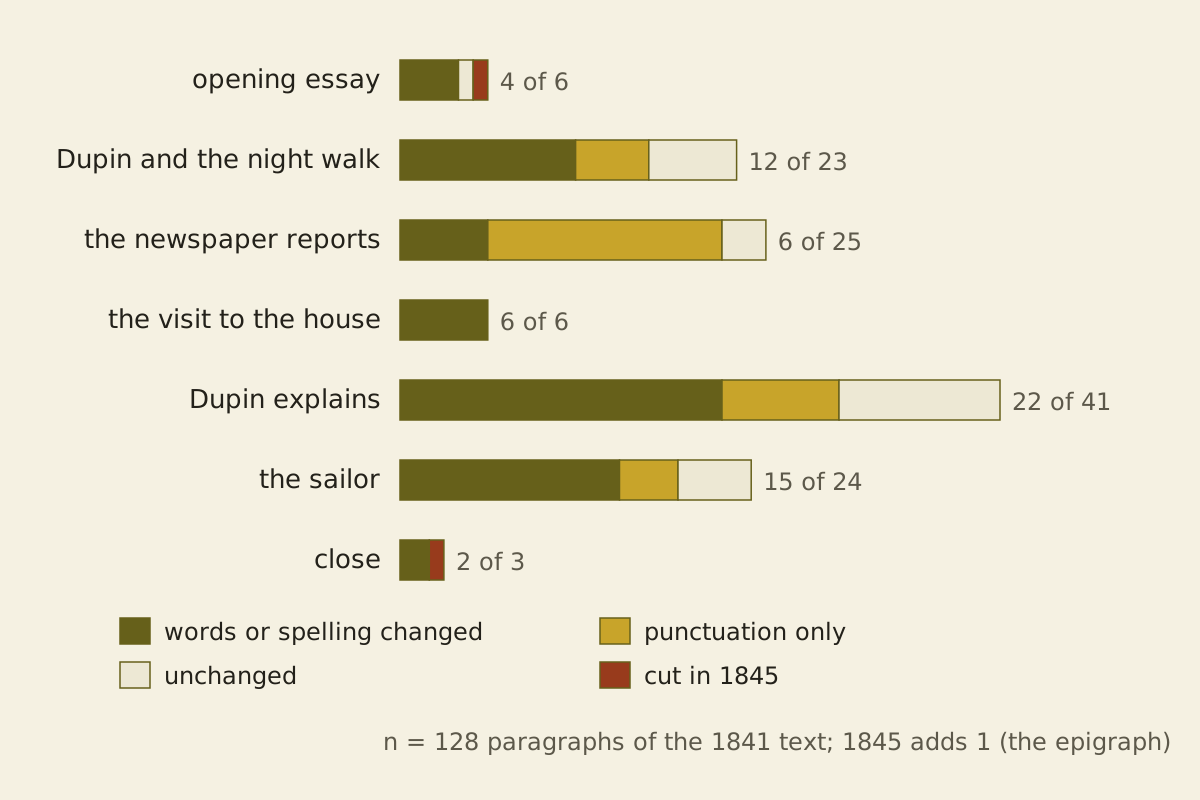
Each 1841 paragraph by section and by what happened to it in the 1845 Tales text. n = 128 paragraphs; 1845 adds 1, the epigraph.
Credit line for reuse
"‘The Murders in the Rue Morgue,’ 1841 paragraphs and their 1845 status, by section" by Once Upon a Version — https://onceuponaversion.com/craft/rue-morgue-narrator/ — licensed under CC BY 4.0 (https://creativecommons.org/licenses/by/4.0/)
Data: The Murders in the Rue Morgue, Graham’s Magazine (1841) and Tales (1845) texts, E. A. Poe Society of Baltimore transcriptions, retrieved 2026-11-03
Every 1841 paragraph and its 1845 counterpart, as CSV (where the data comes from) Data: The Murders in the Rue Morgue, Graham’s Magazine (1841) and Tales (1845) texts, E. A. Poe Society of Baltimore transcriptions, retrieved 2026-11-03
| Section of the 1841 text | Paragraphs | Words or spelling changed | Punctuation only | Unchanged | Cut in 1845 |
|---|---|---|---|---|---|
| Opening essay | 6 | 4 | 0 | 1 | 1 |
| Dupin and the night walk | 23 | 12 | 5 | 6 | 0 |
| The newspaper reports | 25 | 6 | 16 | 3 | 0 |
| The visit to the house | 6 | 6 | 0 | 0 | 0 |
| Dupin explains | 41 | 22 | 8 | 11 | 0 |
| The sailor | 24 | 15 | 4 | 5 | 0 |
| Close | 3 | 2 | 0 | 0 | 1 |
Where did the pocket change?
The newspaper reports changed least in their wording, in 6 of their 25 paragraphs, but several changes touch the pocket directly. The paper “Le Tribunal” became the “Gazette des Tribunaux.” The narrator’s sentence about not following the sailor’s story disappeared, so the 1845 paragraph opens at “What he stated was, in substance, this.” One clue also moved:
1841 · Graham’s Magazine, p. 176
“I disentangled this little tuft from among the tresses remaining upon the head of Madame L’Espanaye.”
written by Edgar A. Poe · Graham’s Magazine, April 1841, p. 176
1845 · Tales, p. 142
“I disentangled this little tuft from the rigidly clutched fingers of Madame L’Espanaye.”
written by Edgar A. Poe · Tales (Wiley and Putnam, 1845), p. 142
What changed: In 1845 the hair comes from the dead woman’s hand, not from her head, so the clue now puts the ape’s hair in her grip.
The ape also changed its pronoun between the printings. The 1841 text reads “Gnashing his teeth, and flashing fire from his eyes, he flew upon the body of the girl” (p. 178), while the 1845 sentence reads “Gnashing its teeth” and “it flew” (p. 149), which is the wording printed under Clarke’s 1919 plate above. The 1845 text also adds a footnote to Dupin’s closing French phrase, “Rousseau — Nouvelle Heloise.”
What the device does not prove
The table sorts the facts, but it does not settle three larger questions. The first is fairness: nothing in the table shows that the tale plays fair with its reader in any modern sense. Every delayed fact is one the narrator possesses, yet most of them reach the reader only through Dupin’s explanation, and some were never available to check beforehand.
The ribbon from the foot of the lightning-rod is never mentioned until Dupin produces it on page 176, and neither is the tuft of hair. A reader working alongside the newspaper reports could notice the strange voice and the abandoned gold, but could not have weighed evidence that the text had not yet described.
The second question concerns the empty concealed row, which is a reading of these 16 facts rather than a rule about the narrator. Two personal details never come out at all: the “objects I then sought” in Paris (p. 167) and the service Le Bon once did for Dupin (p. 172). Neither touches the case, so neither appears in the table, and this page does not classify them.
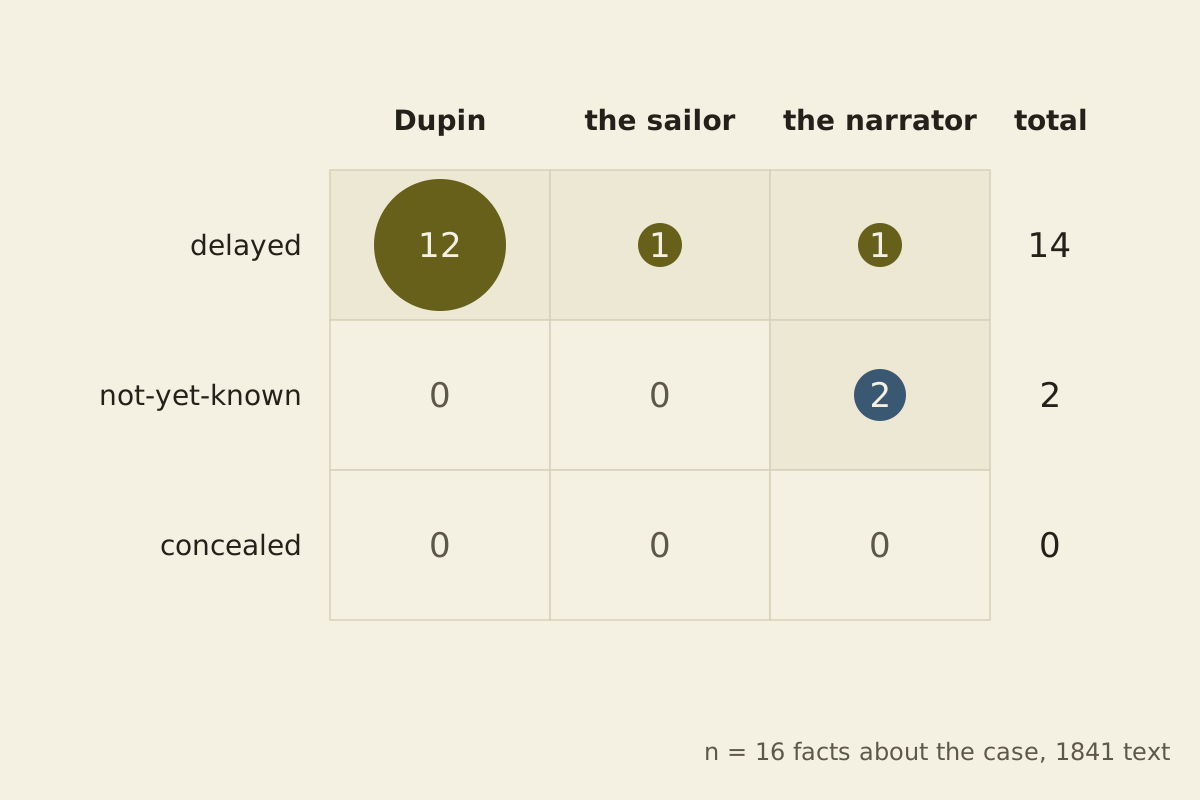
The 16 facts by kind and by who hands them to the reader; no fact is classed as concealed. n = 16 facts, Graham’s Magazine, April 1841.
Credit line for reuse
"Sixteen facts by kind and by who hands them over, ‘The Murders in the Rue Morgue,’ 1841" by Once Upon a Version — https://onceuponaversion.com/craft/rue-morgue-narrator/ — licensed under CC BY 4.0 (https://creativecommons.org/licenses/by/4.0/)
Data: The Murders in the Rue Morgue, Graham’s Magazine (1841) text, E. A. Poe Society of Baltimore transcription, retrieved 2026-11-03
In words: 14 delayed (12 handed over by Dupin, 1 by the sailor, 1 by the narrator), 2 not-yet-known (both given by the narrator as guesses), and 0 concealed.
The third question is history. The count says nothing about where the device came from or what it led to, and whether later writers borrowed the delayed narrator from Poe is a question about other books and other evidence. Poe’s narrator and Dupin return in the same narrator’s next case, The Mystery of Marie Rogêt, which would need a count of its own.
In the April 1841 Graham’s, Poe’s narrator ends where he began, looking back: “I have scarcely anything to add.” By then the reader holds the 14 facts the narrator held from his opening sentence about Paris, together with the 2 guesses he could never turn into facts. Under the last paragraph of that printing, a line the 1845 Tales drops, stands a dateline: “Philadelphia, March, 1841.”
Sources
Editions
- Edgar A. Poe, “The Murders in the Rue Morgue,” Graham’s Magazine (Philadelphia), vol. XVIII, no. 4, April 1841, pp. 166–179. Transcription with page and column markers by the Edgar Allan Poe Society of Baltimore (Text-02b). https://www.eapoe.org/works/tales/morgueb.htm (full text)
- Edgar A. Poe, “The Murders in the Rue Morgue,” in Tales (New York: Wiley and Putnam, 1845), pp. 116–150. Transcription by the Edgar Allan Poe Society of Baltimore (Text-04b), with its record of the title page and contents. https://www.eapoe.org/works/tales/morgued.htm (full text, title page and contents)
- Arthur Conan Doyle, A Study in Scarlet (first printed in Beeton’s Christmas Annual, 1887). Project Gutenberg eBook #244. https://www.gutenberg.org/ebooks/244 (full text)
Catalogues and databases
- Edgar Allan Poe Society of Baltimore, “The Murders in the Rue Morgue”: list of manuscripts, authorized printings and reprints (Text-01 to Text-04c), with notes on the “Johnston” fair-copy manuscript of early 1841. https://www.eapoe.org/works/info/pt030.htm (full page)
Cite this page
Once Upon a Version. “The Murders in the Rue Morgue: Its Narrator Knows the End.” Once Upon a Version. Published 2026-11-05. https://onceuponaversion.com/craft/rue-morgue-narrator/ (accessed day month year).
Write in the date you read the page; the page has no DOI.
More from The Teller's Craft
The Teller's Craft
Arabian Nights: Per Zotenberg, Galland’s Copy Ends Mid-Story
Type frame story, a story that holds other stories (no tale-type number cited)
By Zotenberg’s 1888 account, the copyist of the manuscript Galland translated stopped in night 281, with Scheherazade still telling; her pardon is not in it.
Picture credit
"Stories from the Arabian Nights (1907), colour plate of a rider on a flying horse" by Edmund Dulac — https://commons.wikimedia.org/wiki/File:'As_he_descended,_the_daylight_in_which_hitherto_he_had_been_travelling_faded_from_view.'_(18412346383).jpg — Public domain in US (published London 1907); DE/FR (Edmund Dulac d. 1953, life+70, public domain from 1 January 2024)
The Teller's Craft
Goldilocks and the Three Bears: Southey’s Intruder Was Old
Type nursery tale printed by an author (no tale-type number cited)
Southey’s 1837 intruder is an unnamed old woman. Cundall’s 1849 preface says he made her a girl; of four texts checked, only Steel’s 1918 calls her Goldilocks.
Picture credit
"De drie beren (titel op object)" by Anonymous — https://commons.wikimedia.org/wiki/File:De_drie_beren_(titel_op_object),_RP-P-OB-205.807.jpg — CC0 1.0 (https://creativecommons.org/publicdomain/zero/1.0/); modified: Cropped to the last of the eight panels (bottom right), keeping the picture and a margin of paper; the printed verse above and below is left out
The Teller's Craft
The Goose Girl: Of 7 Editions Checked, Iron Stove From 1840
Type ATU 533, as classified by D. L. Ashliman
In the Grimms’ 1815 Goose Girl the princess confides in a tiled stove; in the 1857 text it is an iron one. Seven editions checked, with each repeated line.
Picture credit
"The Goosegirl" by Arthur Rackham — https://commons.wikimedia.org/wiki/File:Snowdrop-Rackham-135.jpg — Public domain in US (published New York: Dutton, 1920, per the Internet Archive record of the scanned copy; the plates first appeared in 1909); DE/FR (Arthur Rackham d. 1939, life+70)