The Mystery of Marie Rogêt: 1845 Rewrites the Serial’s Clues
Between the magazine serial of 1842–43 and his Tales of 1845, Poe’s tale stopped promising one confessed killer and made room for an accident and a second person.
By Once Upon a Version
Published
How a version is traced · Version history · Contact · Report an error (contact@onceuponaversion.com)
In short
- Edgar Allan Poe’s “The Mystery of Marie Rogêt” ran in three parts in The Ladies’ Companion of New York (November 1842, December 1842, February 1843) and was reprinted with revisions and 24 footnotes in his Tales of 1845.
- Counted in the E. A. Poe Society’s comparison of the two texts, 306 marked differences separate them, 101 of them changes of wording; the 16 followed here change what the tale points to.
- The serial’s closing editors’ note says “an individual assassin was convicted, upon his own confession,” while the 1845 text drops that line, allows “one, or two” people and raises “an accident at Madame Deluc’s.”
Telling card
- Tale
- The Mystery of Marie Rogêt
- Type
- detective short story built on a real case (no tale-type number)
- Teller
- Dupin’s unnamed friend (fictional); written by Edgar Allan Poe
- Recorded by
- n/a
5 more fields: edited by, told, published, this text, earliest known
- Edited by
- Poe’s own revisions and footnotes for Tales (New York: Wiley and Putnam, 1845), pp. 151–199
- Told
- n/a (written work); the narrator sets the case about two years after the Rue Morgue
- Published
- The Ladies’ Companion (New York), vol. XVIII, nos. 1, 2 and 4: November 1842, December 1842 and February 1843
- This text
- The three 1842–43 installments and the 1845 Tales text, E. A. Poe Society of Baltimore transcriptions
- Earliest known
- The November 1842 installment; no manuscript of the tale survives, according to the E. A. Poe Society
This card as CSV · where these values come from
Data: The Mystery of Marie Roget, The Ladies’ Companion (1842–43) and Tales (1845) texts, E. A. Poe Society of Baltimore transcriptions, retrieved 2026-11-03
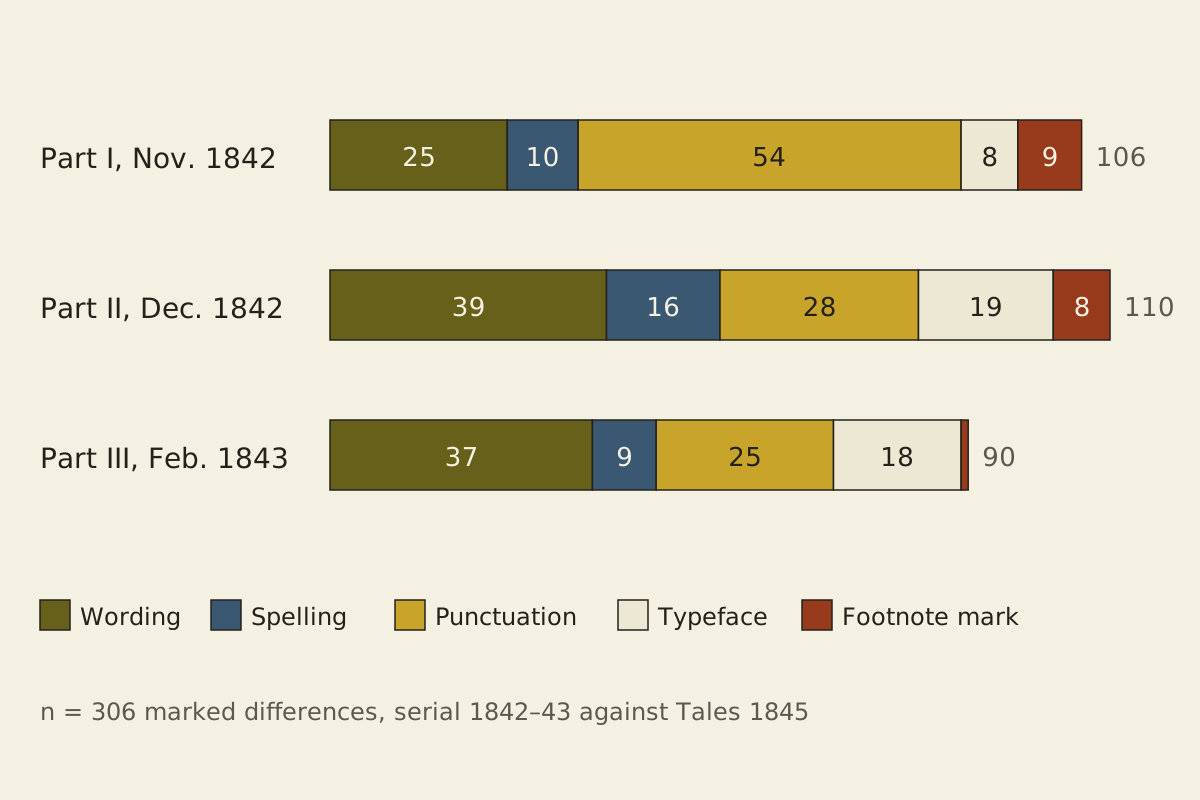
Marked differences between the serial and the 1845 Tales text, by installment and kind. n = 306, counted in the E. A. Poe Society comparative text.
Credit line for reuse
"Marked differences between the serial and the 1845 text of ‘The Mystery of Marie Rogêt,’ by installment" by Once Upon a Version — https://onceuponaversion.com/mystery-tellers/marie-roget-revisions/ — licensed under CC BY 4.0 (https://creativecommons.org/licenses/by/4.0/)
Data: The Mystery of Marie Roget, The Ladies’ Companion (1842–43) and Tales (1845) texts, E. A. Poe Society of Baltimore transcriptions, retrieved 2026-11-03
In a footnote for his 1845 Tales, Edgar Allan Poe wrote that notes “were considered unnecessary” the first time round. The note stands at the foot of page 151 of Tales, published in New York by Wiley and Putnam, directly under the title of “The Mystery of Marie Rogêt,” and it dates the first printing of the tale to November 1842.
The same note names the real case behind the story: “A young girl, Mary Cecilia Rogers, was murdered in the vicinity of New York.” It goes on to claim that confessions made “long subsequent to the publication” confirmed “absolutely all the chief hypothetical details” of the solution that Dupin reaches.
That claim is Poe’s own account, written in 1845. This page treats it as a statement in one printing rather than as a finding about the real case, and sets the 1842–43 serial beside the 1845 text instead, listing with page numbers what the revisions change.
Which texts are compared here?
Four printings are compared. They are quoted from the transcription made by the Edgar Allan Poe Society of Baltimore, with every quotation on this page also read on a scan of the printed page. Each printing is what this site calls a one-evening text, a single fixed witness, so the serial and the book are kept apart and are never merged into one “standard” version of the story.
- Part I, The Ladies’ Companion (New York), vol. XVIII, no. 1, November 1842, pp. 15–20, 6,862 words.
- Part II, vol. XVIII, no. 2, December 1842, pp. 93–99, 6,598 words.
- Part III, vol. XVIII, no. 4, February 1843, pp. 162–167, 6,211 words.
- Tales (New York: Wiley and Putnam, 1845), pp. 151–199, 19,589 words of text plus 24 footnotes.
The three parts appeared in nos. 1, 2 and 4 of the magazine’s volume XVIII. The serial has 103 paragraphs and the 1845 text has 102, because one paragraph of Part II disappears. According to the Society’s list of texts, no manuscript of the tale survives, and a copy of Tales that carries later handwritten changes by Poe, known as the “J. L. Graham” copy, is a further version that is not used here.
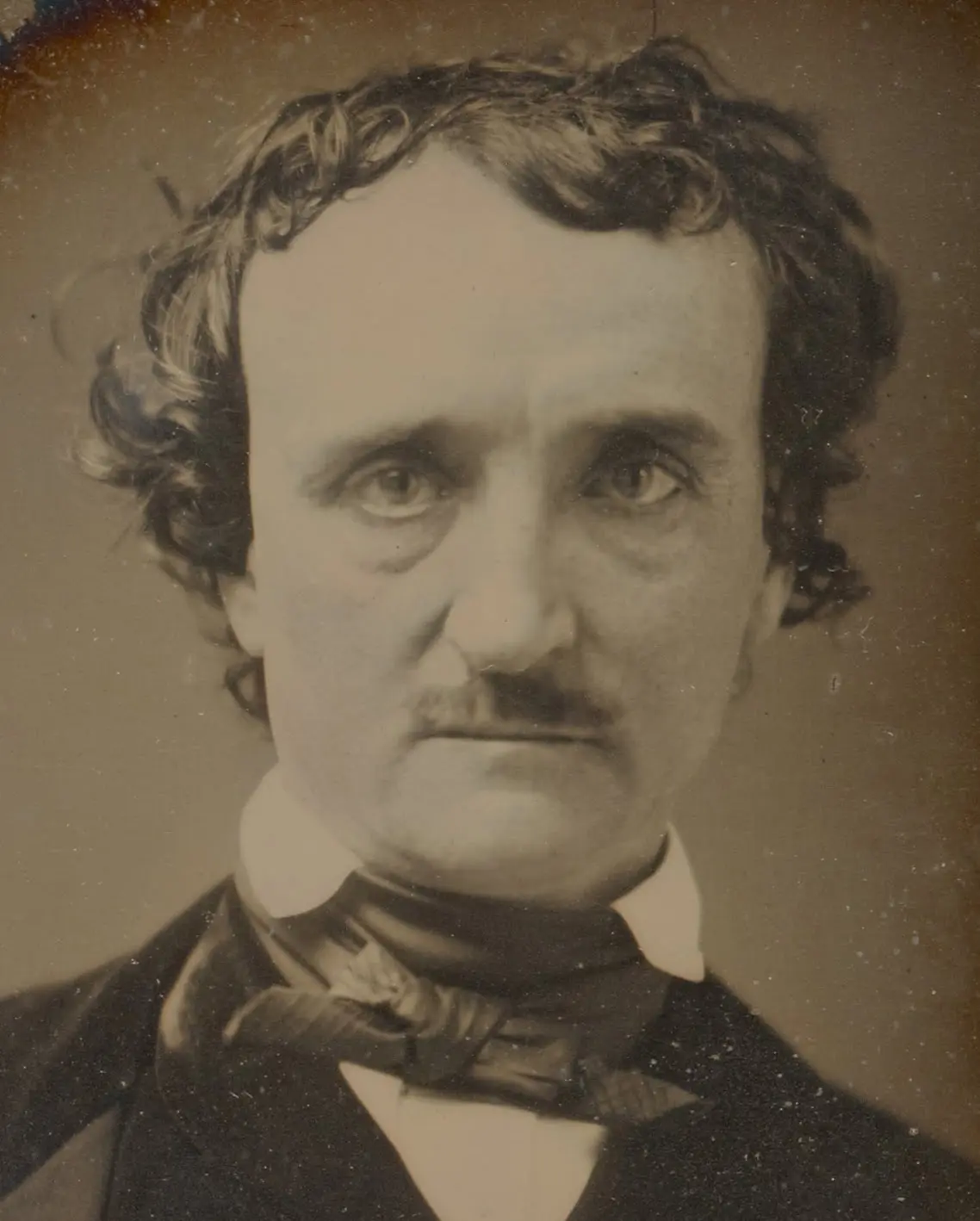
Edgar Allan Poe, four years after the Tales text, in a detail of the plate. Daguerreotype by an unidentified American photographer, 1849. J. Paul Getty Museum.
Full credit
"Edgar Allan Poe" by Unknown maker, American (daguerreotypist) — https://commons.wikimedia.org/wiki/File:1849_face_detail,_from-_Unknown_maker,_American_-_Edgar_Allan_Poe_-_Google_Art_Project_(cropped).jpg — Public domain in US (made 1849 by an unidentified photographer, presumed not to have lived past 1955 since he was working in 1849; anonymous unpublished work, more than 120 years since creation); DE/FR (anonymous work, more than 70 years since it was made); photograph released by the J. Paul Getty Museum Open Content Program
Two lines on the serial’s printed pages differ from the transcription. In both places this page follows the printed pages. On page 165 of the February 1843 number the deed is “known only to one living human being,” in the singular, and on page 167 the editors write “brought to pass; that an individual assassin,” without the extra “and” that appears in the transcription.
What happens in each installment?
The story moves the Rue Morgue pair, Dupin and his unnamed friend, onto a case that the narrator openly ties to New York. Part I sets out the case: Marie, a young woman who once worked in a perfume shop, leaves her mother’s house on a Sunday morning saying she will visit her aunt in the Rue des Drômes, and on the fourth day her body is found “floating in the Seine” (p. 16).
The rest of the installment gathers what the Paris papers print about the body, the suitor St. Eustache, and the thicket near the Barrière du Roule where some boys later find her belongings.
Part II gives most of its pages to Dupin as he takes the newspapers apart, continuing his answer to one paper’s argument that the body cannot be Marie’s at all, and ends with the popular view that a gang killed her. Part III argues against the gang, turns to the evidence of Madame Deluc, who keeps a roadside inn near the thicket, and follows a man of dark complexion and a missing boat before the editors break in with their bracketed note.
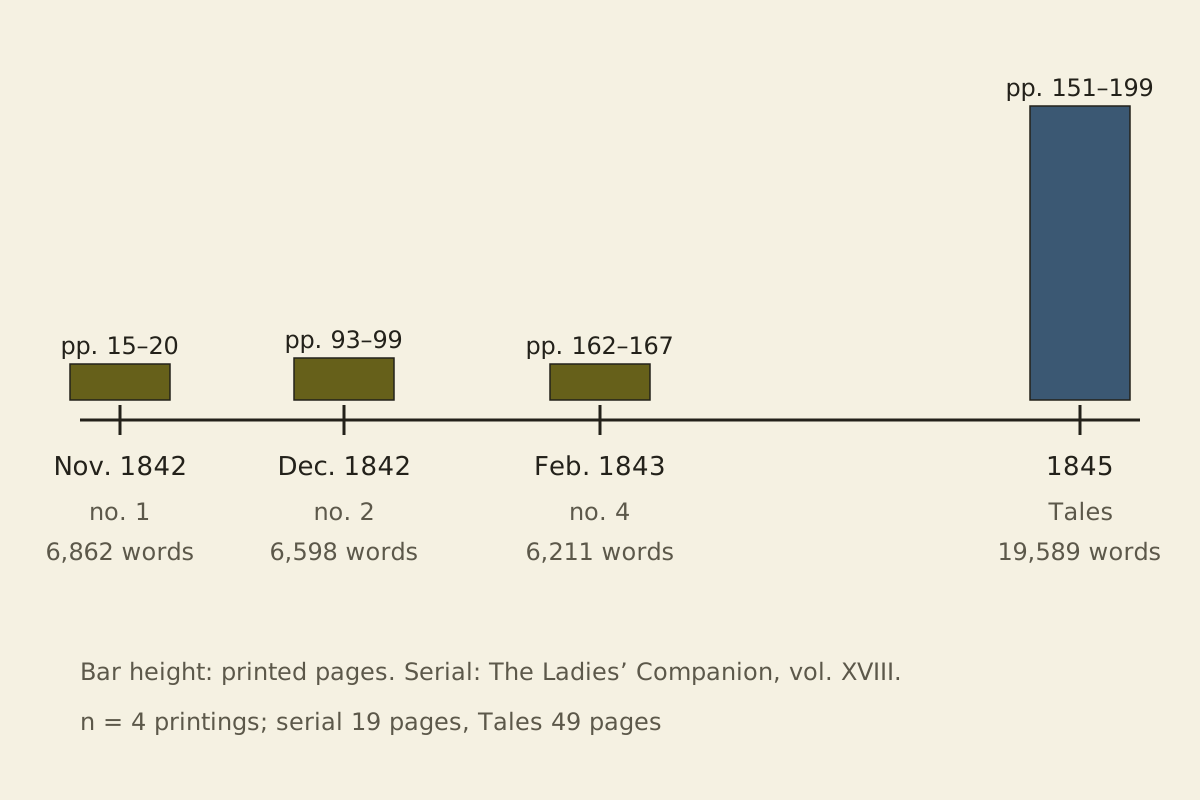
The four printings compared, with their pages and word counts. n = 4 printings; the serial fills 19 pages, Tales 49.
Credit line for reuse
"Four printings of ‘The Mystery of Marie Rogêt,’ 1842–1845" by Once Upon a Version — https://onceuponaversion.com/mystery-tellers/marie-roget-revisions/ — licensed under CC BY 4.0 (https://creativecommons.org/licenses/by/4.0/)
Data: The Mystery of Marie Roget, The Ladies’ Companion (1842–43) and Tales (1845) texts, E. A. Poe Society of Baltimore transcriptions, retrieved 2026-11-03
The four printings, with pages, paragraphs and words, as CSV (where the data comes from) Data: The Mystery of Marie Roget, The Ladies’ Companion (1842–43) and Tales (1845) texts, E. A. Poe Society of Baltimore transcriptions, retrieved 2026-11-03
The narrator is the unnamed friend who told “The Murders in the Rue Morgue,” and he opens by saying he wrote that earlier tale “about a year ago.” The Paris police who come to Dupin here are the same force he mocked in 1841, when he named a real Paris officer; the memoirs signed by Vidocq, the officer Dupin named are another Paris crime story with a real name on the title page.
What did Poe change about the ending?
Sixteen changes of wording are followed on this page, chosen because each one alters what the tale points to, and each is quoted with its page numbers from every printing that carries it: 12 from both, and the 4 passages cut or added in 1845 from the one printing that has them. Nine of the 16 fall in the text of Part III, six in Part II and one in Part I, so the changes gather toward the end of the argument rather than spreading evenly through it.
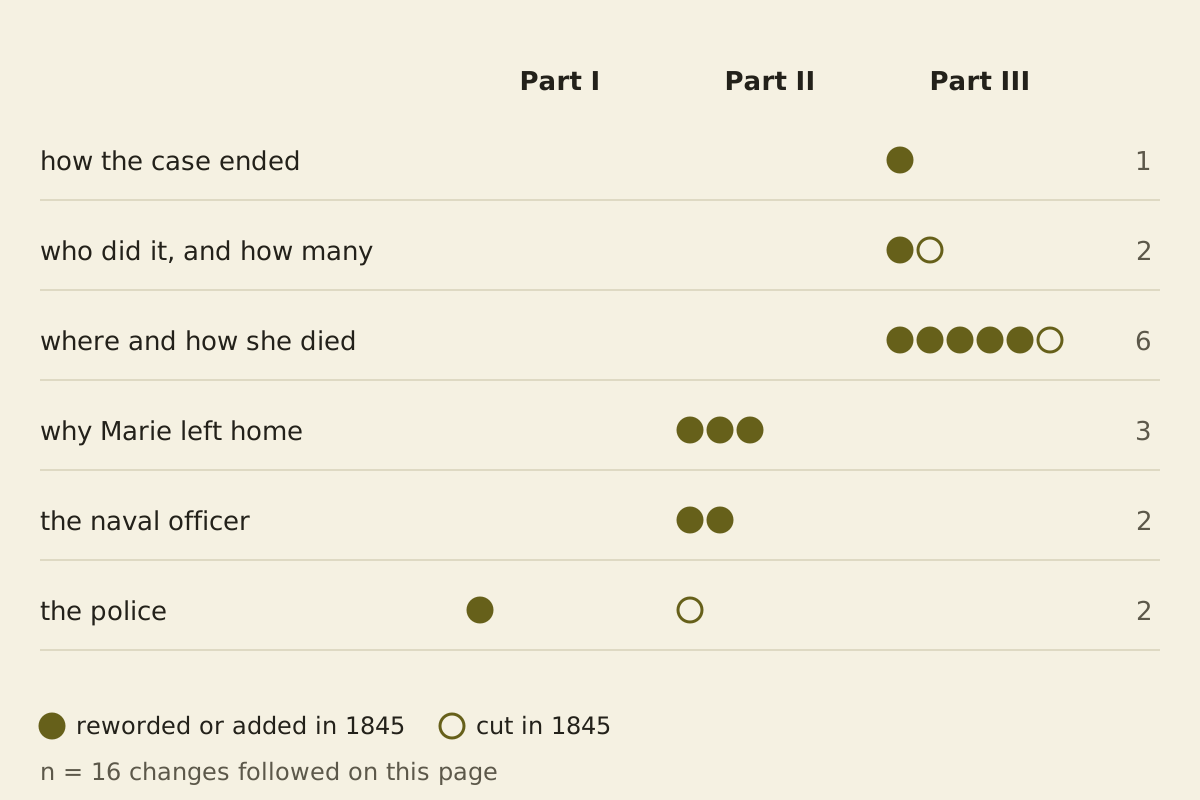
The 16 changes this page follows, by what they point to and by installment; open dots are passages cut in 1845. n = 16 changes.
Credit line for reuse
"Sixteen changes in ‘The Mystery of Marie Rogêt,’ serial to 1845, by what they point to" by Once Upon a Version — https://onceuponaversion.com/mystery-tellers/marie-roget-revisions/ — licensed under CC BY 4.0 (https://creativecommons.org/licenses/by/4.0/)
Data: The Mystery of Marie Roget, The Ladies’ Companion (1842–43) and Tales (1845) texts, E. A. Poe Society of Baltimore transcriptions, retrieved 2026-11-03
The serial’s promise
The first change comes in Part I, before the crime is even told. The November 1842 text says the police tried many times to hire Dupin and calls this case “The only instance, nevertheless, in which such attempt proved successful, was the instance to which I have already alluded” (p. 15). In 1845 the same place reads “One of the most remarkable instances” (p. 153), so the 1845 text no longer says that this was the only case the police persuaded him to take.
The serial’s last page makes a firmer claim. After Dupin’s last speech, a bracketed note signed “Eds.” says that the part of the manuscript which follows up his clue has been left out, and then it reports the outcome of the case:
February 1843 · The Ladies’ Companion, p. 167
“that an individual assassin was convicted, upon his own confession, of the murder of Marie Rogêt”
written by Edgar A. Poe · The Ladies’ Companion, February 1843, p. 167
1845 · Tales (Wiley and Putnam), p. 197
“that the result desired was brought to pass; and that the Prefect fulfilled”
written by Edgar A. Poe · Tales (Wiley and Putnam, 1845), p. 197
What changed: The 1845 note keeps the omission and the Prefect’s payment but no longer says that anyone was convicted or confessed.
Whatever the bracket leaves out stays in what this site calls the narrator’s pocket, which sorts held-back information into three kinds: not-yet-known (the teller does not know it either), delayed (the teller knows it and saves it for its place) and concealed (the teller knows it and deliberately keeps it back). The bracket describes a deliberate omission, which makes it the concealed kind in both printings. The difference is that the editors, not the narrator, say they are keeping it back.
One, or two
The largest group of changes sits in Dupin’s summing-up in Part III. The serial counts a single person who knows the truth and then asks “And who that one?” (p. 165). The 1845 text cuts the question, along with the promise after it that the answer will not be difficult to find. The count changes as well:
February 1843 · The Ladies’ Companion, p. 165
“The horrors of this dark deed are known only to one living human being, and to God.”
written by Edgar A. Poe · The Ladies’ Companion, February 1843, p. 165
1845 · Tales (Wiley and Putnam), p. 194
“The horrors of this dark deed are known only to one, or two, living human beings, and to God.”
written by Edgar A. Poe · Tales (Wiley and Putnam, 1845), p. 194
What changed: The 1845 text allows a second person and puts “beings” in the plural to match.
The next sentence changes too. The serial reads “We have attained the idea of a murder perpetrated” (p. 165), while the 1845 text reads “We have attained the idea either of a fatal accident under the roof of Madame Deluc, or of a murder perpetrated” (p. 194). A few pages earlier the 1845 text had already added “There might have been a wrong here, or, more possibly, an accident at Madame Deluc’s” (p. 189), in a passage where the serial moves straight on.
The thicket loses its certainty in the same way. In the serial Dupin says “That it was the scene, I believe” (p. 162) and later “You will here bear in mind that I admit the thicket as the scene of the outrage” (p. 164). In 1845 the first sentence becomes “I may or I may not believe” (p. 185) and the second loses its admission. The serial’s line “We are not forced to suppose a premeditated design of murder or of violation” (p. 165) is cut entirely.
Marie’s purpose and the naval officer
Part II changes the reasons given for Marie leaving home. Where the serial has her think “I am to meet a certain person for the purpose of elopement” (p. 98), the 1845 text adds “or for certain other purposes known only to myself” (p. 183), and a later clause adds “or not until certain concealments are effected” (p. 183). Neither printing says what those purposes or concealments were, and this page does not guess.
The naval officer of her first disappearance moves a little too. In the serial the gap between Marie’s two disappearances “is precisely the general period of the cruises of our men-of-war” (p. 98), while in 1845 it “is a few months more than” that period (p. 182). The serial also has Dupin attack “the culpable remissness of the police” in a sentence of Part II that the 1845 text drops.
The 16 changes, quoted with pages from the printings that carry them, as CSV (where the data comes from) Data: The Mystery of Marie Roget, The Ladies’ Companion (1842–43) and Tales (1845) texts, E. A. Poe Society of Baltimore transcriptions, retrieved 2026-11-03
| # | Points to | Serial | 1845 | Change |
|---|---|---|---|---|
| 1 | the police | Part I, p. 15 | p. 153 | reworded |
| 2 | the naval officer | Part II, p. 98 | p. 182 | reworded |
| 3 | the naval officer | Part II, p. 98 | p. 182 | reworded |
| 4 | why Marie left home | Part II, p. 98 | p. 182 | reworded |
| 5 | why Marie left home | Part II, p. 98 | p. 183 | reworded |
| 6 | why Marie left home | Part II, p. 98 | p. 183 | reworded |
| 7 | the police | Part II, p. 98 | none | cut |
| 8 | where and how she died | Part III, p. 162 | p. 185 | reworded |
| 9 | where and how she died | Part III | p. 189 | added |
| 10 | where and how she died | Part III, p. 164 | p. 190 | reworded |
| 11 | where and how she died | Part III, p. 164 | p. 190 | reworded |
| 12 | who did it, and how many | Part III, p. 165 | p. 194 | reworded |
| 13 | who did it, and how many | Part III, p. 165 | none | cut |
| 14 | where and how she died | Part III, p. 165 | p. 194 | reworded |
| 15 | where and how she died | Part III, p. 165 | none | cut |
| 16 | how the case ended | Part III, p. 167 | p. 197 | reworded |
n = 16 changes: 12 reworded, 3 cut and 1 added in 1845. The CSV gives both quotations for the 12 reworded rows and the one quotation for each cut or added passage, with the edition and page of each.
Which footnotes did Poe add in 1845?
Apart from the magazine’s notes on where each installment continued, the serial printed one footnote of its own, “See murders in the Rue Morgue.” (Part I, p. 19). The 1845 text has 24 footnotes, so 23 are new. Eleven of the new notes name a New York or Philadelphia newspaper standing behind a Paris paper in the story, and seven give a place or a person, such as “Nassau Street.” on page 153.
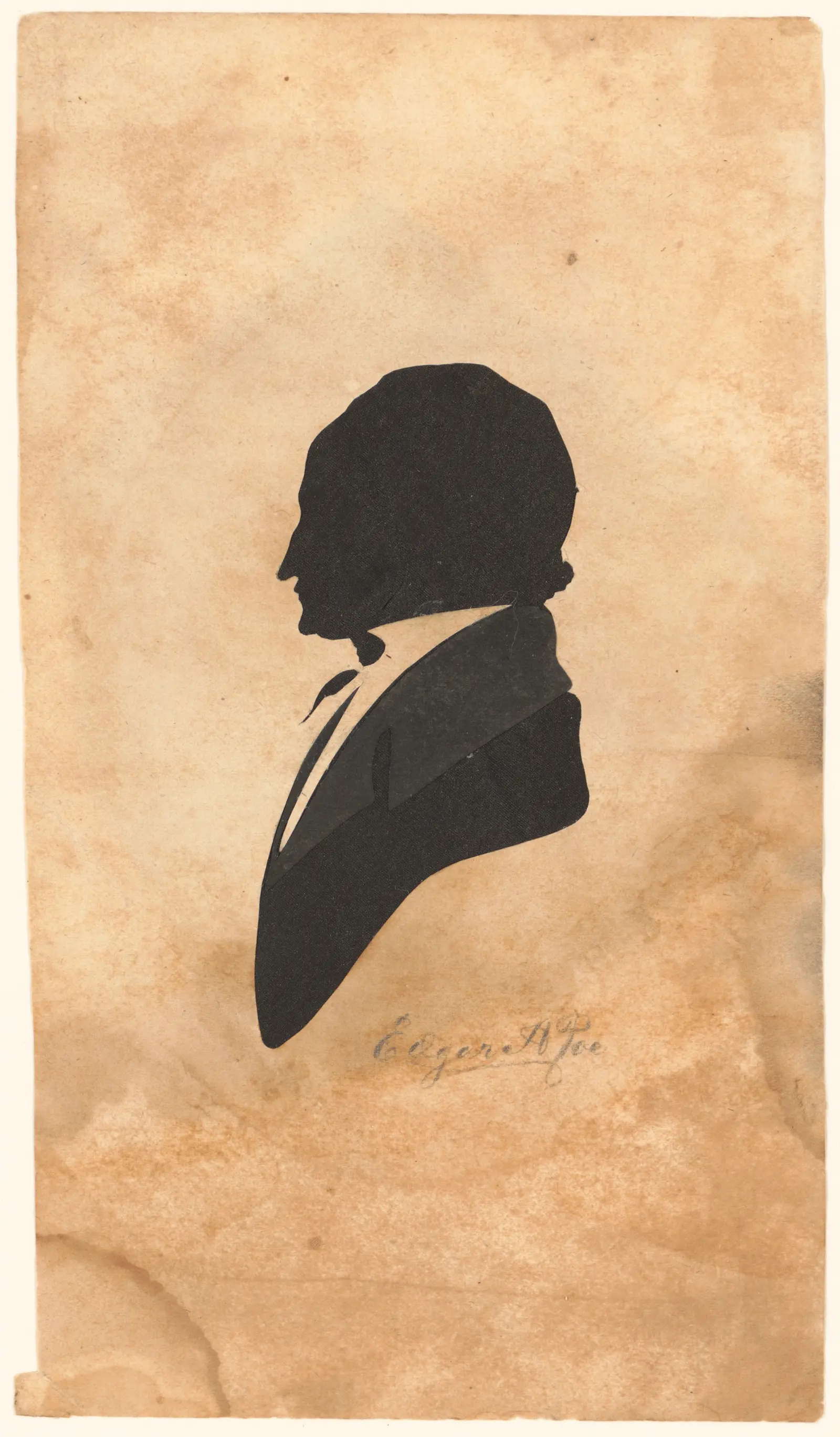
Edgar Allan Poe in profile, cut paper and silk on a paper sheet. Anonymous American artist, 19th century. The Metropolitan Museum of Art, 60.603.21.
"Edgar Allan Poe" by Anonymous American artist — https://commons.wikimedia.org/wiki/File:Edgar_Allan_Poe_MET_DP140871.jpg — CC0 1.0 (https://creativecommons.org/publicdomain/zero/1.0/)
The longest note, the one on page 151, runs to 248 words over two pages. It tells the reader that the tale followed “the essential” facts of the real murder while only paralleling the rest, and that “the investigation of the truth was the object.” Its last sentence claims that two confessions, one of them by “the Madame Deluc of the narrative,” confirmed the conclusion that the tale had reached.
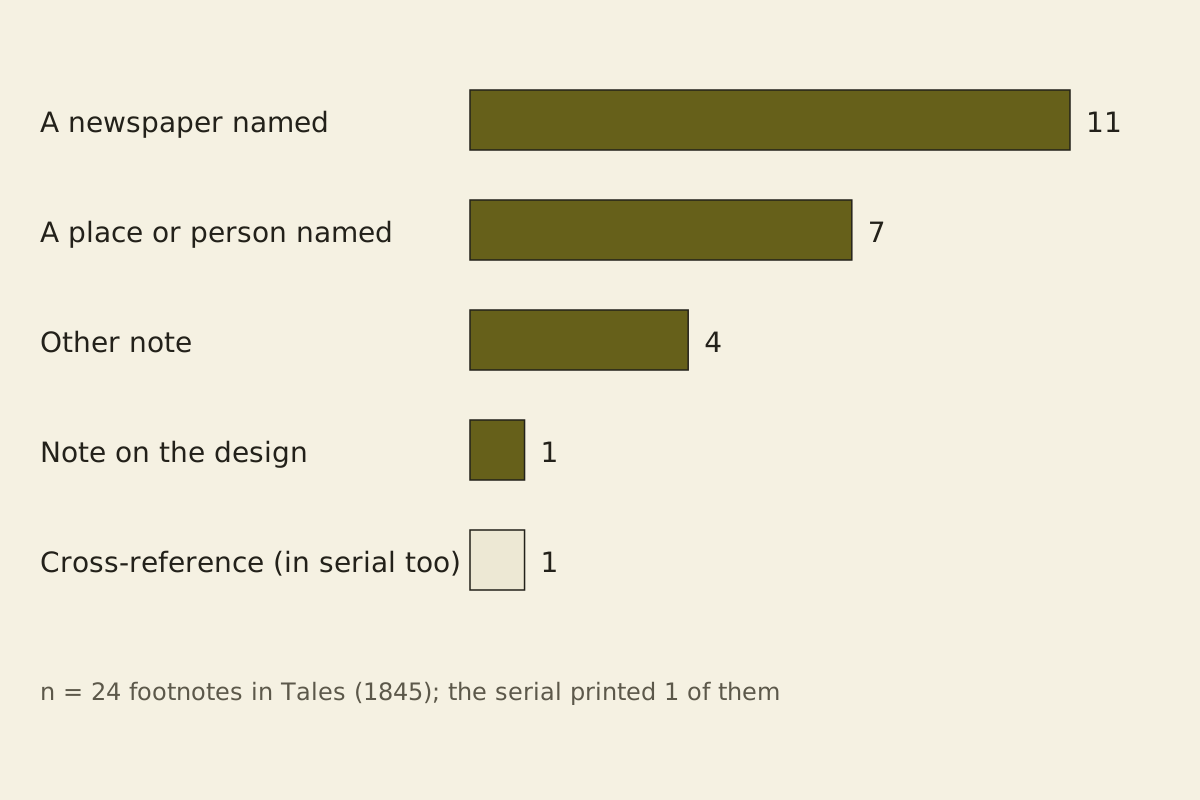
The 24 footnotes of the 1845 text by kind. n = 24 footnotes; one, the cross-reference to the Rue Morgue, was also printed in the serial.
Credit line for reuse
"The 24 footnotes of ‘The Mystery of Marie Rogêt’ in Tales, 1845, by kind" by Once Upon a Version — https://onceuponaversion.com/mystery-tellers/marie-roget-revisions/ — licensed under CC BY 4.0 (https://creativecommons.org/licenses/by/4.0/)
Data: The Mystery of Marie Roget, The Ladies’ Companion (1842–43) and Tales (1845) texts, E. A. Poe Society of Baltimore transcriptions, retrieved 2026-11-03
All 24 footnotes of 1845, with pages and kinds, as CSV (where the data comes from) Data: The Mystery of Marie Roget, The Ladies’ Companion (1842–43) and Tales (1845) texts, E. A. Poe Society of Baltimore transcriptions, retrieved 2026-11-03
Poe’s claim has been disputed. Richard Fusco, in a 1978 study published by the Poe Society, argues that Poe invented the support he claims from the confession of the real woman behind Madame Deluc, and that her reported statement came between the second and third installments rather than long after publication. Fusco also reads the 1845 changes as Poe softening the certainty of 1842. This page reports both accounts side by side and does not test Fusco’s dating, which rests on sources it has not read.
Motif grid: what the two texts point to
The grid compares the two texts on seven features of the case as each printing tells it. Each feature has a written rule, given in the definitions file, for what counts as present and which forms count as transformed.
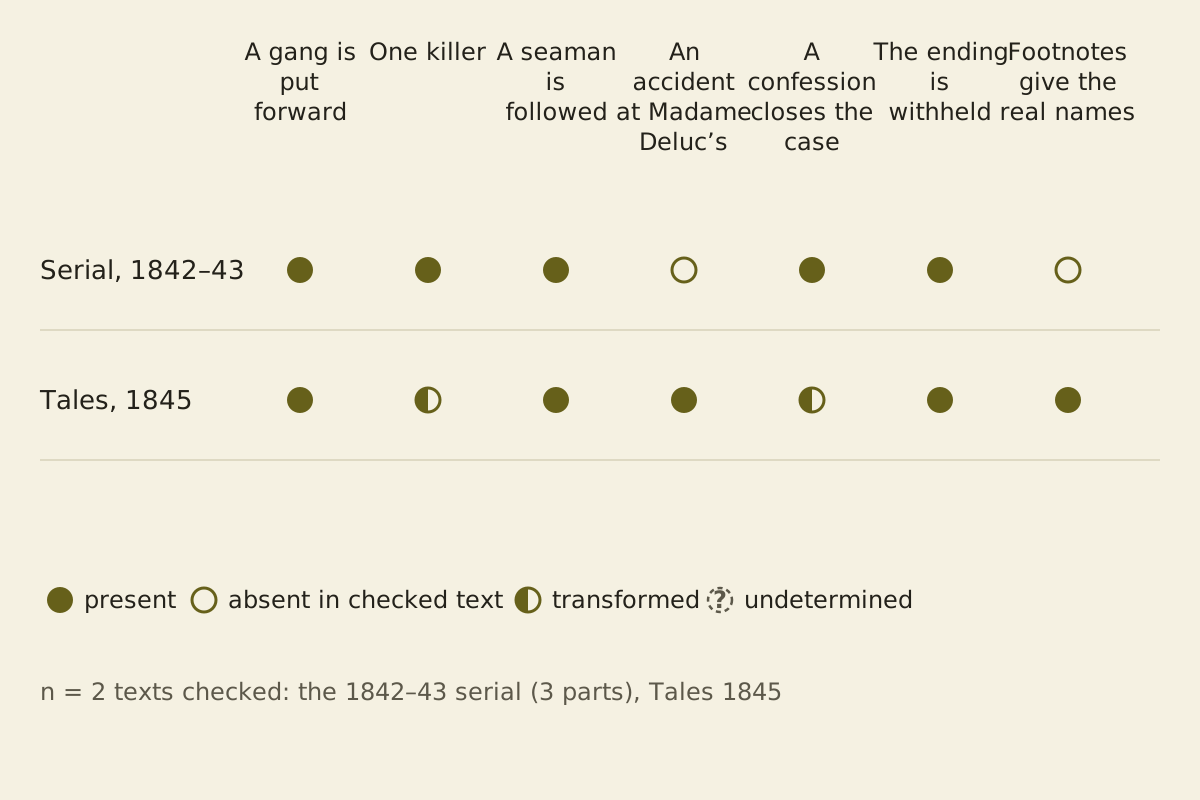
Seven features in the serial and the 1845 text; filled is present, open is absent in the checked text, half-filled is transformed. n = 2 texts checked.
Credit line for reuse
"Motif grid: seven features of ‘The Mystery of Marie Rogêt’ in the serial and in 1845" by Once Upon a Version — https://onceuponaversion.com/mystery-tellers/marie-roget-revisions/ — licensed under CC BY 4.0 (https://creativecommons.org/licenses/by/4.0/)
Data: The Mystery of Marie Roget, The Ladies’ Companion (1842–43) and Tales (1845) texts, E. A. Poe Society of Baltimore transcriptions, retrieved 2026-11-03
The grid, cell by cell with pages and evidence, as CSV (where the data comes from) Data: The Mystery of Marie Roget, The Ladies’ Companion (1842–43) and Tales (1845) texts, E. A. Poe Society of Baltimore transcriptions, retrieved 2026-11-03
| Text | A gang is put forward | One killer | A seaman is followed | An accident at Madame Deluc’s | A confession closes the case | The ending is withheld | Footnotes give the real names |
|---|---|---|---|---|---|---|---|
| The Ladies’ Companion, 1842–43 (3 parts) | present | present | present | absent in checked text | present | present | absent in checked text |
| Tales (Wiley and Putnam, 1845) | present | transformed | present | present | transformed | present | present |
n = 2 texts checked: the three-part serial in The Ladies’ Companion (1842–43) and Tales (1845). Of the 14 cells, 10 are present, 2 transformed and 2 absent in the checked text, and none is undetermined. “Transformed” here means that the 1845 text allows “one, or two” people, and that it moves the confessions from the editors’ note to Poe’s own footnote.
The seven feature definitions, as CSV (where the data comes from) Data: The Mystery of Marie Roget, The Ladies’ Companion (1842–43) and Tales (1845) texts, E. A. Poe Society of Baltimore transcriptions, retrieved 2026-11-03
What do the two texts not share?
Three features hold in both printings. Both report the newspapers’ view that a gang killed Marie and have Dupin argue against it, both follow a seaman of dark complexion who is linked to the naval officer of her first disappearance, and both print the editors’ note that leaves out the follow-up of the clue.
Four features differ. Only the 1845 text raises an accident at Madame Deluc’s inn and gives New York names in its footnotes, while only the serial counts a single person who knows the deed and reports a conviction on confession. The wording outside these 16 changes differs too, but mostly in small ways: 187 of the 306 marked differences are matters of spelling, punctuation or typeface, such as the serial’s “segar-girl” becoming the “cigar-girl” of 1845.
What the revisions do not settle
The comparison shows what each printing says, not what happened to Mary Rogers, a young woman whose death this page does not try to explain. Neither text names a killer, and the 1845 text adds possibilities without choosing among them. Whether the revisions answered news of the real case is a question about letters and newspapers that this page has not read, so the order of events in 1842–43 is left to the studies listed below.
The last word on the outcome belongs to the editors’ bracket in each printing. In February 1843 the note signed “Eds.” told readers of The Ladies’ Companion that an individual assassin had confessed; in the 1845 Tales the same bracket says only that “the result desired was brought to pass,” and Poe’s own footnote, at the head of the tale, carries the claim about confessions instead.
Sources
Editions
- Edgar A. Poe, “The Mystery of Marie Roget,” Part I, The Ladies’ Companion (New York), vol. XVIII, no. 1, November 1842, pp. 15–20. Transcription with page and column markers by the Edgar Allan Poe Society of Baltimore (Text-02b, part 1). https://www.eapoe.org/works/tales/rogeta1.htm (full text)
- Edgar A. Poe, “The Mystery of Marie Roget,” Part II, The Ladies’ Companion (New York), vol. XVIII, no. 2, December 1842, pp. 93–99. Transcription by the Edgar Allan Poe Society of Baltimore (Text-02b, part 2). https://www.eapoe.org/works/tales/rogeta2.htm (full text)
- Edgar A. Poe, “The Mystery of Marie Roget,” Part III, The Ladies’ Companion (New York), vol. XVIII, no. 4, February 1843, pp. 162–167. Transcription by the Edgar Allan Poe Society of Baltimore (Text-02b, part 3), corrected here in two places from the printed page. https://www.eapoe.org/works/tales/rogeta3.htm (full text)
- Edgar A. Poe, “The Mystery of Marie Roget,” in Tales (New York: Wiley and Putnam, 1845), pp. 151–199, with its footnotes. Transcription by the Edgar Allan Poe Society of Baltimore (Text-03b). https://www.eapoe.org/works/tales/rogetb.htm (full text and footnotes)
- Edgar A. Poe, “The Purloined Letter,” The Gift for 1845 (available about October 1844), pp. 41–61. Transcription by the Edgar Allan Poe Society of Baltimore (Text-02b). https://www.eapoe.org/works/tales/plttra.htm (full text)
Research
- Richard Fusco, “Poe’s Revisions of ‘The Mystery of Marie Rogêt’ — a Hoax?,” in Poe at Work: Seven Textual Studies (Baltimore: Edgar Allan Poe Society, 1978), pp. 91–99. https://www.eapoe.org/papers/psbbooks/pb19781h.htm (full text; paraphrased, not quoted)
Catalogues and databases
- Edgar Allan Poe Society of Baltimore, “The Mystery of Marie Roget”: list of manuscripts, authorized printings and reprints (Text-01 to Text-03c), with bibliography. https://www.eapoe.org/works/info/pt040.htm (full page)
- Edgar Allan Poe Society of Baltimore, “The Mystery of Marie Roget”: comparative text of the Ladies’ Companion and Tales printings. https://www.eapoe.org/works/cmprs/pt040c03.htm (full page)
- Edgar Allan Poe Society of Baltimore, “The Purloined Letter”: list of manuscripts, authorized printings and reprints. https://www.eapoe.org/works/info/pt051.htm (full page)
Cite this page
Once Upon a Version. “The Mystery of Marie Rogêt: 1845 Rewrites the Serial’s Clues.” Once Upon a Version. Published 2026-11-05. https://onceuponaversion.com/mystery-tellers/marie-roget-revisions/ (accessed day month year).
Write in the date you read the page; the page has no DOI.
More from Mystery Tellers
Mystery Tellers
Dr. Watson: Counted Here, 56 of 60 Holmes Stories Are His
Type detective fiction (no tale-type number)
Dr. Watson narrates 56 of the 60 Sherlock Holmes stories, counted story by story. Holmes tells two, two are third-person, and Poe's friend did it in 1841.
Picture credit
"Original drawing for “Silver Blaze”" by Sidney Paget — https://commons.wikimedia.org/wiki/File:The_Adventure_of_Silver_Blaze_01.jpg — Public domain in US (published 1892 in The Strand Magazine); DE/FR (Sidney Paget d. 1908, life+70); faithful photograph of a two-dimensional drawing (PD-Art; auction-house photograph, Christie's)
Mystery Tellers
Arsène Lupin: In the 1905 Story, the Narrator Is Lupin
Type short story (no tale-type number)
In the earliest known Arsène Lupin story (Je sais tout, July 1905), the passenger who tells it is Lupin; the 1907 book adds a friend’s frame around his voice.
Picture credit
"Frontispiece, Arsène Lupin (Doubleday, 1909)" by H. Richard Boehm — https://commons.wikimedia.org/wiki/File:Frontispiece-Arsene_Lupin_(Doubleday,_1909).jpg — Public domain in US (published 1909); DE/FR (H. Richard Boehm d. 1914, life+70)
Mystery Tellers
Vidocq’s Memoirs: The 1828 Preface Admits Another Hand
Type memoir of crime and police (no tale-type number)
Vidocq’s Mémoires (1828–29) carry his name, yet their own preface says a reviser rewrote volume 1 and part of volume 2; a study cited by the BnF names two.
Picture credit
"Portrait d'Eugène Vidocq (1775-1857), aventurier et chef de la police de sûreté (G.12180)" by Achille Devéria — https://commons.wikimedia.org/wiki/File:Portrait_d%27Eug%C3%A8ne_Vidocq_(1775-1857),_aventurier_et_chef_de_la_police_de_s%C3%BBret%C3%A9._G.12180_(1_of_4).jpg — CC0 1.0 (https://creativecommons.org/publicdomain/zero/1.0/)