Arsène Lupin: In the 1905 Story, the Narrator Is Lupin
In Maurice Leblanc's earliest known Arsène Lupin story, printed in 1905, the passenger who tells the tale turns out to be Lupin himself, and the 1907 book later sets a friend's frame around his voice.
By Once Upon a Version
Published
How a version is traced · Version history · Contact · Report an error (contact@onceuponaversion.com)
In short
- In “L'Arrestation d'Arsène Lupin,” printed in Je sais tout in July 1905, the passenger who tells the story is unmasked at the arrest as Arsène Lupin himself.
- Of the seven things he holds back that are tracked here, he knows six while he hides them, and the 1905 text ends on his own last words.
- The 1907 book adds a closing frame by an unnamed friend; of its nine stories, Lupin narrates two, the friend one, and an outside voice six.
Telling card
- Tale
- L'Arrestation d'Arsène Lupin (The Arrest of Arsène Lupin)
- Type
- short story (no tale-type number)
- Teller
- A first-person passenger calling himself Bernard d'Andrézy, revealed at the arrest as Arsène Lupin (a character); written by Maurice Leblanc
- Recorded by
- n/a
5 more fields: edited by, told, published, this text, earliest known
- Edited by
- Maurice Leblanc, for the 1907 book (adds a closing frame in which an unnamed friend speaks)
- Told
- n/a, written work; in the 1907 frame the friend says Lupin told it to him one winter evening
- Published
- Je sais tout no. 6, July 1905, pp. 708-714 (Paris: Pierre Lafitte)
- This text
- The 1907 book, Arsène Lupin, gentleman-cambrioleur (Project Gutenberg 32854), checked against the 1905 magazine pages
- Earliest known
- Je sais tout no. 6, July 1905: the earliest Lupin story known to this page
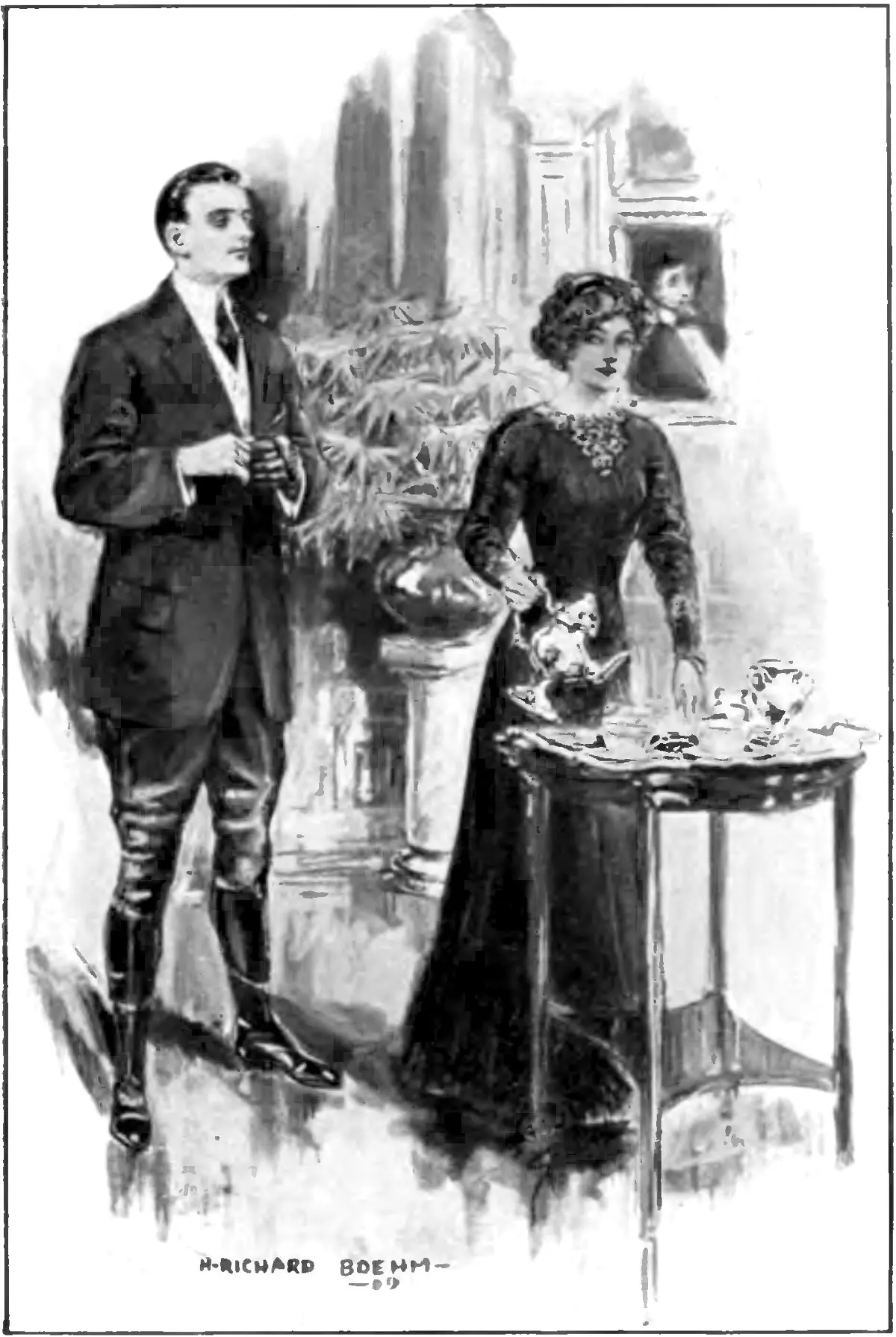
Frontispiece of the 1909 novel Arsène Lupin, not an illustration of the 1905 story: a man in riding boots and a woman at a tea table. The book's library record lists Edgar Jepson, Maurice Leblanc and Francis de Croisset as creators without marking their roles. H. Richard Boehm, Arsène Lupin (New York: Doubleday, Page), 1909.
Full credit
"Frontispiece, Arsène Lupin (Doubleday, 1909)" by H. Richard Boehm — https://commons.wikimedia.org/wiki/File:Frontispiece-Arsene_Lupin_(Doubleday,_1909).jpg — Public domain in US (published 1909); DE/FR (H. Richard Boehm d. 1914, life+70)
The passenger who tells Maurice Leblanc's earliest known Lupin story answers to Bernard d'Andrézy, a dead man's name. The story ran in the Paris magazine Je sais tout in July 1905, on pages 708 to 714, as “L'Arrestation d'Arsène Lupin.”
A wireless message warns a liner bound for America that Arsène Lupin is on board, and the narrator spends the crossing helping the other passengers guess which of them he is. At the gangway the detective Ganimard stops him, and the voice that has told the whole story turns out to be the thief's.
This page reads that story in two printings, the magazine of 1905 and the book of 1907, and asks who holds the narrative voice and when the reader is let into the secret. It then follows the voice through the other eight stories of the 1907 book, and sets the Lupin texts beside the Raffles stories that Ernest William Hornung collected in 1899, another thief with a friend nearby.
Who tells “L'Arrestation d'Arsène Lupin”?
The story is told in the first person by a passenger on the liner Provence. The other passengers call him Monsieur d'Andrézy, and he is on good terms with the captain. When Nelly Underdown, a Chicago heiress raised in Paris, asks whether he knows anything about Lupin, he offers to run the inquiry himself.
« Je ne sais rien de précis, mademoiselle, lui répondis-je, mais est-il impossible de conduire nous-mêmes notre enquête, tout aussi bien que le ferait le vieux Ganimard, l'ennemi personnel d'Arsène Lupin ? »
written by Maurice Leblanc · Je sais tout, no. 6, July 1905, p. 709
In this site's rendering, he tells her that he knows nothing definite, but asks why the passengers should not run their own inquiry as well as old Ganimard, Lupin's personal enemy, would. Then he takes the passenger list from his pocket and narrows thirteen first-class names beginning with R down to one: Rozaine, a quiet young man.
The narrator tells all this after the events. As the liner reaches port, he says that if he lived a hundred years he would not forget the smallest detail of that moment, which places the telling after the crossing. So the voice already knows how the story ends. It belongs to the man the whole ship is hunting, and the reader has nothing else to go on.
He also gives himself a past. On page 713, as the American coast comes into view, he explains that the Andrézy family comes of good Poitou stock with a slightly faded coat of arms, and that a gentleman may fairly dream of restoring its lustre. Every word of that family history comes from a man whose name, by Ganimard's account a few paragraphs later, belonged to someone who died three years earlier in Macedonia.
Which printings are checked here?
The first printing is in Je sais tout, a monthly magazine published in Paris by Pierre Lafitte. Its catalogue record at the Bibliothèque nationale de France starts the numbering with no. 1, dated 15 February 1905, so the sixth issue falls in July 1905. The table of contents of the magazine's 1905 volume lists “L'Arrestation d'Arsène Lupin” on page 708, and the story runs to page 714. French Wikisource's list of Leblanc's work in the magazine agrees with that count: no. 6, dated 15 July 1905.
The second printing is the book Arsène Lupin, gentleman-cambrioleur, published by Pierre Lafitte et Cie in 1907 with a preface by Jules Claretie. The BnF records it as one volume of 307 pages, and the book collects nine stories, the first of which is “L'Arrestation d'Arsène Lupin.” Claretie's preface says the character first appeared in Je sais tout, and French Wikisource's list of Leblanc's work there has no Lupin title before this one, so it is the earliest Lupin story known to this page.
The book is read here in the Project Gutenberg text, which follows the 1907 edition. Leblanc lived from 1864 to 1941 and Claretie from 1840 to 1913, according to the German national authority file.
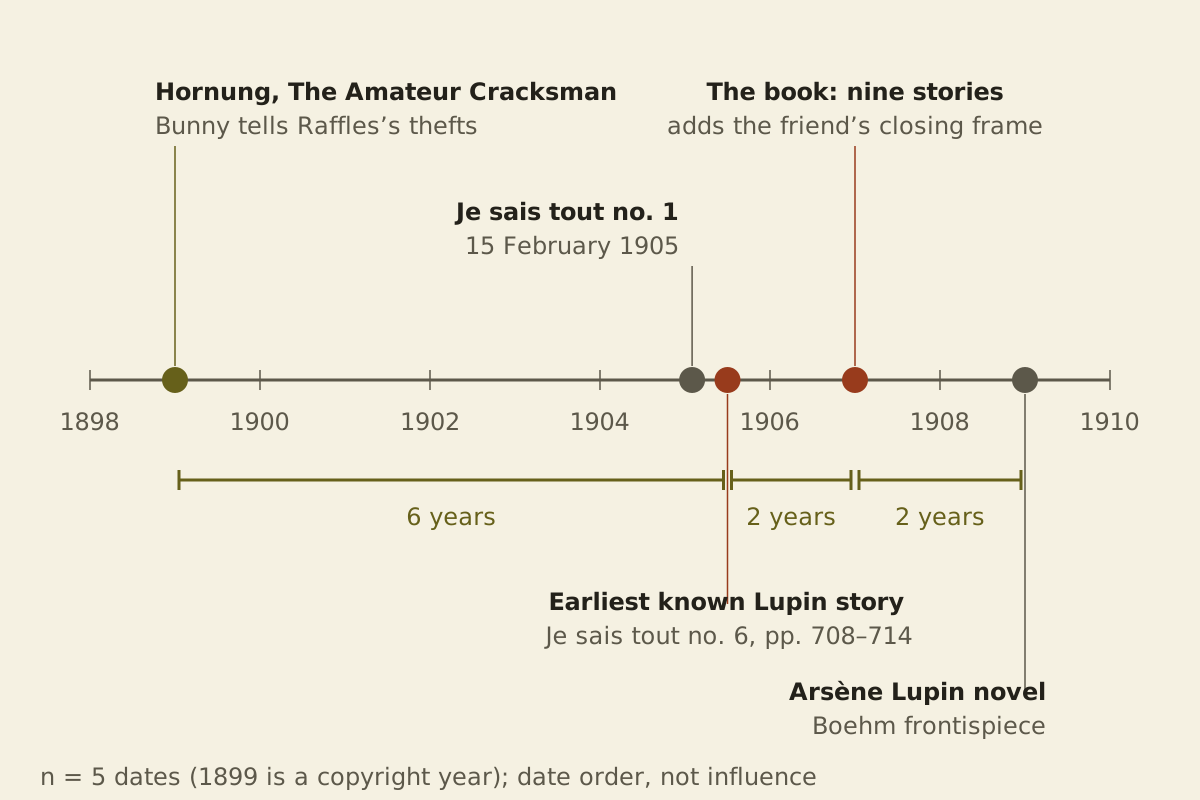
Five dates named on this page, from the 1899 copyright of Hornung's Raffles book to the 1909 novel; between the four distinct years the gaps are 6, 2 and 2 years. The order is an order of dates, not a line of influence.
Credit line for reuse
"Five dates around the earliest known Arsène Lupin story, 1899 to 1909" by Once Upon a Version — https://onceuponaversion.com/mystery-tellers/arsene-lupin-narrator/ — licensed under CC BY 4.0 (https://creativecommons.org/licenses/by/4.0/)
Data: BnF catalogue records and Je sais tout, 1905 (French Wikisource), retrieved 2026-11-03
The five dates and their sources, as CSV (where the data comes from) Data: Five printings, Once Upon a Version, 2026-11-03
The Lupin quotations are in French, from the 1905 pages or the 1907 book text, each followed by this site's English rendering; Hornung's are from the Project Gutenberg text of The Amateur Cracksman. The 1909 novel appears only through its frontispiece, which is used above because no illustration of the 1905 story could be used here: the 1905 drawing is signed Georges Leroux, and a painter of that name in the German authority file died in 1957, so the drawing may still be under copyright in France and Germany.
What does the passenger keep in his pocket?
This site uses the narrator's pocket for whatever a story has not yet handed to the reader, and each item is sorted into one of three kinds. Not yet known means the narrator does not know it yet either; delayed means the narrator knows it by the time of telling but lets it arrive in the order he met it; concealed means he knew it at the time and keeps it back on purpose.
Seven items are tracked in “L'Arrestation d'Arsène Lupin,” from the wireless message to the arrest. Six are concealed: the narrator knew each one while the crossing was going on. One is delayed: the choice Nelly makes on the gangway, which he could not know until she made it. None is not yet known.
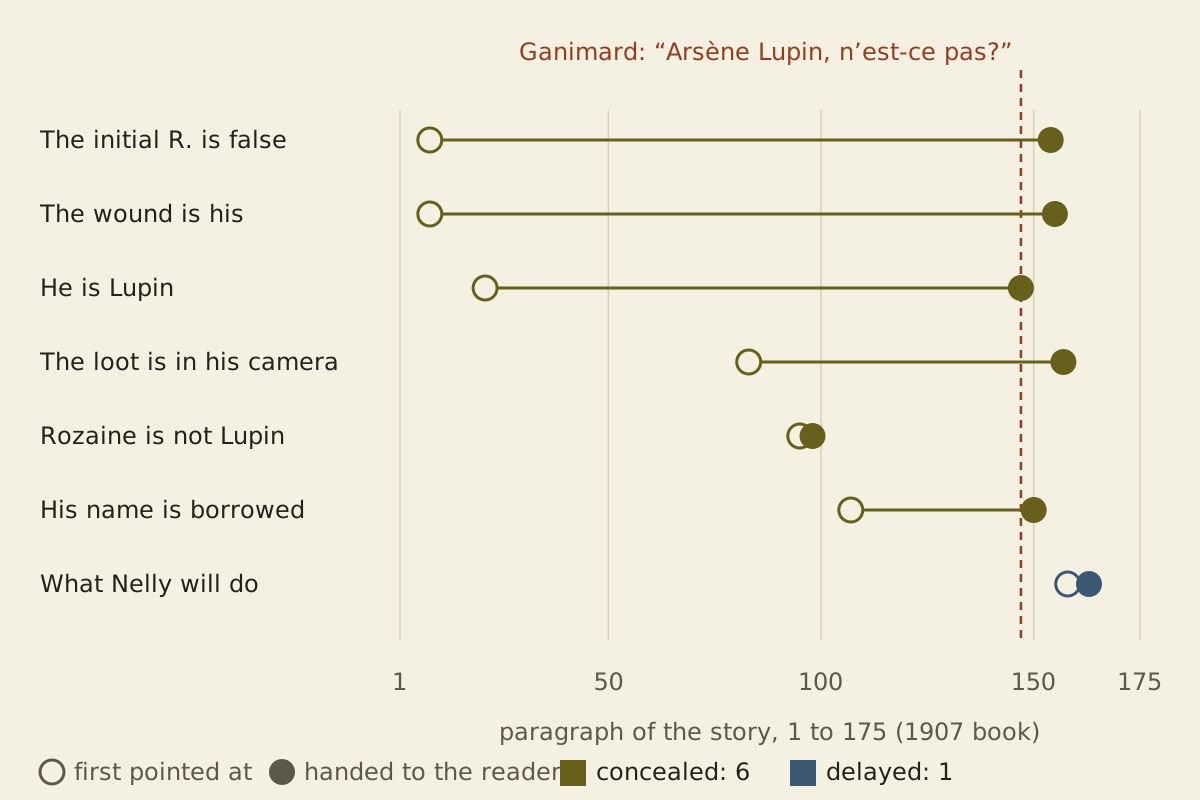
Where the text points at each item and where the reader is given it, by paragraph of the 1907 book text; the dashed line is Ganimard's question. n = 7 items.
Credit line for reuse
"The passenger's pocket in “L'Arrestation d'Arsène Lupin”" by Once Upon a Version — https://onceuponaversion.com/mystery-tellers/arsene-lupin-narrator/ — licensed under CC BY 4.0 (https://creativecommons.org/licenses/by/4.0/)
Data: L'Arrestation d'Arsène Lupin, Project Gutenberg text of the 1907 book and Je sais tout, 1905, retrieved 2026-11-03
The seven pocket items, with French wording and pages, as CSV (where the data comes from) Data: The passenger's pocket, Once Upon a Version, 2026-11-03
| Item | First pointed at (1905 page) | Handed over (1905 page) | By | Kind |
|---|---|---|---|---|
| The initial R. is a false trail | p. 709 | p. 713 | Ganimard | concealed |
| The wounded right forearm is the narrator’s | p. 709 | p. 713 | Ganimard (the blow); the narrator reports it | concealed |
| The narrator is Arsène Lupin | p. 709 | p. 713 | Ganimard | concealed |
| The jewels and the money are in the narrator’s camera | p. 712 | p. 714 | the narrator | concealed |
| Rozaine is not Lupin | p. 712 | p. 712 | events (the attack on Rozaine) | concealed |
| The name Bernard d'Andrézy belongs to someone else | p. 713 | p. 713 | Ganimard | concealed |
| What Nelly will do with the camera | p. 714 | p. 714 | Nelly (her act) | delayed |
Several of the concealed items are in plain sight: the wireless message on page 709 says the thief has a wound on his right forearm, and Ganimard strikes the narrator there on page 713. On page 712 the narrator shows Nelly his camera and asks whether a box no bigger than “un appareil pas plus grand que celui-ci” could not hold all of Lady Jerland's jewels. In this site's rendering, he asks whether a camera no bigger than this one could not hold them, and in the end it does.
Whether the story plays fair with its reader depends on which kind of item a clue belongs to. The wound and the camera are true and are given early, so a careful reader holds them as long as the narrator does. On page 710 the narrator even notices that Rozaine has shown his left arm, not his right, and then lets a sudden commotion carry the point away. The clues are on the page, but the voice that reports them never says what they mean.
Other items are steered. On page 712 the narrator says that when he watched Rozaine, he thought of the “double rôle que tenait sans doute ce curieux personnage,” the double part this odd man was no doubt playing, although he knew that Rozaine was playing no part at all. That sentence is the clearest case of concealment in the story, because it is the narrator's own comment, not a line spoken to deceive Nelly.
The same device works the other way in Poe's “Rue Morgue,” where the narrator's pocket holds delayed facts, not concealed ones. Poe's unnamed narrator knows the answer only because he tells the case afterwards, and the page on that story counts no concealed items among the 16 it traces. Leblanc's narrator is the culprit, so the facts he keeps back were his from the start.
What did the 1907 book add?
Set the two printings side by side and the narration is close to identical. The edges are not. The 1905 page stops on Lupin's last words to Ganimard, followed by the author's name. The 1907 book keeps that line and then lets a new voice speak.
1905 · Je sais tout, no. 6, p. 714
« Dommage, tout de même, de ne pas être un honnête homme… »
written by Maurice Leblanc · Je sais tout, no. 6, July 1905, p. 714, last line, followed by the signature
1907 · Arsène Lupin, gentleman-cambrioleur
« C'est ainsi qu'un soir d'hiver, Arsène Lupin me raconta l'histoire de son arrestation. »
written by Maurice Leblanc · Arsène Lupin, gentleman-cambrioleur (Paris: Pierre Lafitte, 1907), first paragraph after the same last line
What changed: In 1905 the story ends with Lupin's sigh that it is a pity not to be an honest man. In 1907 an unnamed friend follows it to say that this is how, one winter evening, Lupin told him the story of his arrest.
The frame runs on for seven more paragraphs, three of them short lines spoken by Lupin, in which the friend says he has seen Lupin twenty times and seen a different man each time, and he ends by calling the book's adventures ones he is trying to piece together from Lupin's confidences.
The first of Lupin's three lines is “Moi-même, me dit-il, je ne sais plus bien qui je suis.” In this site's rendering, Lupin tells the friend that even he no longer quite knows who he is. The question of identity that the passenger kept hidden for the length of a crossing is handed to Lupin himself, and the frame leaves it open.
The 1905 printing has no frame at all. Apart from picture captions and one subheading, the only words outside the passenger's narration are a headnote that the magazine printed in bold under the title, calling the piece “le récit que nous publions,” the account we are publishing. Only these two printings are compared here, and the later Lupin stories in the magazine are not checked, so this page does not say whether the frame was printed anywhere before 1907.
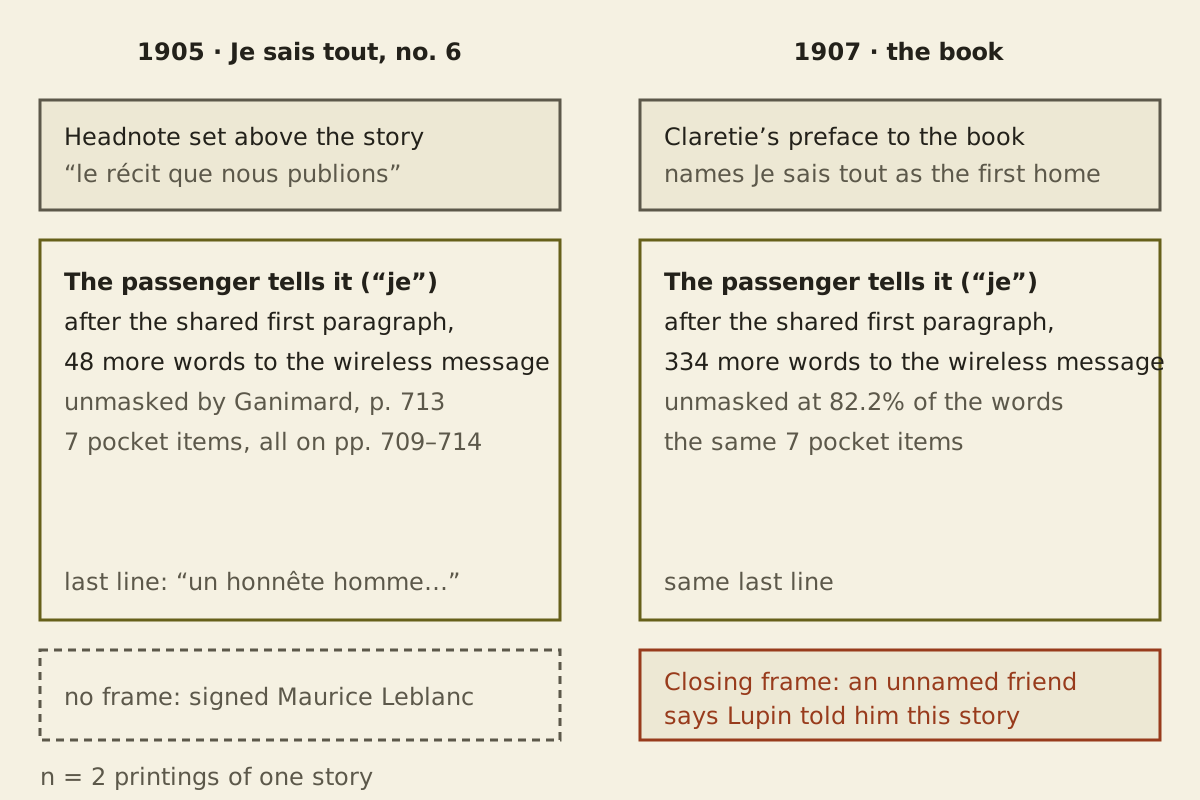
The layers around the passenger's narration in the two printings. Word counts are from the 1905 pages and the 1907 book text. n = 2 printings of one story.
Credit line for reuse
"Two printings of “L'Arrestation d'Arsène Lupin,” 1905 and 1907" by Once Upon a Version — https://onceuponaversion.com/mystery-tellers/arsene-lupin-narrator/ — licensed under CC BY 4.0 (https://creativecommons.org/licenses/by/4.0/)
Data: L'Arrestation d'Arsène Lupin, Project Gutenberg text of the 1907 book and Je sais tout, 1905, retrieved 2026-11-03
Other changes are smaller. In the opening, after a first paragraph that both printings share, the magazine needs 48 more words to reach the wireless message and the book needs 334, much of it on the strangeness of a ship still tied to land by wireless.
Lupin's calling card, left at a baron's house, reads « Reviendrai quand les meubles seront authentiques » in 1905, and gains a signature in 1907: « Arsène Lupin, gentleman-cambrioleur, reviendra quand les meubles seront authentiques », borrowing the phrase that is also the book's subtitle. In this site's rendering, the 1905 card says he will come back when the furniture is genuine, and the 1907 card has Arsène Lupin, gentleman burglar, say the same.
Neither printing is “the” story, since each is what this site calls a one-evening text, a dated witness with its own wording. All seven pocket items appear in both. In this site's studio terms, the book is a second pressing with one new voice on it.
Who tells the other eight stories in the 1907 book?
After the first story, the book does not keep Lupin in the narrator's seat. Two of the nine stories are told by Lupin in the first person, one is told by the friend, and six are told by a voice outside the action. In three of those six, the friend still steps in to say “I,” in an aside or a closing frame.
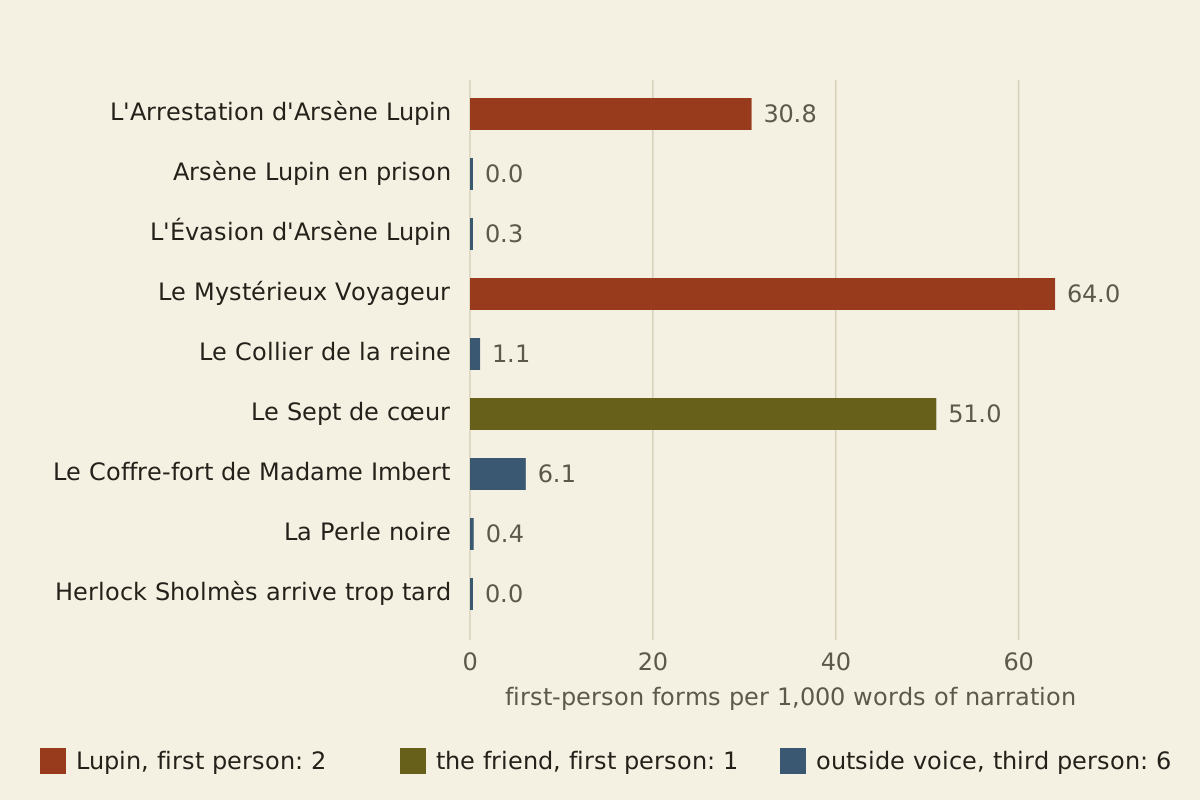
Forms of the French pronoun je, with its object and possessive forms, per 1,000 words of narration, in each story of the 1907 book; dialogue paragraphs, with their speech tags, and quoted speech are left out. n = 9 stories.
Credit line for reuse
"Who tells the nine stories of Arsène Lupin, gentleman-cambrioleur (1907)" by Once Upon a Version — https://onceuponaversion.com/mystery-tellers/arsene-lupin-narrator/ — licensed under CC BY 4.0 (https://creativecommons.org/licenses/by/4.0/)
Data: Arsène Lupin, gentleman-cambrioleur, Project Gutenberg text of the 1907 book, retrieved 2026-11-03
The nine stories and who tells them, as CSV (where the data comes from) Data: Who tells the nine Lupin stories of 1907, Once Upon a Version, 2026-11-03
| Story | Who tells it | Friend says “I” | First-person forms per 1,000 words |
|---|---|---|---|
| L'Arrestation d'Arsène Lupin | Lupin, first person | closing frame | 30.8 |
| Arsène Lupin en prison | outside voice, third person | none | 0.0 |
| L'Évasion d'Arsène Lupin | outside voice, third person | none | 0.3 |
| Le Mystérieux Voyageur | Lupin, first person | none | 64.0 |
| Le Collier de la reine | outside voice, third person | aside | 1.1 |
| Le Sept de cœur | the friend, first person | whole story | 51.0 |
| Le Coffre-fort de Madame Imbert | outside voice, third person | closing frame | 6.1 |
| La Perle noire | outside voice, third person | opening aside and closing frame | 0.4 |
| Herlock Sholmès arrive trop tard | outside voice, third person | none | 0.0 |
Lupin narrates again in “Le Mystérieux Voyageur,” the fourth story, but gives himself away early: bound and robbed on a train, he says “moi, Arsène Lupin!” In this site's rendering, he marvels that the man left tied up on the seat was he, Arsène Lupin. The line comes 26.7 percent of the way into the story's words. In the first story, Ganimard's question comes 82.2 percent of the way in, so only the first story keeps its teller hidden into the last fifth of its words.
The friend tells “Le Sept de cœur” himself, and it opens with a question he says he has often been asked, namely how he came to know Arsène Lupin. He calls himself Lupin's “historiographe,” his historian, and only near the end does he say that his club friend Jean Daspry was Lupin. The ninth story brings an English detective named Herlock Sholmès to a château, where Lupin goes by the name Velmont.
In two of the third-person stories, “Le Coffre-fort de Madame Imbert” and “La Perle noire,” Lupin's own voice comes back after the events, inside quotation marks. The friend says he had the story of the safe from Lupin himself, “un jour qu'il était en veine de confidence,” on a day when Lupin was in a confiding mood. The pearl story closes with Lupin explaining to the friend how the affair was done, so the book keeps letting Lupin tell, but from inside the friend's frame.
Claretie's preface quotes the writer Marcel L'Heureux on one difference between the Lupin stories and those of Sherlock Holmes.
« ici, nous savons d'avance qu'Arsène Lupin est le coupable »
written by Jules Claretie, quoting Marcel L'Heureux · preface to Arsène Lupin, gentleman-cambrioleur (Paris: Pierre Lafitte, 1907)
In this site's rendering: here, we know in advance that Arsène Lupin is the guilty one. Once readers know that, a narrator who turns out to be the thief can no longer surprise them in the same way, and in the book the hidden teller appears only once.
Motif grid: who tells the thief's story
The grid compares the ten Lupin texts checked here with Hornung's Raffles book on four features of the telling. Each feature has a written rule, in the definitions file, for what counts as present and what counts as transformed.
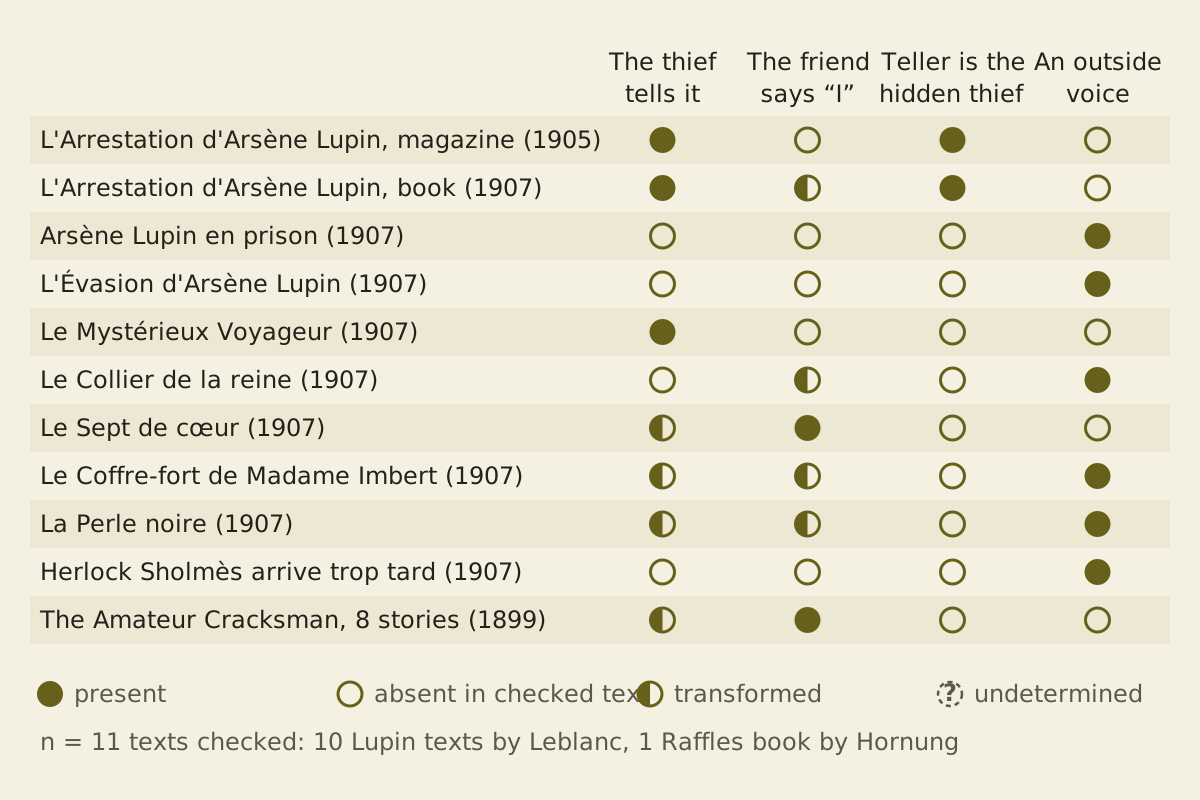
Four features of the telling in 11 texts; filled is present, open is absent in the checked text, half-filled is transformed. n = 11 texts checked.
Credit line for reuse
"Who tells the thief's story: four features in 11 texts" by Once Upon a Version — https://onceuponaversion.com/mystery-tellers/arsene-lupin-narrator/ — licensed under CC BY 4.0 (https://creativecommons.org/licenses/by/4.0/)
Data: Who tells the thief's story, Once Upon a Version, built from Je sais tout, 1905 and Project Gutenberg texts, retrieved 2026-11-03
The grid, cell by cell with evidence, as CSV (where the data comes from) Data: Who tells the thief's story, Once Upon a Version, 2026-11-03
| Text | The thief tells it | The friend says “I” | The teller is the hidden thief | An outside voice tells it |
|---|---|---|---|---|
| L'Arrestation d'Arsène Lupin, magazine (1905) | present | absent in checked text | present | absent in checked text |
| L'Arrestation d'Arsène Lupin, book (1907) | present | transformed | present | absent in checked text |
| Arsène Lupin en prison (1907) | absent in checked text | absent in checked text | absent in checked text | present |
| L'Évasion d'Arsène Lupin (1907) | absent in checked text | absent in checked text | absent in checked text | present |
| Le Mystérieux Voyageur (1907) | present | absent in checked text | absent in checked text | absent in checked text |
| Le Collier de la reine (1907) | absent in checked text | transformed | absent in checked text | present |
| Le Sept de cœur (1907) | transformed | present | absent in checked text | absent in checked text |
| Le Coffre-fort de Madame Imbert (1907) | transformed | transformed | absent in checked text | present |
| La Perle noire (1907) | transformed | transformed | absent in checked text | present |
| Herlock Sholmès arrive trop tard (1907) | absent in checked text | absent in checked text | absent in checked text | present |
| The Amateur Cracksman, 8 stories (1899) | transformed | present | absent in checked text | absent in checked text |
n = 11 texts checked: “L'Arrestation d'Arsène Lupin” in Je sais tout (1905) and in the 1907 book, the other eight stories of the 1907 book, and Hornung's The Amateur Cracksman (1899) as one row. Of the 44 cells, 13 are present, 8 transformed and 23 absent in the checked text; none is undetermined.
The four feature definitions, as CSV (where the data comes from) Data: Feature definitions, Once Upon a Version, 2026-11-03
What the texts do not share
The grid shows as many differences as likenesses: Hornung's friend, Bunny, narrates all eight Raffles stories; Leblanc's friend narrates one of nine. Raffles never narrates a whole story in the checked book, while Lupin narrates two. Only Leblanc's first story hides its teller, and it does so in both printings.
Both of Hornung's men have names, Raffles and Bunny, while the friend who speaks at the end of Leblanc's first story has none. The Lupin texts checked here never mention Raffles or Hornung, and none of the printings named here says that one writer borrowed from the other.
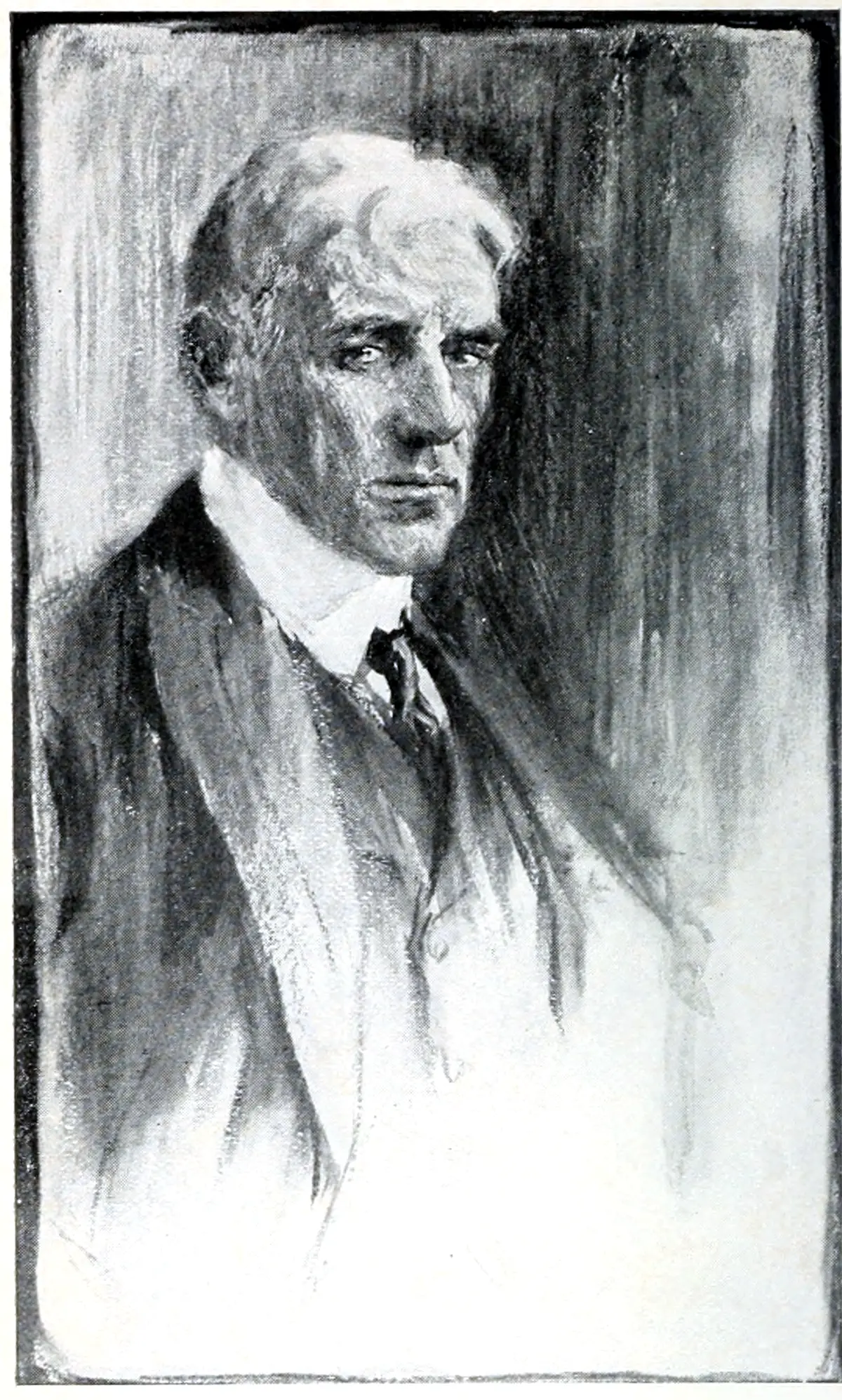
Raffles, in the frontispiece of the 1905 American printing, where the plate is captioned with his name alone. F. C. Yohn, The Amateur Cracksman (New York: Charles Scribner's Sons), 1905.
"“Raffles,” frontispiece of The Amateur Cracksman (Scribner, 1905)" by F. C. Yohn — https://commons.wikimedia.org/wiki/File:The_amateur_Cracksman-frontispiece.png — Public domain in US (published 1905); DE/FR (F. C. Yohn d. 1933, life+70)
Raffles and Bunny, 1899: a thief told by his friend
Hornung's The Amateur Cracksman collects eight stories about Raffles, a gentleman cricketer who is also a burglar. They are told by Bunny, who was Raffles's junior at school and becomes his partner in the thefts. Hornung dedicated the book “TO A. C. D. THIS FORM OF FLATTERY.” In all eight stories, Bunny is the one who says “I” in the narration.
The first story begins with Bunny himself in trouble: “It was half-past twelve when I returned to the Albany as a last desperate resort.” He has come back to Raffles's rooms after losing at cards, and by the end of the night he has helped with a burglary. From the first page, then, this friend is a partner in the thefts rather than a bystander.
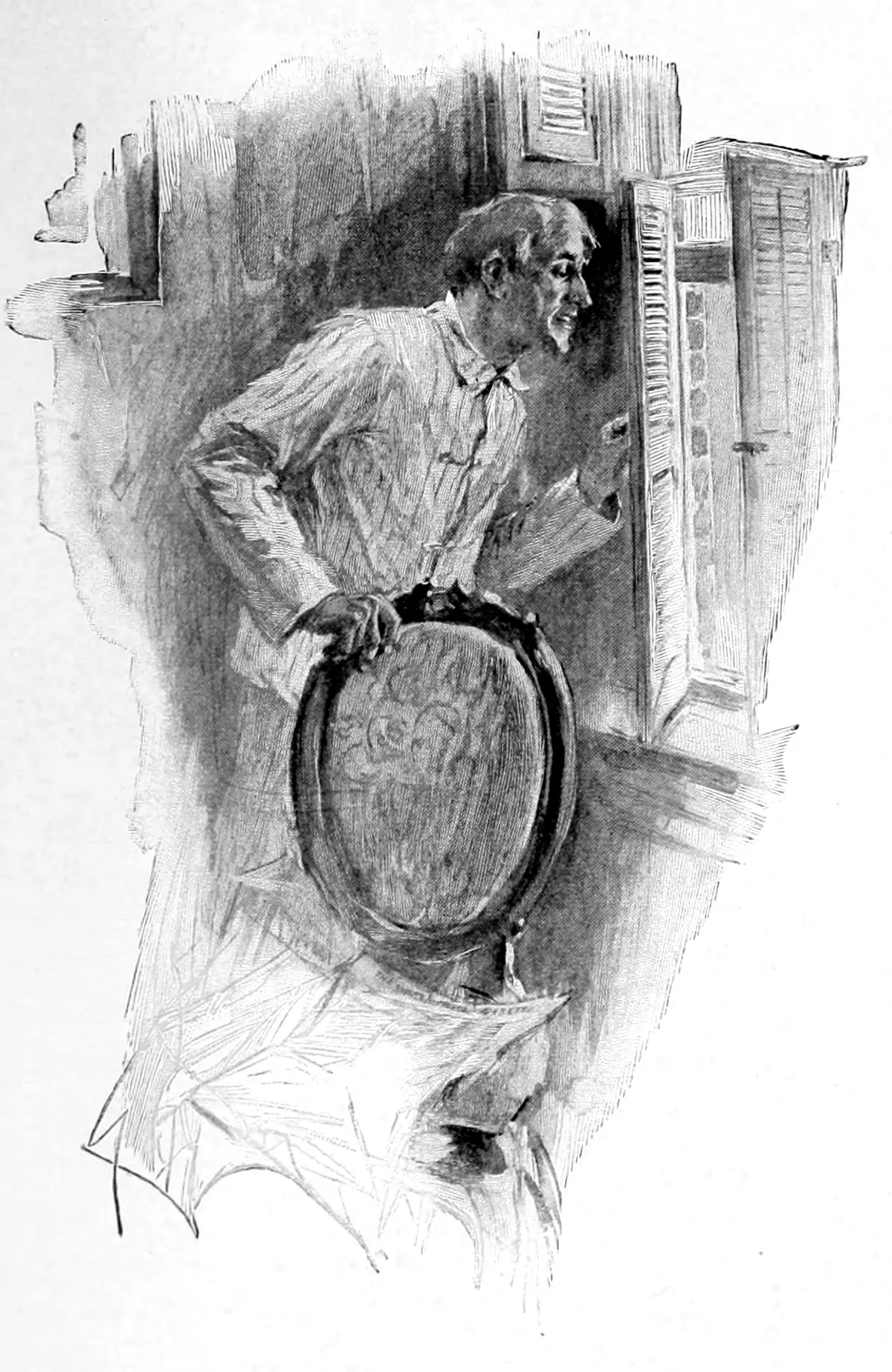
Raffles at a shuttered window, in a plate captioned “I saw them from my own window,” the start of his account to Bunny of what he saw. F. C. Yohn, The Amateur Cracksman (New York: Charles Scribner's Sons), 1905.
Full credit
"“I saw them from my own window,” plate for The Amateur Cracksman (Scribner, 1905)" by F. C. Yohn — https://commons.wikimedia.org/wiki/File:The_amateur_Cracksman-pg_112.png — Public domain in US (published 1905); DE/FR (F. C. Yohn d. 1933, life+70)
Bunny narrates as Watson does, from beside the central figure, and Raffles tells some of his own cases inside Bunny's narration. In one story Raffles even teases him about the future: “if ever you write my memoirs, you won't have any difficulty in working up that chase.” Leblanc's friend says much the same of himself in 1907: he is trying to piece Lupin's adventures together. In the book, though, he narrates only one of them himself.
Hornung's book came six years before Leblanc's 1905 story, and the two stories are compared here only as two arrangements of a thief and a friend. For how far the friend's role reaches beyond thieves, the Watson page on this site counts it across sixty Holmes stories.
In the July 1905 pages of Je sais tout, Maurice Leblanc gave the last word of “L'Arrestation d'Arsène Lupin” to the thief himself, a sigh to Ganimard that it is a pity not to be an honest man. Two years later, in the Lafitte book, Leblanc let an unnamed friend speak after that sigh and claim the story as something Lupin had told him.
Sources
Editions
- Maurice Leblanc, “L’Arrestation d’Arsène Lupin,” Je sais tout (Paris: Pierre Lafitte), no. 6, July 1905, pp. 708–714. French Wikisource transcription of the scanned 1905 volume (part I). https://fr.wikisource.org/wiki/Livre:Je_sais_tout,_Partie_I,_1905.djvu (full text of the story, pp. 708–714; the lines quoted were checked against the page scans)
- Maurice Leblanc, Arsène Lupin, gentleman-cambrioleur, preface by Jules Claretie (Paris: Pierre Lafitte, 1907). Project Gutenberg eBook #32854, based on the 1907 edition. https://www.gutenberg.org/ebooks/32854 (full text)
- E. W. Hornung, The Amateur Cracksman (8 stories; dedicated “To A. C. D.”). Project Gutenberg eBook #706. https://www.gutenberg.org/ebooks/706 (full text)
- E. W. Hornung, The Amateur Cracksman, illustrated by F. C. Yohn (New York: Charles Scribner’s Sons, 1905; copyright 1899). English Wikisource transcription of the scanned book. https://en.wikisource.org/wiki/Page:Hornung_-_The_amateur_cracksman_(Scribner,_1905).djvu/131 (two plate captions and the catalogue record of the scan)
- Arsène Lupin (New York: Doubleday, Page, 1909), frontispiece by H. Richard Boehm; the library record lists Edgar Jepson, Maurice Leblanc and Francis de Croisset as creators without marking their roles. https://commons.wikimedia.org/wiki/File:Frontispiece-Arsene_Lupin_(Doubleday,_1909).jpg (frontispiece and the library record of the scan)

Catalogues and databases
- Bibliothèque nationale de France, catalogue général, periodical record: Je sais tout : magazine encyclopédique illustré (Paris: P. Lafitte, 1905–1939), no. 1 (15 February 1905)–no. 403 (August 1939), monthly. FRBNF32795534. https://catalogue.bnf.fr/ark:/12148/cb32795534m (catalogue record) Text licence: Licence Ouverte (Etalab), https://www.etalab.gouv.fr/wp-content/uploads/2017/04/ETALAB-Licence-Ouverte-v2.0.pdf
- Bibliothèque nationale de France, catalogue général: Maurice Leblanc, Arsène Lupin : gentleman-cambrioleur, préface de Jules Claretie (Paris: Pierre Lafitte et Cie, 1907), 307 p. FRBNF47625309. https://catalogue.bnf.fr/ark:/12148/cb476253091 (catalogue record) Text licence: Licence Ouverte (Etalab), https://www.etalab.gouv.fr/wp-content/uploads/2017/04/ETALAB-Licence-Ouverte-v2.0.pdf
- French Wikisource, “Auteur:Maurice Leblanc/Je sais tout,” list of Leblanc’s works printed in Je sais tout. https://fr.wikisource.org/wiki/Auteur:Maurice_Leblanc/Je_sais_tout (list page; used for the issue date only, checked against the BnF numbering)
- Gemeinsame Normdatei (GND) authority records via lobid-gnd (hbz): Leblanc, Maurice, 118779125; Claretie, Jules, 119069830; Hornung, Ernest W., 123499720; Yohn, Frederick C., 173096921; Leroux, Georges, 130202363. https://lobid.org/gnd/118779125 (authority records) Text licence: CC0 1.0, https://creativecommons.org/publicdomain/zero/1.0/
Cite this page
Once Upon a Version. “Arsène Lupin: In the 1905 Story, the Narrator Is Lupin.” Once Upon a Version. Published 2026-11-05. https://onceuponaversion.com/mystery-tellers/arsene-lupin-narrator/ (accessed day month year).
Write in the date you read the page; the page has no DOI.
More from Mystery Tellers
Mystery Tellers
Dr. Watson: Counted Here, 56 of 60 Holmes Stories Are His
Type detective fiction (no tale-type number)
Dr. Watson narrates 56 of the 60 Sherlock Holmes stories, counted story by story. Holmes tells two, two are third-person, and Poe's friend did it in 1841.
Picture credit
"Original drawing for “Silver Blaze”" by Sidney Paget — https://commons.wikimedia.org/wiki/File:The_Adventure_of_Silver_Blaze_01.jpg — Public domain in US (published 1892 in The Strand Magazine); DE/FR (Sidney Paget d. 1908, life+70); faithful photograph of a two-dimensional drawing (PD-Art; auction-house photograph, Christie's)
Mystery Tellers
The Mystery of Marie Rogêt: 1845 Rewrites the Serial’s Clues
Type detective short story built on a real case (no tale-type number)
Poe’s Marie Rogêt ran as a serial in 1842–43, then in his 1845 Tales. Side by side: the 1845 text drops a confessed killer and allows an accident.
Picture credit
"Edgar Allan Poe" by Unknown maker, American (daguerreotypist) — https://commons.wikimedia.org/wiki/File:1849_face_detail,_from-_Unknown_maker,_American_-_Edgar_Allan_Poe_-_Google_Art_Project_(cropped).jpg — Public domain in US (made 1849 by an unidentified photographer, presumed not to have lived past 1955 since he was working in 1849; anonymous unpublished work, more than 120 years since creation); DE/FR (anonymous work, more than 70 years since it was made); photograph released by the J. Paul Getty Museum Open Content Program
Mystery Tellers
Vidocq’s Memoirs: The 1828 Preface Admits Another Hand
Type memoir of crime and police (no tale-type number)
Vidocq’s Mémoires (1828–29) carry his name, yet their own preface says a reviser rewrote volume 1 and part of volume 2; a study cited by the BnF names two.
Picture credit
"Portrait d'Eugène Vidocq (1775-1857), aventurier et chef de la police de sûreté (G.12180)" by Achille Devéria — https://commons.wikimedia.org/wiki/File:Portrait_d%27Eug%C3%A8ne_Vidocq_(1775-1857),_aventurier_et_chef_de_la_police_de_s%C3%BBret%C3%A9._G.12180_(1_of_4).jpg — CC0 1.0 (https://creativecommons.org/publicdomain/zero/1.0/)