Dr. Watson: Counted Here, 56 of 60 Holmes Stories Are His
Counted story by story in Arthur Conan Doyle's nine Holmes books, Dr. Watson tells 56 of the 60 cases, Holmes tells two, and two are told by no one inside the story.
By Once Upon a Version
Published
How a version is traced · Version history · Contact · Report an error (contact@onceuponaversion.com)
In short
- Of the 60 Sherlock Holmes stories in Doyle's nine books, Dr. Watson narrates 56, counting the two in which Holmes tells an old case inside Watson's frame.
- Holmes narrates two himself, “The Blanched Soldier” and “The Lion's Mane” (both 1926), and two, “His Last Bow” (1917) and “The Mazarin Stone” (1921), are told in the third person.
- The friend who tells a detective's cases is older than Watson: in 1842 Poe's unnamed narrator says he wrote up an earlier Dupin case about a year before.
Telling card
- Tale
- The Sherlock Holmes stories (4 novels, 56 short stories)
- Type
- detective fiction (no tale-type number)
- Teller
- Dr. John H. Watson (a character) in 56; Sherlock Holmes in 2; a third-person voice in 2; written by Arthur Conan Doyle
- Recorded by
- n/a
5 more fields: edited by, told, published, this text, earliest known
- Edited by
- n/a
- Told
- n/a, written works
- Published
- Beeton's Christmas Annual (1887) to The Strand Magazine (April 1927)
- This text
- Project Gutenberg texts of the nine books, story by story (see the CSV)
- Earliest known
- A Study in Scarlet, Beeton's Christmas Annual, 1887
This card as CSV · where these values come from
Data: Telling card: The Sherlock Holmes stories, Once Upon a Version, 2026-11-03
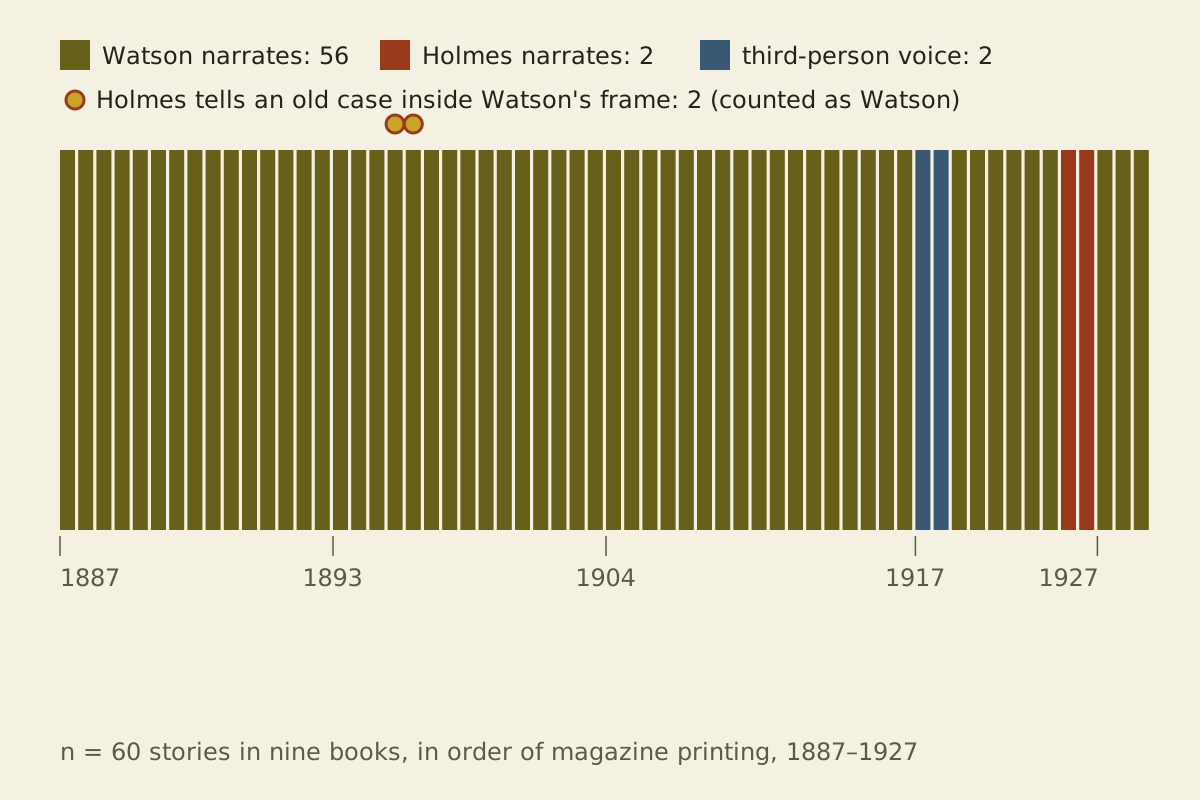
One bar per story, in order of magazine printing from 1887 to 1927; the two gold rings mark Holmes's old cases told inside Watson's frame. n = 60 stories in Doyle's nine Holmes books.
Credit line for reuse
"Who narrates the 60 Sherlock Holmes stories, in printing order" by Once Upon a Version — https://onceuponaversion.com/mystery-tellers/detective-narrators/ — licensed under CC BY 4.0 (https://creativecommons.org/licenses/by/4.0/)
Data: The Sherlock Holmes stories, Project Gutenberg texts of the nine books, retrieved 2026-11-03; Wikisource lists of Holmes stories and of their Strand Magazine printings, retrieved 2026-11-03
Sherlock Holmes once complained that Watson had “worried me to write an experience of my own,” and then gave in. The line opens “The Blanched Soldier,” printed in The Strand Magazine in November 1926, 39 years after Watson's first case appeared in print. That late complaint is the reason for a count: of the 60 Sherlock Holmes stories, Watson tells 56, Holmes tells two, and two have no narrator inside the story.
The count is this page's own, made from the Project Gutenberg texts of the nine books, and it rests on one rule about frames that is set out below. It answers a narrow question, who holds the narrative voice in each story, and it does not try to rank the stories or to judge how reliable their narrators are. A downloadable table gives every story with its narrator, its magazine printing and the edition used, so any reader can redo the sums.
Which 60 stories are counted here?
The 60 are the four novels and the 56 short stories in Doyle's nine Holmes books: A Study in Scarlet, The Sign of the Four, The Hound of the Baskervilles, The Valley of Fear, and the collections The Adventures, The Memoirs, The Return, His Last Bow and The Case-Book of Sherlock Holmes. Other short Holmes pieces that Doyle wrote outside these books, such as “The Field Bazaar” of 1896, are not counted.
The first printing in the count is A Study in Scarlet in Beeton's Christmas Annual for 1887. The last is “The Adventure of Shoscombe Old Place,” printed in The Strand Magazine in April 1927, which makes the run 40 years long. Dates come from two lists on Wikisource, the Holmes story list and the list of Holmes stories in The Strand. For three late stories the two lists disagree by a year, and the table marks those rows as disputed.
The counting rule
A story's narrator here is the voice that tells it outside quotation marks. When Watson's voice sits outside the quotation marks and Holmes tells the case inside them, the story counts for Watson, because the frame is his. That happens twice, in “The Gloria Scott” and “The Musgrave Ritual,” both printed in 1893. Each novel counts once, as one story, even where it hands whole chapters to another voice.
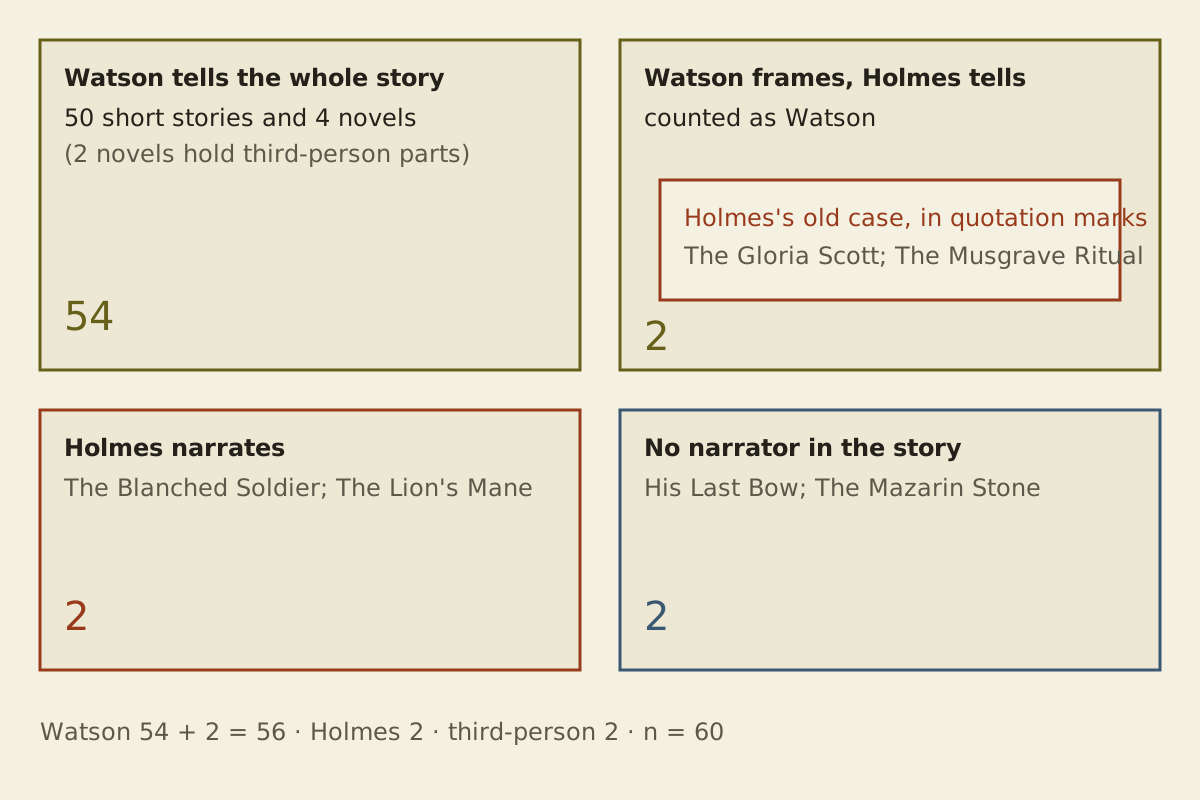
Four kinds of telling and how each one is counted; the two framed stories go to Watson. n = 60 stories.
Credit line for reuse
"Four kinds of telling in the 60 Sherlock Holmes stories" by Once Upon a Version — https://onceuponaversion.com/mystery-tellers/detective-narrators/ — licensed under CC BY 4.0 (https://creativecommons.org/licenses/by/4.0/)
Data: The Sherlock Holmes stories, Project Gutenberg texts of the nine books, retrieved 2026-11-03
Two ways of counting
The texts were sorted twice, by two methods built separately, so that each could catch the other's mistakes. The first strips out quoted speech and counts first-person pronouns in what is left, then checks whether the name Holmes or the name Watson turns up more often in that narration. The second looks only at speech tags, such as “said I,” “said Holmes” and “said Watson,” in the same narration.
Neither method is enough on its own. That is why both were used. The speech tags alone cannot see a frame, because in “The Gloria Scott” and “The Musgrave Ritual” Watson almost never writes “said Holmes”; in those two the second method has to fall back on which name the narration mentions. The pronoun count alone is thrown off by letters and confessions printed without quotation marks, which is why the chapters of the novels are reported separately in the table.
Both methods give the same answer for every one of the 60 stories: Watson 56, Holmes 2, third-person voice 2. The table below shows the result book by book, and the full list, one row per story with its sources, can be downloaded beside it.
| Book | Stories | Watson | Holmes | Third-person voice |
|---|---|---|---|---|
| The four novels | 4 | 4 | 0 | 0 |
| The Adventures of Sherlock Holmes | 12 | 12 | 0 | 0 |
| The Memoirs of Sherlock Holmes | 11 | 11 | 0 | 0 |
| His Last Bow | 8 | 7 | 0 | 1 |
| The Return of Sherlock Holmes | 13 | 13 | 0 | 0 |
| The Case-Book of Sherlock Holmes | 12 | 9 | 2 | 1 |
| All nine books | 60 | 56 | 2 | 2 |
The 60 stories and their narrators, as CSV (where the data comes from) Data: The 60 Sherlock Holmes stories and who narrates them, Once Upon a Version, 2026-11-03
“The Cardboard Box” is counted with His Last Bow, the book it was collected in by 1917, although the Project Gutenberg text of the Memoirs also prints it, and it is counted only once.
Watson's 56
Watson's voice arrives with a heading, before a single scene has been described. Part I of A Study in Scarlet is presented as “Being a reprint from the Reminiscences of” John H. Watson, a retired army doctor.
From then on, across forty years of printings, he keeps reminding readers that he is the one doing the writing and that the cases come from his records. In “The Five Orange Pips” he begins, “When I glance over my notes and records of the Sherlock Holmes cases,” and in “The Musgrave Ritual” he refers to “these incoherent memoirs.”
In The Hound of the Baskervilles the writing becomes part of the plot. In chapter 8 Watson says, “I will follow the course of events by transcribing my own letters to Mr. Sherlock Holmes.” The reports he sent from Dartmoor then stand in the book as chapters of their own. Two chapters later he changes method again: in chapter 10, “Extract from the Diary of Dr. Watson,” he writes that he must now “trust once more to my recollections, aided by the diary which I kept at the time.”
The novels also lend long stretches to other tellers inside Watson's frame. In The Sign of the Four, chapter XII, “The Strange Story of Jonathan Small,” is the longest chapter in the book, more than 10,000 words in the Project Gutenberg text, and only 4.5 percent of them stand outside quotation marks.
The prisoner tells his own story in his own words, and Watson's narration does little more than open and close the chapter around him. The Hound ends the same way: in chapter 15, “A Retrospection,” only 6.3 percent of the words stand outside quotation marks, and nearly all of the rest is Holmes explaining the case aloud.
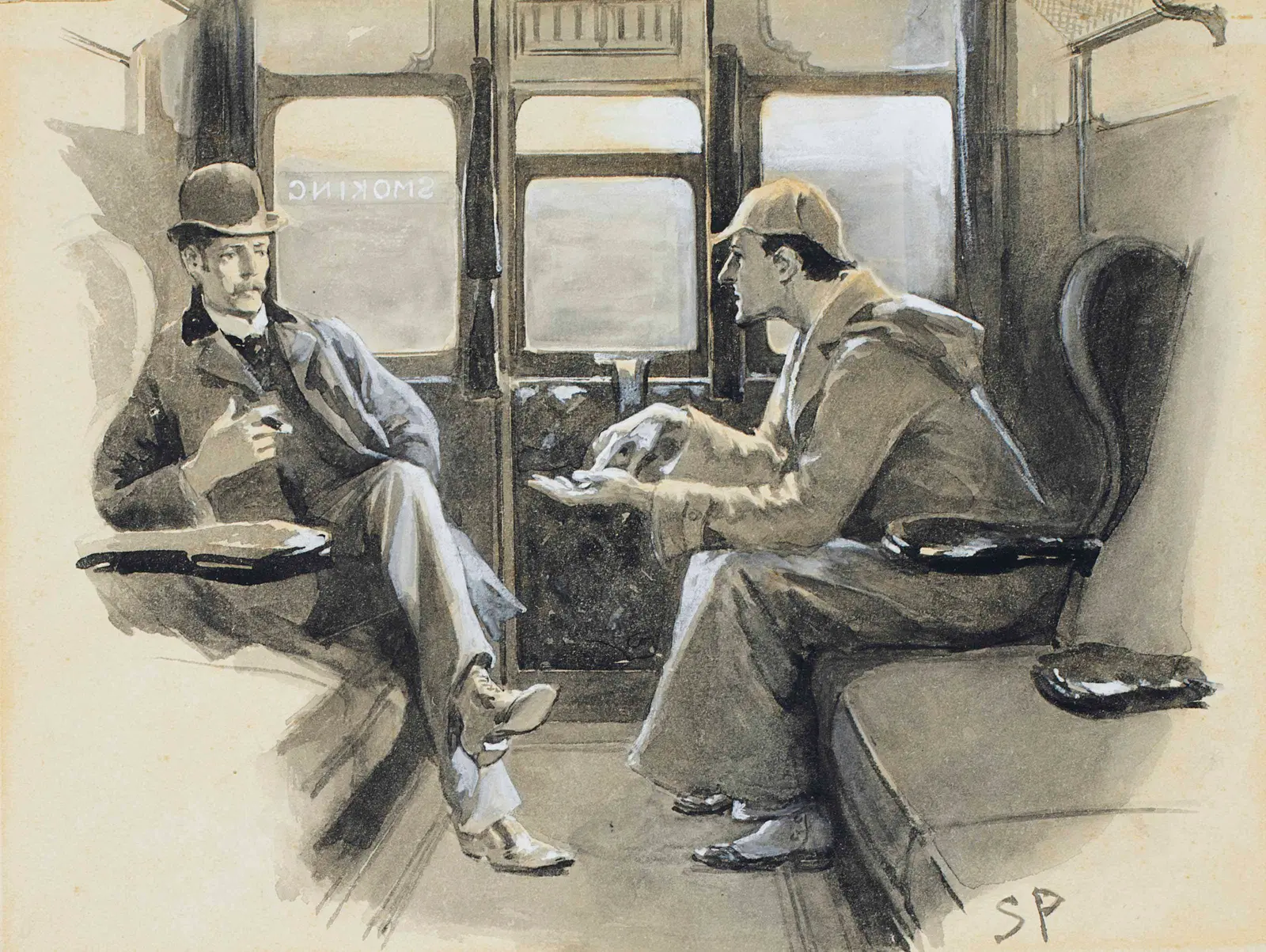
Holmes and Watson in a railway carriage, original drawing for “Silver Blaze”, where Holmes “gave me a sketch of the events”. Sidney Paget, The Strand Magazine, December 1892.
Full credit
"Original drawing for “Silver Blaze”" by Sidney Paget — https://commons.wikimedia.org/wiki/File:The_Adventure_of_Silver_Blaze_01.jpg — Public domain in US (published 1892 in The Strand Magazine); DE/FR (Sidney Paget d. 1908, life+70); faithful photograph of a two-dimensional drawing (PD-Art; auction-house photograph, Christie's)
The friend who tells the stories is named in almost all of them. Of Watson's 56, his name appears in the text of 55. The exception is “The Engineer's Thumb” (March 1892), where the narrator is a doctor in practice, as in the other stories, but no one in the story calls him Watson.
Watson's own voice does not always carry most of the words. In the two framed stories Holmes has most of them. In “The Gloria Scott” only 4.7 percent of the words stand outside quotation marks, and in “The Musgrave Ritual” 11.8 percent. The median for Watson's 52 short stories is 26.3 percent, so these two frames are thin even by his standard.
Both framed stories go back to the years before Watson met Holmes, to cases Watson could not have witnessed. In “The Gloria Scott” Holmes explains why Watson should study the case: “Because it was the first in which I was ever engaged.” In “The Musgrave Ritual” he pulls out the papers of his early work and calls them cases “done prematurely before my biographer had come to glorify me.”
The voice even signs a preface. His Last Bow (1917) opens with a short note on Holmes's retirement that ends, “Several previous experiences which have lain long in my portfolio have been added to His Last Bow so as to complete the volume.” It is signed John H. Watson, M.D., yet the title story it introduces is the one told in the third person.
What does Holmes say about Watson's writing?
Inside the stories Holmes reviews his narrator. The reviews are poor. In “The Copper Beeches” (June 1892) he says, “you have erred perhaps in attempting to put colour and life into each of your statements instead of confining yourself to the task of placing upon record that severe reasoning from cause to effect.” Watson answers that he has done Holmes full justice.
The complaint returns in “The Abbey Grange” (September 1904), in harder words: “Your fatal habit of looking at everything from the point of view of a story instead of as a scientific exercise has ruined what might have been an instructive and even classical series of demonstrations.” This time Watson hits back. “Why do you not write them yourself?” he asks, and Holmes promises to, some day: “I propose to devote my declining years to the composition of a textbook.”
Watson also says, more than once, that he could not tell everything when he wanted to. “The Empty House” (October 1903) begins with the claim that “Only now, at the end of nearly ten years, am I allowed to supply those missing links.” He had been “barred by a positive prohibition from his own lips,” meaning Holmes's.
“The Second Stain” (December 1904) opens with Watson saying he had meant “The Abbey Grange” to be his last story, and that “The real reason lay in the reluctance which Mr. Holmes has shown to the continued publication of his experiences.”
These passages are the only evidence this page uses on the question of whether Watson can be trusted. They show what the stories say about their own telling: the detective doubts the narrator's taste, and the narrator says the detective controls what may be printed. They do not, and cannot, test any fact inside the fiction.
Holmes takes the pen, 1926
Only two stories are narrated by Holmes, and the two were printed a month apart: “The Blanched Soldier” in November 1926 and “The Lion's Mane” in December 1926. Each one begins by explaining why Holmes is holding the pen. Set beside Watson's first opening, the change of voice is plain.
1887 · A Study in Scarlet, Watson narrating
In the year 1878 I took my degree of Doctor of Medicine of the University of London, and proceeded to Netley to go through the course prescribed for surgeons in the army.
written by Arthur Conan Doyle · A Study in Scarlet (first printed 1887), Part I, chapter I, Project Gutenberg text
1926 · The Blanched Soldier, Holmes narrating
The ideas of my friend Watson, though limited, are exceedingly pertinacious. For a long time he has worried me to write an experience of my own.
written by Arthur Conan Doyle · “The Blanched Soldier” (first printed 1926), opening, in The Case-Book of Sherlock Holmes (John Murray, 1927), Project Gutenberg text
What changed: Watson opens with his own life and degree; Holmes opens with Watson. Both write in the first person, but only Holmes begins by describing the other man.
Holmes goes on to say that he used to accuse Watson “of pandering to popular taste instead of confining himself rigidly to facts and figures.” Then he admits that, pen in hand, the case must be told so that it will interest the reader. The complaint about Watson's style turns into a confession about his own. Twenty-two years after “The Abbey Grange,” the man who once wanted a textbook instead of stories is writing a story of his own.
He also says why he likes a companion who does not know the answer. A partner, he writes, is best when he is “one to whom each development comes as a perpetual surprise, and to whom the future is always a closed book, is, indeed, an ideal helpmate.” On Holmes's account, then, Watson's ignorance is part of the method. In what this site calls the narrator's pocket, a clue Watson lacks while the case runs is not-yet-known; once he writes the case up afterwards, keeping the ending back is delayed.
“The Lion's Mane” explains the change more simply, and it does so in its opening paragraph, before the case begins. Holmes has retired to the Sussex coast, Watson visits only now and then, and so, in Holmes's words, “Thus I must act as my own chronicler.” Watson is absent from the case. Holmes tells it alone.
The same opening also promises a particular kind of telling. Holmes writes that he “must needs tell my tale in my own plain way, showing by my words each step upon the difficult road which lay before me.” In the terms used above, that is the delayed kind of pocket: Holmes writes after the case and knows its answer, but he promises that each fact will reach the reader at the point where he met it.
Whether the story keeps that promise is a question for a close reading of the case, which this count does not attempt.
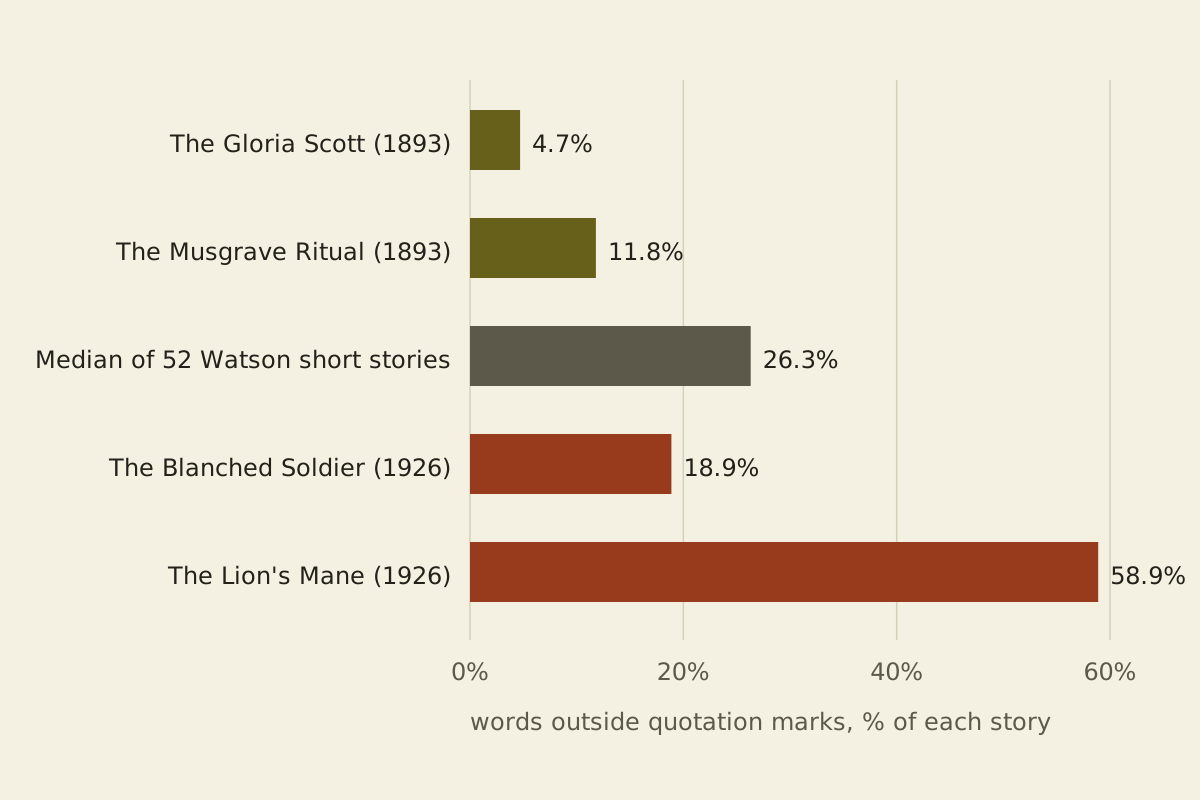
The narrator's own share of the words in the four stories where Holmes's voice carries the case, against the median of Watson's 52 short stories. Counted in the Project Gutenberg texts.
Credit line for reuse
"The narrator's share of the words in four Holmes stories" by Once Upon a Version — https://onceuponaversion.com/mystery-tellers/detective-narrators/ — licensed under CC BY 4.0 (https://creativecommons.org/licenses/by/4.0/)
Data: The Sherlock Holmes stories, Project Gutenberg texts of the nine books, retrieved 2026-11-03
Holmes's own narration does not hand him the whole page either. In “The Blanched Soldier” only 18.9 percent of the words stand outside quotation marks, because the client tells most of the story to Holmes in direct speech. “The Lion's Mane,” with no Watson and few long speeches, is the only story of the four where the narrator's lines pass half the words, at 58.9 percent.
The two told by nobody in the story
Two of the 60 stories have no narrator inside them. “His Last Bow,” which Wikisource dates to 1917, begins “It was nine o’clock at night upon the second of August” and follows its characters from outside. “The Mazarin Stone,” printed in The Strand in October 1921, does the same with Watson himself: “It was pleasant to Dr. Watson to find himself once more in the untidy room.”
In both, Watson is a character seen from outside, not the voice telling the story. In “His Last Bow” the outside voice even withholds his name for a while: he first appears as “the chauffeur, a heavily built, elderly man with a grey moustache,” and only Holmes's “Another glass, Watson!” near the end tells the reader who was driving. Neither text explains the change of voice, so this page records it as a fact of the printed stories and does not guess at a reason.
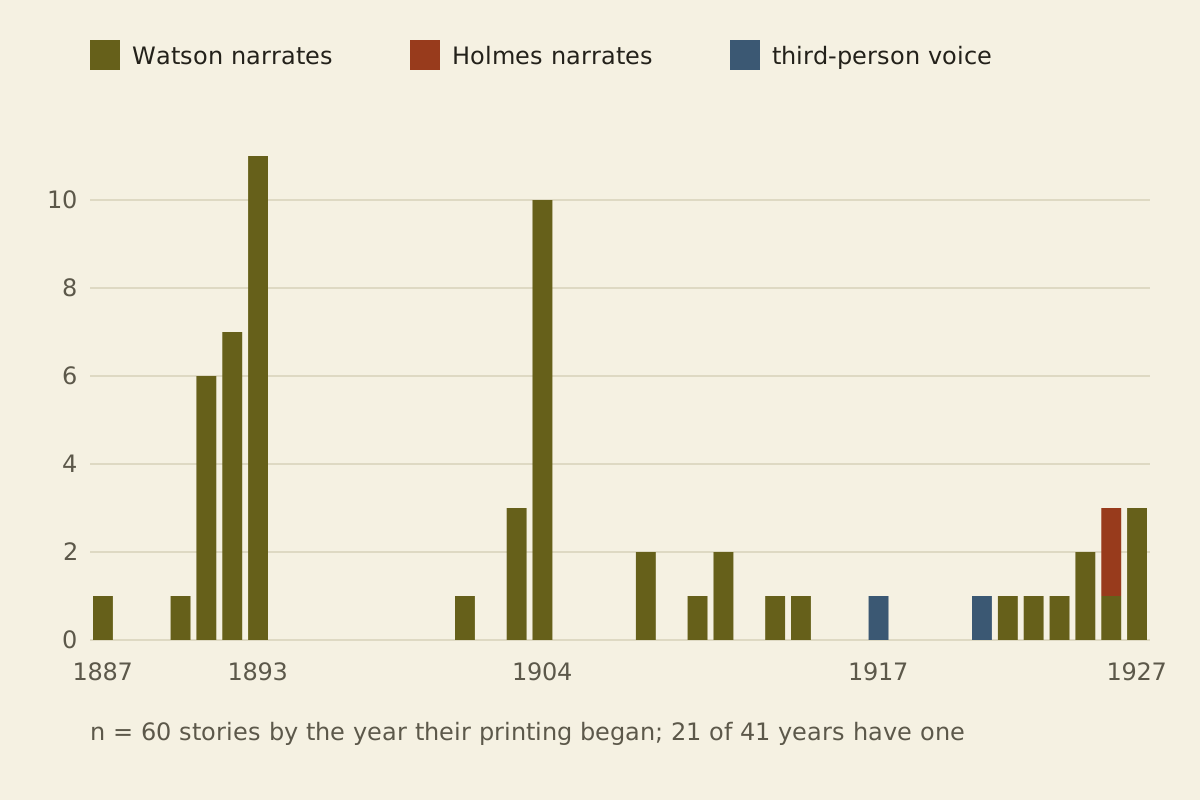
The 60 stories by the year their printing began, colored by narrator, with the two serialized novels under the year each began; 21 of the 41 years from 1887 to 1927 have at least one. n = 60 stories.
Credit line for reuse
"The 60 Sherlock Holmes stories by year of magazine printing and narrator" by Once Upon a Version — https://onceuponaversion.com/mystery-tellers/detective-narrators/ — licensed under CC BY 4.0 (https://creativecommons.org/licenses/by/4.0/)
Data: The Sherlock Holmes stories, Project Gutenberg texts of the nine books, retrieved 2026-11-03; Wikisource lists of Holmes stories and of their Strand Magazine printings, retrieved 2026-11-03
Two of Watson's novels also hand whole parts to an outside voice. In A Study in Scarlet, the first five chapters of Part II tell an older story set in Utah in the third person, before Watson's reminiscences resume. In The Valley of Fear, Part II tells an American story in the third person. Watson had already stepped aside once in that novel: chapter III of Part I begins, “Now for a moment I will ask leave to remove my own insignificant personality.”
Those sections stay inside Watson's books, so the novels count for him. They show that the narrator's voice in the Holmes books was never a fixed rule, even when the friend is the one who signs the book.
Who else handed the cases to a friend?
A friend who tells a detective's cases did not begin with Watson, and it did not end with him. The works below are set in the order of their printing, except that the two French texts are taken together. The order is not a claim that one writer copied another; where a text names an earlier writer, that is quoted.
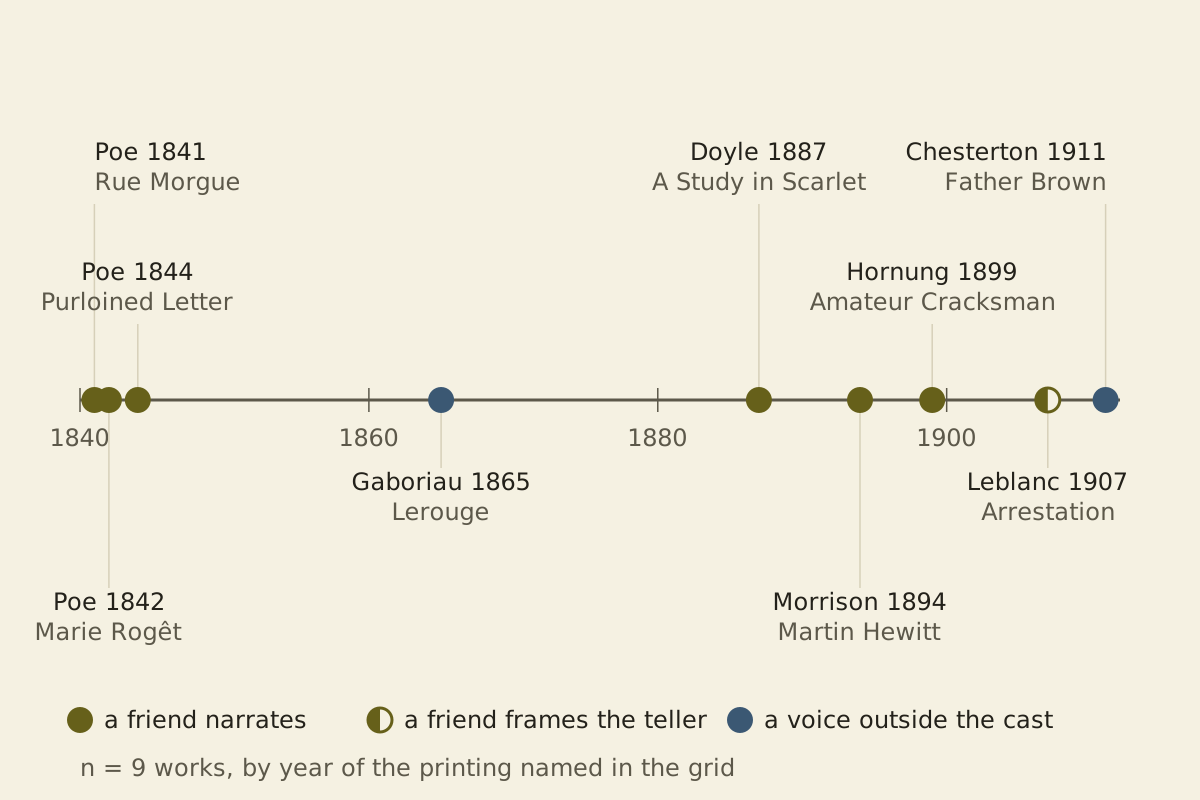
Nine works in order of the printing named on this page, marked by who tells them; the order is not a line of influence. n = 9 works.
Credit line for reuse
"Detective stories told by a friend or an outside voice, 1841 to 1911" by Once Upon a Version — https://onceuponaversion.com/mystery-tellers/detective-narrators/ — licensed under CC BY 4.0 (https://creativecommons.org/licenses/by/4.0/)
Data: Dupin tales, E. A. Poe Society of Baltimore transcriptions, retrieved 2026-11-03; Project Gutenberg texts of Doyle, Morrison, Hornung, Leblanc, Chesterton and Gaboriau, retrieved 2026-11-03
Poe's unnamed friend, 1841 to 1844
Edgar Allan Poe's Dupin tales are told by a friend who is never named. In “The Murders in the Rue Morgue” (Graham's Magazine, April 1841) he announces his own writing: “The narrative which follows will appear to the reader somewhat in the light of a commentary upon the propositions just advanced.” He tells it after the case is over, which this site's account of the Rue Morgue narrator who already knows the end reads as a delayed pocket.
In 1842, at the start of “The Mystery of Marie Rogêt,” the same narrator claims the earlier tale. He writes that in it “I endeavored, about a year ago, to depict some very remarkable features in the mental character of my friend, the Chevalier C. Auguste Dupin.” The changes Poe later made to that second tale are compared in Poe's revised Marie Rogêt, the same narrator three years later.
“The Purloined Letter,” printed in The Gift for 1845, again leaves the friend unnamed; he sits “in company with my friend C. Auguste Dupin.” In the 1844 text he says nothing about writing the case down.
Doyle's first Holmes novel names this predecessor directly: in A Study in Scarlet Watson tells Holmes, “You remind me of Edgar Allen Poe’s Dupin.” Holmes is not flattered: “Now, in my opinion, Dupin was a very inferior fellow.” On that page of the 1887 novel, Doyle's narrator names Poe's detective, and Doyle's detective dismisses him.
Brett, the reporter, 1894
Arthur Morrison's Martin Hewitt, Investigator (1894) gives the cases to a journalist named Brett. Hewitt teases him in the first story, and Brett explains how he works: “Such of the cases, however, as I personally saw nothing of I have put into narrative form from the particulars given me.”
That sentence matches what the text does: in three of the book's seven stories the narration has almost no first-person words, fewer than 3 in every 1,000. Brett is a friend who narrates some cases and, by his own account, writes up others from what he was told. Morrison's book therefore puts both arrangements under one friend's name: the friend as witness, and an outside voice that the friend says he wrote up from what he was told. Doyle's two outside-voice stories give no such account of themselves.
Bunny, the burglar's friend, 1899
E. W. Hornung's The Amateur Cracksman (1899) keeps the friend and changes the trade. Bunny narrates all eight stories about Raffles, a gentleman cricketer who is also a burglar, and Hornung dedicated the book to “A. C. D.” with the words “this form of flattery.”
Hornung's book also has a framed story of its own: “Le Premier Pas” opens, “That night he told me the story of his earliest crime,” and Raffles then tells it almost entirely in his own quoted words. Only 8.6 percent of that story's words stand outside quotation marks, between the thin frames of “The Gloria Scott” and “The Musgrave Ritual.”
In French: Lupin's unnamed listener, 1907
The French texts are taken on their own terms here, not as copies of the English line. Maurice Leblanc's first Lupin story, “L'Arrestation d'Arsène Lupin,” is told in the first person by a passenger on a liner. In the closing paragraphs of the 1907 book text the voice changes, and an unnamed friend explains where the story came from.
« C’est ainsi qu’un soir d’hiver, Arsène Lupin me raconta l’histoire de son arrestation. »
written by Maurice Leblanc · Arsène Lupin, gentleman-cambrioleur (Paris: Pierre Lafitte, 1907), “L'Arrestation d'Arsène Lupin,” closing paragraphs
In this site's English rendering, the friend says that this is how, one winter evening, Arsène Lupin told him the story of his arrest. The friend frames the tale, as Watson frames “The Gloria Scott,” but the man he frames is a thief, and what that narrator keeps back is the subject of the Lupin story whose narrator turns out to be the thief himself. The friend says the stories are ones he is trying to piece together from Lupin's confidences.
Jules Claretie's preface to the 1907 book says the character first appeared in the magazine Je sais tout, and the same preface brings in Vidocq, beside Balzac and Victor Hugo's Javert. Vidocq's case is a different one again, a detective whose memoirs carry his own name, set out in Vidocq's memoirs, a detective's story signed with his own name.
Émile Gaboriau's L'Affaire Lerouge, dated 1865 in the Project Gutenberg text, is told by a voice outside the cast, and no friend narrates it. It sits in the grid below as one row of facts.
The two French texts checked here do not follow the English pattern in the same way, and they are not offered as a French version of it. Gaboriau's novel, printed twenty-two years before A Study in Scarlet, has no narrating friend at all. Leblanc's story, in the book printed twenty years after it, gives the first person to the thief and keeps the friend for a closing frame. Two texts are too few to describe a French tradition, so the grid reports them one row at a time.
Father Brown, 1911
Chesterton's The Innocence of Father Brown (1911) drops the narrating friend. Its first story begins with a voice outside the cast, which says “the man we must follow was by no means conspicuous.” The priest has a companion in several of the stories, Flambeau, but Flambeau never becomes the narrator. Eleven of the twelve stories have almost no first-person narration; the twelfth, “The Wrong Shape,” contains a criminal's written confession and a brief “I say” from the outside narrator.
Motif grid: who tells the case in 14 checked works
Each row below is one work or one group of Holmes stories, and each column is one feature of the telling, defined in a table you can download. A cell is present when at least one checked text in the row shows the feature.
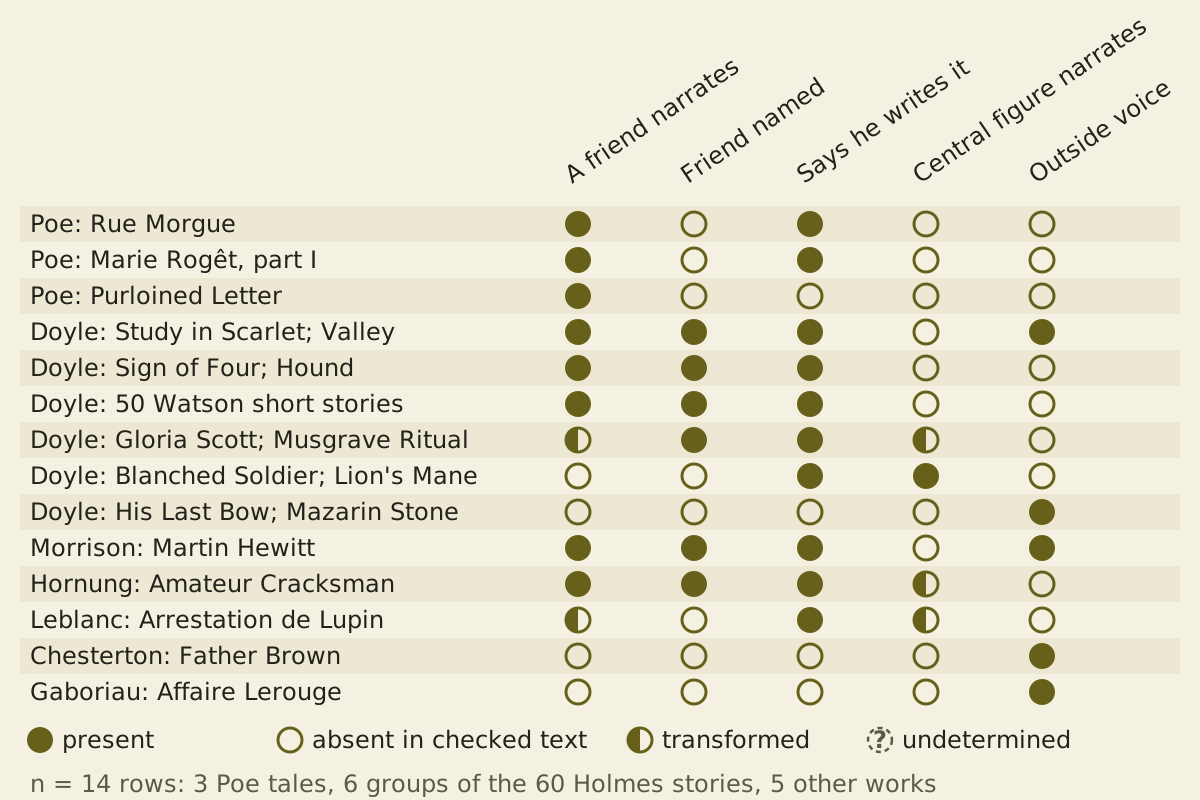
Five features of the telling in 14 rows of works; filled is present, open is absent in the checked text, half-filled is transformed. n = 14 rows checked.
Credit line for reuse
"Who tells the case: five features in 14 detective works" by Once Upon a Version — https://onceuponaversion.com/mystery-tellers/detective-narrators/ — licensed under CC BY 4.0 (https://creativecommons.org/licenses/by/4.0/)
Data: Companion grid, Once Upon a Version, built from E. A. Poe Society transcriptions and Project Gutenberg texts, retrieved 2026-11-03
The grid with the evidence for every cell, as CSV (where the data comes from) Data: Who tells the case: five features in 14 detective works, Once Upon a Version, 2026-11-03
| Work | A friend narrates | The narrating friend is named | The narrator says he is writing it down | The central figure narrates | A voice outside the cast narrates |
|---|---|---|---|---|---|
| Edgar Allan Poe, The Murders in the Rue Morgue (1841) | present | absent in checked text | present | absent in checked text | absent in checked text |
| Edgar Allan Poe, The Mystery of Marie Rogêt, part I (1842) | present | absent in checked text | present | absent in checked text | absent in checked text |
| Edgar Allan Poe, The Purloined Letter (1844) | present | absent in checked text | absent in checked text | absent in checked text | absent in checked text |
| Arthur Conan Doyle, A Study in Scarlet; The Valley of Fear (1887; 1914–1915) | present | present | present | absent in checked text | present |
| Arthur Conan Doyle, The Sign of the Four; The Hound of the Baskervilles (1890; 1901–1902) | present | present | present | absent in checked text | absent in checked text |
| Arthur Conan Doyle, The 50 short stories Watson narrates throughout (1891–1927) | present | present | present | absent in checked text | absent in checked text |
| Arthur Conan Doyle, The Gloria Scott; The Musgrave Ritual (1893) | transformed | present | present | transformed | absent in checked text |
| Arthur Conan Doyle, The Blanched Soldier; The Lion's Mane (1926) | absent in checked text | absent in checked text | present | present | absent in checked text |
| Arthur Conan Doyle, His Last Bow; The Mazarin Stone (1917; 1921) | absent in checked text | absent in checked text | absent in checked text | absent in checked text | present |
| Arthur Morrison, Martin Hewitt, Investigator (7 stories) (1894) | present | present | present | absent in checked text | present |
| E. W. Hornung, The Amateur Cracksman (8 stories) (1899) | present | present | present | transformed | absent in checked text |
| Maurice Leblanc, L'Arrestation d'Arsène Lupin (1907) | transformed | absent in checked text | present | transformed | absent in checked text |
| G. K. Chesterton, The Innocence of Father Brown (12 stories) (1911) | absent in checked text | absent in checked text | absent in checked text | absent in checked text | present |
| Émile Gaboriau, L'Affaire Lerouge (1865) | absent in checked text | absent in checked text | absent in checked text | absent in checked text | present |
n = 14 texts checked, counting each group or collection below as one: three Poe tales; six groups covering all 60 Holmes stories; Morrison's Martin Hewitt, Investigator; Hornung's The Amateur Cracksman; Leblanc's “L'Arrestation d'Arsène Lupin”; Chesterton's The Innocence of Father Brown; and Gaboriau's L'Affaire Lerouge. Of the 14 rows, 8 have a friend who narrates and 2 more have a friend who only frames the tale. The central figure narrates in one row and tells a case inside a friend's frame in three more.
What counts as present and transformed for each feature, as CSV (where the data comes from) Data: Definitions for the companion grid, Once Upon a Version, 2026-11-03
Counted across the 14 rows, ten have a friend who narrates or frames the telling, five hand some or all of it to a voice outside the cast, and only one lets the central figure narrate whole stories.
The grid also shows what these works do not share: Poe's friend is never named, and neither is Leblanc's; Brett, Bunny and Watson are, while Chesterton and Gaboriau have no narrating friend at all. Only Doyle's late two give the whole narration to the detective, and three rows tell a case inside a friend's frame. A friend who tells the case covers several different ways of telling, not one model passed down.
Who holds the pen?
The count gives a plain answer to the question in the title, and it also shows how often the answer bends. The four stories Watson did not tell are all in the table, with their dates. So are the third-person chapters of the two novels, for readers who want the exceptions inside Watson's own books.
Watson holds the pen for 56 of the 60, yet he hands it to Holmes inside two of those, gives up whole parts of two novels to an outside voice, and signs a preface to a book whose title story he does not tell.
Illustration of one figure telling a case while another writes it down.
Illustration: Once Upon a Version. Generated illustration — not a historical image, manuscript or record. © Once Upon a Version, all rights reserved; reuse by request.
What the count leaves out
The count reads the stories as they stand in the Project Gutenberg texts of the nine books, not in their first magazine printings, whose wording can differ. A change of wording between printings could alter a sentence quoted here, and the narrator of each story is counted only in these texts, not in the magazines.
The dates are as listed on Wikisource, and two of its lists disagree for three late stories: “The Three Garridebs,” “The Illustrious Client” and “The Retired Colourman.” Some stories also ran in an American weekly; the copyright line of the 1905 New York edition of The Return of Sherlock Holmes names Doyle and Collier's Weekly. The table gives the dates as listed, and it does not claim that each one was the first appearance anywhere.
The motif grid counts only what was found, so a cell marked absent means the feature was not found in the text checked for that row. It says nothing about other stories by the same writer, or about detective fiction as a whole.
The friend's role was taken by a reporter in 1894, a burglar's friend in 1899 and an unnamed listener in Leblanc's book of 1907, while Chesterton's priest needed no friend at all. The reliability of any of these narrators is judged here only from what the texts say about themselves, such as Holmes's charge that Watson pandered to popular taste.
Doyle left the last turn of this arrangement to Holmes himself. In “The Blanched Soldier,” printed in November 1926, Holmes takes up the pen at Watson's urging, writes about a case from January 1903, when Watson had left him for a wife, and finds that he too must tell it so that it will interest the reader, the very thing he had blamed Watson for.
Sources
Editions
- Arthur Conan Doyle, A Study in Scarlet (first printed in Beeton’s Christmas Annual, 1887). Project Gutenberg eBook #244. https://www.gutenberg.org/ebooks/244 (full text)
- Arthur Conan Doyle, The Sign of the Four (first printed in Lippincott’s Monthly Magazine, February 1890). Project Gutenberg eBook #2097. https://www.gutenberg.org/ebooks/2097 (full text)
- Arthur Conan Doyle, The Adventures of Sherlock Holmes (12 stories). Project Gutenberg eBook #1661. https://www.gutenberg.org/ebooks/1661 (full text)
- Arthur Conan Doyle, The Memoirs of Sherlock Holmes (this text also prints “The Cardboard Box”). Project Gutenberg eBook #834. https://www.gutenberg.org/ebooks/834 (full text)
- Arthur Conan Doyle, The Hound of the Baskervilles. Project Gutenberg eBook #2852. https://www.gutenberg.org/ebooks/2852 (full text)
- Arthur Conan Doyle, The Return of Sherlock Holmes (13 stories). Project Gutenberg eBook #108. https://www.gutenberg.org/ebooks/108 (full text)
- Arthur Conan Doyle, The Valley of Fear. Project Gutenberg eBook #3289. https://www.gutenberg.org/ebooks/3289 (full text)
- Arthur Conan Doyle, His Last Bow (preface signed John H. Watson, M.D., and seven stories; “The Cardboard Box” is read from eBook #834). Project Gutenberg eBook #2350. https://www.gutenberg.org/ebooks/2350 (full text)
- Arthur Conan Doyle, The Case-Book of Sherlock Holmes (London: John Murray, 1927; 12 stories). Project Gutenberg eBook #69700. https://www.gutenberg.org/ebooks/69700 (full text)
- Edgar A. Poe, “The Murders in the Rue Morgue,” Graham’s Magazine (Philadelphia), vol. XVIII, no. 4, April 1841, pp. 166–179. Transcription with page and column markers by the Edgar Allan Poe Society of Baltimore (Text-02b). https://www.eapoe.org/works/tales/morgueb.htm (full text)
- Edgar A. Poe, “The Mystery of Marie Roget,” Part I, The Ladies’ Companion (New York), vol. XVIII, no. 1, November 1842, pp. 15–20. Transcription with page and column markers by the Edgar Allan Poe Society of Baltimore (Text-02b, part 1). https://www.eapoe.org/works/tales/rogeta1.htm (full text)
- Edgar A. Poe, “The Purloined Letter,” The Gift for 1845 (available about October 1844), pp. 41–61. Transcription by the Edgar Allan Poe Society of Baltimore (Text-02b). https://www.eapoe.org/works/tales/plttra.htm (full text)
- Arthur Morrison, Martin Hewitt, Investigator (1894; 7 stories). Project Gutenberg eBook #11252. https://www.gutenberg.org/ebooks/11252 (full text)
- E. W. Hornung, The Amateur Cracksman (8 stories; dedicated “To A. C. D.”). Project Gutenberg eBook #706. https://www.gutenberg.org/ebooks/706 (full text)
- Maurice Leblanc, Arsène Lupin, gentleman-cambrioleur, preface by Jules Claretie (Paris: Pierre Lafitte, 1907). Project Gutenberg eBook #32854, based on the 1907 edition. https://www.gutenberg.org/ebooks/32854 (full text)
- G. K. Chesterton, The Innocence of Father Brown (12 stories). Project Gutenberg eBook #204. https://www.gutenberg.org/ebooks/204 (full text)
- Émile Gaboriau, L’Affaire Lerouge (dated 1865 in this text). Project Gutenberg eBook #15579. https://www.gutenberg.org/ebooks/15579 (full text)
Catalogues and databases
- “Author:Arthur Conan Doyle/Sherlock Holmes,” list of Sherlock Holmes stories with dates, English Wikisource. https://en.wikisource.org/wiki/Author:Arthur_Conan_Doyle/Sherlock_Holmes (list of stories and dates)
- “The Complete Adventures of Sherlock Holmes in The Strand Magazine (UK),” English Wikisource portal. https://en.wikisource.org/wiki/Portal:Sherlock_Holmes_(UK_Strand) (list of stories and dates)
- “A Study in Scarlet,” versions page, English Wikisource. https://en.wikisource.org/wiki/A_Study_in_Scarlet (versions page)
- “The Sign of the Four,” versions page, English Wikisource. https://en.wikisource.org/wiki/The_Sign_of_the_Four (versions page)
- “Author:Arthur Conan Doyle,” English Wikisource; with the 1917 New York edition of His Last Bow (George H. Doran), contents and preface, and the 1905 New York edition of The Return of Sherlock Holmes (McClure, Phillips & Co.), title and copyright page. https://en.wikisource.org/wiki/Author:Arthur_Conan_Doyle (author page and the 1917 contents)
- English Wikisource author pages for Arthur Morrison, Ernest William Hornung and Gilbert Keith Chesterton. https://en.wikisource.org/wiki/Author:Ernest_William_Hornung (author pages)
Cite this page
Once Upon a Version. “Dr. Watson: Counted Here, 56 of 60 Holmes Stories Are His.” Once Upon a Version. Published 2026-11-05. https://onceuponaversion.com/mystery-tellers/detective-narrators/ (accessed day month year).
Write in the date you read the page; the page has no DOI.
More from Mystery Tellers
Mystery Tellers
Arsène Lupin: In the 1905 Story, the Narrator Is Lupin
Type short story (no tale-type number)
In the earliest known Arsène Lupin story (Je sais tout, July 1905), the passenger who tells it is Lupin; the 1907 book adds a friend’s frame around his voice.
Picture credit
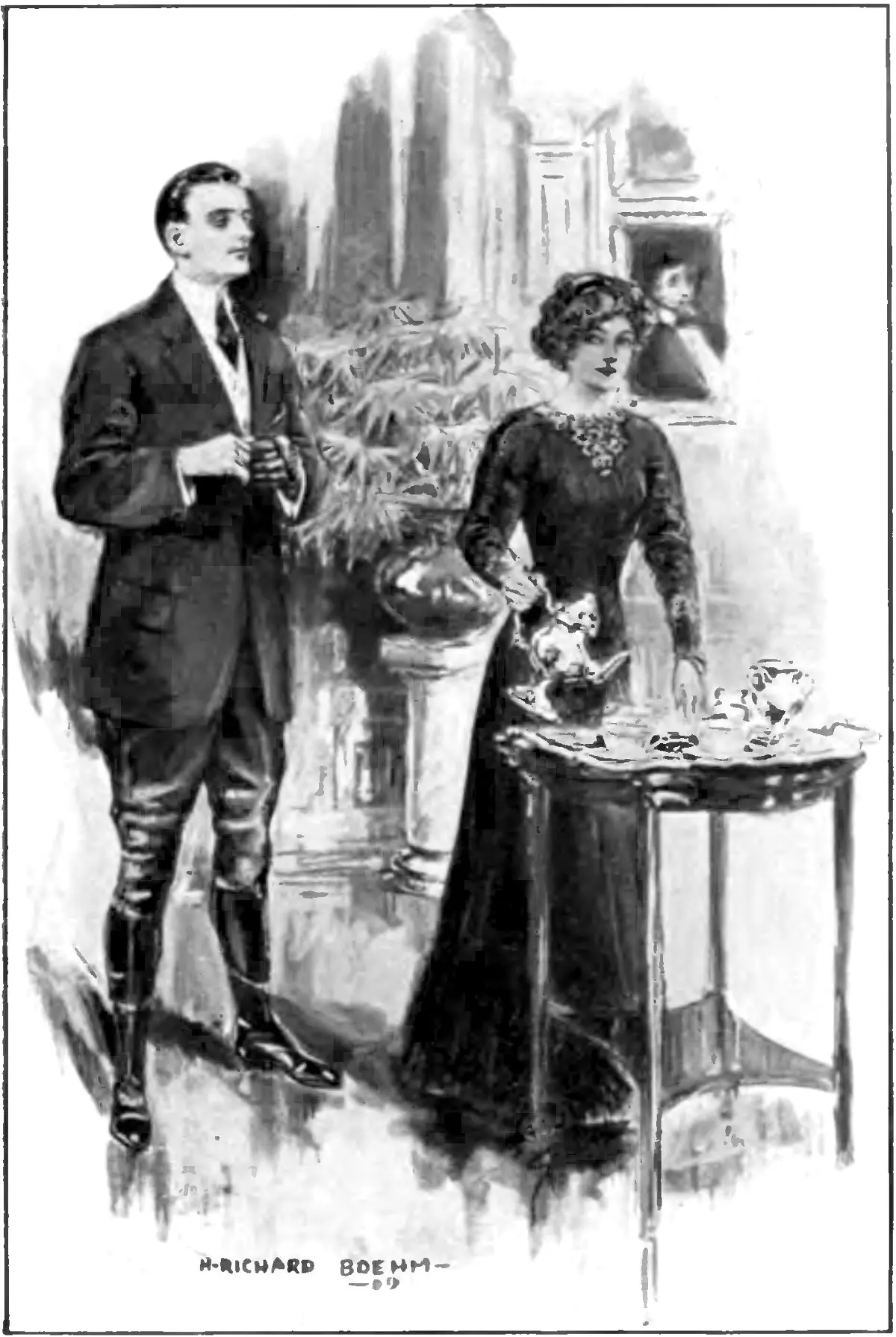
"Frontispiece, Arsène Lupin (Doubleday, 1909)" by H. Richard Boehm — https://commons.wikimedia.org/wiki/File:Frontispiece-Arsene_Lupin_(Doubleday,_1909).jpg — Public domain in US (published 1909); DE/FR (H. Richard Boehm d. 1914, life+70)
Mystery Tellers
The Mystery of Marie Rogêt: 1845 Rewrites the Serial’s Clues
Type detective short story built on a real case (no tale-type number)
Poe’s Marie Rogêt ran as a serial in 1842–43, then in his 1845 Tales. Side by side: the 1845 text drops a confessed killer and allows an accident.
Picture credit
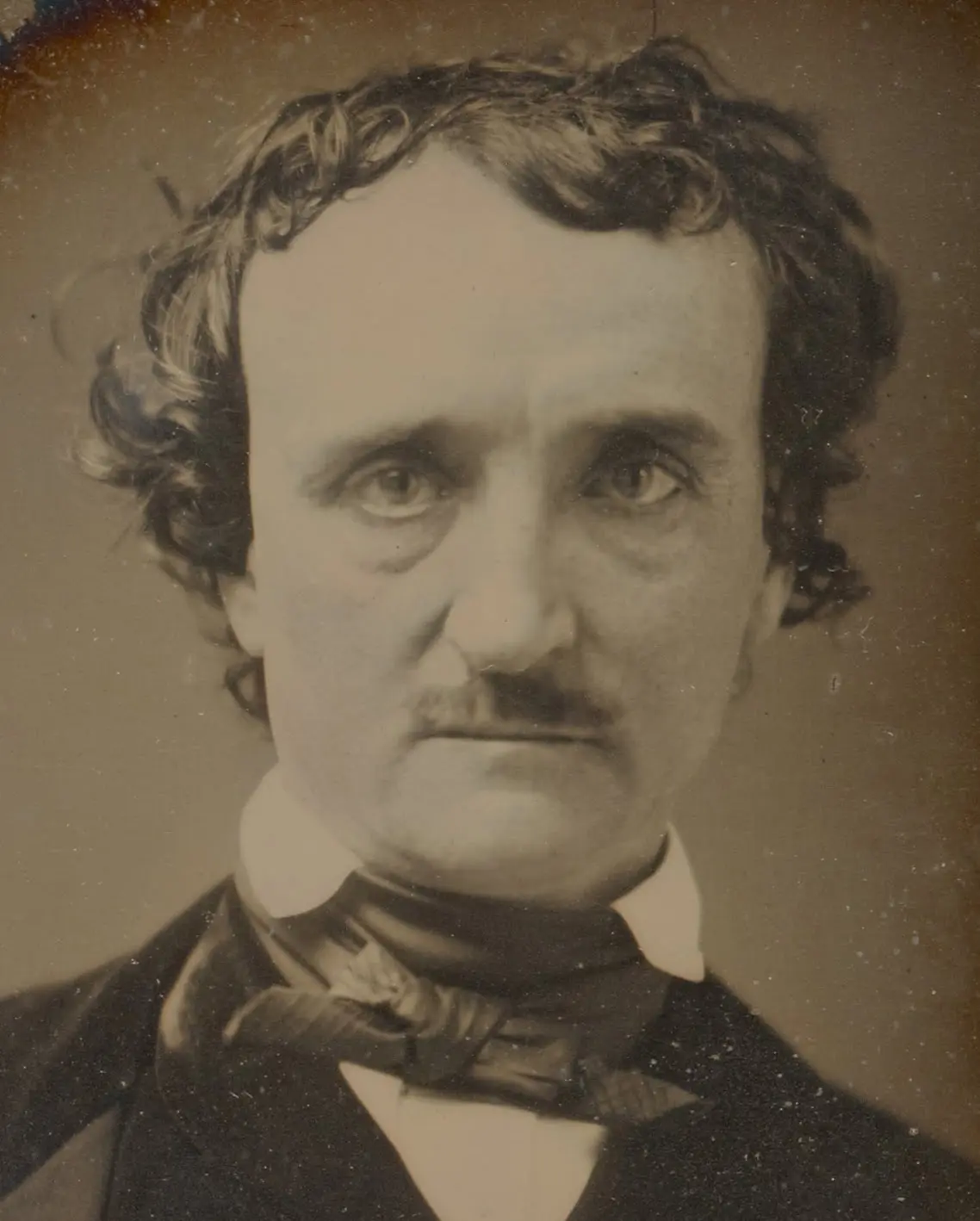
"Edgar Allan Poe" by Unknown maker, American (daguerreotypist) — https://commons.wikimedia.org/wiki/File:1849_face_detail,_from-_Unknown_maker,_American_-_Edgar_Allan_Poe_-_Google_Art_Project_(cropped).jpg — Public domain in US (made 1849 by an unidentified photographer, presumed not to have lived past 1955 since he was working in 1849; anonymous unpublished work, more than 120 years since creation); DE/FR (anonymous work, more than 70 years since it was made); photograph released by the J. Paul Getty Museum Open Content Program
Mystery Tellers
Vidocq’s Memoirs: The 1828 Preface Admits Another Hand
Type memoir of crime and police (no tale-type number)
Vidocq’s Mémoires (1828–29) carry his name, yet their own preface says a reviser rewrote volume 1 and part of volume 2; a study cited by the BnF names two.
Picture credit
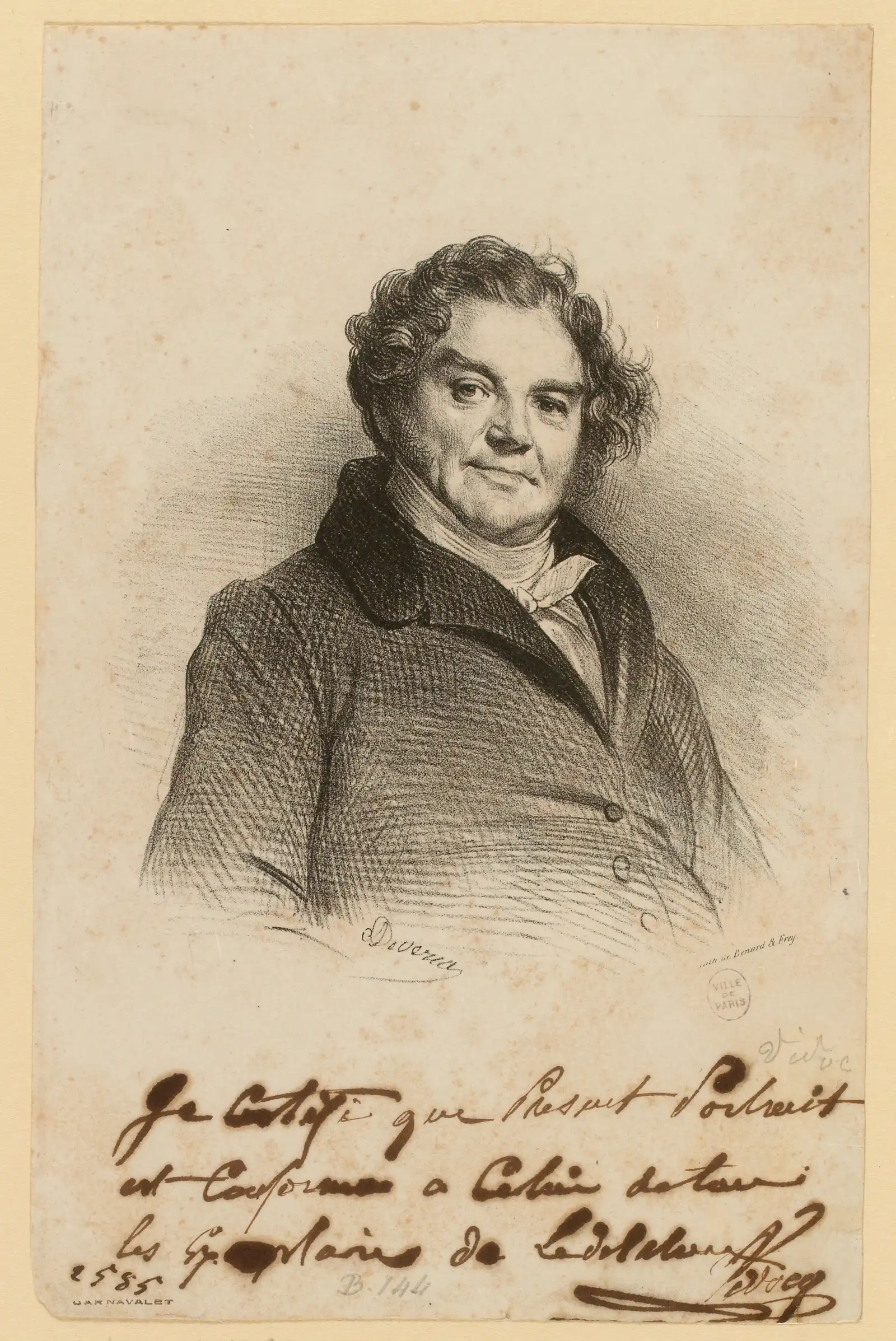
"Portrait d'Eugène Vidocq (1775-1857), aventurier et chef de la police de sûreté (G.12180)" by Achille Devéria — https://commons.wikimedia.org/wiki/File:Portrait_d%27Eug%C3%A8ne_Vidocq_(1775-1857),_aventurier_et_chef_de_la_police_de_s%C3%BBret%C3%A9._G.12180_(1_of_4).jpg — CC0 1.0 (https://creativecommons.org/publicdomain/zero/1.0/)