Vidocq’s Memoirs: The 1828 Preface Admits Another Hand
Vidocq's memoirs carry his name, and the opening volume warns that unsigned copies are fakes, yet the book's own preface admits that another writer rewrote volume 1.
By Once Upon a Version
Published
How a version is traced · Version history · Contact · Report an error (contact@onceuponaversion.com)
In short
- The Mémoires de Vidocq came out in Paris from Tenon in four volumes, 1828–29; volumes 1 to 3 carry his name on the title page, and volume 1 warns that unsigned copies are counterfeit.
- By the book's own preface, written in Vidocq's voice, a reviser chosen by the publisher rewrote volume 1 and part of volume 2, and Vidocq claims the pen alone from his time with the Boulogne privateers onward.
- According to Jean Savant, as summed up in the BnF catalogue, Émile Morice prepared volume 1 and Louis-François L'Héritier worked on volumes 2 to 4, the last one without Vidocq.
Telling card
- Tale
- Mémoires de Vidocq (Memoirs of Vidocq)
- Type
- memoir of crime and police (no tale-type number)
- Teller
- Eugène François Vidocq (1775-1857), the name on the title pages
- Recorded by
- n/a
5 more fields: edited by, told, published, this text, earliest known
- Edited by
- An unnamed reviser, by the book's own preface; according to Jean Savant as summarized in the BnF record, Émile Morice prepared vol. 1, Louis-François L'Héritier revised vols. 2-3 and made vol. 4 alone, without Vidocq
- Told
- n/a, a written memoir; the preface says the manuscript was finished in January 1828
- Published
- Paris: Tenon, 1828-1829, 4 vols.
- This text
- Tomes I-III in the Project Gutenberg text (38057-38059), with the passages quoted from tomes I-II checked against French Wikisource; tome IV title page only
- Earliest known
- Tome I, Paris: Tenon, 1828, the earliest book edition known to this page; its preface says extracts had already run in London newspapers (not checked here)
This card as CSV · where these values come from
Data: Telling card: Mémoires de Vidocq, Once Upon a Version, 2026-11-04
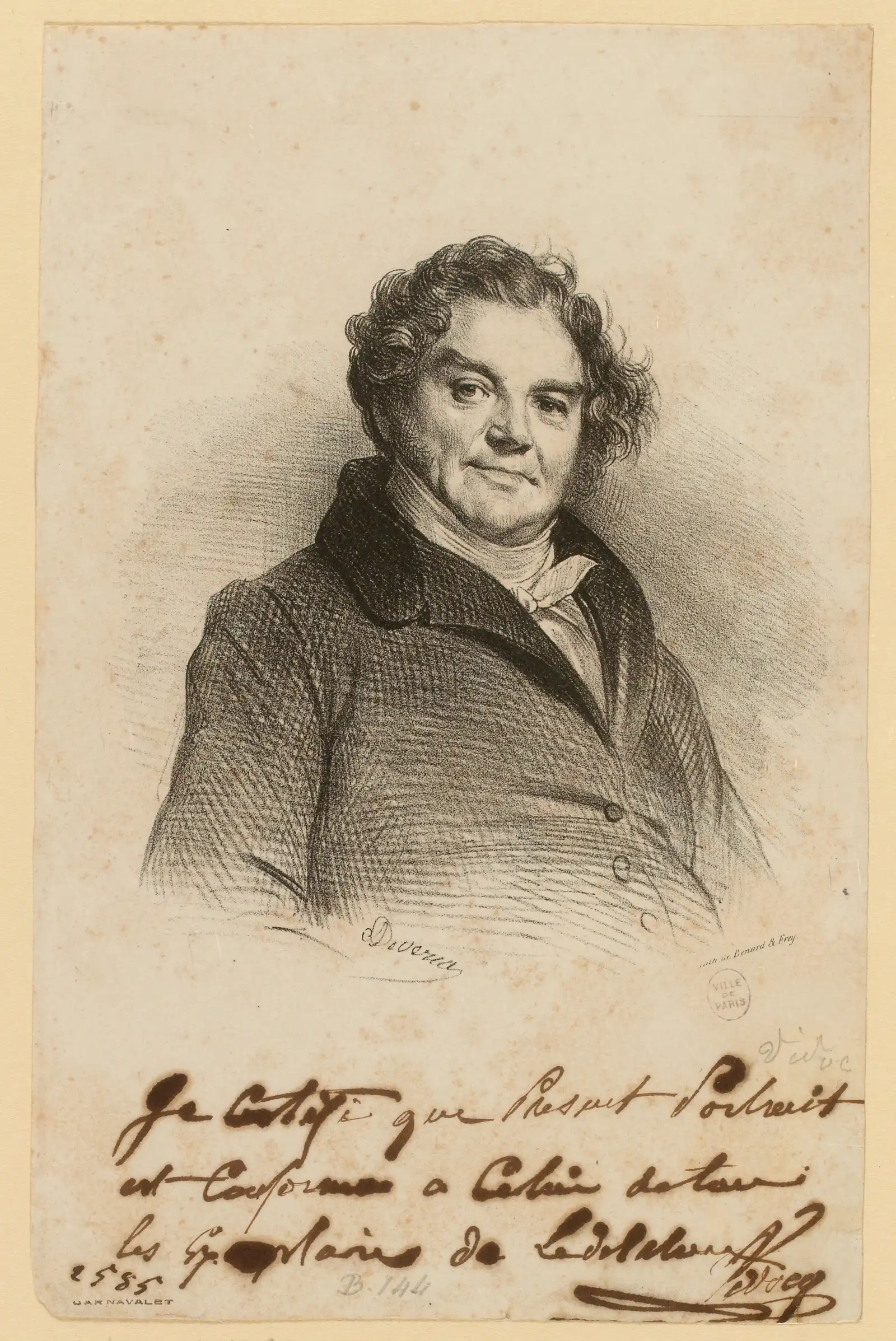
Eugène-François Vidocq, with a handwritten note below the print that certifies the portrait and is signed Vidocq. Achille Devéria, lithograph, Musée Carnavalet, Paris, G.12180, about 1828.
"Portrait d'Eugène Vidocq (1775-1857), aventurier et chef de la police de sûreté (G.12180)" by Achille Devéria — https://commons.wikimedia.org/wiki/File:Portrait_d%27Eug%C3%A8ne_Vidocq_(1775-1857),_aventurier_et_chef_de_la_police_de_s%C3%BBret%C3%A9._G.12180_(1_of_4).jpg — CC0 1.0 (https://creativecommons.org/publicdomain/zero/1.0/)
The first volume of Vidocq's memoirs warns, in his voice, that any copy he has not signed is a counterfeit. The volume was published in Paris by Tenon, rue Hautefeuille, in 1828, as the Mémoires de Vidocq, chef de la police de Sûreté jusqu'en 1827.
« Les exemplaires voulus par la loi ont été déposés, je poursuivrai comme contrefaits ceux non signés de moi. »
written by Eugène François Vidocq, as credited · Mémoires de Vidocq, tome I (Paris: Tenon, 1828), notice before the title page
In this site's rendering: the copies the law requires have been deposited, and he will prosecute as counterfeit any copy he has not signed. The notice makes his signature the test of a genuine copy. Who wrote the sentences inside is a separate question. The book raises it itself.
Which books are counted here?
Vidocq was born in Arras on 23 July 1775, by his own first chapter and by the German national authority file, and he died in 1857. By his own account he went through prisons, escapes and the convict chain before he ran the Paris brigade de sûreté, a squad that, he writes, was created in 1812. His title pages call him its chief until 1827, and his preface mentions letters of pardon granted to him in 1818.
The memoirs are the main subject here: four volumes from Tenon, Paris, 1828–29, in the catalogue of the Bibliothèque nationale de France. The first two volumes are read in the Project Gutenberg text, with the passages quoted here checked against French Wikisource; the third is read at its title page and searched in full, and the fourth is read only at its title page. Two English printings are counted beside them, a London edition whose third volume is dated 1829 and a Philadelphia printing whose copyright line is dated 1859.
English renderings of the French on this page are this site's own. The title pages of the first three volumes describe him twice over: chief of the Sûreté until 1827, and, in the first volume's wording, “aujourd'hui propriétaire et fabricant de papier, à Saint-Mandé,” now a proprietor and paper manufacturer at Saint-Mandé, outside Paris.
Under that, each volume prints a motto credited to the memoirs themselves. The first one ends “En police, il vaut mieux ne pas faire d'affaire que d'en créer”: in police work it is better to make no case than to make one up.
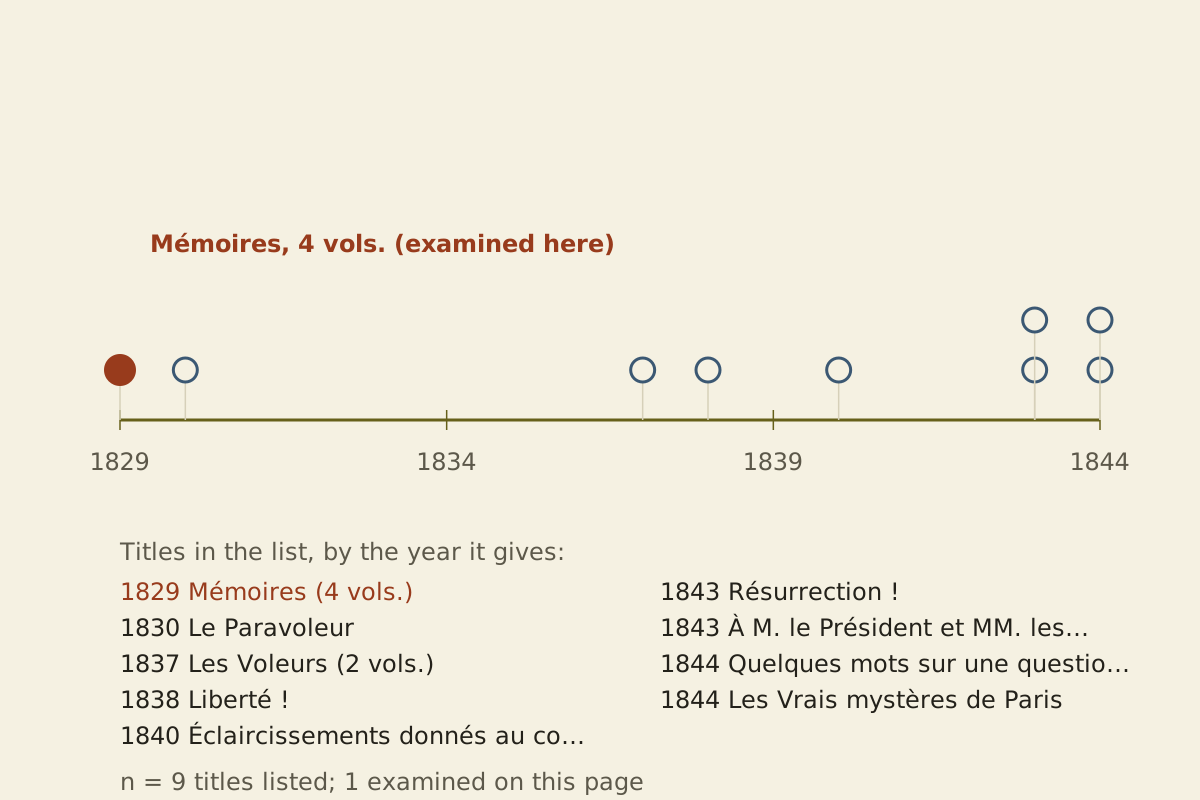
Nine titles that French Wikisource's author page lists under Vidocq's name, placed at the year the list gives. Only the Mémoires are examined on this page; the list gives 1829 for them, while the title pages give 1828 and 1829.
Credit line for reuse
"Nine titles listed under Vidocq's name, 1829 to 1844" by Once Upon a Version — https://onceuponaversion.com/mystery-tellers/vidocq-memoirs/ — licensed under CC BY 4.0 (https://creativecommons.org/licenses/by/4.0/)
Data: French Wikisource author page of Eugène-François Vidocq, retrieved 2026-11-04
The nine listed titles, as CSV (where the data comes from) Data: Titles listed under Vidocq's name, French Wikisource, retrieved 2026-11-04
The other eight titles, from Le Paravoleur (1830) to Les Vrais mystères de Paris (1844), are not read here, so this page says nothing about who wrote them. Each volume of the memoirs is treated as what this site calls a one-evening text, a dated witness with its own wording, not as Vidocq's voice in general.
What does the book say about its own writing?
The first volume opens with a preface headed Vidocq au lecteur, Vidocq to the reader, eight pages numbered i to viii. It carries no signature at its end and is written in the first person as Vidocq, and it begins with a date: he finished the memoirs, he says, in January 1828, and meant to see them through the press himself.
Then, in February, he broke his right arm in five places. While he was too ill to read his manuscript, the publisher offered a reviser, recommended by a respected writer, and Vidocq accepted. The sentence ends “j'eus un teinturier” (p. ii): he had a teinturier, literally a dyer, the word the book uses for a hidden reviser.
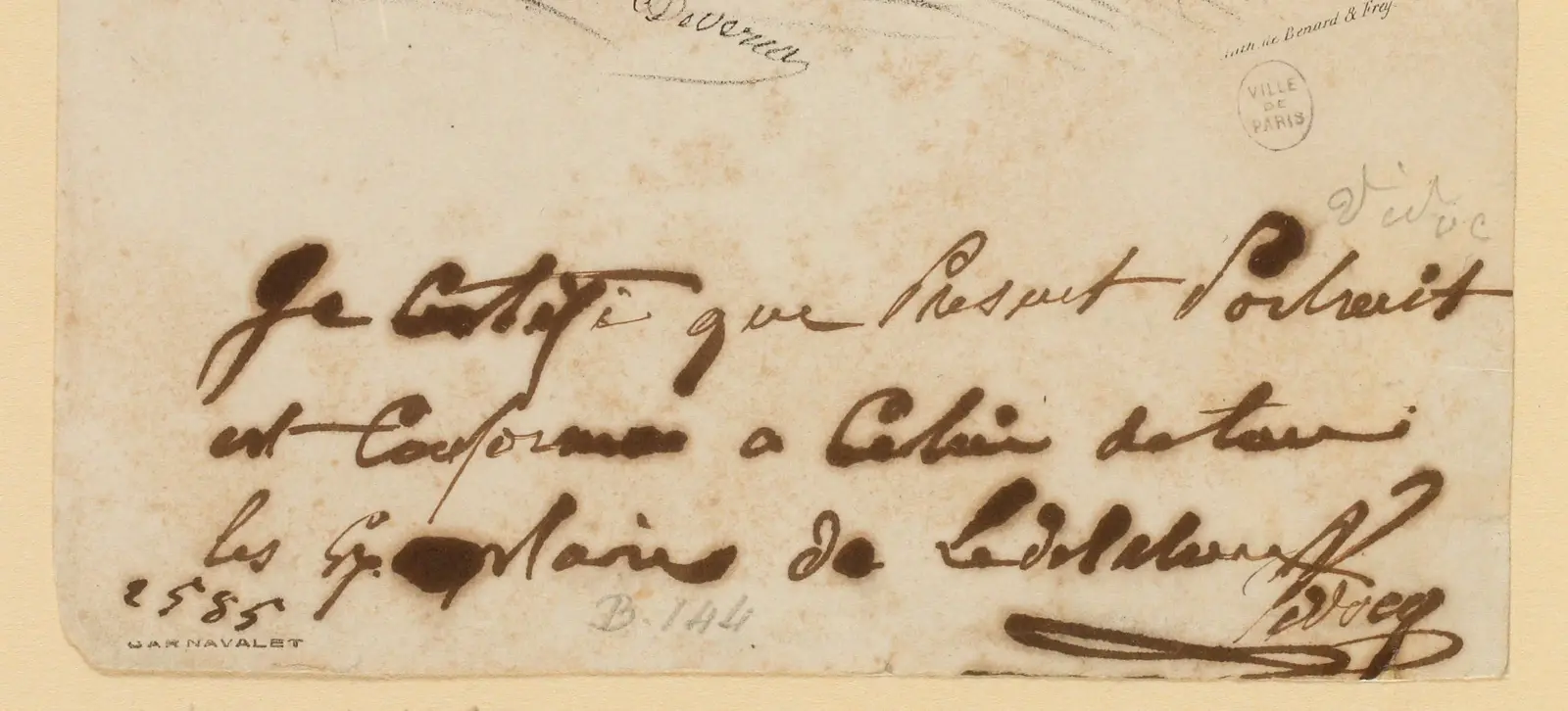
Foot of the same sheet: a note in brown ink that the museum's record reads as certifying that this portrait matches the one in all copies of the edition, which it does not name, signed Vidocq. Achille Devéria, lithograph, Musée Carnavalet, Paris, G.12180, about 1828.
Full credit
"Portrait d'Eugène Vidocq (G.12180), detail of the handwritten certificate" by Achille Devéria — https://commons.wikimedia.org/wiki/File:Portrait_d%27Eug%C3%A8ne_Vidocq_(1775-1857),_aventurier_et_chef_de_la_police_de_s%C3%BBret%C3%A9._G.12180_(1_of_4).jpg — CC0 1.0 (https://creativecommons.org/publicdomain/zero/1.0/); modified: Cropped to the foot of the sheet, full width, from below the printed signature line to the bottom edge, to show the handwritten note; no other change
When he came back from Douai in July, the preface goes on, he asked for the printed sheets. The first volume and part of the second had been rewritten. In place of his lively narration he found a flat one that made his life read as a long premeditation of crime. He bought back his manuscript, and he also accuses the reviser of selling the work in London, where “vendait mes Mémoires à Londres” (pp. vi–vii) is his phrase.
His complaint is about voice more than events. “Sauf quelques altérations, les faits étaient bien les mêmes” (p. iv), he writes: apart from a few changes, the facts were the same. What had gone, by his account, was the chance and necessity in his life, so that his crimes read as planned, and his speech was made coarse. He also noticed names missing, among them that of his successor, Coco-Lacour (p. v).
Those missing names made him suspect, he says, the hand of the police and a deal kept from both the publisher and himself. He then pulls back from the charge. The only thing he accuses the reviser of with certainty is incompetence. The preface offers the suspicion and the retreat in the same paragraph, and this page reports both without choosing.
Even so, he does not withdraw the text. To protect the publisher and satisfy the public, he says, “j'accepte aujourd'hui, comme mienne, une rédaction que j'avais d'abord le dessein de répudier” (p. vii): he now accepts as his own a wording he had first meant to disown. He adds that he made some corrections, and then draws a line in the book.
1828 · tome I, Au lecteur, p. viii
« Ceci explique la différence de ton dont on pourra être frappé en comparant entre elles quelques portions de ces Mémoires ; mais, à partir de mon admission parmi les corsaires de Boulogne, on se convaincra facilement que je n'ai plus d'interprète »
written by Eugène François Vidocq, as credited · Mémoires de Vidocq, tome I (Paris: Tenon, 1828), Au lecteur, p. viii
1828 · tome II, chapter XXXI, p. 455
« Depuis mon admission parmi les corsaires de Boulogne, on s'appercevra facilement que c'est moi seul qui tiens la plume. »
written by Eugène François Vidocq, as credited · Mémoires de Vidocq, tome II (Paris: Tenon, 1828), chapter XXXI, p. 455
What changed: The first volume explains the changes of tone and says that from his joining the Boulogne privateers onward he has no interpreter. Near the end of the second volume, the same boundary comes back in stronger words: from that point it is he alone who holds the pen.
In this site's rendering, the first passage says the preface explains the difference of tone a reader may notice between parts of the memoirs, and that from his admission among the Boulogne privateers onward he has no interpreter. The second says that from the same point, readers will easily see that he alone holds the pen. The privateers come in the second volume, so by the book's own account the reviser's text runs from page one of volume 1 into volume 2.
The closing pages of volume 2 also add a motive. There Vidocq calls the reviser a so-called man of letters who had been paid, “moyennant une prime” (p. 454), to distort the manuscript and blacken him. That is a charge made by the author against an unnamed man, and nothing on this page can test it.
The same pages explain why he now feels free to write more. A court at Douai had restored his civil rights, he says, after the pardon of 1818, so he could rework everything about the police that he had first held back.
Volume 2 ends on the claim that the reader now hears “c'est Vidocq, citoyen libre, qui s'explique avec franchise” (p. 456): Vidocq, a free citizen, speaking frankly. He also says that the baron Pasquier had liked the prose of his police reports, which is his evidence that he could write the rest himself.
The book gives two answers to the question of who wrote it. It says that the published wording of the first volume and more is mostly another man's, and that Vidocq has adopted it as his own. Whether either statement is true cannot be settled from the book, because the only witness it calls is Vidocq.
Whose hand, by the catalogue's account?
The BnF's record of the Tenon edition lists three people as authors. Vidocq is marked as the author of the text, and Louis-François L'Héritier (1789–1852) and Émile Morice (1797–1836) are listed with no role given. A note in the record explains the other two names, and it credits the explanation to someone else: “D'après Jean Savant,” according to Jean Savant.
By that note, Morice prepared the first volume at Tenon's request and roughed up Vidocq's manuscript; when Vidocq complained, Tenon offered L'Héritier as teinturier for the second and third volumes. Of the fourth, the note says: « Quant à la fabrication du 4e vol. L'Héritier s'en charge seul, avec la complicité de Tenon, sans la participation de Vidocq ». In this site's rendering, L'Héritier made the fourth volume alone, with Tenon's help and without Vidocq taking part.
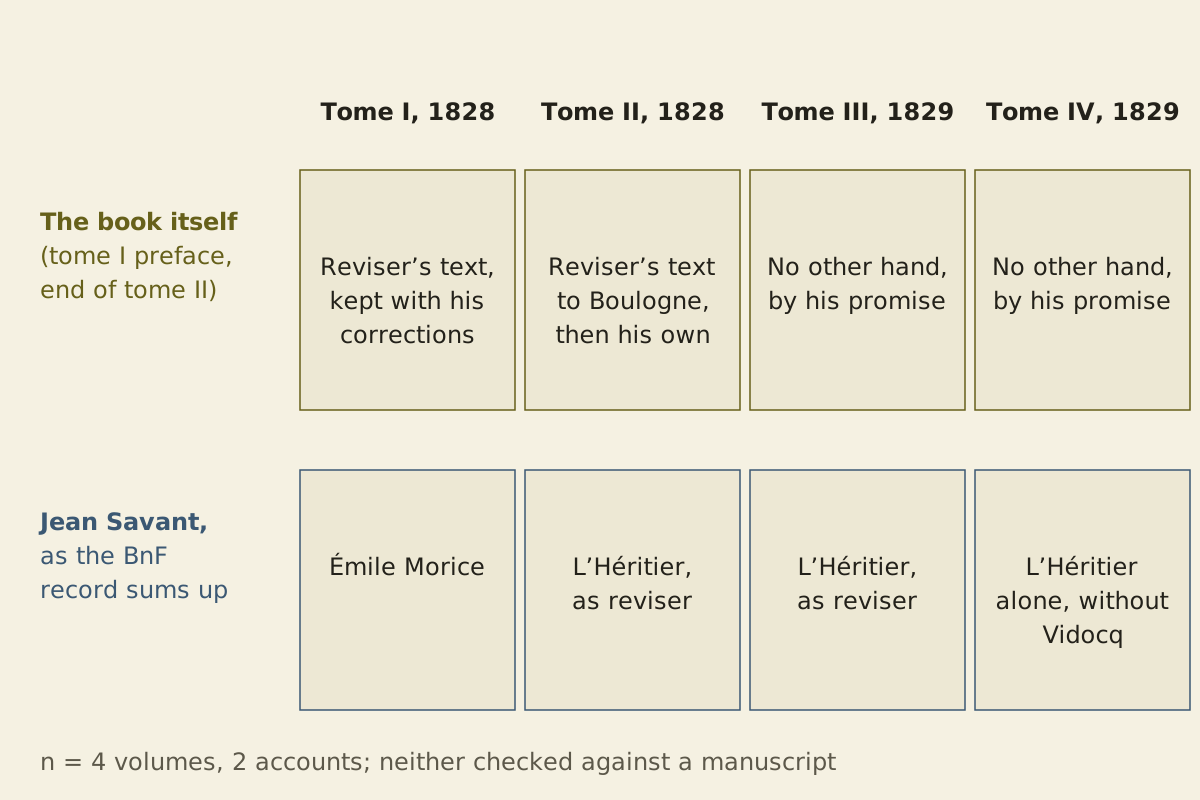
The hands behind each volume, by the book's own account (preface to tome I and end of tome II) and by Jean Savant as the BnF record sums him up. n = 4 volumes, 2 accounts; neither is checked here against a manuscript.
Credit line for reuse
"Who wrote each volume of Vidocq's Mémoires: two accounts" by Once Upon a Version — https://onceuponaversion.com/mystery-tellers/vidocq-memoirs/ — licensed under CC BY 4.0 (https://creativecommons.org/licenses/by/4.0/)
Data: Mémoires de Vidocq (Project Gutenberg, French Wikisource) and BnF record FRBNF31573785, retrieved 2026-11-04
Every claim about the writers, who makes it and on what evidence, as CSV (where the data comes from) Data: Names and hands in Vidocq's memoirs, Once Upon a Version, 2026-11-04
| Claim | Volumes | Writer named | Who makes the claim | Evidence |
|---|---|---|---|---|
| A reviser rewrote the text (“j'eus un teinturier”) | 1 | none | Vidocq, in the preface | the book itself |
| He accepts the reviser's text as his own, with corrections | 1 | none | Vidocq, in the preface | the book itself |
| From the Boulogne privateers on, no interpreter | 1–2 | none | Vidocq, in the preface | the book itself |
| A paid reviser had distorted it; from Boulogne on, he alone writes | 1–2 | none | Vidocq, end of tome II | the book itself |
| Morice prepared volume 1 for Tenon | 1 | Émile Morice | Jean Savant, via the BnF record | catalogue note citing a study |
| L'Héritier was the reviser | 2–3 | Louis-François L'Héritier | Jean Savant, via the BnF record | catalogue note citing a study |
| L'Héritier made volume 4 without Vidocq | 4 | Louis-François L'Héritier | Jean Savant, via the BnF record | catalogue note citing a study |
| No translator named | English, vol. 3 (1829) | none | library record | library record |
| “Written by himself”; the preface says passages were pruned | Philadelphia (copyright 1859) | initials F. L. only | the printing itself | the book itself |
The two accounts agree that someone else worked on the first volume and part of the second. They part on the later volumes: the book promises that no one would interfere again, while Savant, as the BnF reports him, gives the third volume to L'Héritier as reviser and the fourth to L'Héritier alone. The note cites Savant only as “op. cit.,” so it does not say which of his books it draws on, and Savant's own work is not read here.
Savant lived from 1911 to 1998, by the BnF's own heading, and the catalogue lists several of his books on Vidocq, among them Le vrai Vidocq (Hachette, 1957). His account comes more than a century after the volumes, which makes the note useful and also second-hand: the BnF records what Savant said, and this page records what the BnF says he said.
In this site's studio terms, Morice and L'Héritier, if Savant is right, are uncredited session players: none of the legible title pages read here prints their names.
Who put the memoirs into English?
The English Memoirs of Vidocq followed almost at once. The library record of one copy, kept in Munich, gives London, Hunt and Clarke, and 1829 for its third volume, and it names no translator. The translation has been attributed to William Maginn (1794–1842), but this page found no readable source for that attribution and leaves it as an attribution.
The French preface has a charge that belongs here too. Vidocq says the reviser sold the work in London, and that extracts printed in the papers there came back to Paris passed off as translations. That remark is the only thing this page reads about English versions before 1829, and those newspaper extracts are not checked.
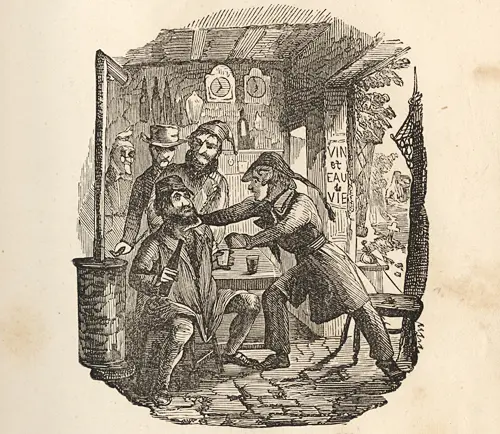
“Vidocq arresting Pons,” from an 1859 New Orleans printing of the English memoirs. George Cruikshank, Memoirs of Vidocq (New Orleans: J. C. Morgan), 1859.
Full credit
"“Vidocq arresting Pons,” Memoirs of Vidocq (New Orleans: J. C. Morgan, 1859)" by George Cruikshank — https://commons.wikimedia.org/wiki/File:George_Cruikshank_-_Vidocq_arresting_Pons.jpg — Public domain in US (published 1859); DE/FR (George Cruikshank d. 1878, life+70; if the 1859 block was cut by another engraver, presumed: an engraver working in 1859 cannot have lived past 1955)
An American printing from Philadelphia, by T. B. Peterson and Brothers, shows two more hands at work. Its title page carries no date; the copyright line on the back is dated 1859, though the library record of the scanned copy gives 1847. The title page reads “Written by himself, and translated from the original French,” with “original designs by Cruikshank,” and again names no translator.
Its preface, signed only with the initials F. L., then speaks as “we”: “We have been compelled occasionally to prune down pruriencies offensive to American taste” (p. 20). The words on that page are presented as his, while the preface says in the same book that some of them were cut.
The same preface vouches for the stories. Of Vidocq's accounts it says that “none of them have been contradicted” (p. 19), although many of the people he named were still alive. That is the preface's argument for the facts, and it says nothing about the sentences. The New Orleans printing of the same year, which carries the Cruikshank plate above, repeats the formula on its title page, “Written by Himself and Translated from the French,” as the description of the scanned plate records it.
Motif grid: name and hand in five printings
The grid asks four things of each printing: whether its title page names Vidocq, whether it claims the words are his, whether it admits another hand, and whether it names that hand. Each has a written rule in the definitions file. A cell is marked absent only for the parts of a printing that were read, which are listed in the definitions.
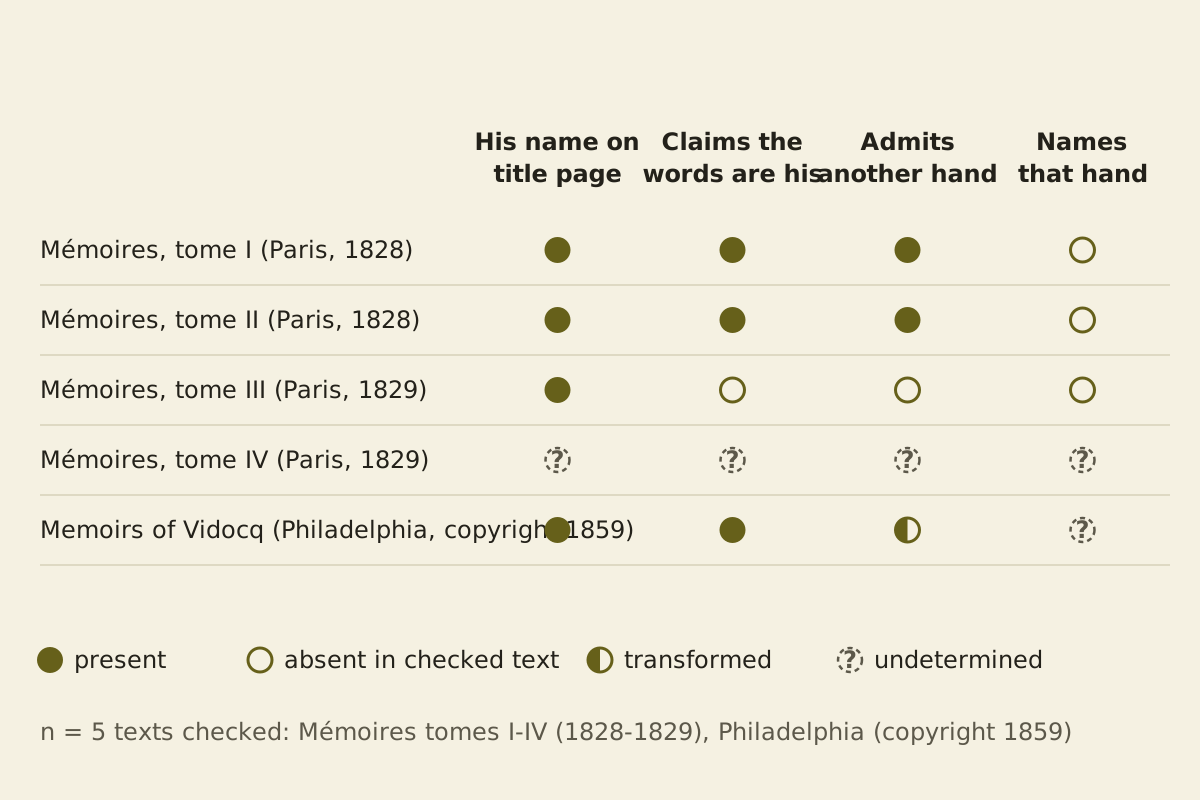
Four features of name and hand in five printings; filled is present, open is absent in the checked text, half-filled is transformed, and a dashed ring with a question mark is undetermined. n = 5 texts checked.
Credit line for reuse
"Name and hand in five printings of Vidocq's memoirs" by Once Upon a Version — https://onceuponaversion.com/mystery-tellers/vidocq-memoirs/ — licensed under CC BY 4.0 (https://creativecommons.org/licenses/by/4.0/)
Data: Name and hand in five printings, Once Upon a Version, 2026-11-04
The grid, cell by cell with page and evidence, as CSV (where the data comes from) Data: Name and hand in five printings, Once Upon a Version, 2026-11-04
| Printing | His name on the title page | The printing claims the words are his | The printing admits another hand | The printing names that hand |
|---|---|---|---|---|
| Mémoires, tome I (Paris, 1828) | present | present | present | absent in checked text |
| Mémoires, tome II (Paris, 1828) | present | present | present | absent in checked text |
| Mémoires, tome III (Paris, 1829) | present | absent in checked text | absent in checked text | absent in checked text |
| Mémoires, tome IV (Paris, 1829) | undetermined | undetermined | undetermined | undetermined |
| Memoirs of Vidocq (Philadelphia, copyright 1859) | present | present | transformed | undetermined |
n = 5 texts checked: the four Tenon volumes of the Mémoires (1828–29) and the Philadelphia printing (copyright 1859). Of the 20 cells, 9 are present, 5 absent in the checked text, 1 transformed and 5 undetermined. The fourth volume's cells are all undetermined because only its title page was read, in a transcription where the line with the name cannot be made out. The Philadelphia preface is signed only “F. L.,” initials the printing does not explain, so whether it names its hand is left undetermined.
The four feature definitions, as CSV (where the data comes from) Data: Name and hand: feature definitions, Once Upon a Version, 2026-11-04
What the printings do not share
The volumes differ more than the single name on their spines suggests. Volumes 1 and 2 talk openly about the reviser, while volume 3 never mentions him in the text searched here. The Philadelphia printing admits a different kind of hand, an American editor cutting passages, not a French reviser rewriting them.
None of the passages checked here names the other hand in full, and the naming cells for tome IV and the Philadelphia preface stay undetermined. The only names on this page for those hands, Morice and L'Héritier, come from a catalogue note that cites a twentieth-century study, not from any printing of the memoirs.
The third volume is where the two accounts pull furthest apart. Its silence fits the promise in volume 1 that no one would interfere again, and it fits Savant's account just as well, since a reviser working for Tenon would hardly announce himself. A row of open circles records only that the text checked says nothing, so the grid leaves the question where the sources leave it.
Who named Vidocq in print, 1841 and 1907?
Thirteen years after the first volume, Edgar Allan Poe put Vidocq into a story. In “The Murders in the Rue Morgue,” printed in Graham's Magazine in April 1841, Dupin dismisses the Paris police and names one real officer.
“Vidocq, for example, was a good guesser, and a persevering man.”
written by Edgar A. Poe · Graham's Magazine, April 1841, p. 171
In the tale where Dupin names Vidocq, the line belongs to Dupin, not to Poe's narrator. Dupin goes on to say that Vidocq erred by the very intensity of his investigations. That is a fictional character's judgment of a real man, and it says nothing about who wrote his memoirs.
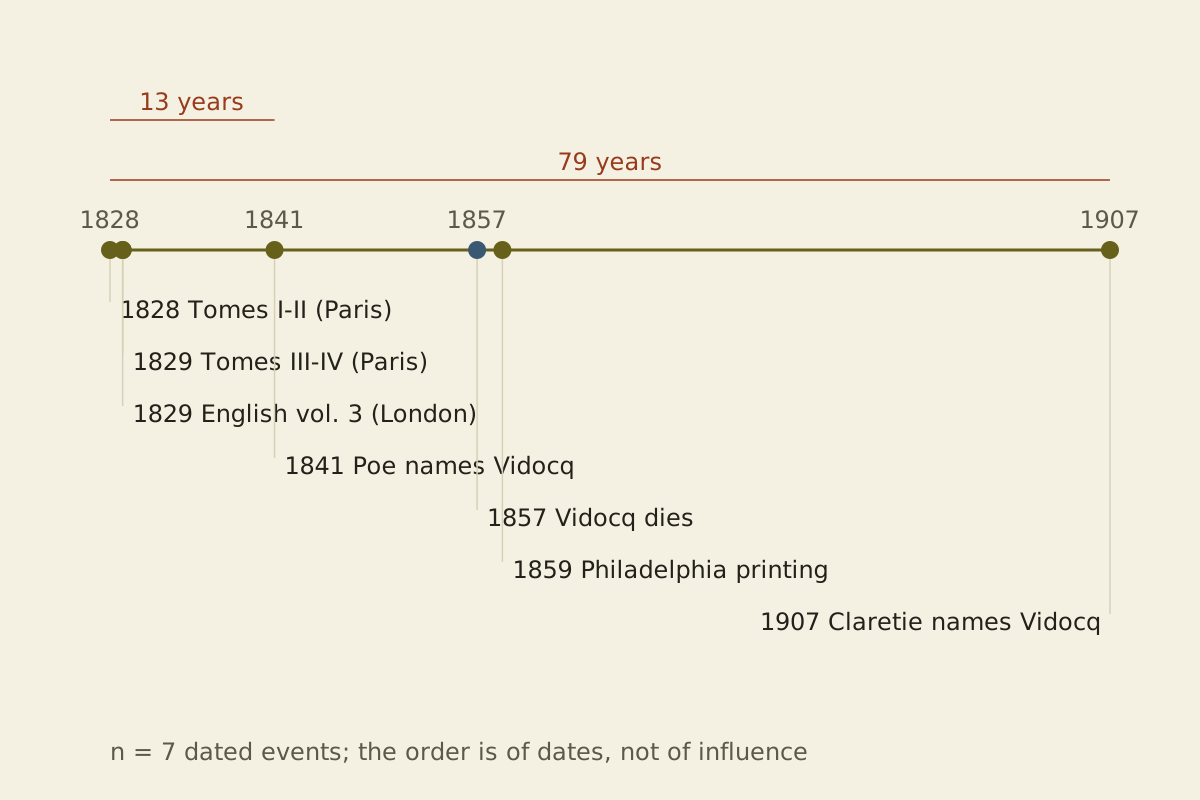
Seven dated events named on this page, from tomes I and II in 1828 to Claretie's preface in 1907; Poe's tale comes 13 years after tome I, Claretie's preface 79. The order is an order of dates, not of influence.
Credit line for reuse
"Seven dates around Vidocq's memoirs, 1828 to 1907" by Once Upon a Version — https://onceuponaversion.com/mystery-tellers/vidocq-memoirs/ — licensed under CC BY 4.0 (https://creativecommons.org/licenses/by/4.0/)
Data: Mémoires de Vidocq, library records and lobid-GND, retrieved 2026-11-04
The seven dates and their sources, as CSV (where the data comes from) Data: Seven dates around Vidocq's memoirs, Once Upon a Version, 2026-11-04
Seventy-nine years after the first volume, Jules Claretie brought Vidocq into his preface to Maurice Leblanc's first Lupin book. He is writing about Balzac and Victor Hugo, and their police characters.
« Et tous deux songeaient à Vidocq, cet étrange loup-cervier devenu chien de garde, dont le poète des Misérables et le romancier de Rubempré avaient pu recueillir les confidences. »
written by Jules Claretie · preface to Arsène Lupin, gentleman-cambrioleur (Paris: Pierre Lafitte, 1907)
In this site's rendering: both were thinking of Vidocq, that strange lynx turned watchdog, whose confidences the poet of Les Misérables and the novelist of Rubempré had been able to gather. That Balzac's Vautrin owes something to Vidocq is Claretie's claim here, not this page's finding.
Claretie's next sentence turns to Monsieur Lecoq, a detective of later court novels, so in his preface the real Vidocq comes before the invented detectives. The same preface sets him beside a thief who tells his own story, as Claretie's preface, where Vidocq is named beside Lupin shows, and the friend who tells the detective's cases follows that preface into a count of who narrates.
Every legible title page read here gives the book to one man, and the first volume's notice makes Eugène François Vidocq's signature the mark of a genuine copy. His own preface, in the first volume of 1828, is still the earliest witness known to this page that another hand was in the text, and it is Vidocq who says so.
Sources
Editions
- Mémoires de Vidocq, chef de la police de Sûreté, jusqu’en 1827, aujourd’hui propriétaire et fabricant de papier, à Saint-Mandé, tome I (Paris: Tenon, 1828). Project Gutenberg eBook #38057. https://www.gutenberg.org/ebooks/38057 (full text)
- Mémoires de Vidocq, tome II (Paris: Tenon, 1828). Project Gutenberg eBook #38058. https://www.gutenberg.org/ebooks/38058 (full text)
- Mémoires de Vidocq, tome III (Paris: Tenon, 1829). Project Gutenberg eBook #38059. https://www.gutenberg.org/ebooks/38059 (title page read; full text searched)
- Mémoires de Vidocq, tomes I, II and IV (Paris: Tenon, 1828–1829). French Wikisource transcriptions of the scanned volumes. https://fr.wikisource.org/wiki/Livre:Vidocq_-_M%C3%A9moires_-_Tome_1.djvu (tome I pp. i–viii; tome II pp. 453–456; tome IV title page)
- Memoirs of Vidocq, “written by himself, and translated from the original French,” with engravings from designs by Cruikshank (Philadelphia: T. B. Peterson and Brothers, 306 Chestnut Street; title page undated, copyright entered 1859 on its verso; the library record of the scanned copy gives 1847). Scanned copy of the University of Toronto. https://archive.org/details/memoirsofvidocqp00vido (title page, its verso (copyright line) and preface (pp. 19–20))
- Edgar A. Poe, “The Murders in the Rue Morgue,” Graham’s Magazine (Philadelphia), vol. XVIII, no. 4, April 1841, pp. 166–179. Transcription with page and column markers by the Edgar Allan Poe Society of Baltimore (Text-02b). https://www.eapoe.org/works/tales/morgueb.htm (full text)
- Maurice Leblanc, Arsène Lupin, gentleman-cambrioleur, preface by Jules Claretie (Paris: Pierre Lafitte, 1907). Project Gutenberg eBook #32854, based on the 1907 edition. https://www.gutenberg.org/ebooks/32854 (full text)
Research
- Jean Savant (1911–1998), studies of Vidocq; the BnF catalogue lists among them Le vrai Vidocq (Paris: Hachette, 1957) and La vie aventureuse de Vidocq (Paris: Hachette, 1970). The note in the BnF record of the Tenon edition cites him as “op. cit.” without naming the book. https://catalogue.bnf.fr/ark:/12148/cb31573785p (bibliographic reference)
Catalogues and databases
- Bibliothèque nationale de France, catalogue général: Mémoires de Vidocq, chef de la police de sûreté jusqu’en 1827, aujourd’hui propriétaire et fabricant de papiers à Saint-Mandé (Paris: Tenon, 1828–1829), 4 vol. FRBNF31573785. https://catalogue.bnf.fr/ark:/12148/cb31573785p (catalogue record) Text licence: Licence Ouverte (Etalab), https://www.etalab.gouv.fr/wp-content/uploads/2017/04/ETALAB-Licence-Ouverte-v2.0.pdf
- Library record of Memoirs of Vidocq, principal […] of the French police until 1827, and now proprietor of the paper manufactory at St. Mandé, vol. 3 (London: Hunt and Clarke, 1829), Bayerische Staatsbibliothek, Munich, Biogr.c. 442 m-27, as given in Internet Archive item 10071539bsb. https://archive.org/details/10071539bsb (catalogue record)
- French Wikisource, “Auteur:Eugène-François Vidocq,” list of works. https://fr.wikisource.org/wiki/Auteur:Eug%C3%A8ne-Fran%C3%A7ois_Vidocq (list page; used as a lead)
- Gemeinsame Normdatei (GND) authority records via lobid-gnd (hbz): Vidocq, Eugène François, 118768360; Morice, Emile, 1055600450; L’Héritier, Louis François, 1055258590; Devéria, Achille, 116088451; Cruikshank, George, 11867742X; Maginn, William, 101137540. https://lobid.org/gnd/118768360 (authority records) Text licence: CC0 1.0, https://creativecommons.org/publicdomain/zero/1.0/
Cite this page
Once Upon a Version. “Vidocq’s Memoirs: The 1828 Preface Admits Another Hand.” Once Upon a Version. Published 2026-11-05. https://onceuponaversion.com/mystery-tellers/vidocq-memoirs/ (accessed day month year).
Write in the date you read the page; the page has no DOI.
More from Mystery Tellers
Mystery Tellers
Dr. Watson: Counted Here, 56 of 60 Holmes Stories Are His
Type detective fiction (no tale-type number)
Dr. Watson narrates 56 of the 60 Sherlock Holmes stories, counted story by story. Holmes tells two, two are third-person, and Poe's friend did it in 1841.
Picture credit
"Original drawing for “Silver Blaze”" by Sidney Paget — https://commons.wikimedia.org/wiki/File:The_Adventure_of_Silver_Blaze_01.jpg — Public domain in US (published 1892 in The Strand Magazine); DE/FR (Sidney Paget d. 1908, life+70); faithful photograph of a two-dimensional drawing (PD-Art; auction-house photograph, Christie's)
Mystery Tellers
Arsène Lupin: In the 1905 Story, the Narrator Is Lupin
Type short story (no tale-type number)
In the earliest known Arsène Lupin story (Je sais tout, July 1905), the passenger who tells it is Lupin; the 1907 book adds a friend’s frame around his voice.
Picture credit
"Frontispiece, Arsène Lupin (Doubleday, 1909)" by H. Richard Boehm — https://commons.wikimedia.org/wiki/File:Frontispiece-Arsene_Lupin_(Doubleday,_1909).jpg — Public domain in US (published 1909); DE/FR (H. Richard Boehm d. 1914, life+70)
Mystery Tellers
The Mystery of Marie Rogêt: 1845 Rewrites the Serial’s Clues
Type detective short story built on a real case (no tale-type number)
Poe’s Marie Rogêt ran as a serial in 1842–43, then in his 1845 Tales. Side by side: the 1845 text drops a confessed killer and allows an accident.
Picture credit
"Edgar Allan Poe" by Unknown maker, American (daguerreotypist) — https://commons.wikimedia.org/wiki/File:1849_face_detail,_from-_Unknown_maker,_American_-_Edgar_Allan_Poe_-_Google_Art_Project_(cropped).jpg — Public domain in US (made 1849 by an unidentified photographer, presumed not to have lived past 1955 since he was working in 1849; anonymous unpublished work, more than 120 years since creation); DE/FR (anonymous work, more than 70 years since it was made); photograph released by the J. Paul Getty Museum Open Content Program