Arabian Nights: Per Zotenberg, Galland’s Copy Ends Mid-Story
The manuscript Galland translated stops with Scheherazade still telling, by Zotenberg’s account, and the pardon that closes his French is not in it.
By Once Upon a Version
Published
How a version is traced · Version history · Contact · Report an error (contact@onceuponaversion.com)
In short
- The Arabic manuscript that Antoine Galland translated breaks off before the frame story ends: Hermann Zotenberg’s 1888 description counts 282 nights, and the copyist’s own hand stops in the middle of night 281.
- The ending in which the sultan spares Scheherazade is not in that manuscript; the 1806 Paris reprint of Galland’s French prints it at the close of its last volume as the ending Galland had adopted.
- In volume 1 of that reprint, 49 of the 61 nights end on an ellipsis, with Scheherazade stopping in the middle of a scene.
Telling card
- Tale
- The frame story of the Thousand and One Nights (Alf layla wa-layla; Les Mille et une Nuits)
- Type
- frame story, a story that holds other stories (no tale-type number cited)
- Teller
- Scheherazade, a character inside the frame (fictional); the frame itself has an unnamed narrator; the author or compiler is unrecorded
- Recorded by
- n/a
5 more fields: edited by, told, published, this text, earliest known
- Edited by
- Antoine Galland, French translation (first volumes printed 1704–1705); the 1806 reprint corrected by its editors
- Told
- unrecorded
- Published
- Les Mille et une Nuit, translated by Antoine Galland, Paris, from 1704
- This text
- Galland’s French as reprinted Paris: Le Normant, 1806, vols. 1, 7 and 9
- Earliest known
- Galland’s Arabic manuscript, which Zotenberg in 1888 dated to about the second half of the 14th century and called the oldest copy he knew
Illustration of a teller at night facing a drawn curtain, with three small scenes from the tales above her.
Illustration: Once Upon a Version. Generated illustration — not a historical image, manuscript or record. © Once Upon a Version, all rights reserved; reuse by request.
In Galland’s French, Scheherazade’s first night ends mid-sentence, with a genie’s sword raised over a merchant. The scene comes in the first volume of Les Mille et une Nuit, which Galland began printing in Paris in 1704, and it is quoted here from the Paris reprint of 1806. From that night on, the Arabian Nights runs on one rule: Scheherazade stays alive while a story is unfinished.
« Oui, repartit le génie, j’y suis résolu. » En achevant ces paroles… Scheherazade, en cet endroit, s’apercevant qu’il étoit jour, et sachant que le sultan se levoit de grand matin pour faire sa prière et tenir son conseil, cessa de parler.
translated by Antoine Galland · Les Mille et Une Nuits (Paris: Le Normant, 1806), vol. 1, p. 61
The genie, in this site’s English, says he has made up his mind, and with those words the sentence breaks off. Scheherazade sees that it is day. She knows the sultan rises early to pray and hold council, and she stops talking.
Who tells the Arabian Nights, and to whom?
A rider on a flying horse beneath the moon. Edmund Dulac, Stories from the Arabian Nights (Hodder and Stoughton), 1907.
"Stories from the Arabian Nights (1907), colour plate of a rider on a flying horse" by Edmund Dulac — https://commons.wikimedia.org/wiki/File:'As_he_descended,_the_daylight_in_which_hitherto_he_had_been_travelling_faded_from_view.'_(18412346383).jpg — Public domain in US (published London 1907); DE/FR (Edmund Dulac d. 1953, life+70, public domain from 1 January 2024)
The Arabian Nights is a frame narrative, which means a story that holds other stories and hands them to tellers inside it. In Galland’s text the outer story has its own unnamed narrator, who begins with “Les chroniques des Sassaniens” (p. 1; in this site’s English, the chronicles of the Sassanids) and tells how the sultan Schahriar, betrayed by his queen, marries a new wife each night and has her killed the next morning.
Scheherazade, the grand vizier’s daughter, asks to be the next bride. Her plan needs her sister Dinarzade, who sleeps in the same room and wakes her an hour before dawn with a fixed request:
Ma chère sœur, s’écria-t-elle, si vous ne dormez pas, je vous supplie, en attendant le jour qui paroîtra bientôt, de me raconter un de ces contes agréables que vous savez.
translated by Antoine Galland · Les Mille et Une Nuits (Paris: Le Normant, 1806), vol. 1, p. 55
Put into plain English, Dinarzade asks her sister, if she is awake, to tell one of her pleasant stories while they wait for the day. Scheherazade turns to the sultan for leave, and from then on she addresses him. The listener who decides her fate is Schahriar. After the first night, the frame states his reasoning:
J’attendrai jusqu’à demain ; je la ferai toujours bien mourir quand j’aurai entendu la fin de son conte.
translated by Antoine Galland · Les Mille et Une Nuits (Paris: Le Normant, 1806), vol. 1, p. 62
The sentence means, in this site’s rendering, that he will wait until tomorrow, since he can still have her killed once he has heard the end of her tale. This site calls whatever a story has not yet handed to the reader the narrator’s pocket. Scheherazade’s pocket at dawn is of the kind called delayed: she already knows how the tale goes on, and she holds the rest back to a later point.
Where does Scheherazade stop each night?
In the first volume of the 1806 reprint, 61 nights end inside the volume. Night 62 begins on page 462 and runs on into the second volume. Each of the 61 stops can be placed by the sentence in which Scheherazade breaks off, and by what comes just before it.
Of the 61 stops, 49 fall on an ellipsis, in the middle of an action or a speech. Ten fall between two sentences, and two stop on the sentence that closes a story: night 17, after the death of the Greek King, and night 27, when Scheherazade “finit là le conte du pêcheur” (ends the fisherman’s tale there, in this site’s rendering; p. 230). Only once, in night 54, does the text not mention the daylight at all.
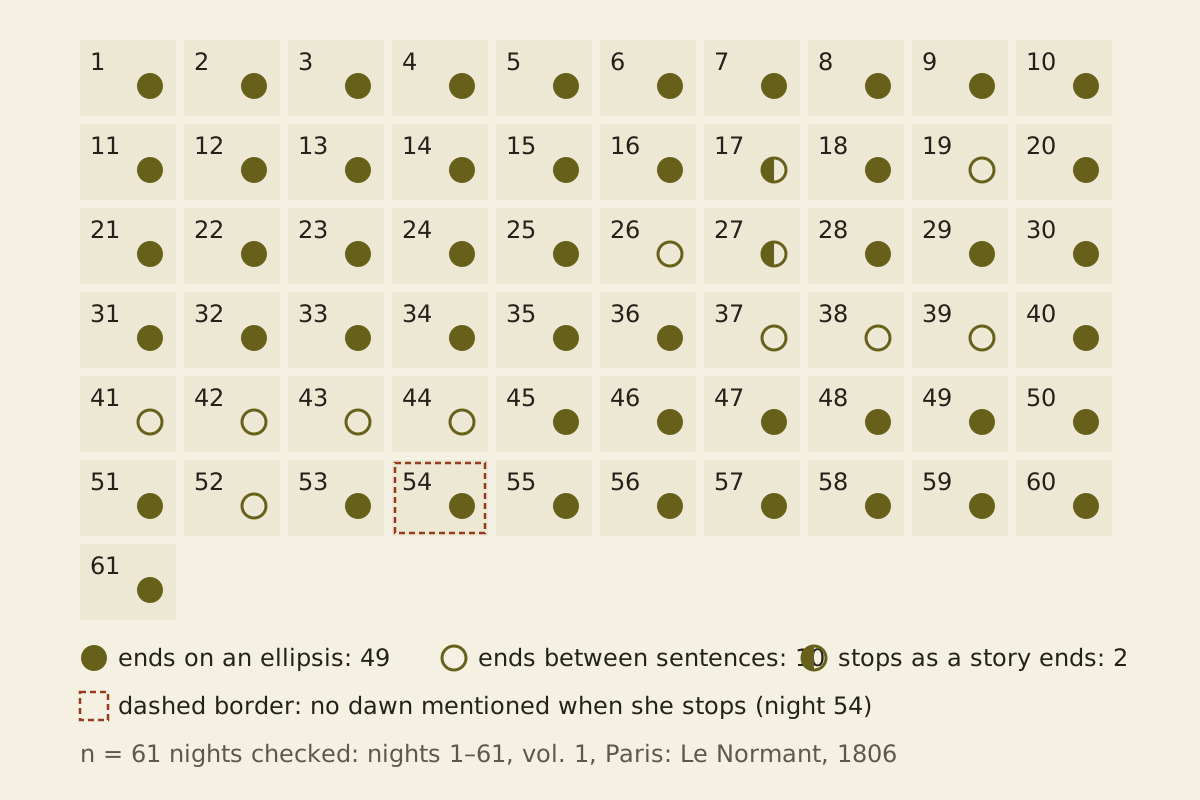
Where each night of volume 1 stops: on an ellipsis, between sentences, or as a story ends. n = 61 nights, Les Mille et Une Nuits, Paris, 1806, vol. 1.
Credit line for reuse
"Where Scheherazade stops, nights 1–61 of Galland’s first volume (1806 reprint)" by Once Upon a Version — https://onceuponaversion.com/craft/arabian-nights-frame/ — licensed under CC BY 4.0 (https://creativecommons.org/licenses/by/4.0/)
Data: Les Mille et Une Nuits, trans. Antoine Galland, Paris, Le Normant, 1806, vol. 1, French Wikisource transcription, retrieved 2026-11-03
All 61 nights, with pages and the words before each stop, as CSV (where the data comes from) Data: Les Mille et Une Nuits, trans. Antoine Galland, Paris, Le Normant, 1806, vol. 1, French Wikisource transcription, retrieved 2026-11-03
In words: nights 19, 26, 37, 38, 39, 41, 42, 43, 44 and 52 end between sentences, nights 17 and 27 stop as a story ends, and the other 49 end on an ellipsis. Night 52 counts as between sentences, since its stop does not say that the second Calender’s story, just finished, is over.
The voice that announces the stop also varies. In 17 of the 61 nights Scheherazade breaks off in her own words, usually with “Mais, sire,” (But, sire, in this site’s rendering) and names the daylight herself. In the other 44 the frame’s narrator reports the stop from outside the tale she was telling: in 43 of them she sees the day and falls silent, and in night 54 she falls silent with no word of the daylight.
The last stop in the volume is one of the sharpest. The third Calender has opened 99 doors in a palace and comes to the one he has been told never to open:
Il ne restoit plus que la centième porte, dont l’ouverture m’étoit défendue…
translated by Antoine Galland · Les Mille et Une Nuits (Paris: Le Normant, 1806), vol. 1, p. 461
In this site’s English: only the hundredth door was left, the one he was forbidden to open. The frame also lets a night run short. Night 41 is one of the shortest in the volume, and when Dinarzade complains, Scheherazade blames her: “Si vous n’aviez pas été paresseuse aujourd’hui, répondit la sultane, j’en aurois dit davantage” (p. 324). In this site’s English, she would have said more if her sister had not been lazy that morning.
Counting a pattern across a whole text is one of the ways this site reads craft; another craft reading, of Goldilocks and the Three Bears, follows a different pattern through its tellings.
How deep do the stories inside stories go?
Scheherazade’s tales are full of people who tell tales, and in two of them a story is the price of a life or of freedom. In the opening tale, three old men each tell the genie a story to buy back a third of a merchant’s crime, “le tiers de son crime” (p. 74), and the genie grants all three thirds.
The third old man’s story itself never appears, because Scheherazade says she does not have it: “je ne vous la dirai point, car elle n’est point venue à ma connoissance” (p. 104). In this site’s English, she will not tell it because it never reached her.
In the Calenders, the lady Zobéïde lets her uninvited guests go free if they tell their stories: “Ceux qui nous raconteront leur histoire … laissez-les aller où il leur plaira” (pp. 290–291). In this site’s English, she orders her slaves to let those who tell their story go wherever they please. Her guests then take turns, and each Calender’s story becomes a tale inside Scheherazade’s tale.
The deepest point in the first volume comes in the Fisherman. Scheherazade tells the sultan about a fisherman, who tells a genie about a Greek King, who tells his vizier what another vizier once told King Sindbad: the story of a husband and a parrot (p. 139). Counting Scheherazade as the first teller, the parrot story reaches the reader through a fourth.
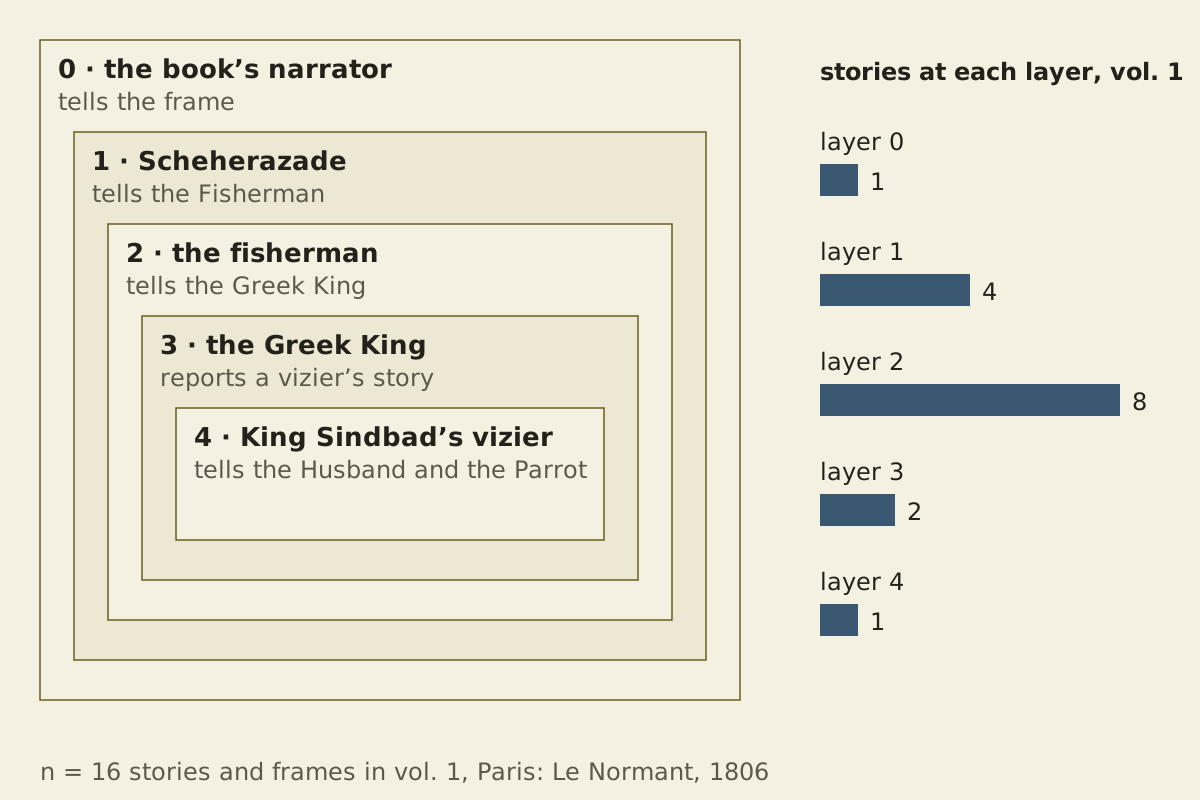
Tellers between the reader and each story in volume 1; the nested boxes show the deepest chain. n = 16 stories and frames, Les Mille et Une Nuits, Paris, 1806, vol. 1.
Credit line for reuse
"Stories inside stories in Galland’s first volume (1806 reprint)" by Once Upon a Version — https://onceuponaversion.com/craft/arabian-nights-frame/ — licensed under CC BY 4.0 (https://creativecommons.org/licenses/by/4.0/)
Data: Les Mille et Une Nuits, trans. Antoine Galland, Paris, Le Normant, 1806, vol. 1, French Wikisource transcription, retrieved 2026-11-03
Who tells which story to whom in volume 1, as CSV (where the data comes from) Data: Les Mille et Une Nuits, trans. Antoine Galland, Paris, Le Normant, 1806, vol. 1, French Wikisource transcription, retrieved 2026-11-03
| Story | Layer | Teller | Listener | Night it begins |
|---|---|---|---|---|
| The frame (preamble) | 0 | the book’s unnamed narrator | the reader | before night 1 |
| The Ass, the Ox and the Labourer | 1 | the grand vizier | Scheherazade | before night 1 |
| The Merchant and the Genie | 1 | Scheherazade | Schahriar | 1 |
| The first old man and the hind | 2 | the first old man | the genie | 4 |
| The second old man and the two black dogs | 2 | the second old man | the genie | 6 |
| The third old man’s story (not told) | 2 | the third old man | the genie | 8 |
| The Fisherman | 1 | Scheherazade | Schahriar | 8 |
| The Greek King and the doctor Douban | 2 | the fisherman | the genie | 11 |
| The Husband and the Parrot | 4 | King Sindbad’s vizier | King Sindbad | 14 |
| The Vizier who was punished | 3 | the Greek King’s vizier | the Greek King | 15 |
| The young King of the Black Isles | 2 | the young king | the sultan | 22 |
| The three Calenders and the five ladies | 1 | Scheherazade | Schahriar | 28 |
| The first Calender | 2 | the first Calender | Zobéïde | 37 |
| The second Calender | 2 | the second Calender | Zobéïde | 40 |
| The Envious Man and the Envied | 3 | the second Calender | a genie, then Zobéïde | 46 |
| The third Calender | 2 | the third Calender | Zobéïde | 53 |
n = 16 stories and frames in volume 1 of the 1806 reprint: the 15 sections of the volume’s own table, plus the third old man’s story, which is named but never told (p. 104). Layer counts the tellers inside the frame, with Scheherazade’s own tales at layer 1.
Who tells a story twice?
One teller in the table tells the same story on two occasions, to two different listeners. The second Calender tells a genie the story of the Envious Man inside his own adventure, then tells it again to Zobéïde, the lady of the house: “Je crois, madame, que vous ne serez pas fâchée que je vous la raconte aussi” (p. 353). In this site’s English, he trusts she will not mind hearing it as well.
What is in the manuscript Galland translated?
Galland’s dedication, to the Marquise d’O, explains where his Arabic text came from. Hermann Zotenberg quoted it in 1888 in Galland’s own spelling: “Il a fallu le faire venir de Syrie et mettre en François le premier volume que voicy, de quatre seulement qui m’ont été envoyez” (Zotenberg, p. 4). In this site’s English, the collection had to be sent for from Syria, and this first volume put into French, out of only four volumes received.
Zotenberg lists three volumes of the Nights among the Arabic manuscripts deposited in the royal library in Paris after Galland’s death in 1715, numbered 1506, 1507 and 1508 in the printed catalogue of 1739. He judged them parts of one manuscript of 22 quires, “incomplet à la fin d’un nombre indéterminé de feuillets” (p. 5), short of an unknown number of leaves at the end, and he dated the copying to about the second half of the 14th century.
On page 6 he counts the nights: the opening of the work and its first tales, divided into 282 nights. Then he says where the first copyist stopped:
La copie originale s’arrête au milieu de la Nuit 281; la fin de cette Nuit et la Nuit 282 ont été ajoutées après coup
written by Hermann Zotenberg · Histoire d’Alâ al-Dîn ou la lampe merveilleuse (Paris: Imprimerie nationale, 1888), p. 6
In this site’s English: the copyist’s own hand stops in the middle of night 281, and the rest of that night and night 282 were added later. The same sentence goes on to date those additions to the 17th or 18th century. He adds that a 15th-century manuscript in the Vatican Library, examined by Guidi, holds the same first 282 nights, and that both copies stop at about the same place, at the start of the story of Qamar al-Zaman.
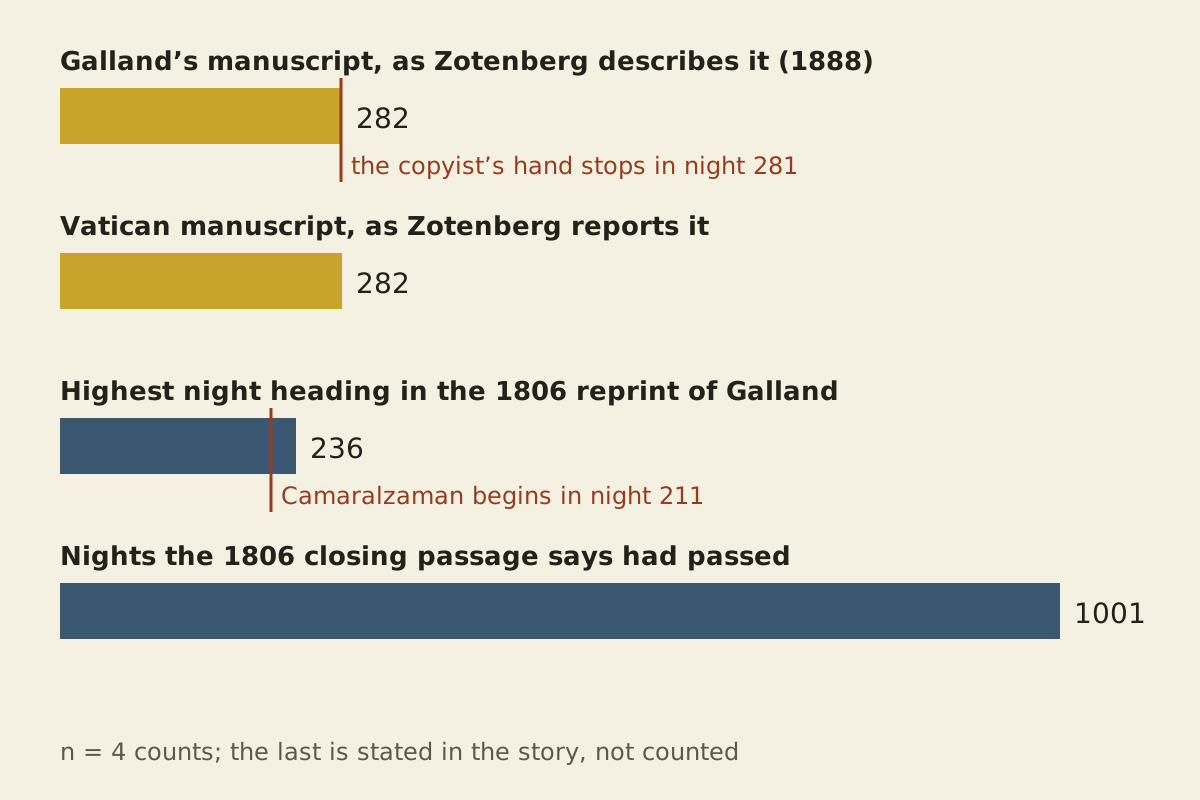
Nights in the two manuscripts as Zotenberg describes them in 1888, against the night headings of the 1806 reprint and the number its closing passage states. n = 4 counts.
Credit line for reuse
"Nights in Galland’s manuscript and in the 1806 reprint of his French" by Once Upon a Version — https://onceuponaversion.com/craft/arabian-nights-frame/ — licensed under CC BY 4.0 (https://creativecommons.org/licenses/by/4.0/)
Data: Hermann Zotenberg, Histoire d’Alâ al-Dîn, Paris, 1888, pp. 1–6, and Les Mille et Une Nuits, Paris, Le Normant, 1806, French Wikisource transcription, retrieved 2026-11-03
The four night counts, with sources, as CSV (where the data comes from) Data: Hermann Zotenberg, Histoire d’Alâ al-Dîn, Paris, 1888, and Les Mille et Une Nuits, Paris, Le Normant, 1806, French Wikisource transcription, retrieved 2026-11-03
The French does not follow that count. In the 1806 reprint the story of Camaralzaman, Galland’s spelling of Qamar al-Zaman, begins in night 211, about 70 nights earlier than where the manuscript stops. The reprint’s night headings stop at the 236th, in its fourth volume (p. 151), and the remaining stories run without them.
Where does the French numbering part from the manuscript?
The gap does not run one way. Zotenberg reports a leaf missing from the second volume of the manuscript that held most of night 102, all of night 103 and a few lines of night 104, which is where the story of the Hunchback begins. In the 1806 reprint the Hunchback begins in night 123, about 20 nights later.
The French also skips two numbers. A translator’s note in volume 2 (p. 290) says that nights 101 and 102 describe seven robes, with verse, and were left untranslated; the next heading is night 103.
Zotenberg’s notice opens with four tales from Galland’s French whose Arabic text, he wrote, had until then remained unknown: the Sleeper Awakened, Aladdin, Ali Baba and the Two Jealous Sisters (p. 1). A copy newly bought by the Bibliothèque nationale, he adds, had partly filled that gap. In the 1806 set all four sit in volumes 5 to 7, after the last night heading and well past the start of Camaralzaman, the point where Zotenberg says the manuscript stops.
In the manuscript the ending is withheld in a different way: no teller chooses to wait; the copy stops. None of the three kinds of pocket fits a text that breaks off, because nothing in it is held back; the rest is missing. Galland’s preface claimed more, saying the Arabic original “a trente-six parties” (has thirty-six parts, in this site’s rendering) and that his book gave only the first.
How did the text change between editions?
The 1806 reprint is not a copy of the first printing. Its editors say they cleared the text of misprints and also of “des nombreuses incorrections qui appartiennent au traducteur” (vol. 1, editors’ notice), the many slips that belonged to the translator himself. In this site’s studio terms, the 1806 set is a later pressing, and each printing is what this site calls a one-evening text, a single fixed witness rather than the work itself.
Galland’s spelling · as Zotenberg quotes it (1888, p. 4)
“Il a fallu le faire venir de Syrie et mettre en François le premier volume que voicy, de quatre seulement qui m’ont été envoyez.”
written by Antoine Galland · dedication to the Marquise d’O, as quoted in Zotenberg 1888, p. 4
1806 · Le Normant reprint, vol. 1
“Il a fallu le faire venir de Syrie, et mettre en français le premier volume que voici, de quatre seulement qui m’ont été envoyés.”
written by Antoine Galland · Les Mille et Une Nuits (Paris: Le Normant, 1806), vol. 1, dedication
What changed: The 1806 text adds a comma and modernises three spellings (François, voicy, envoyez); the four volumes from Syria stay four.
The largest change is where the frame ends. The seventh volume of the reprint, the last of Galland’s own text, closes on the story of the two jealous sisters and “FIN DU TOME SEPTIÈME” (p. 397) without returning to Scheherazade. The pardon comes at the end of the ninth volume (pp. 445–446), after two volumes of further tales by Caussin de Perceval, and a note there explains the move.
The note says the editors kept and transposed to that place “celui qu’avoit adopté M. Galland”, the ending Galland had adopted, because the ending described in the preface to the continuation could only stand at the end of a complete translation. The passage itself says that “Mille et une nuits s’étoient écoulées dans ces innocens amusemens” (vol. 9, p. 445), a thousand and one nights spent in these harmless pastimes, before the sultan gives up his law.
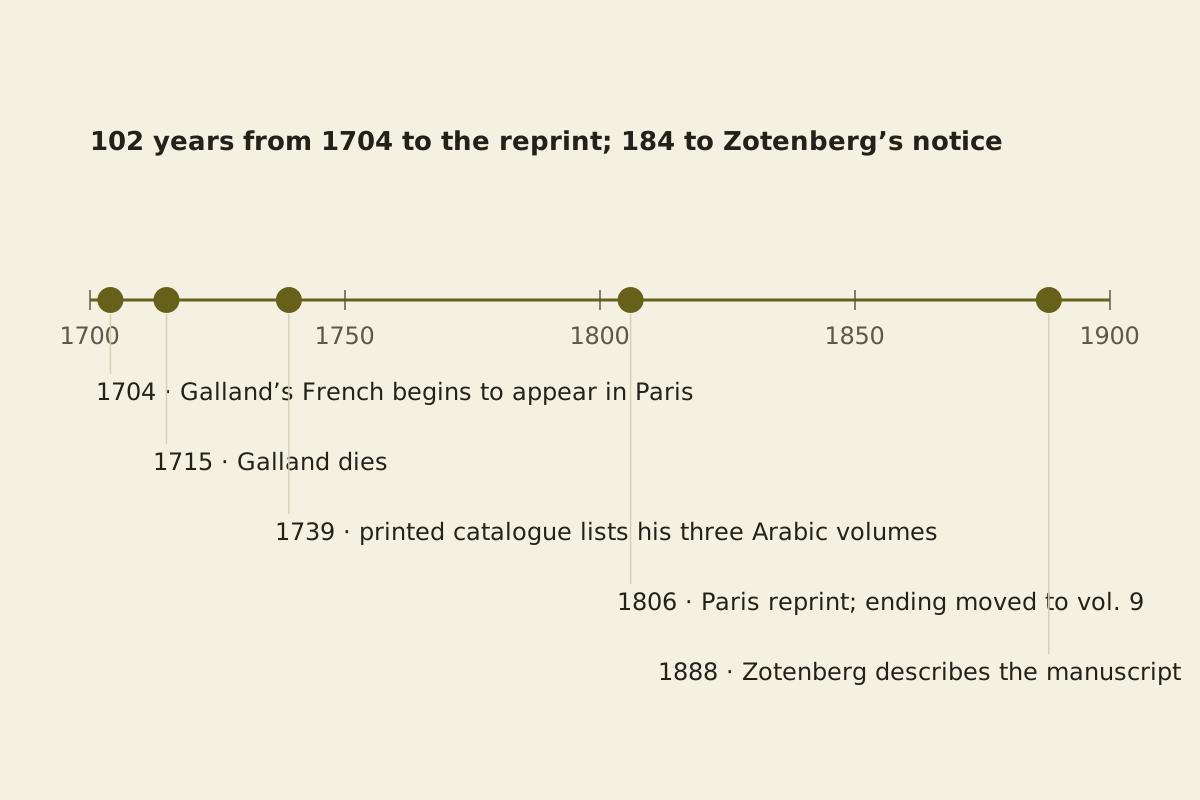
Five dated steps between Galland’s opening volumes and Zotenberg’s description of the manuscript, 1704 to 1888.
Credit line for reuse
"Galland’s Nights from 1704 to 1888" by Once Upon a Version — https://onceuponaversion.com/craft/arabian-nights-frame/ — licensed under CC BY 4.0 (https://creativecommons.org/licenses/by/4.0/)
Data: Hermann Zotenberg, Histoire d’Alâ al-Dîn, Paris, 1888, pp. 3–5, and Les Mille et Une Nuits, Paris, Le Normant, 1806, French Wikisource transcription, retrieved 2026-11-03
From 1704 to the reprint is 102 years, and to Zotenberg’s notice 184. The years are 1704 for the start of Galland’s French (Zotenberg, p. 3, dates the first volumes 1704 and 1705), 1715 for Galland’s death, 1739 for the printed catalogue, 1806 for the reprint and 1888 for the notice.
What the device does not prove
The counts on this page describe one printing of one translation. The 61 stops come from the first volume of the 1806 reprint as transcribed on Wikisource, and they say nothing about how the Arabic manuscript divides its nights, or about any spoken telling. Whether the dawn breaks copy a performance, and where they came from, are questions for other evidence.
The manuscript’s 282 nights, the stop in night 281 and the dating to the 14th century are Zotenberg’s description of 1888, and he calls Galland’s copy “de tous le plus ancien” (p. 6), the oldest of all the copies he knew. This page has not read later studies of the manuscript, and it does not say whether that judgment still stands.
The depth count depends on one choice. The Greek King repeats a story he says another king’s vizier once told, and this page counts him as a teller; a reader who counts only speakers present in the scene would put the parrot story at layer 3, not 4.
Where Galland took his ending from is not traced here either. The 1806 editors say only that he adopted it. The thousand and one nights of the closing passage are a number the story states; the night headings of the same set stop at 236.
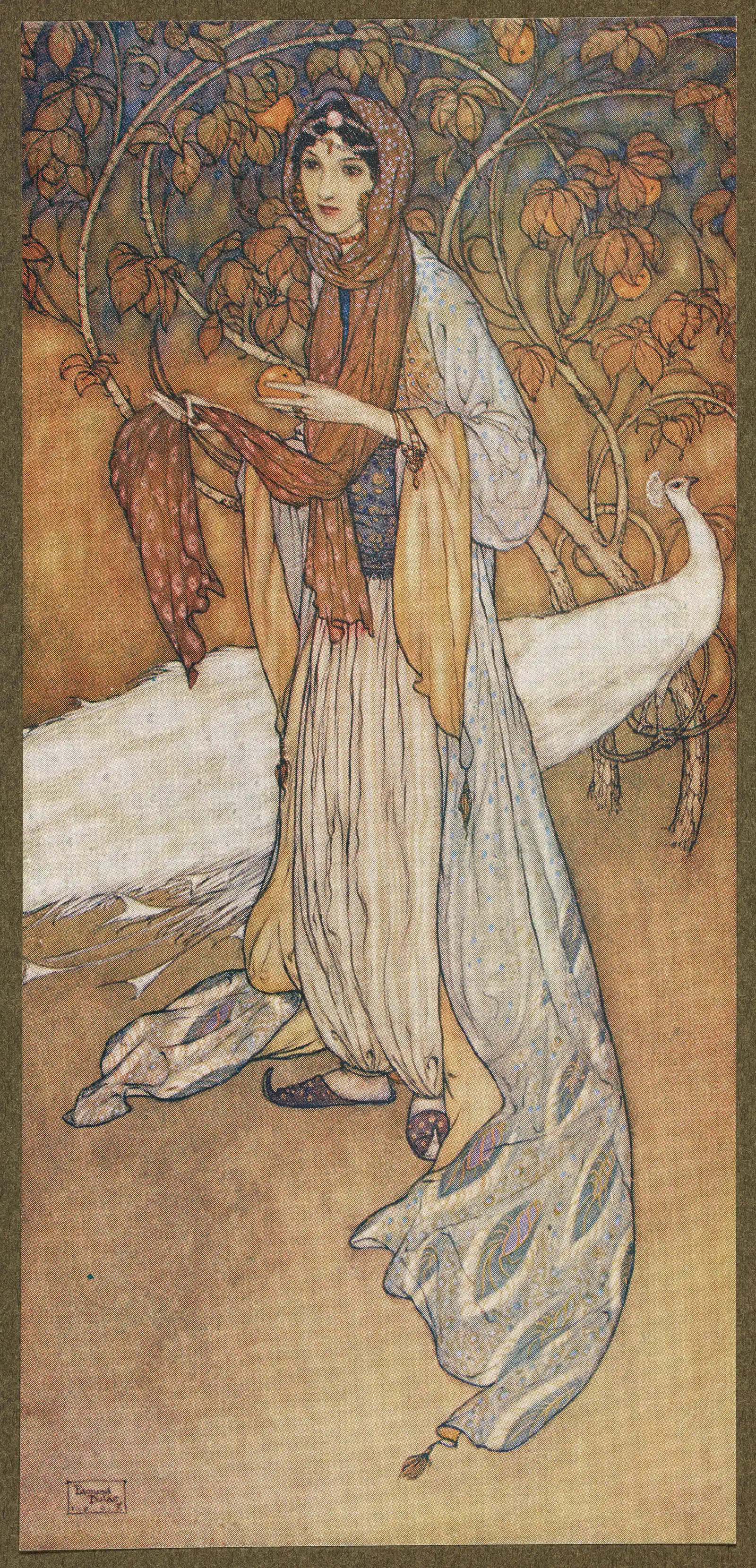
Scheherazade with a white peacock. Edmund Dulac, frontispiece to Stories from the Arabian Nights (Hodder and Stoughton), 1907.
Full credit
"Stories from the Arabian Nights (1907), frontispiece: Scheherazade" by Edmund Dulac — https://commons.wikimedia.org/wiki/File:Frontispiece-_'Scheharazade,_the_heroine_of_the_Thousand_and_One_Nights.'_(18410440304).jpg — Public domain in US (published London 1907); DE/FR (Edmund Dulac d. 1953, life+70, public domain from 1 January 2024); the Commons page carries only the Flickr Commons “No known copyright restrictions” statement, so this basis is the site’s own
Galland’s dedication says that four volumes reached him from Syria; Zotenberg’s notice of 1888 lists three, and they stop before the frame closes. The pardon at the end of the 1806 set is the ending Galland adopted, set down two volumes after his own text stops.
Sources
Editions
- Les Mille et Une Nuits, contes arabes, translated by Antoine Galland; vols. 8–9 continued by Jean-Jacques-Antoine Caussin de Perceval (Paris: Le Normant, 1806), 9 vols. French Wikisource transcription: vol. 1 (editors’ notice, Galland’s dedication and preface, the frame and all fifteen sections), the general table of the nine volumes, the last tale of vol. 7 and the last tale of vol. 9 with its notes; vol. 2, pp. 286–291 and its table, on the page images of the same scan. https://fr.wikisource.org/wiki/Les_Mille_et_Une_Nuits (full text of vol. 1; tables of contents of all nine volumes; vol. 2, pp. 286–291; last tales of vols. 7 and 9)
- Giambattista Basile, Lo cunto de li cunti, “Ntroduzzione,” in Lo cunto de li cunti (Il pentamerone), ed. Benedetto Croce, vol. 1 (Naples, 1891), pp. 5–19. Italian Wikisource transcription. https://it.wikisource.org/wiki/Lo_cunto_de_li_cunti/Lo_Cunto_de_li_Cunti/Ntroduzzione (full text of the introduction)
Research
- Hermann Zotenberg, “Notice sur quelques manuscrits des Mille et une Nuits et la traduction de Galland,” in Histoire d’Alâ al-Dîn ou la lampe merveilleuse: texte arabe (Paris: Imprimerie nationale, 1888), pp. 1–6 and 25–39 used, including the extracts from Antoine Galland’s diary (Bibliothèque nationale, Mss. français 15277–15280) on pp. 26–33. https://archive.org/details/histoiredalald00zote (pp. 1–6 and 25–39 of the French notice, from the page images)
Catalogues and databases
- Gemeinsame Normdatei (GND) records via lobid-gnd: Antoine Galland (GND 118716220, 1646-04-04 to 1715-02-17); Hermann Zotenberg (GND 117014346, 1834-01-26 to 1909-07-02). https://lobid.org/gnd/118716220 (full entries)
Cite this page
Once Upon a Version. “Arabian Nights: Per Zotenberg, Galland’s Copy Ends Mid-Story.” Once Upon a Version. Published 2026-11-05. https://onceuponaversion.com/craft/arabian-nights-frame/ (accessed day month year).
Write in the date you read the page; the page has no DOI.
More from The Teller's Craft
The Teller's Craft
The Murders in the Rue Morgue: Its Narrator Knows the End
Type detective short story (no tale-type number)
Poe’s narrator tells the Rue Morgue case once it is closed, yet gives its facts in the order he met them. Of 16 facts traced in the 1841 text, Dupin gives 12.
Picture credit
"The Murders in the Rue Morgue, for Edgar Allan Poe’s “Tales of Mystery and the Imagination,” Chicago, 1895-96" by Aubrey Beardsley — https://commons.wikimedia.org/wiki/File:The_Murders_in_the_Rue_Morgue,_for_Edgar_Allan_Poe%E2%80%99s_%E2%80%9CTales_of_Mystery_and_the_Imagination,%E2%80%9D_Chicago,_1895-96_MET_DP-21095-001.jpg — CC0 1.0 (https://creativecommons.org/publicdomain/zero/1.0/)
The Teller's Craft
Goldilocks and the Three Bears: Southey’s Intruder Was Old
Type nursery tale printed by an author (no tale-type number cited)
Southey’s 1837 intruder is an unnamed old woman. Cundall’s 1849 preface says he made her a girl; of four texts checked, only Steel’s 1918 calls her Goldilocks.
Picture credit
"De drie beren (titel op object)" by Anonymous — https://commons.wikimedia.org/wiki/File:De_drie_beren_(titel_op_object),_RP-P-OB-205.807.jpg — CC0 1.0 (https://creativecommons.org/publicdomain/zero/1.0/); modified: Cropped to the last of the eight panels (bottom right), keeping the picture and a margin of paper; the printed verse above and below is left out
The Teller's Craft
The Goose Girl: Of 7 Editions Checked, Iron Stove From 1840
Type ATU 533, as classified by D. L. Ashliman
In the Grimms’ 1815 Goose Girl the princess confides in a tiled stove; in the 1857 text it is an iron one. Seven editions checked, with each repeated line.
Picture credit
"The Goosegirl" by Arthur Rackham — https://commons.wikimedia.org/wiki/File:Snowdrop-Rackham-135.jpg — Public domain in US (published New York: Dutton, 1920, per the Internet Archive record of the scanned copy; the plates first appeared in 1909); DE/FR (Arthur Rackham d. 1939, life+70)