Goldilocks and the Three Bears: Southey’s Intruder Was Old
In Southey’s Three Bears of 1837, the intruder is a little old woman with no name who swears at the porridge; in two of the later printings checked here, she is a girl.
By Once Upon a Version
Published
How a version is traced · Version history · Contact · Report an error (contact@onceuponaversion.com)
In short
- In Robert Southey’s “The Story of the Three Bears,” printed in London in 1837 in volume 4 of The Doctor, &c., the intruder is a little old woman with no name.
- Joseph Cundall’s preface of November 1849 says he made the intruder a little girl, Silver-hair, “instead of an old woman”; of the four texts checked here, only Flora Annie Steel’s of 1918 calls her Goldilocks.
- In all four texts the three sizes of porridge pot or bowl, chair and bed, the broken little chair and the bears’ nine lines stay put; the intruder’s age, name, manners and fate change.
Telling card
- Tale
- The Story of the Three Bears (Goldilocks and the Three Bears)
- Type
- nursery tale printed by an author (no tale-type number cited)
- Teller
- Robert Southey (author); inside the book the narrator credits the story to William Dove, a character
- Recorded by
- n/a
5 more fields: edited by, told, published, this text, earliest known
- Edited by
- Later hands checked here: Joseph Cundall, who retold it (preface dated November 1849, book 1850); Andrew Lang, editor of The Green Fairy Book, which reprints it signed “Southey.”; Flora Annie Steel, who retold it (1918)
- Told
- unrecorded
- Published
- The Doctor, &c., vol. 4, London: Longman, Rees, Orme, Brown, Green and Longman, 1837, pp. 318–326
- This text
- Southey, The Doctor, vol. 4, 1837 (Project Gutenberg 71981, checked against page scans of the 1837 printing)
- Earliest known
- The 1837 printing is the earliest text checked here; Cundall in 1849 called the tale a very old nursery tale, a claim this page cannot date
This card as CSV · where these values come from
Data: The Doctor, vol. 4, 1837; A Treasury of Pleasure Books, 1850; The Green Fairy Book (Project Gutenberg 7277); English Fairy Tales, 1918 (Project Gutenberg 17034); GND 118798146; retrieved 2026-11-03
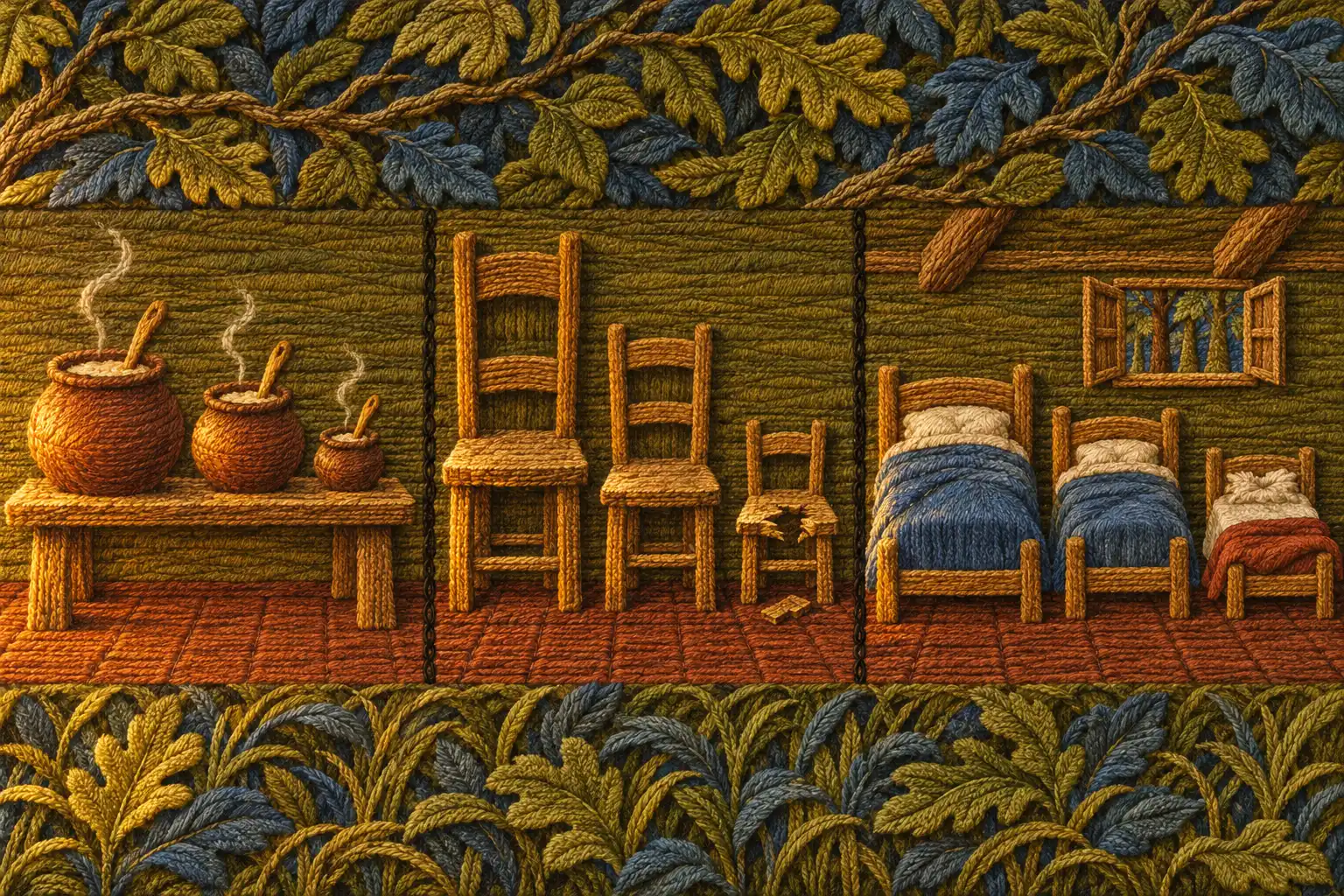
Illustration of the three rounds of the story: porridge pots, chairs and beds in three sizes, the smallest chair broken. Not a scene from any one printing.
Illustration: Once Upon a Version. Generated illustration — not a historical image, manuscript or record. © Once Upon a Version, all rights reserved; reuse by request.
In Robert Southey’s telling, the intruder in the Three Bears’ house is a little old woman who swears. The story fills pages 318 to 326 of the fourth volume of The Doctor, &c., printed in London in 1837. Nobody in it is called Goldilocks. In two later printings of Goldilocks and the Three Bears checked here, a girl takes the old woman’s place, put there by other hands.
Who tells the story inside The Doctor?
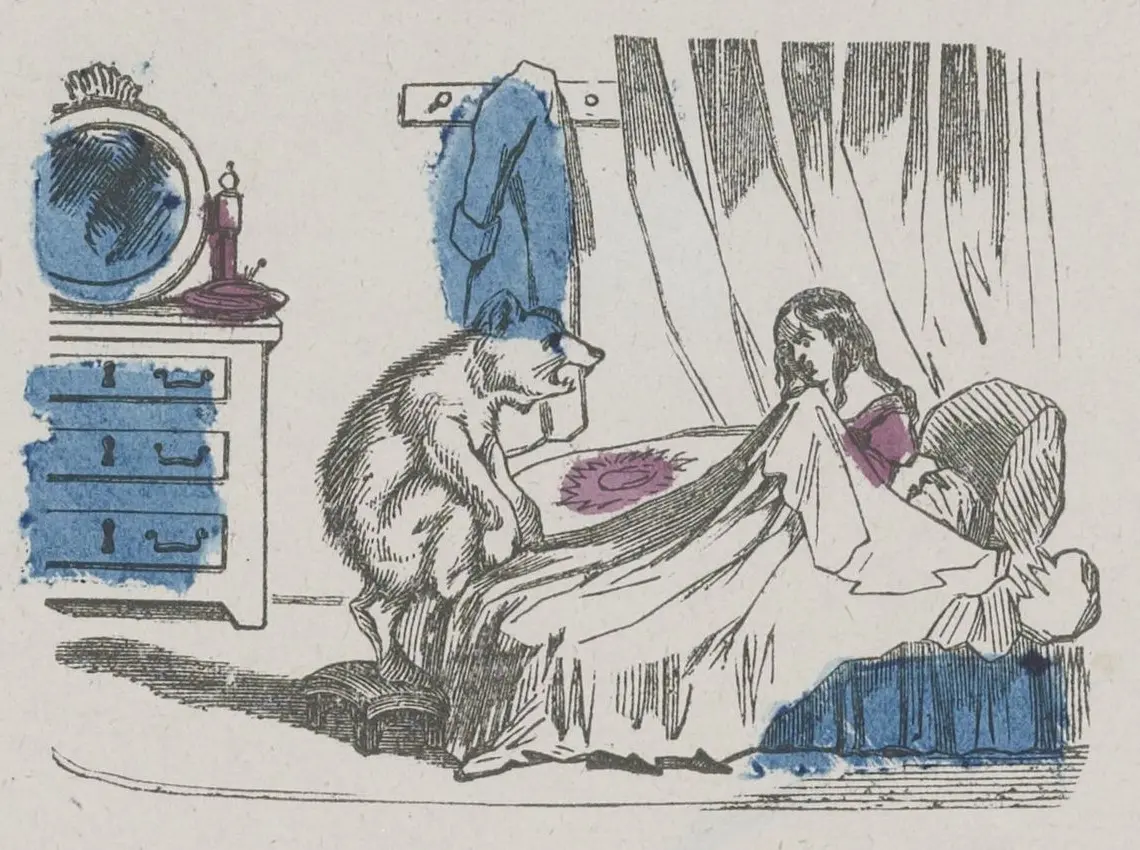
The little bear finds the girl in bed, last panel of the Dutch print De drie Beeren. Anonymous woodcut, Leiden: D. Noothoven van Goor, 1850–1881.
Full credit
"De drie beren (titel op object)" by Anonymous — https://commons.wikimedia.org/wiki/File:De_drie_beren_(titel_op_object),_RP-P-OB-205.807.jpg — CC0 1.0 (https://creativecommons.org/publicdomain/zero/1.0/); modified: Cropped to the last of the eight panels (bottom right), keeping the picture and a margin of paper; the printed verse above and below is left out
The Doctor, &c. is a long, digressive book about a country doctor, Daniel Dove, published in seven volumes, and its title page names no author. Chapter CXXIX, which begins on page 312, interrupts a discussion of the Doctor’s philosophy to offer one chapter “for the nursery,” so that the book will have something for every room of the house. The narrator then credits the story to a character.
For their sakes I will relate one of William Dove’s stories, with which he used to delight young Daniel, and with which the Doctor in his turn used to delight his young favourites
written by Robert Southey · The Doctor, &c., vol. 4, London, 1837, ch. CXXIX, p. 316
William Dove is the Doctor’s uncle, and earlier in the same chapter the narrator says he “could not read.” The book therefore frames the tale as an oral story, passed from an illiterate uncle to a boy and then from the grown boy to other children, a chain that belongs to the fiction. The Telling card above lists the telling as unrecorded, since no real teller, place or evening is recorded in the sources checked here.
The anonymity is also part of the book’s humour. A footnote on page 317 credits a borrowed line, “My good little women and men,” to “Southey,” and the next chapter’s heading offers aphorisms ascribed to “the Laureate, Dr. Southey,” as if he were someone else. Later printings name him outright: Cundall’s preface credits “the great poet Southey,” and Lang’s Green Fairy Book signs the story “Southey.”
The 1837 text is a fixed printing, what this site calls a one-evening text: one dated witness, not the tale itself. Like the Arabian Nights, another story told inside a frame, it tells the reader who is supposed to be speaking, and that speaker is not the author.
How does the 1837 page print three voices?
The narrator also tells the reader how the story should be performed, in a sentence that runs across pages 316 and 317.
which never fails of effect with that fit audience for which it is designed, if it be told with dramatic spirit, in the manner that our way of printing it may sufficiently indicate, without the aid of musical notation.
written by Robert Southey · The Doctor, &c., vol. 4, London, 1837, ch. CXXIX, pp. 316–317
The typography does the remaining work. On pages 322 to 325, every line the Great, Huge Bear speaks is set in large black-letter, a heavy, pointed Gothic style of type. The Middle Bear’s lines are in large roman type, and the Little, Small, Wee Bear’s lines are in small italic, so a reader sees three voice sizes before anyone speaks aloud.
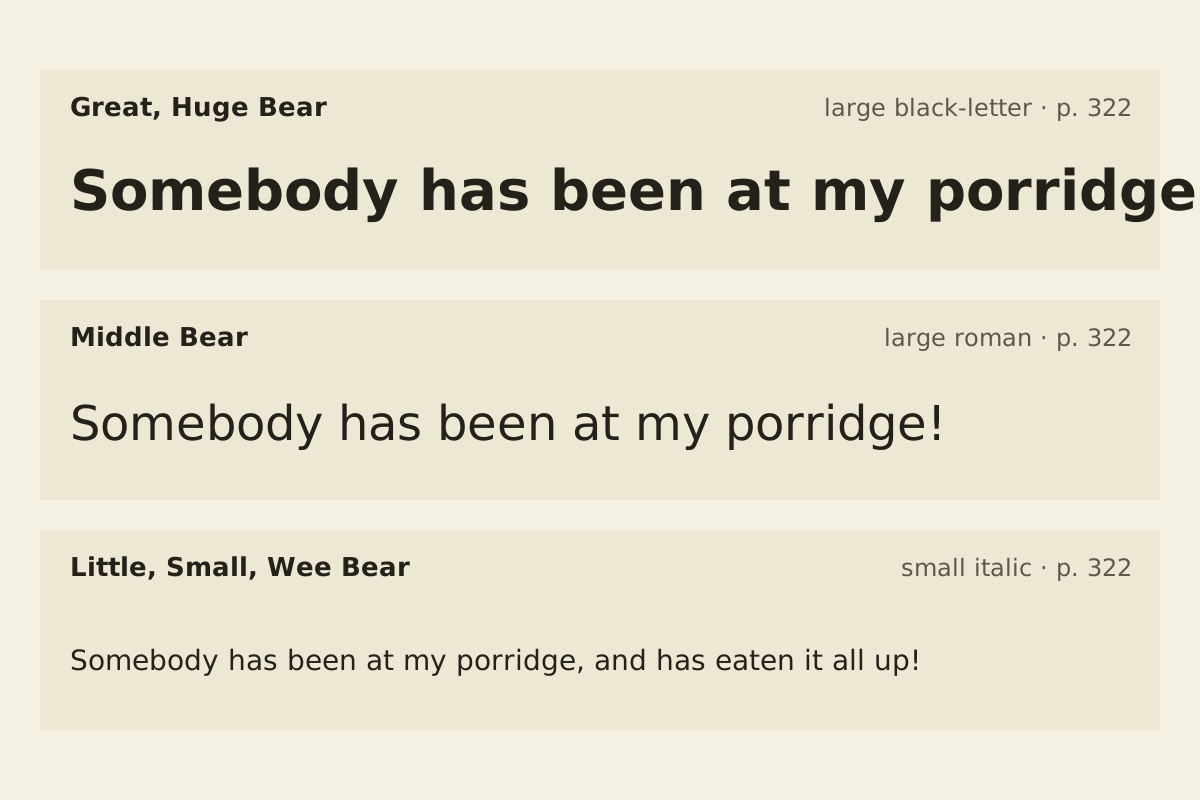
The three porridge lines as the 1837 page sets them, drawn at relative sizes only; the drawing does not copy the typefaces used in 1837. Robert Southey, The Doctor, vol. 4, p. 322, 1837.
Credit line for reuse
"Three voices, three type styles in Southey’s Three Bears (1837)" by Once Upon a Version — https://onceuponaversion.com/craft/goldilocks-three-bears/ — licensed under CC BY 4.0 (https://creativecommons.org/licenses/by/4.0/)
Data: The Doctor, &c., vol. 4, London, 1837, pp. 322–325, retrieved 2026-11-03
The next chapter, CXXX, even assigns the parts: “Papa and Uncle, will do the Great, Huge Bear, best,” while Sister, Aunt and Mamma “will excel them” in the little bear’s voice. Cundall’s 1850 printing keeps three sizes, though not the same faces: large roman for the great bear, a medium roman for the middle one and small italic for the little one.
The narrator who gives these directions also knows a great deal. He judges the old woman before she touches anything (“She could not have been a good, honest old Woman,” p. 319), and he explains that the bears’ spoons were wooden, since silver ones would have gone into her pocket (p. 322). At the third chair he turns to the listener: “And you know what the little old Woman had done to the third chair” (p. 324). Only at the end does he claim not to know something.
What happens three times, and what changes the third time?
The story has three rounds: porridge, chairs and beds. In each round the old woman tries the great bear’s thing, then the middle bear’s, then the little bear’s, and the little one is “just right.” When the bears come home, they repeat the pattern in speech: each bear speaks once per round, great to little, which makes nine lines, and every one of them begins “Somebody has been.”
The intruder’s complaints follow a pattern of their own: the porridge is “too hot” and then “too cold,” and the chairs are “too hard” and then “too soft,” so each pair names two opposite extremes before the third object settles between them.
The beds break that symmetry slightly: the great bed is “too high at the head,” the middle bed “too high at the foot,” and the little bed is right at both ends. Every round therefore ends on the smallest object, which is also the object the intruder damages or occupies.
Counting the words shows where the news sits: in the 1837 text the first two lines of each round are short and almost identical. The third is always the longest, at 12, 15 and 11 words, because only the little bear adds what has happened: the porridge is eaten, the chair is broken, and “here she is.”
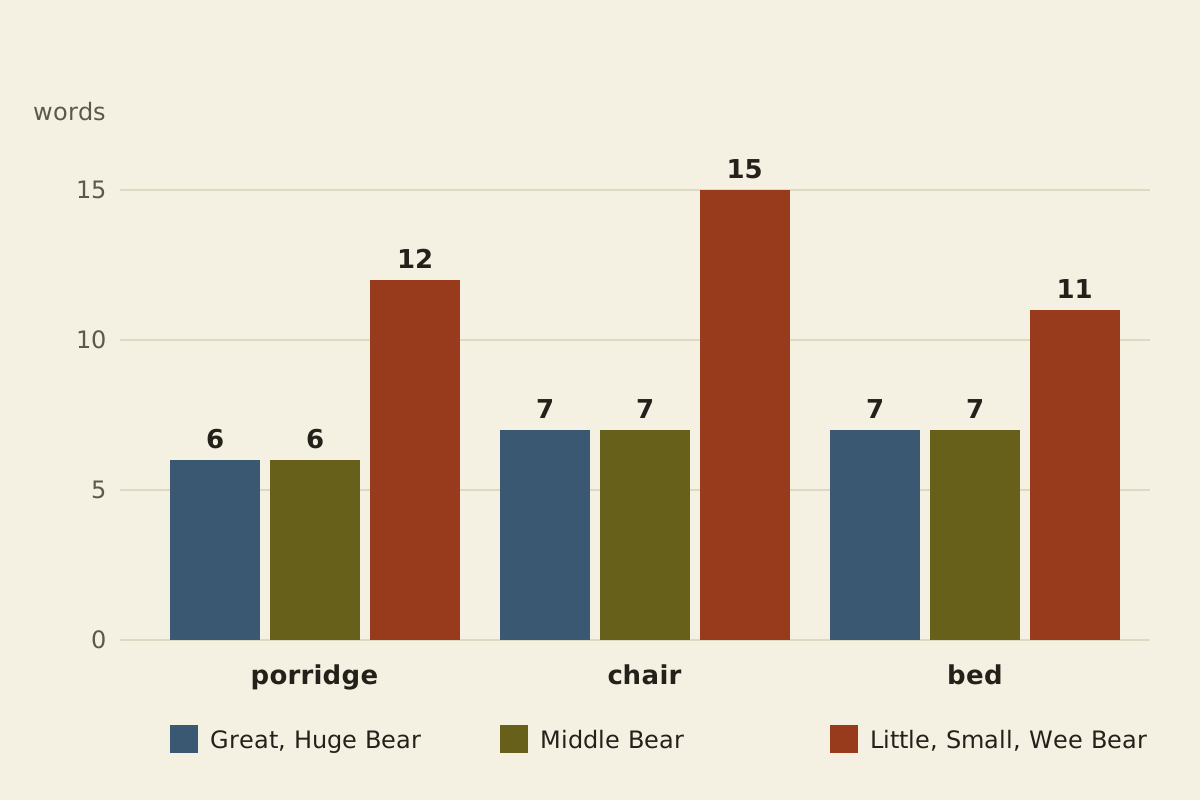
Words in each of the bears’ nine lines, by round. Robert Southey, The Doctor, vol. 4, pp. 322–325, 1837.
Credit line for reuse
"Words in each bear’s line, Southey’s Three Bears (1837)" by Once Upon a Version — https://onceuponaversion.com/craft/goldilocks-three-bears/ — licensed under CC BY 4.0 (https://creativecommons.org/licenses/by/4.0/)
Data: The Doctor, &c., vol. 4, London, 1837, pp. 322–325, retrieved 2026-11-03
The nine lines, with page and type style, as CSV (where the data comes from) Data: The Doctor, &c., vol. 4, London, 1837, pp. 322–325, retrieved 2026-11-03
| Round | Great, Huge Bear | Middle Bear | Little, Small, Wee Bear |
|---|---|---|---|
| porridge (p. 322) | 6 | 6 | 12 |
| chair (pp. 323–324) | 7 | 7 | 15 |
| bed (pp. 324–325) | 7 | 7 | 11 |
Read this way, the repetition does practical work for the teller. The first two lines set up a rhythm that a listener can predict, and the third line breaks it with new information. It also moves the plot, because the little bear’s bed line is the one that wakes her: the great bear’s voice was “no more to her than the roaring of wind,” but the little bear’s was “so sharp, and so shrill, that it awakened her at once.”
What the count does not show
The count describes how one printed text is built. It does not show why tellers favour threes, whether repetition helped anyone remember the tale, or where the pattern came from. Those are questions about origins, and four printings from 1837 to 1918 cannot answer them.
Motif grid: what four tellings keep
Each motif below was defined before any cell was filled: what counts as present, and which specific changes count as transformed. Absent means only that the checked text does not have it. Undetermined marks the cells where only a transcription was read, because a transcription’s capitals or italics may not follow the printed page.
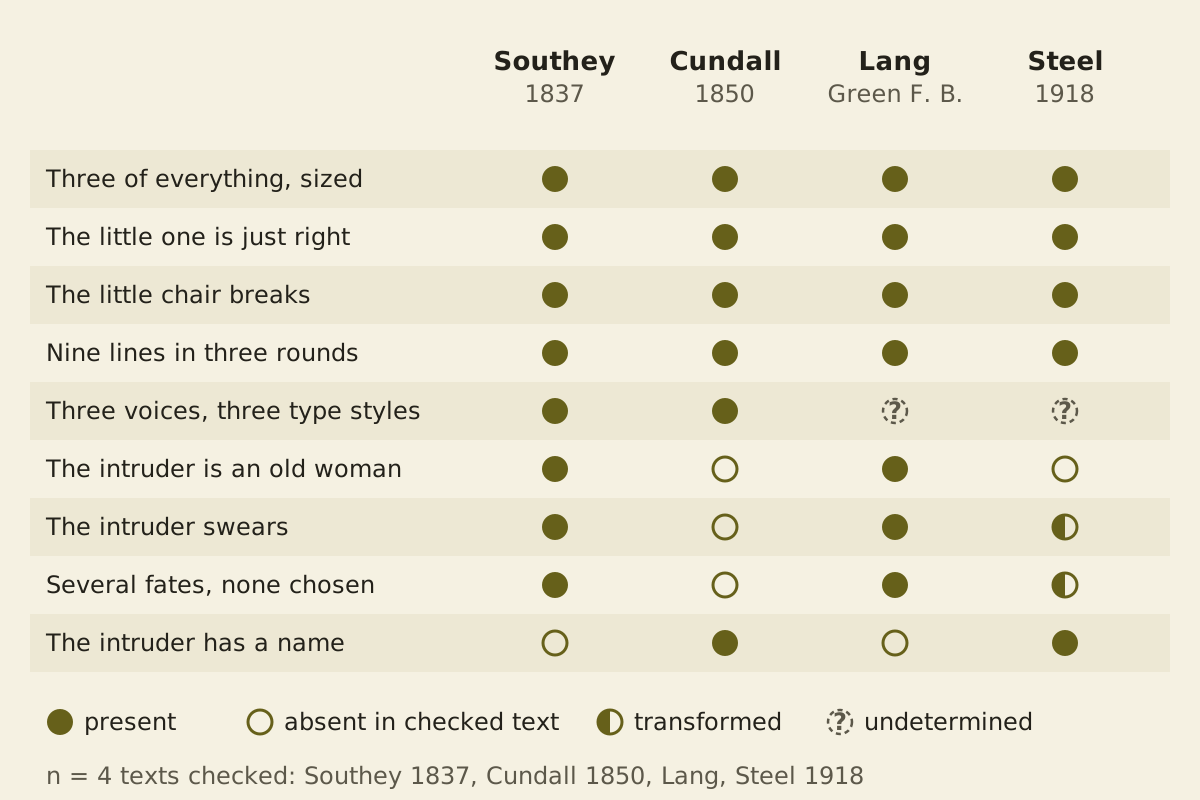
Nine motifs in four tellings; n = 4 texts checked: Southey 1837, Cundall 1850, Lang (Green Fairy Book), Steel 1918.
Credit line for reuse
"Repetition grid: the Three Bears in four tellings, 1837–1918" by Once Upon a Version — https://onceuponaversion.com/craft/goldilocks-three-bears/ — licensed under CC BY 4.0 (https://creativecommons.org/licenses/by/4.0/)
Data: Southey 1837, Cundall 1850, Lang (Green Fairy Book), Steel 1918, retrieved 2026-11-03
The 36 cells, with page or paragraph and short quotations, as CSV (where the data comes from) Data: Southey 1837, Cundall 1850, Lang (Green Fairy Book), Steel 1918, retrieved 2026-11-03
| Motif | Southey 1837 | Cundall 1850 | Lang (Green Fairy Book) | Steel 1918 |
|---|---|---|---|---|
| Three of everything, sized to the bears | present | present | present | present |
| Great, middle, little; the little one is just right | present | present | present | present |
| The little chair breaks | present | present | present | present |
| Nine lines: each bear speaks once in each round | present | present | present | present |
| Three voices printed in three type styles | present | present | undetermined | undetermined |
| The intruder is an old woman | present | absent in checked text | present | absent in checked text |
| The intruder swears | present | absent in checked text | present | transformed |
| Several fates offered, none chosen | present | absent in checked text | present | transformed |
| The intruder has a name | absent in checked text | present | absent in checked text | present |
n = 4 texts checked: Southey, The Doctor, vol. 4 (1837), pp. 318–326; Cundall, A Treasury of Pleasure Books for Young Children (1850); Lang, The Green Fairy Book (Project Gutenberg text); Steel, English Fairy Tales (1918). Of the 36 cells, 26 are present, 6 absent in the checked text, 2 transformed and 2 undetermined. The definitions are a separate download: the nine motif definitions as CSV (where the data comes from) Data: Once Upon a Version, 2026-11-03.
Four motifs are present in all four texts, and all four belong to the counting frame: three sizes, the order ending in “just right,” the broken chair and the nine lines. Every motif in the grid that changes concerns the intruder.
The four texts agree almost completely about furniture, arithmetic and dialogue, and disagree about a single character: her age, name, language and punishment. A reteller who wanted a different moral could leave the counting machinery untouched and change only the person who walks through it. Steel’s two transformed cells follow the definitions exactly: her girl does not swear but is “very cross,” and the list of possible fates survives with one fate replaced.
When did the old woman become a girl?
The first change on record in these texts is Cundall’s, and he explained it himself. Put the two openings side by side and the sentence barely moves.
1837 · Southey, The Doctor, vol. 4
And while they were walking, a little old Woman came to the house. She could not have been a good, honest old Woman
written by Robert Southey · The Doctor, &c., vol. 4, London, 1837, p. 319
1850 · Cundall, A Treasury of Pleasure Books (preface dated 1849)
And while they were walking, a little girl named Silver-hair came to the house.
retold by Joseph Cundall · A Treasury of Pleasure Books for Young Children, London, 1850, The Story of the Three Bears, second page
What changed: Cundall keeps Southey’s sentence and swaps “a little old Woman” for “a little girl named Silver-hair.” He also drops the narrator’s verdict on her honesty.
His preface, signed “J. C.” and dated Kentish Town, November 1849, says he gave Southey’s version “with permission,” only making the intruder a little girl, and goes on to give two reasons for the alteration.
This I did because I found that the tale is better known with Silver-Hair, and because there are so many other stories of old women.
written by Joseph Cundall · A Treasury of Pleasure Books for Young Children, London, 1850, preface, first page
The first reason points to tellings with a girl that were already in circulation, but the preface names none, and this page has not checked any. In this site’s studio terms, Cundall’s book is a new pressing with the lead part sung by someone else. Other parts go quiet with the change: the swearing, the spoon joke and the old woman’s “ugly, dirty head,” which becomes “little Silver-hair’s pretty head.” The ending shrinks to a single line, “away she ran into the wood.”
The change did not sweep every later printing. Lang’s Green Fairy Book prints the old woman, her bad words and all three possible fates, and it closes with the signature “Southey.” The Project Gutenberg text gives no year, but the German union catalogue lists a second edition of 1893, so Lang’s first appeared no later than that. Bolte and Polívka’s notes to the Grimms’ tales (vol. 1, 1913, p. 455) point readers from Southey’s story to Lang’s book.
A Dutch broadsheet printed in Leiden between 1850 and 1881, whose last panel opens this page, goes further in its verses. Its intruder is “een meisje,” and its bears have become a family: “Papa, de groote beer,” “Mama, zijn vrouw” and “de kleine beer, hun kind.” In this site’s rendering, that is a girl, and Papa, the big bear; Mama, his wife; and the little bear, their child. That print is a free retelling in rhyme and is not counted in the grid.
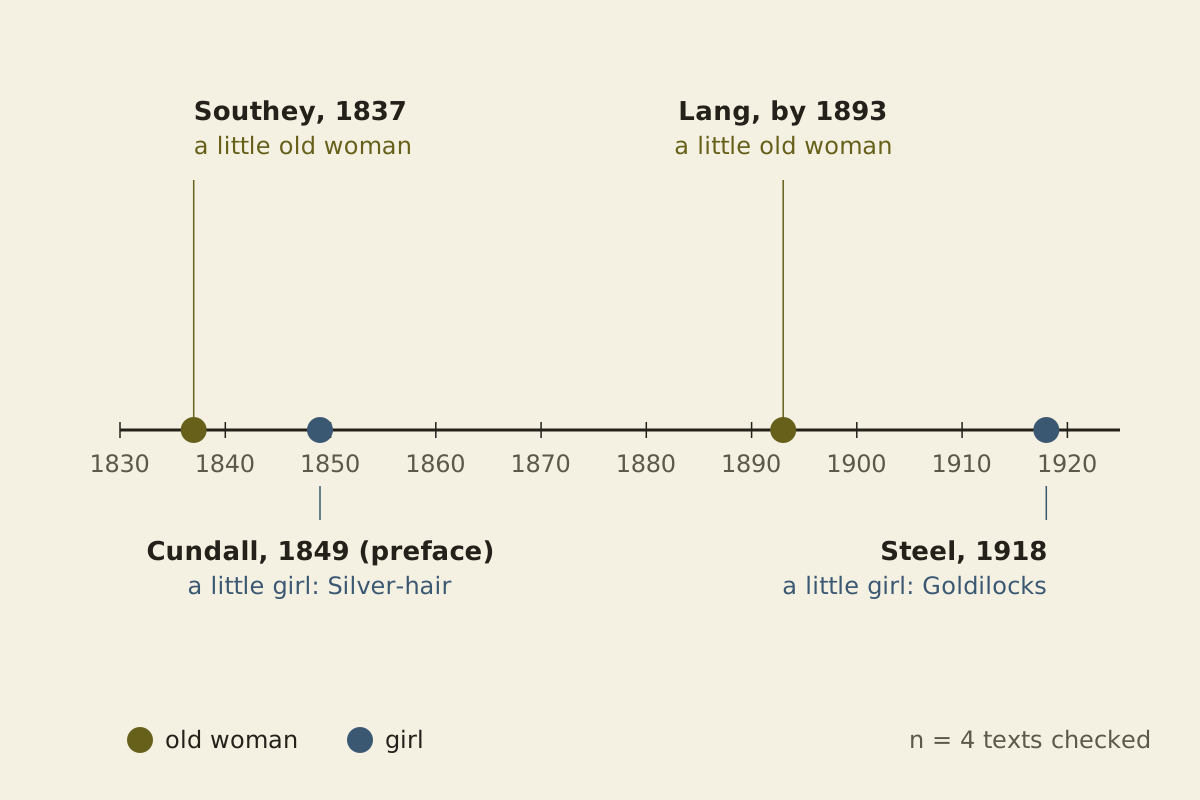
Who comes into the bears’ house, by year; n = 4 texts checked. Lang’s point sits at 1893, the year of a catalogued second edition, the latest possible date for his book.
Credit line for reuse
"The intruder in four tellings of the Three Bears, 1837–1918" by Once Upon a Version — https://onceuponaversion.com/craft/goldilocks-three-bears/ — licensed under CC BY 4.0 (https://creativecommons.org/licenses/by/4.0/)
Data: Southey 1837, Cundall 1850, Lang (Green Fairy Book), Steel 1918; hbz union catalogue; retrieved 2026-11-03
The four tellings, with years and endings, as CSV (where the data comes from) Data: Southey 1837, Cundall 1850, Lang (Green Fairy Book), Steel 1918; hbz union catalogue; retrieved 2026-11-03
| Year | Text | Intruder | Name | How it ends |
|---|---|---|---|---|
| 1837 | Southey 1837 | a little old woman | no name | she jumps from the window; three possible fates, “I cannot tell” |
| 1849 (preface) | Cundall 1850 | a little girl | Silver-hair | she runs into the wood |
| by 1893 | Lang (Green Fairy Book) | a little old woman | no name | Southey’s three fates, “I cannot tell” |
| 1918 | Steel 1918 | a little girl | Goldilocks | three fates, one changed to a whipping for truancy; “no one can say” |
Steel and Rackham, 1918: where does Goldilocks come in?
Of the four texts checked, Steel’s English Fairy Tales, published by Macmillan in 1918 with drawings by Arthur Rackham, is the one that names her Goldilocks. Steel also gives her a home, a mother and an errand.
And while they were away a little girl called Goldilocks, who lived at the other side of the wood and had been sent on an errand by her mother, passed by the house
retold by Flora Annie Steel · English Fairy Tales, London: Macmillan, 1918, The Story of the Three Bears
Steel turns the rudeness into a lesson in a child’s conduct. Her bears are “polite, well-brought-up Bears,” her girl is “not at all a well-brought-up little girl,” and she sits down because she was tired from catching butterflies instead of running her errand. The bears eat from bowls rather than pots, and on the pillow lies “Goldilocks’s yellow head.” Rackham’s drawing for the book follows Steel rather than Southey: a young girl with long hair sits up in the little bed while the smallest bear points at her.
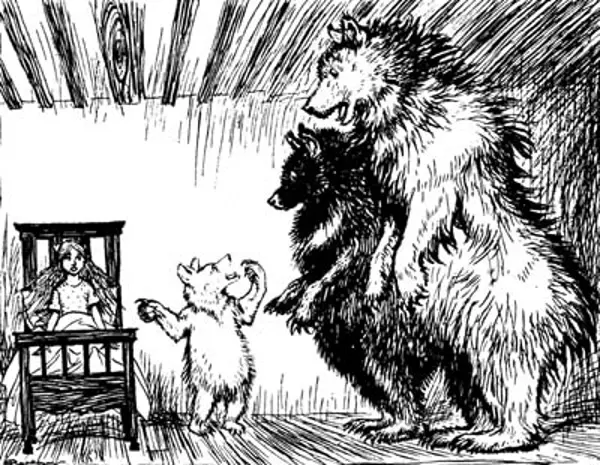
The little bear finds the girl in his bed. Arthur Rackham, English Fairy Tales retold by Flora Annie Steel, 1918.
"The Three Bears, English Fairy Tales by Flora Annie Steel (1918)" by Arthur Rackham — https://commons.wikimedia.org/wiki/File:The3bears-rackham-021.png — Public domain in US (published London 1918); DE/FR (Arthur Rackham d. 1939, life+70)
The ending has the same shape as Southey’s, three fates and an open verdict, but the constable and the House of Correction are gone; in their place, she “got whipped for being a bad girl and playing truant, no one can say.” The vagrant adult of 1837 has become a truant child who might get a whipping.
That does not make 1918 the first use of the name with this tale: this page checked four texts, not the whole printed record. Even the Blue Fairy Book, the first of Lang’s colour books by the Green Fairy Book’s own preface, has a “Pretty Goldilocks,” but she is a princess in a different story.
Southey’s narrator refuses to settle the old woman’s fate. Whether she broke her neck, got lost in the wood or was sent to the House of Correction “for a vagrant as she was, I cannot tell.” Having claimed to know everything else, he leaves this one point open, and in the next chapter he hands the voices to the family reading aloud: the great bear to Papa and Uncle, the little one to Sister, Aunt and Mamma.
Sources
Editions
- [Robert Southey], The Doctor, &c., vol. 4 (London: Longman, Rees, Orme, Brown, Green and Longman, 1837), chapter CXXIX, pp. 312–326, with “The Story of the Three Bears” on pp. 318–326, and the opening of chapter CXXX (p. 327). Published without the author’s name on the title page. Project Gutenberg eBook no. 71981, checked against page scans of the 1837 printing. https://www.gutenberg.org/ebooks/71981 (full text of chapters CXXIX–CXXX; title page and pp. 316–326 also on page scans of the 1837 printing)
- [Joseph Cundall, ed.], A Treasury of Pleasure Books for Young Children, with illustrations by John Absolon and Harrison Weir (London: Grant and Griffith; Joseph Cundall, 1850): preface signed “J. C.,” dated Kentish Town, November 1849 (pp. [v]–vi), and “The Story of the Three Bears.” https://archive.org/details/treasuryofpleasu00cundiala (title page, preface and the Three Bears, from page scans; short quotations only)
- Andrew Lang, ed., The Green Fairy Book (London: Longmans, Green): preface “To the Friendly Reader,” contents and “The Story of the Three Bears,” signed “Southey.” Project Gutenberg eBooks 33571 (from the seventh impression, 1906, with H. J. Ford’s illustrations) and 7277. https://www.gutenberg.org/ebooks/33571 (full text of the preface and of the Three Bears; contents of the 1906 impression)
- Flora Annie Steel, English Fairy Tales, illustrated by Arthur Rackham (London: Macmillan, 1918), “The Story of the Three Bears.” Project Gutenberg eBook no. 17034. https://www.gutenberg.org/ebooks/17034 (full text of the Three Bears and the title page)
- Andrew Lang, ed., The Blue Fairy Book (London and New York: Longmans, Green, 1889). Project Gutenberg eBook 503. https://www.gutenberg.org/ebooks/503 (contents and the source note printed after each tale, with the whole book searched for named sources; full text of “Aladdin and the Wonderful Lamp,” “Beauty and the Beast” and “The Sleeping Beauty in the Wood”; the title and opening of “The Story of Pretty Goldilocks”)
Research
- Johannes Bolte and Jiří Polívka, Anmerkungen zu den Kinder- und Hausmärchen der Brüder Grimm, vol. 1: nos. 1–60 (Leipzig: Dieterich, 1913): foreword (Vorwort, p. V, signed Berlin, November 1912) and the 66 entries. German Wikisource transcription (proofread twice against the page scans). https://de.wikisource.org/wiki/Anmerkungen_zu_den_Kinder-_und_Hausm%C3%A4rchen_der_Br%C3%BCder_Grimm_I (foreword and all 66 entries; every teller’s name and the opening of each entry quoted with its page; the passage on Southey’s Three Bears (p. 455, in the notes to no. 53) paraphrased, not quoted)
Catalogues and databases
- Gemeinsame Normdatei (GND) records via lobid-gnd: Robert Southey (GND 118798146, 1774–1843); Joseph Cundall (GND 172028965, 1818–1895); Andrew Lang (GND 11877865X, 1844–1912); Flora Annie Webster Steel (GND 122129970, 1847–1929); Arthur Rackham (GND 119073498, 1867–1939). https://lobid.org/gnd/118798146 (full entries)
- hbz union catalogue (via lobid resources): Andrew Lang, ed., The Green Fairy Book, “2. ed,” London, 1893; and BnF catalogue général: The Green Fairy Book, 4th edition (London: Longmans, Green, 1895). https://lobid.org/resources/990038242380206441 (catalogue records)
- D. L. Ashliman, Folklore and Mythology Electronic Texts (University of Pittsburgh), index page, with the entry “Beauty and the Beast: folktales of type 425C.” https://sites.pitt.edu/~dash/folktexts.html (index of tale-type pages)
Cite this page
Once Upon a Version. “Goldilocks and the Three Bears: Southey’s Intruder Was Old.” Once Upon a Version. Published 2026-11-05. https://onceuponaversion.com/craft/goldilocks-three-bears/ (accessed day month year).
Write in the date you read the page; the page has no DOI.
More from The Teller's Craft
The Teller's Craft
The Murders in the Rue Morgue: Its Narrator Knows the End
Type detective short story (no tale-type number)
Poe’s narrator tells the Rue Morgue case once it is closed, yet gives its facts in the order he met them. Of 16 facts traced in the 1841 text, Dupin gives 12.
Picture credit
"The Murders in the Rue Morgue, for Edgar Allan Poe’s “Tales of Mystery and the Imagination,” Chicago, 1895-96" by Aubrey Beardsley — https://commons.wikimedia.org/wiki/File:The_Murders_in_the_Rue_Morgue,_for_Edgar_Allan_Poe%E2%80%99s_%E2%80%9CTales_of_Mystery_and_the_Imagination,%E2%80%9D_Chicago,_1895-96_MET_DP-21095-001.jpg — CC0 1.0 (https://creativecommons.org/publicdomain/zero/1.0/)
The Teller's Craft
Arabian Nights: Per Zotenberg, Galland’s Copy Ends Mid-Story
Type frame story, a story that holds other stories (no tale-type number cited)
By Zotenberg’s 1888 account, the copyist of the manuscript Galland translated stopped in night 281, with Scheherazade still telling; her pardon is not in it.
Picture credit
"Stories from the Arabian Nights (1907), colour plate of a rider on a flying horse" by Edmund Dulac — https://commons.wikimedia.org/wiki/File:'As_he_descended,_the_daylight_in_which_hitherto_he_had_been_travelling_faded_from_view.'_(18412346383).jpg — Public domain in US (published London 1907); DE/FR (Edmund Dulac d. 1953, life+70, public domain from 1 January 2024)
The Teller's Craft
The Goose Girl: Of 7 Editions Checked, Iron Stove From 1840
Type ATU 533, as classified by D. L. Ashliman
In the Grimms’ 1815 Goose Girl the princess confides in a tiled stove; in the 1857 text it is an iron one. Seven editions checked, with each repeated line.
Picture credit
"The Goosegirl" by Arthur Rackham — https://commons.wikimedia.org/wiki/File:Snowdrop-Rackham-135.jpg — Public domain in US (published New York: Dutton, 1920, per the Internet Archive record of the scanned copy; the plates first appeared in 1909); DE/FR (Arthur Rackham d. 1939, life+70)