Beauty and the Beast: Two French Tellers, 1740 and 1756
Beauty and the Beast has two named French tellers: Gabrielle-Suzanne de Villeneuve published a book-length version in 1740, and Jeanne-Marie Leprince de Beaumont’s much shorter one of 1756 is told by a governess to her pupils.
By Once Upon a Version
Published
How a version is traced · Version history · Contact · Report an error (contact@onceuponaversion.com)
In short
- The earliest known printing named here is Villeneuve’s, of 1740; in a 1786 reprint her tale runs to about 41,000 French words, and Beaumont’s of 1756 to about 5,500, or about 13 percent.
- Beaumont gives the tale to a fictional governess, Mlle Bonne, who tells it to her pupils in a garden; J. R. Planché wrote in 1858 that Beaumont had only cut Villeneuve’s work down.
- Of nine motifs checked in three texts, three are present in all of them: the rose, the ring that brings Beauty back, and the water that revives the dying Beast.
Telling card
- Tale
- Beauty and the Beast (La Belle et la Bête)
- Type
- ATU 425C, as classified by D. L. Ashliman
- Teller
- Gabrielle-Suzanne de Villeneuve (written, 1740); Jeanne-Marie Leprince de Beaumont (written, 1756), who gives the telling to a governess, Mlle Bonne
- Recorded by
- n/a (written tales; no collecting is recorded)
5 more fields: edited by, told, published, this text, earliest known
- Edited by
- Beaumont’s text is an abridgment of Villeneuve’s, by Planché’s account (1858); English: J. R. Planché (1858); Andrew Lang, The Blue Fairy Book (1889), a shorter retelling credited to Villeneuve
- Told
- n/a (written works); inside Beaumont’s book, Mlle Bonne tells it to her pupils in a garden
- Published
- Villeneuve, La Jeune Amériquaine et les Contes marins (La Haye, 1740, by the BnF record; Paris, 1740–41, by Planché); Beaumont, Magasin des enfans, vol. 1 (London, 1756), pp. 70–102
- This text
- Villeneuve in Le Cabinet des fées, vol. 26 (1786), pp. 33–238, and in Planché’s English (1858); Beaumont, 1756 printing; Lang, 1889
- Earliest known
- Earliest known printing named on this page: Villeneuve’s, of 1740 (La Haye, by the BnF record; Paris, 1740–41, by Planché), not read here; the earliest text read here is the 1756 printing
This card as CSV · where these values come from
Data: BnF catalogue, Villeneuve (1786 reprint), Beaumont 1756, Planché 1858, Lang 1889, Ashliman’s tale-type number and GND via lobid-gnd, retrieved 2026-11-04
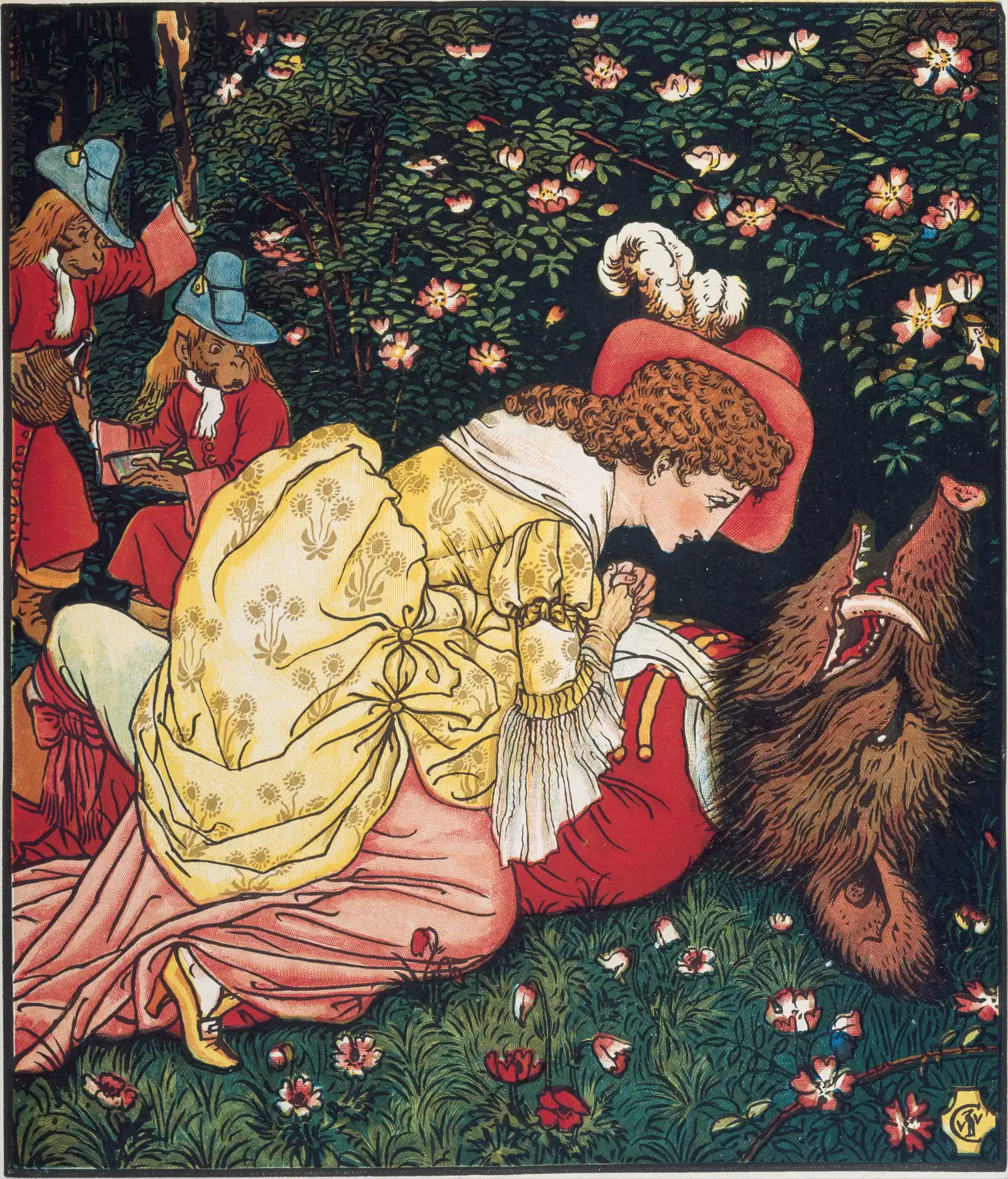
Beauty finds the Beast lying among the roses. Walter Crane, Beauty and the Beast, colour wood engraving, about 1901 edition.
"Beauty and the Beast, book; colour wood engraving, engraved and printed by Edmund Evans (about 1901 edition)" by Walter Crane — https://commons.wikimedia.org/wiki/File:Beauty_and_the_Beast_MET_DT11058.jpg — CC0 1.0 (https://creativecommons.org/publicdomain/zero/1.0/)
After dinner, a governess named Mlle Bonne keeps her promise to tell her pupils a story. She is a character in the fifth dialogue of Jeanne-Marie Leprince de Beaumont’s Magasin des enfans, printed in London in 1756, and the story she tells in the garden is “La Belle & la Bête,” Beauty and the Beast.
She was not the first to tell it in print. Sixteen years earlier, in 1740, Gabrielle-Suzanne de Villeneuve had published a far longer tale under the same title. This page sets the two French tellings side by side, adds two English texts of the nineteenth century, and counts what each one keeps.
Which tellings are compared here?
Three tellings are compared, read in four named public-domain printings. The French is quoted from page scans of old printings, with this site’s English rendering beside it; the English of J. R. Planché and of Andrew Lang’s Blue Fairy Book is quoted from Project Gutenberg texts.
- Villeneuve 1740. “La Belle et la Bête,” first printed in La Jeune Amériquaine et les Contes marins (The Hague, 1740, by the record of the Bibliothèque nationale de France). That first printing has no readable scan for this page, so the French is read in the reprint in Le Cabinet des fées, volume 26 (Geneva and Paris, 1786), pages 33 to 238, and the English in J. R. Planché’s translation of 1858.
- Beaumont 1756. “La Belle & la Bête,” in the first volume of Magasin des enfans (London, 1756), pages 70 to 102, read in a microfilm scan of that printing.
- Lang 1889. “Beauty and the Beast,” in The Blue Fairy Book, edited by Andrew Lang (London, 1889), read in Project Gutenberg’s text.
Each of these is what this site calls a one-evening text: a single printing that can be pinned to a place, a year and a page, not the story itself. None of them is offered here as an “original.” They are the earliest printings this page could read, and the dates below say exactly which ones. Villeneuve’s 1740 printing is the earliest known printing of the tale named on this page, and it is known here only from the BnF record and from Planché.
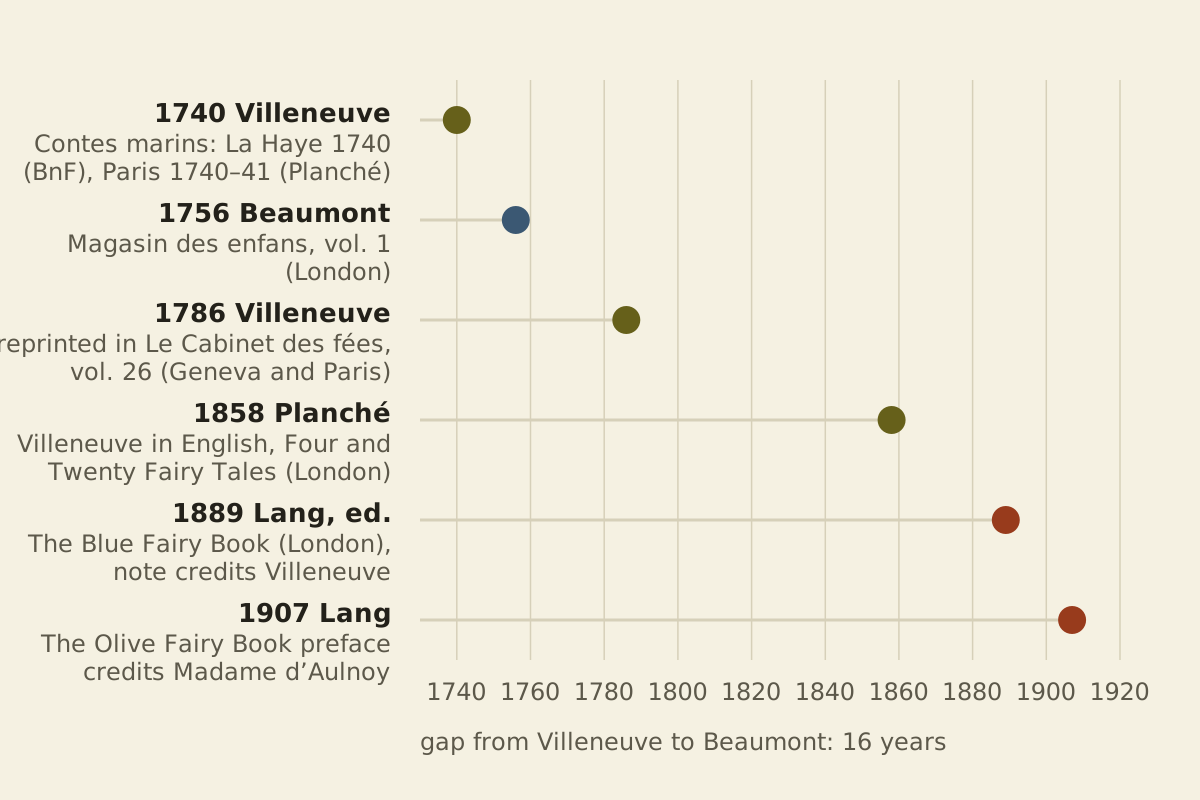
Five printings of the tale and one preface on one line, from Villeneuve’s printing of 1740 to the Lang preface of 1907.
Credit line for reuse
"Five printings of Beauty and the Beast and a 1907 preface, 1740 to 1907" by Once Upon a Version — https://onceuponaversion.com/tellings/beauty-and-the-beast-versions/ — licensed under CC BY 4.0 (https://creativecommons.org/licenses/by/4.0/)
Data: BnF catalogue, Planché 1858, Beaumont 1756, Lang 1889 and 1907 (Project Gutenberg) and the 1786 title page, retrieved 2026-11-04
The three texts, their tellers and printings, as CSV (where the data comes from) Data: Villeneuve (1786 reprint), Planché 1858 (Project Gutenberg 52719), Beaumont 1756 and Lang 1889 (Project Gutenberg 503), retrieved 2026-11-04; BnF catalogue
| Year | Who | Printing |
|---|---|---|
| 1740 | Villeneuve | La Jeune Amériquaine et les Contes marins (La Haye, 1740, by the BnF record; Paris, 1740–41, by Planché) |
| 1756 | Beaumont | Magasin des enfans, vol. 1 (London) |
| 1786 | Villeneuve | reprinted in Le Cabinet des fées, vol. 26 (Geneva and Paris) |
| 1858 | Planché | Villeneuve in English, Four and Twenty Fairy Tales (London) |
| 1889 | Lang, ed. | The Blue Fairy Book (London), note credits Villeneuve |
| 1907 | Lang | The Olive Fairy Book preface credits Madame d’Aulnoy |
The two French printings are 16 years apart; the Geneva reprint came 46 years after Villeneuve’s first printing, and Lang’s English 149 years after it. Both tellers are dated by the national authority file of German libraries: Villeneuve lived from 1695 to 1755 and Beaumont from 1711 to 1780.
In the international index of folktale types, a catalogue that gives a number to each plot found in many tellings, this tale is ATU 425C, as classified by D. L. Ashliman, whose list of folktexts under that number includes both Beaumont’s and Villeneuve’s versions. The number groups similar plots for comparison; it does not say that one text was copied from another, and this page uses it only as an identification.
Who were the two tellers?
Very little is known about Villeneuve, and Planché said so in 1858. His note gives her as Gabrielle Susanne Barbot, “daughter of a gentleman of Rochelle,” the widow of a lieutenant-colonel of infantry, Monsieur de Gallon, Seigneur de Villeneuve, and says she died in Paris in the house of the playwright Crébillon on 29 December 1755. “Such is the sum of the information afforded us by editors and biographers,” he adds. The German authority file gives the same day of death and a birth date of 28 November 1695.
Planché knew more about Beaumont. By his account she was born at Rouen in 1711, began writing in 1748, came to England, and lived for a long time in London as a governess, writing books both to teach and to amuse the young. She married twice, returned to France in 1762 and died in 1780, and her works, he says, filled seventy volumes. The one that sold best was Le Magazin des Enfans, “in which appeared her abridgment of Beauty and the Beast.”
So the two tellers wrote for different settings. Villeneuve’s tale came out in a book of tales in several parts, and Beaumont’s came out in a schoolbook, inside a lesson. Neither of the printings read here records a living teller who told either woman the tale, and the sources checked here name no collector or informant for either tale: both are presented as written works.
Who tells the tale in Beaumont’s 1756 book?
Magasin des enfans is a book of dialogues. Its title page calls them conversations between a wise governess and several of her pupils, and the tales come inside those conversations. On page 70 a pupil, Lady Charlotte, reminds the governess that she promised them a pretty tale, and Mlle Bonne gives way.
Quand vous êtes bonnes filles, je n’ai pas le courage de vous rien refuser: allons donc nous asseoir dans le jardin, & je vous dirai le conte que je vous ai promis la derniére fois.
written by Jeanne-Marie Leprince de Beaumont · Magasin des enfans, vol. 1, London, 1756, p. 70
In this site’s rendering: she has no heart to refuse good girls anything, so they will sit in the garden and she will tell the tale she promised last time. The heading “La Belle & la Bête. Conte.” follows on the same page, and the first words of the tale are “Il y avoit une fois un marchand” (there was once a merchant).
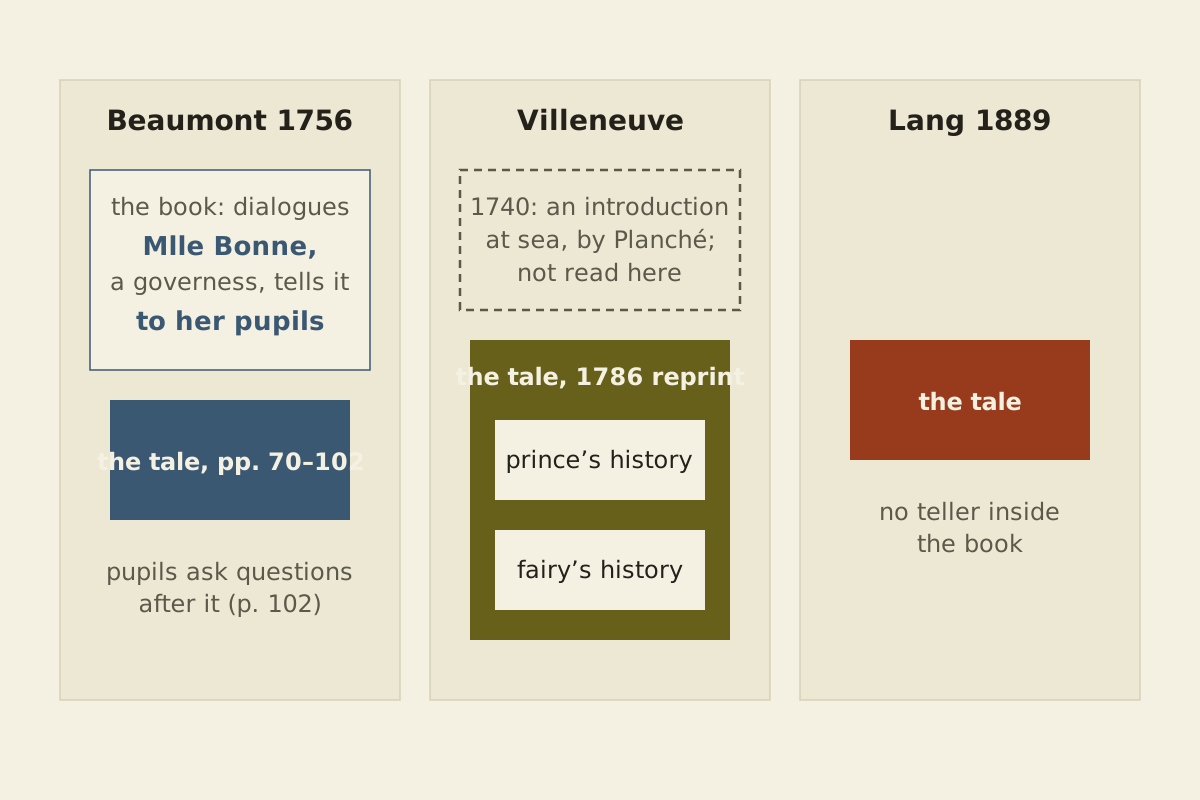
Who tells the tale inside each book. The dashed box marks a frame described by others and not read here.
Credit line for reuse
"Who tells Beauty and the Beast inside each book" by Once Upon a Version — https://onceuponaversion.com/tellings/beauty-and-the-beast-versions/ — licensed under CC BY 4.0 (https://creativecommons.org/licenses/by/4.0/)
Data: Villeneuve (1786 reprint), Planché 1858 (Project Gutenberg 52719), Beaumont 1756 and Lang 1889 (Project Gutenberg 503), retrieved 2026-11-04
The frame does not stop when the tale does. On page 102, after the prince has married Beauty and her sisters have been turned to stone, Lady Charlotte asks whether the sisters stayed statues for ever, and Mlle Bonne answers that they did, because their hearts stayed wicked. Another pupil, Lady Spirituelle, then says she loves Beauty madly but would not have married the Beast, “elle étoit trop horrible” (it was too horrible).
J’aime cette Belle à la folie; mais il me semble, si j’avois été à sa place, que je n’aurois pas voulu épouser la bête; elle étoit trop horrible.
written by Jeanne-Marie Leprince de Beaumont · Magasin des enfans, vol. 1, London, 1756, p. 102
Beaumont’s book gives the tale a teller, an audience and a reply. All three are invented, but the setting is specific: a governess, a group of pupils with English titles, and a garden after dinner. Beaumont herself, by Planché’s account, was a governess in London.
What did Villeneuve print in 1740?
Villeneuve’s first printing is known on this page only from two descriptions, and they do not agree on every detail. The catalogue of the Bibliothèque nationale de France records La Jeune Amériquaine et les Contes marins, “par Mme de ***,” published at The Hague “aux dépens de la Compagnie” in 1740, two parts in one volume. The record adds that the library’s copy “ne contient que le texte de ‘La Belle et la Bête’, précédé d’une introduction” (contains only the text of Beauty and the Beast, preceded by an introduction).
Planché, writing in 1858, gives a different place and a frame. In a footnote he says the Contes marins were “So called from being supposed to be narrated on board a ship bound to St. Domingo. 4 vols. 12mo. Paris, 1740-41.” Neither the ship nor the introduction can be checked here, because the 1740 printing was not read.
The BnF record also notes that the work is by Madame de Villeneuve but has sometimes been attributed to Madame de Lintot; this page reports that note and does not take it further.
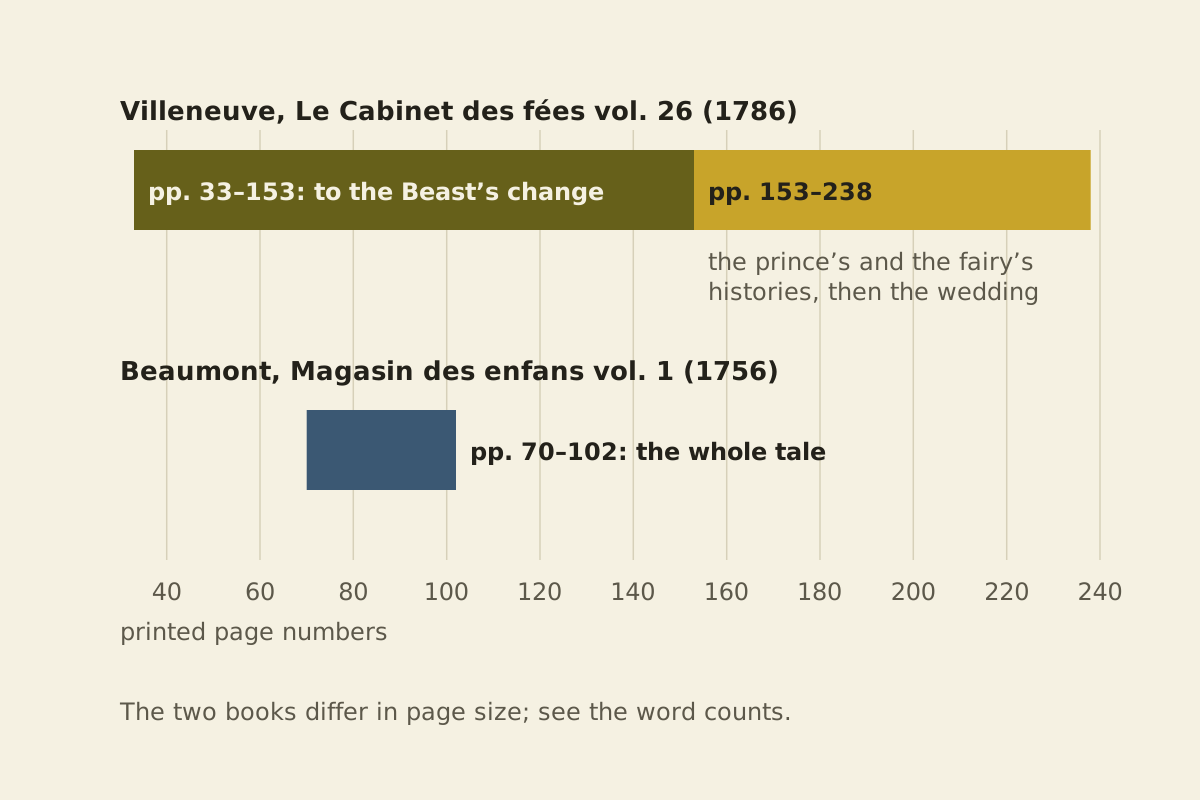
Where the pages go in the two French printings read here. Page sizes differ, so the word counts below are the fairer measure.
Credit line for reuse
"Where the pages go: Villeneuve 1786 and Beaumont 1756" by Once Upon a Version — https://onceuponaversion.com/tellings/beauty-and-the-beast-versions/ — licensed under CC BY 4.0 (https://creativecommons.org/licenses/by/4.0/)
Data: Villeneuve (1786 reprint) and Beaumont 1756, page scans, retrieved 2026-11-04
What can be read is the 1786 reprint in Le Cabinet des fées, a large collection of French fairy tales. There the tale has no frame at all. A half-title reads “Par Madame de Villeneuve,” and on page 33 the tale opens straight away in a far-off country with a rich merchant. The volume’s table of contents lists two items under her name, the history of Beauty and the Beast and the history of the Beast.
The second item is the reason the tale is so long. By page 153 the Beast has already turned back into a prince, and Beauty asks him by what misfortune he had been so cruelly changed into a beast. He answers at length.
In Planché’s English the prince “commenced his narrative in the following words,” under the heading “The Story of the Beast,” and after him a fairy gives an equally long account of Beauty’s own birth. The tale ends on page 238, with the story written into the archives of the kingdom and of the Happy Island.
| Printing | Pages | What they hold |
|---|---|---|
| Villeneuve, 1786 reprint | 33–153 | Beauty’s story, to the Beast’s change |
| Villeneuve, 1786 reprint | 153–238 | the prince’s and the fairy’s histories, and the wedding |
| Beaumont 1756 | 70–102 | the whole tale, told by Mlle Bonne |
How long is each telling?
Page counts mislead, because the two French books are printed on different page sizes. Words are a better measure, so each text was counted, and each French count was made two ways. The first way counts the word tokens in the text layer of the scan over the tale’s pages. The second multiplies the number of pages by the words on full pages copied from the page images (page 95 for Villeneuve; pages 71 and 90 for Beaumont).
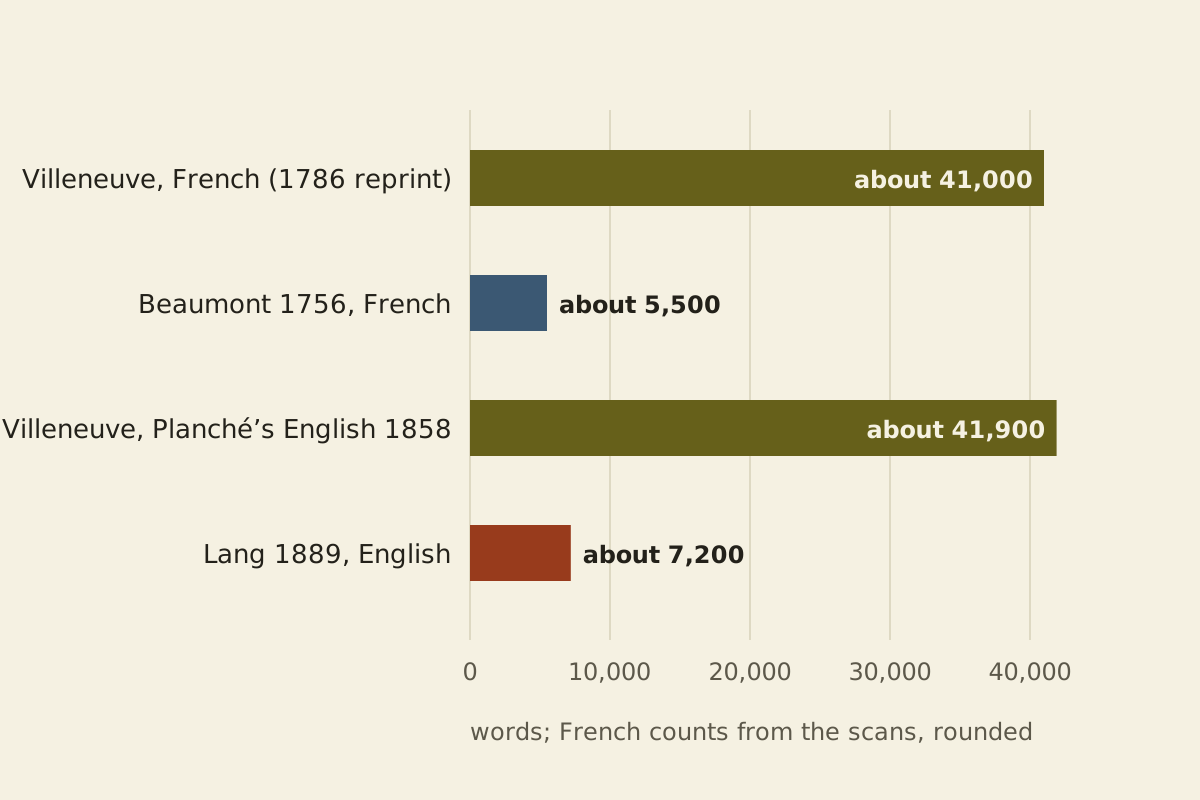
Length of four texts in words. The French counts are rounded from two methods that agree within 1.3 percent.
Credit line for reuse
"Length of four Beauty and the Beast texts, in words" by Once Upon a Version — https://onceuponaversion.com/tellings/beauty-and-the-beast-versions/ — licensed under CC BY 4.0 (https://creativecommons.org/licenses/by/4.0/)
Data: Villeneuve (1786 reprint), Planché 1858 (Project Gutenberg 52719), Beaumont 1756 and Lang 1889 (Project Gutenberg 503), retrieved 2026-11-04
Word counts with both methods, as CSV (where the data comes from) Data: Villeneuve (1786 reprint), Planché 1858 (Project Gutenberg 52719), Beaumont 1756 and Lang 1889 (Project Gutenberg 503), retrieved 2026-11-04
| Text | Language | Pages | Words (about) |
|---|---|---|---|
| Villeneuve 1740, as reprinted in Le Cabinet des fées vol. 26 (1786) | French | 33–238 | 41,000 |
| Beaumont 1756, Magasin des enfans vol. 1 | French | 70–102 | 5,500 |
| Villeneuve in J. R. Planché’s English, 1858 | English | 225–328 | 41,900 |
| Lang, The Blue Fairy Book, 1889 | English | n/a | 7,200 |
The two methods give 40,726 and 41,200 words for Villeneuve, and 5,532 and 5,462 for Beaumont. Method by method, that puts Beaumont’s French at 13.6 and 13.3 percent of Villeneuve’s, a little more than one word in eight. Planché’s English, which he says leaves out only a dozen lines, comes to 41,894 words, close to the French count. Lang’s English has 7,162 words, about 17 percent of Planché’s.
These counts describe the scans and texts named in the table, not every edition. The scan counts include stray marks and miss a few words, so the page shows rounded figures. In this site’s studio terms, the 1786 volume and Planché’s book are two pressings of Villeneuve’s long take, and Beaumont’s is a different take altogether.
Why does Beauty ask for a rose?
All three tellings send the merchant away on business, and all three let the youngest daughter ask for a single rose while her sisters ask for ornaments and dresses.
In Planché’s English of Villeneuve, Beauty first asks only to see her father come home safe. When he presses her, she says she loves the rose “passionately” and has not seen one since the family moved to the country, and the narrator explains that she asked “to obey her father, and at the same time to avoid putting him to any expense for her.”
Beaumont’s Beauty first asks for nothing at all, because she thinks the whole cargo would not buy what her sisters want. When her father presses her, she asks for a rose because none grows where they live.
The narrator then says, on page 76, that Beauty did not really care about a rose; she asked so that her sisters could not say she refused a present to make herself look better than them. Lang follows Villeneuve here: his Beauty asks only to see her father home safely, and names a rose when he insists.
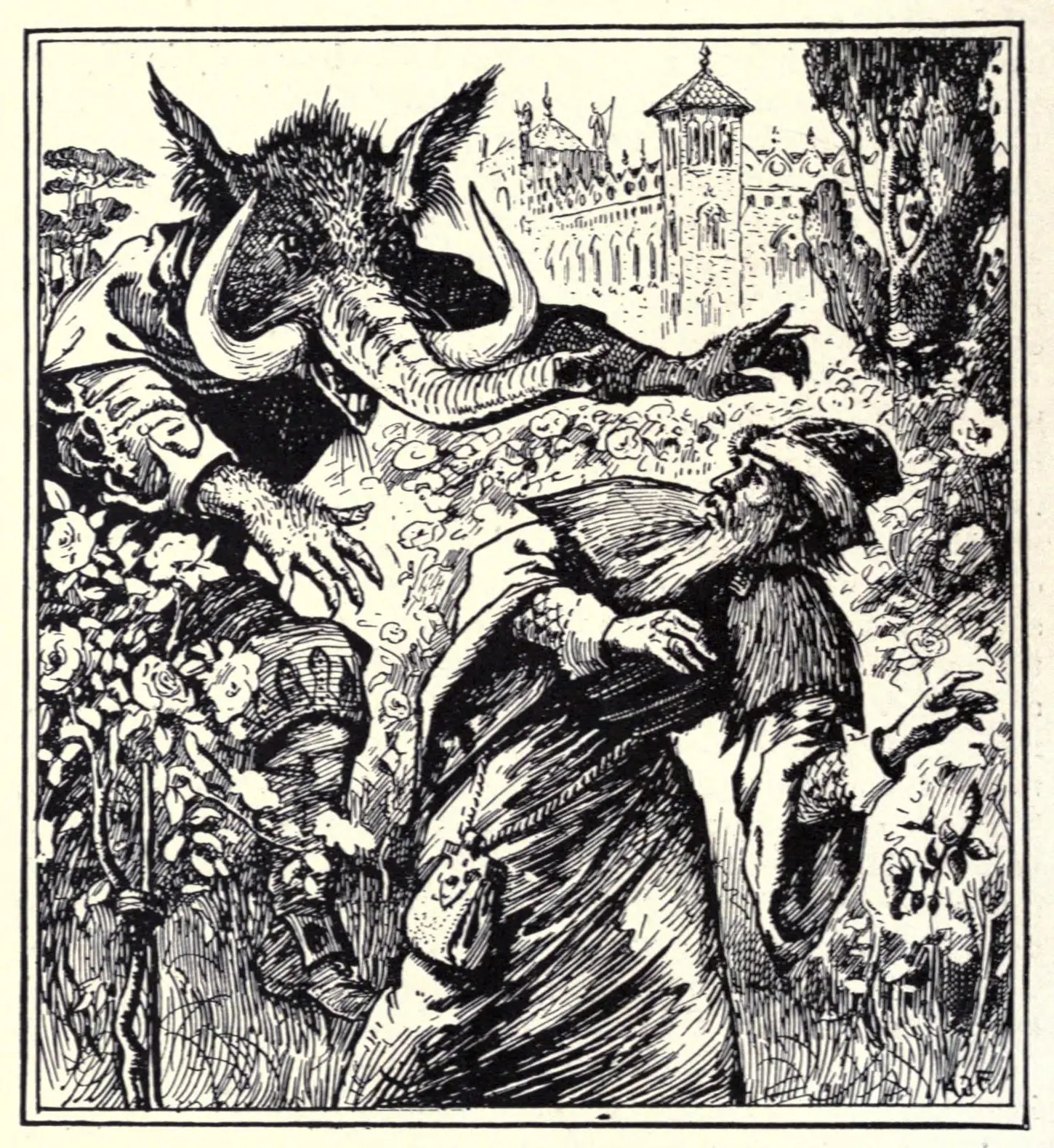
The Beast catches the merchant gathering roses. H. J. Ford, The Blue Fairy Book, 1889, p. 104.
Full credit
"The Blue Fairy Book (1889), p. 104: plate to “Beauty and the Beast”" by H. J. Ford — https://commons.wikimedia.org/wiki/File:The_Blue_Fairy_Book-0138.jpg — Public domain in US (published London and New York 1889); DE/FR (Henry Justice Ford d. 1941, life+70, public domain from 1 January 2012); modified: Cropped to the plate and its ruled frame with a strip of paper around it; the page text above and below is left out
The scene in the garden then runs much the same way in all three. The merchant has lost his way in a forest, finds an empty palace that feeds and shelters him, and picks a rose on his way out. In Villeneuve’s English the Beast roars, “Who gave thee permission to gather my roses?”; Lang’s Beast asks, “Who told you that you might gather my roses?” Beaumont’s Beast accuses him of stealing his roses a few pages later, after the merchant has eaten and slept in the empty palace.
What fills the Beast’s palace?
The palace is where the long and short tellings differ most in texture. Villeneuve fills it with things to do. Beauty finds a room of mirrors, a library, an aviary of talking parrots and a troop of monkeys who serve as her courtiers and act tragedies with the parrots supplying the voices. One room has windows that show, by a trick of reflection, the stage of the finest city in the world.
renvoyoit de dessus le théâtre de la plus belle ville du monde. C’est le chef-d’œuvre de l’optique de faire reverbérer de si loin.
written by Gabrielle-Suzanne de Villeneuve · Le Cabinet des fées, vol. 26, Genève and Paris, 1786, p. 94
In this site’s rendering, the glass sent back the image from the theatre of the most beautiful city in the world, a masterpiece of optics to reflect from so far. Lang keeps a version of this: eight windows in an empty room, each showing a new entertainment, and parrots and cockatoos that greet Beauty by name, but no monkeys.
Beaumont keeps a shorter list. Her Beauty finds a door marked as her own apartment, a large library, music, a book in gold letters telling her to wish and command, and a mirror in which she sees her father arriving home, on pages 87 to 89.
What does the Beast ask each evening?
Both French Beasts ask Beauty the same question night after night, and her refusals give each tale its rhythm. But the two Beasts are not asking the same thing. Put the two French printings next to Planché’s English and the difference is plain.
Villeneuve · Cabinet des fées reprint, 1786, p. 94
ce fut la question ordinaire; & le, voulez-vous que je couche avec vous, fit cesser sa bonne humeur.
written by Gabrielle-Suzanne de Villeneuve · Le Cabinet des fées, vol. 26, Genève and Paris, 1786, p. 94
Planché · Four and Twenty Fairy Tales, 1858
what she did not smile at was the usual question, and the words, “Will you marry me?” put an end to her good humour.
translated by J. R. Planché · Four and Twenty Fairy Tales, London, 1858, The Beauty and the Beast
Beaumont · Magasin des enfans, 1756, p. 90
lorsqu’il lui dit: la Belle, voulez-vous être ma femme?
written by Jeanne-Marie Leprince de Beaumont · Magasin des enfans, vol. 1, London, 1756, p. 90
What changed: In the 1786 French the Beast asks to sleep with her; in Planché’s English and in Beaumont he asks her to marry him.
In this site’s rendering, the French of page 94 says that what spoiled her good humour was the usual question, whether he might sleep with her, and that she got off by answering no. On the next page Beauty repeats it to herself: “La demande qu’il me fait à chaque fois, si je veux coucher avec lui” (the request he makes each time, whether she will sleep with him, in this site’s rendering of her words).
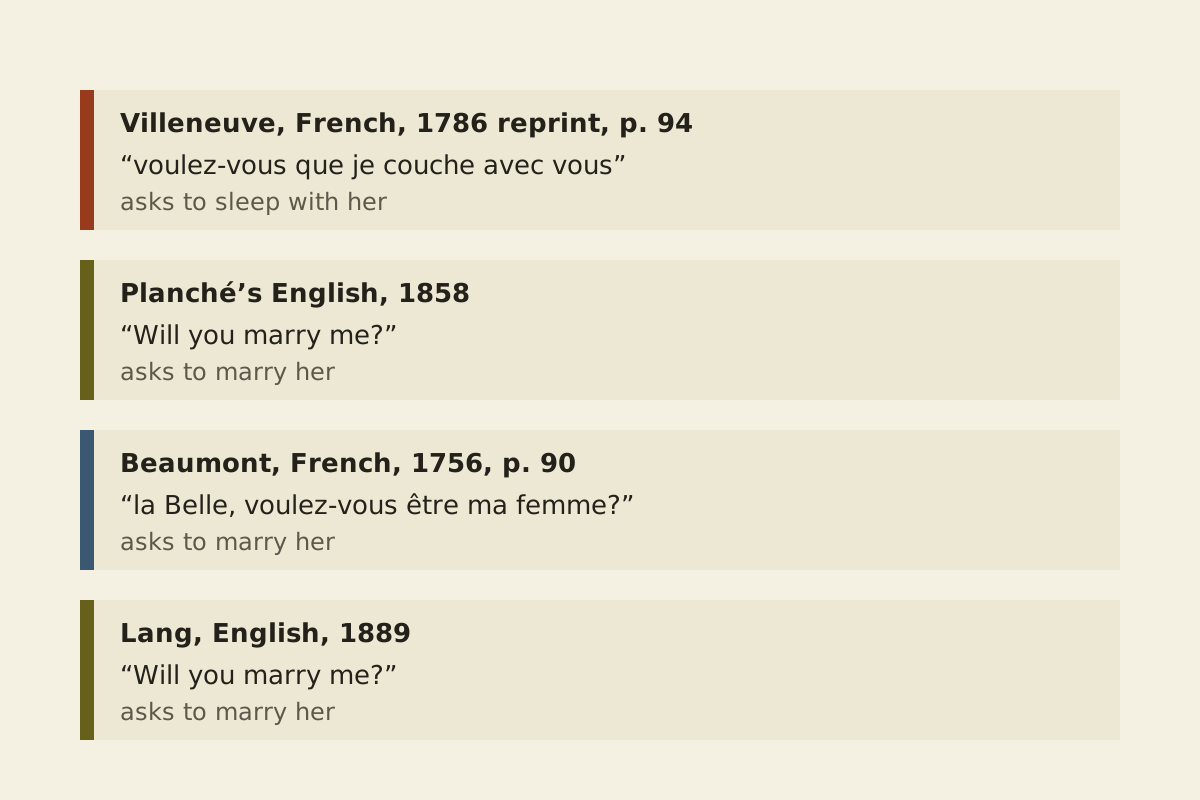
The evening question in four texts, with page numbers where the printing has them.
Credit line for reuse
"What the Beast asks each evening, in four texts" by Once Upon a Version — https://onceuponaversion.com/tellings/beauty-and-the-beast-versions/ — licensed under CC BY 4.0 (https://creativecommons.org/licenses/by/4.0/)
Data: Villeneuve (1786 reprint), Planché 1858 (Project Gutenberg 52719), Beaumont 1756 and Lang 1889 (Project Gutenberg 503), retrieved 2026-11-04
Planché tells his readers that he changed very little. His note says: “I have omitted a dozen lines, and softened one objectionable expression.” He does not say which expression he softened. The Beast’s question is one place where his English and the 1786 French differ in exactly this way, but the note alone cannot show that it is the place he meant.
Beaumont’s Beast asks a plainer question in plainer words, and her Beauty answers it differently too. On pages 90 and 91 she nearly dies of fright and then says no, but she has already told him she likes him, as he looks, better than men who hide a false heart behind a human face. The two French tellings agree that the question returns each evening; they disagree about what is being asked.
| Text | What the Beast asks | Where |
|---|---|---|
| Villeneuve, French | to sleep with her | 1786 reprint, p. 94 |
| Planché, English | to marry her | 1858, same scene |
| Beaumont, French | to marry her | 1756, p. 90 |
| Lang, English | to marry her | Blue Fairy Book, the Beast’s first evening visit |
Was Beaumont’s text a cut of Villeneuve’s?
Nothing in Beaumont’s own pages says where her tale came from. On pages 70 to 102 she names no other writer, and the frame presents the story simply as one the governess promised. The claim that she shortened Villeneuve comes from Planché, who made it in the note to his 1858 translation.
It is only those who have read the original story by Madame de Villeneuve, either in the Contes Marins, or in the Cabinet des Fées, who will not be surprised to find that Madame de Beaumont has merely the merit of having cut this admirable work down to the smallest comprehensible dimensions, and made a pretty little nursery tale of one of the most ingeniously constructed stories in the whole catalogue of fairy chronicles.
written by J. R. Planché · Four and Twenty Fairy Tales, London, 1858, note on The Beauty and the Beast
Planché’s “original story” is his phrase for Villeneuve’s printing; this page keeps the dates instead. He goes on to say what was lost: “The story of the Beast is but alluded to in a few words, and that of the real parents of Beauty altogether omitted.” He asks that Beaumont’s text never be printed without saying it is “simply an abridgment of her composition, adapted to the use of juvenile readers, by Madame de Beaumont.”
The two French printings bear out the parts of his account that can be counted. Beaumont gives the curse a single sentence on page 100, where the prince says a wicked fairy had condemned him to stay in that shape until a beautiful girl agreed to marry him.
Une méchante fée m’avoit condamné à rester sous cette figure, jusqu’à ce qu’une belle fille consentît à m’épouser
written by Jeanne-Marie Leprince de Beaumont · Magasin des enfans, vol. 1, London, 1756, p. 100
Villeneuve gives the same matter the prince’s long history, and Beauty’s parentage the fairy’s. Beaumont’s family is also smaller. Her merchant has six children, “trois garçons & trois filles” (three boys and three girls), on pages 70 and 71; Villeneuve’s has twelve, “six boys and six girls” in Planché’s English.
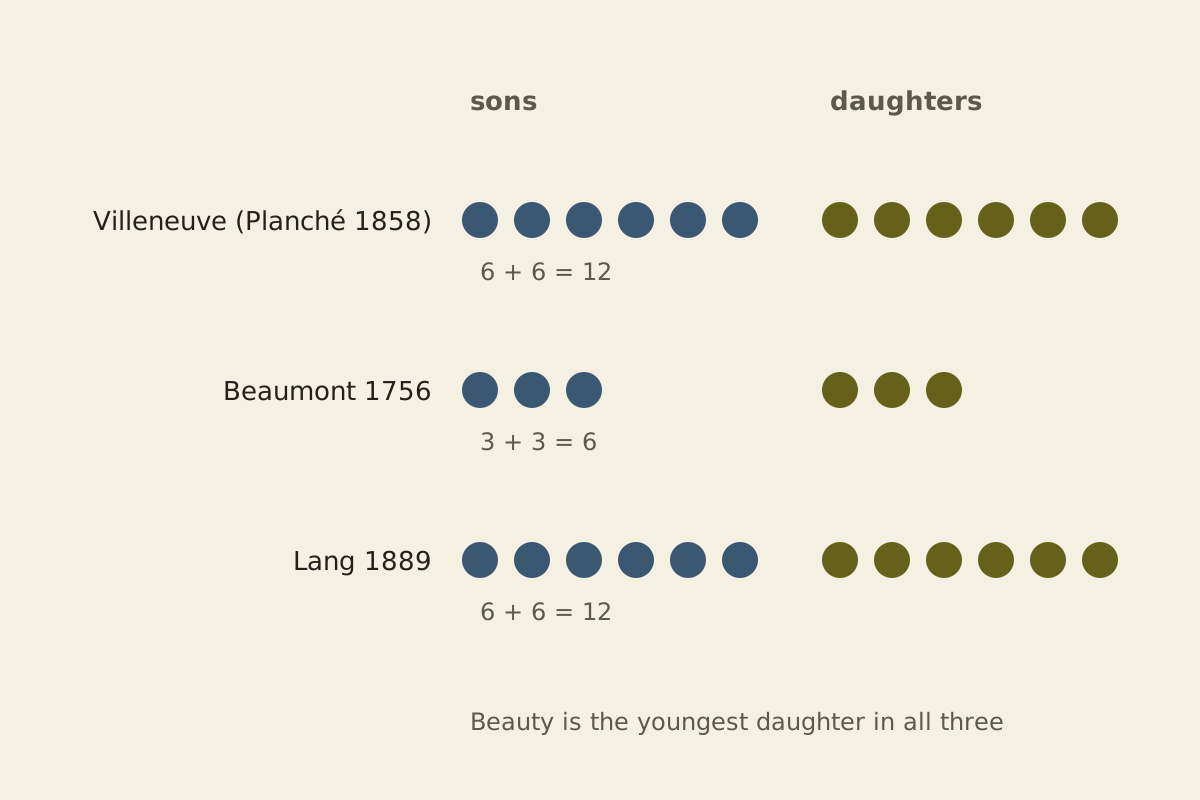
The merchant’s children in three tellings. Beauty is the youngest daughter in each.
Credit line for reuse
"The merchant’s children in three tellings of Beauty and the Beast" by Once Upon a Version — https://onceuponaversion.com/tellings/beauty-and-the-beast-versions/ — licensed under CC BY 4.0 (https://creativecommons.org/licenses/by/4.0/)
Data: Planché 1858 (Project Gutenberg 52719), Beaumont 1756 and Lang 1889 (Project Gutenberg 503), retrieved 2026-11-04
| Text | Sons | Daughters |
|---|---|---|
| Villeneuve (Planché 1858) | 6 | 6 |
| Beaumont 1756 | 3 | 3 |
| Lang 1889 | 6 | 6 |
The children, the evening question and the frames, as CSV (where the data comes from) Data: Villeneuve (1786 reprint), Planché 1858 (Project Gutenberg 52719), Beaumont 1756 and Lang 1889 (Project Gutenberg 503), retrieved 2026-11-04
Planché also explains, in his preface, why he translated the long text at all. He says that, apart from Beaumont’s tales, few if any of the stories in his volume had “ever been placed in their integrity before the English reader.” By his account, then, English readers already had Beaumont’s short tale in 1858, and his book set out to give them Villeneuve’s whole one.
What the page cannot settle is how Beaumont worked. Planché was writing a century later and gives no source for his judgment beyond the two texts themselves. A shorter telling with the same opening and the same rose is similar to the longer one, and Planché read the similarity as abridgment; this page reports that reading as his.
Lang’s English, 1889
Andrew Lang’s Blue Fairy Book of 1889 printed a third telling, in English and for children, and it follows Villeneuve rather than Beaumont. Its merchant has “six sons and six daughters,” its Beauty dreams of a prince, and the note printed after it reads “La Belle et la Bete. Par Madame de Villeneuve.” The preface of the book does not name who made this English version; the survey of Lang’s Fairy Books and the retellers his prefaces credit sets out what those prefaces do say.
The same editor reprinted other writers’ tales under their names in later volumes, among them Southey’s Three Bears, which the Green Fairy Book prints under Southey’s name.
Lang’s Beast is Villeneuve’s, as the note says, minus the histories. He asks “Beauty, will you marry me?” each evening. When Beauty finally says yes, the Beast changes, a fairy and a queen arrive in a chariot, and the queen thanks Beauty for “having restored my dear son to his natural form.” No one explains the enchantment or reveals that Beauty was born a princess.
At 7,162 words, Lang’s English is longer than Beaumont’s French but shorter than either Villeneuve text by more than 33,000 words. It has details that Beaumont’s text lacks, such as the twelve children and the dreams, and, like Beaumont’s, neither of the two histories.
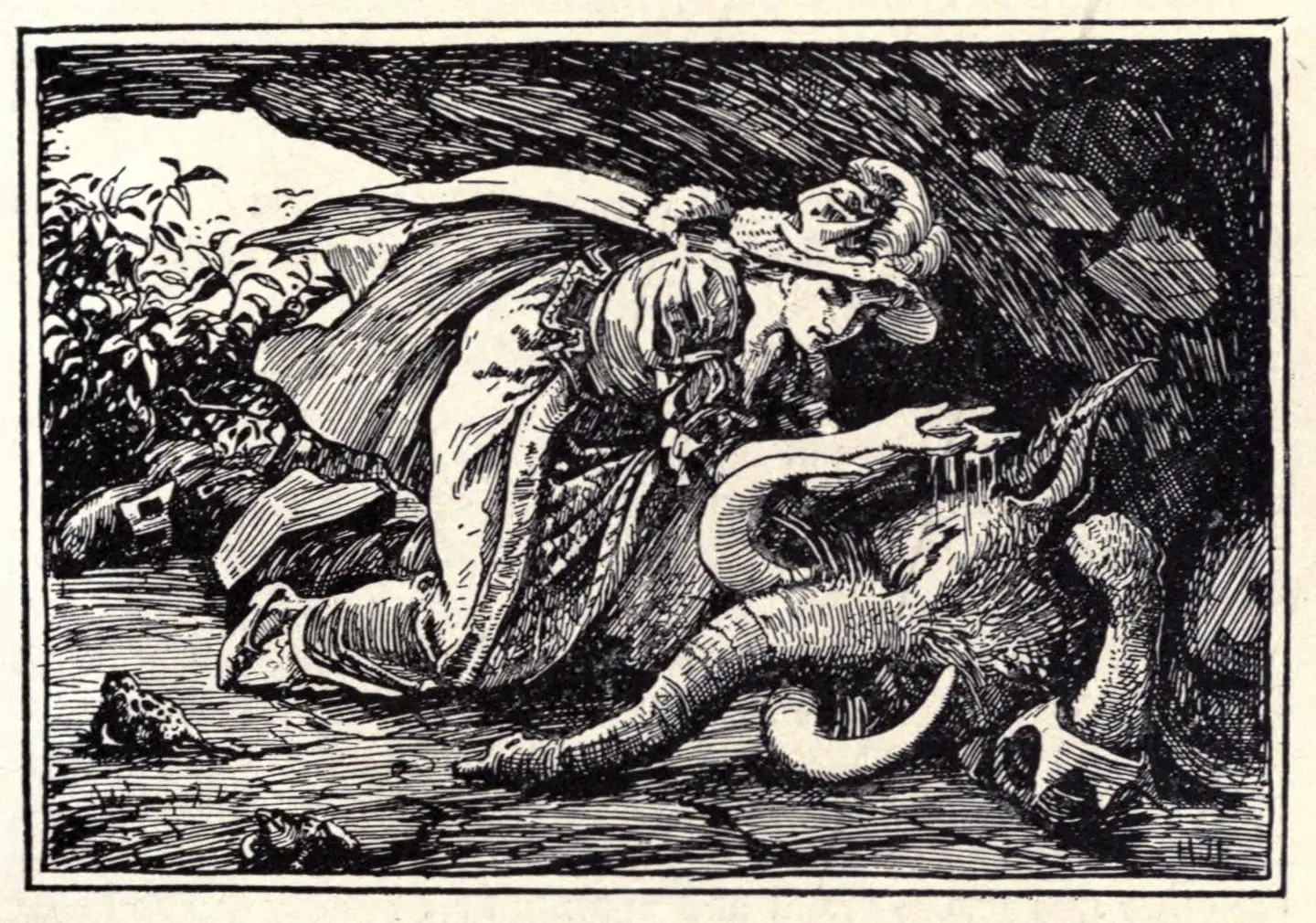
Beauty finds the Beast lying in the cave. H. J. Ford, The Blue Fairy Book, 1889, p. 117.
Full credit
"The Blue Fairy Book (1889), p. 117: plate to “Beauty and the Beast”" by H. J. Ford — https://commons.wikimedia.org/wiki/File:The_Blue_Fairy_Book-0151.jpg — Public domain in US (published London and New York 1889); DE/FR (Henry Justice Ford d. 1941, life+70, public domain from 1 January 2012); modified: Cropped to the plate and its ruled frame with a strip of paper around it; the page text above and below is left out
Lang’s own books do not agree. In the preface to The Olive Fairy Book of 1907 he wrote of Madame d’Aulnoy: “To her we owe Beauty and the Beast and The Yellow Dwarf.” The 1889 note and the 1907 preface are both his books, and they name different authors for the same tale.
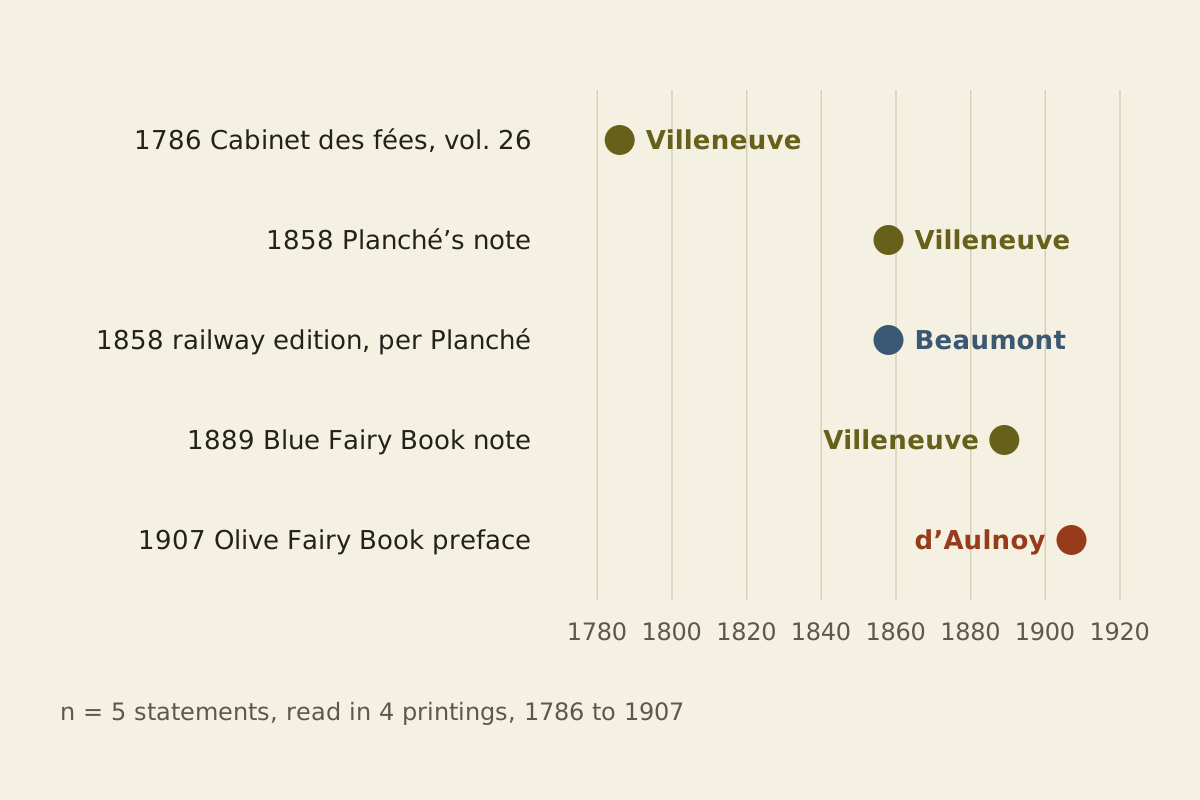
Whom later printings name as the tale’s author; n = 5 statements, read in 4 printings (one is Planché’s report of another edition).
Credit line for reuse
"Whom later printings name as the author of Beauty and the Beast" by Once Upon a Version — https://onceuponaversion.com/tellings/beauty-and-the-beast-versions/ — licensed under CC BY 4.0 (https://creativecommons.org/licenses/by/4.0/)
Data: Le Cabinet des fées (1786), Planché 1858, Lang 1889 and 1907 (Project Gutenberg), retrieved 2026-11-04
The five statements, with their wording, as CSV (where the data comes from) Data: Le Cabinet des fées (1786), Planché 1858, Lang 1889 and 1907 (Project Gutenberg), retrieved 2026-11-04
| Year | Printing | Names as author |
|---|---|---|
| 1786 | Le Cabinet des fées, vol. 26 | Villeneuve |
| 1858 | Planché, Four and Twenty Fairy Tales | Villeneuve |
| 1858 | a French Railway Library edition, as reported by Planché in 1858 (its own date unrecorded) | Beaumont |
| 1889 | Lang, The Blue Fairy Book | Villeneuve |
| 1907 | Lang, The Olive Fairy Book | d’Aulnoy |
Planché had already seen the credit move. He wrote that “La Belle et la Bête, par Madame Leprince de Beaumont,” was then circulating, without a word of explanation, as part of the French Railway Library. This page has not seen that edition and reports it as Planché’s statement. Of the five statements, three name Villeneuve, one Beaumont and one d’Aulnoy; this page does not choose among them.
Motif grid: what three tellings keep
Each motif was defined before any cell was filled, with what counts as present and which specific changes count as transformed. A cell marked absent means only that the checked text does not contain the motif. The Villeneuve column is read in the 1786 reprint and in Planché’s English; where the two differ, the cell says so.
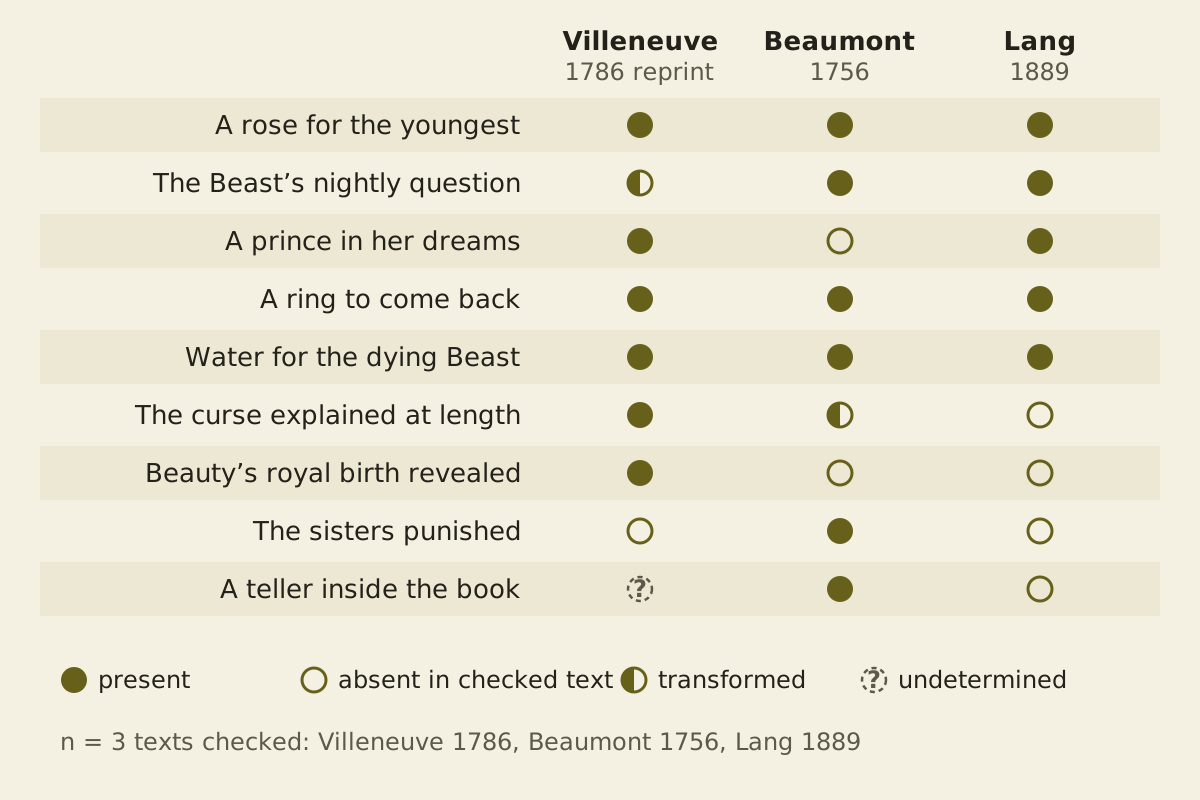
Nine motifs in three tellings; n = 3 texts checked: Villeneuve (1786 reprint, with Planché 1858), Beaumont 1756, Lang 1889.
Credit line for reuse
"Motif grid: Beauty and the Beast in three tellings" by Once Upon a Version — https://onceuponaversion.com/tellings/beauty-and-the-beast-versions/ — licensed under CC BY 4.0 (https://creativecommons.org/licenses/by/4.0/)
Data: Villeneuve (1786 reprint), Planché 1858 (Project Gutenberg 52719), Beaumont 1756 and Lang 1889 (Project Gutenberg 503), retrieved 2026-11-04
The 27 cells, with coordinates and quotations, as CSV (where the data comes from) Data: Villeneuve (1786 reprint), Planché 1858 (Project Gutenberg 52719), Beaumont 1756 and Lang 1889 (Project Gutenberg 503), retrieved 2026-11-04
| Motif | Villeneuve (1786 reprint) | Beaumont 1756 | Lang 1889 |
|---|---|---|---|
| A rose for the youngest | present | present | present |
| The Beast’s nightly question | transformed | present | present |
| A prince in her dreams | present | absent in checked text | present |
| A ring to come back | present | present | present |
| Water for the dying Beast | present | present | present |
| The curse explained at length | present | transformed | absent in checked text |
| Beauty’s royal birth revealed | present | absent in checked text | absent in checked text |
| The sisters punished | absent in checked text | present | absent in checked text |
| A teller inside the book | undetermined | present | absent in checked text |
n = 3 texts checked: Villeneuve, “La Belle et la Bête,” Le Cabinet des fées, vol. 26 (1786), pages 33 to 238, with Planché’s English of 1858; Beaumont, Magasin des enfans, vol. 1 (1756), pages 70 to 102; Lang, The Blue Fairy Book (1889).
What counts as each motif, as CSV (where the data comes from) Data: Once Upon a Version, 2026-11-04
Of the 27 cells, 17 are present, 7 absent, 2 transformed and 1 undetermined. Three motifs are present in all three texts: the rose the father picks for his youngest daughter, the ring that carries Beauty back to the palace, and the water she uses to revive the dying Beast. Villeneuve and Beaumont each have six motifs present, and Lang five.
The two transformed cells follow forms listed in advance. Villeneuve’s Beast asks for something other than marriage, as the side-by-side shows, and Beaumont’s prince explains his curse in one sentence instead of a history. The single undetermined cell is Villeneuve’s frame: the 1786 reprint has none, but the 1740 printing had an introduction by the BnF record, and that printing was not read. It stays undetermined rather than absent.
What do the versions not share?
The three tellings part ways most clearly at the end. In Villeneuve, Beauty turns out to be the Princess of the Happy Island, and her sisters, far from being punished, marry and live at her court; Planché’s English says she went on calling them by “the tender names of father, brothers, and even sisters.” In Beaumont the fairy turns the two sisters into statues at the palace gate. In Lang the fairy offers to send for all of Beauty’s brothers and sisters “to dance at your wedding.”
Illustration of a single picked rose, the flower all three tellings send home with the merchant.
Illustration: Once Upon a Version. Generated illustration — not a historical image, manuscript or record. © Once Upon a Version, all rights reserved; reuse by request.
The dreams divide them too. Villeneuve’s Beauty meets an unknown young man in her sleep from her first night at the palace; on page 95 of the reprint, “Son inconnu, qui n’attendoit que ce moment pour paroître” (her unknown one, who waited only for that moment to appear) comes to her as soon as she lies down. Lang keeps him. Beaumont has a lady in Beauty’s dream instead, who turns out at the end to be a fairy, and no young man appears until the Beast changes on page 99.
Planché himself compared the tale with others, and his comparisons show how far likeness can be stretched. He rejected a claim that Villeneuve expanded Perrault’s Riquet à la houppe, and found more points of resemblance in Madame d’Aulnoy’s Le Mouton, where a king turned into a ram lets a girl visit her family. He also noticed that a Cinderella of Basile’s and a German one begin, like this tale, with a father asking his daughters what to bring home.
Planché went further than likeness. From those openings he inferred that the Italian and German writers had mixed two old stories, and that Villeneuve’s tale was founded on one of them. This page reports that inference as his and does not adopt it, because similar openings, on their own, are not a line of descent.
Another reader set the tale beside a much older one. Lang’s long essay on Cupid and Psyche in 1887 calls Le Loup Blanc, one of M. Cosquin’s Lorraine tales, a story “of the type of Beauty and the Beast” (p. l), and the old woman’s Cupid and Psyche in Apuleius shows who tells that tale and how it differs. The same question of who counts as the first teller runs through Sleeping Beauty, another tale with several named tellers from Basile to the Grimms, where no printing is the single original either.
How does each ending close?
Each telling closes on a different note. Beaumont’s fairy tells Beauty, on page 100, that she has been rewarded for her choice: “vous avez préféré la vertu à la beauté & à l’esprit” (you preferred virtue to beauty and to wit). The tale’s last sentence, on page 102, says Beauty lived with the prince a long time in perfect happiness, “parce qu’il étoit fondé sur la vertu” (because it was founded on virtue). That closing line belongs to a schoolbook, and the pupils’ questions follow it at once.
Villeneuve’s close is about memory, not virtue. On page 238 of the reprint the prince’s mother has the story written down “dans les archives de cet empire, & dans celui de l’isle heureuse, pour la transmettre à la postérité” (in the archives of that empire and of the Happy Island, to hand it down to posterity), and accounts of it are sent through the whole world. Lang’s English ends in the plainest way of the three, with a wedding the next day and the words “lived happily ever after.”
What the versions do share is a merchant, a rose and a Beast who asks his question again every night. Everything else depends on who is telling, and in 1756 that was a governess named Mlle Bonne, sitting in a garden with pupils she called good girls. When she finished, her pupils argued with the ending, and one of them said she would never have married the Beast.
Sources
Editions
- Jeanne-Marie Leprince de Beaumont, Magasin des enfans, ou dialogues entre une sage gouvernante et plusieurs de ses élèves, vol. 1 (Londres, 1756), fifth dialogue, “La Belle & la Bête,” pp. 70–102. https://archive.org/details/bim_eighteenth-century_magasin-des-enfans-ou-d_leprince-de-beaumont-ma_1756_1 (full text of the tale and of the dialogue around it (pp. 69–102), with the title page)
- Gabrielle-Suzanne de Villeneuve, “La Belle et la Bête,” in Le Cabinet des fées, ou Collection choisie des contes des fées, et autres contes merveilleux, vol. 26 (Genève: Barde, Manget & Compagnie; Paris: Cuchet, 1786), pp. 33–238. https://archive.org/details/lecabinetdesfe26maye (full text of the tale, with the title page and table of contents)
- J. R. Planché, trans., Four and Twenty Fairy Tales, Selected from Those of Perrault, and Other Popular Writers (London: G. Routledge, 1858): “The Story of the Beauty and the Beast” by Madame de Villeneuve, pp. 225–328, and the notes on Villeneuve and Beaumont. Project Gutenberg eBook 52719. https://www.gutenberg.org/ebooks/52719 (full text of the tale, the preface and the notes on Villeneuve and Beaumont)
- Andrew Lang, ed., The Blue Fairy Book (London and New York: Longmans, Green, 1889). Project Gutenberg eBook 503. https://www.gutenberg.org/ebooks/503 (contents and the source note printed after each tale, with the whole book searched for named sources; full text of “Aladdin and the Wonderful Lamp,” “Beauty and the Beast” and “The Sleeping Beauty in the Wood”; the title and opening of “The Story of Pretty Goldilocks”)
- Andrew Lang, ed., The Olive Fairy Book (New York: Longmans, Green, 1907). Project Gutenberg eBook 27826. https://www.gutenberg.org/ebooks/27826 (title and copyright pages, preface and contents)
- The Most Pleasant and Delectable Tale of the Marriage of Cupid and Psyche, done into English by William Adlington, with a discourse on the fable by Andrew Lang (London: David Nutt, 1887; Bibliothèque de Carabas): title page, preface (pp. xiii–xvi), discourse (pp. xvii–lxxxvi) and the reprinted tale (pp. 1–65). https://archive.org/details/cu31924026490213 (title page, preface and the opening, middle and closing pages of the discourse (among them p. l); the first and last pages of the reprinted tale; catalogue record)
Catalogues and databases
- Bibliothèque nationale de France, catalogue général, notice FRBNF31583041: Villeneuve, La Jeune Amériquaine et les Contes marins, par Mme de \\\* (La Haye: aux dépens de la Compagnie, 1740). Licence Ouverte. https://catalogue.bnf.fr/ark:/12148/cb31583041b (full catalogue record)
- D. L. Ashliman, Folklore and Mythology Electronic Texts (University of Pittsburgh), index page, with the entry “Beauty and the Beast: folktales of type 425C.” https://sites.pitt.edu/~dash/folktexts.html (index of tale-type pages)
- Gemeinsame Normdatei (GND), via lobid-gnd: Villeneuve, Gabrielle-Suzanne de, GND 100795455; Leprince de Beaumont, Jeanne-Marie, GND 119481006; Planché, James R., GND 12115873X; Crane, Walter, GND 118522639. CC0. https://lobid.org/gnd/100795455 (full authority records)
Cite this page
Once Upon a Version. “Beauty and the Beast: Two French Tellers, 1740 and 1756.” Once Upon a Version. Published 2026-11-05. https://onceuponaversion.com/tellings/beauty-and-the-beast-versions/ (accessed day month year).
Write in the date you read the page; the page has no DOI.
More from One Tale, Many Tellers
One Tale, Many Tellers
Brothers Grimm: Their ‘Peasant Woman’ Was a Tailor’s Wife
Type ATU 533, as classified by D. L. Ashliman
The Grimms’ 1815 preface calls Dorothea Viehmann a peasant woman. Her biography records an innkeeper’s daughter who married a tailor. Both prefaces, compared.
Picture credit
"Portret van Jacob Ludwig Karl Grimm" by Ludwig Emil Grimm — https://commons.wikimedia.org/wiki/File:Portret_van_Jacob_Ludwig_Karl_Grimm,_RP-P-1907-1042.jpg — CC0 1.0 (https://creativecommons.org/publicdomain/zero/1.0/); modified: cropped to the plate (sheet margins removed)
One Tale, Many Tellers
Grimm Fairy Tales 1–60: Counted Here, 21 Named Tellers
Type collection of folktales (no single ATU number)
Bolte and Polívka’s 1913 notes on Grimm tales 1–60 name 21 tellers, 13 of them women, and 34 of 62 credits name Kassel. The register lists them entry by entry.
Picture credit
"Doppelportrait der Brüder Jacob und Wilhelm Grimm" by Elisabeth Jerichau-Baumann — https://commons.wikimedia.org/wiki/File:Alte_Nationalgalerie-Jerichau-Baumann-Gebr%C3%BCder_Grimm_DSC8174.jpg — CC0 1.0 (https://creativecommons.org/publicdomain/zero/1.0/); modified: cropped to the painted canvas; gilt frame and wall removed
One Tale, Many Tellers
Sleeping Beauty: In Basile and Perrault, No Kiss Wakes Her
Type ATU 410, as classified by D. L. Ashliman
Sleeping Beauty in Basile (printed 1636): twins draw out a splinter. Perrault (1697): the spell ends. Of 4 texts compared here, only 2 Grimm texts use a kiss.
Picture credit
"La Belle au Bois Dormant" by Gustave Doré — https://commons.wikimedia.org/wiki/File:La_Belle_au_Bois_Dormant_(136548149).jpg — Public domain in US (published 1867); DE/FR (Gustave Doré d. 1883, life+70); the wood engraver’s signature at lower right is not legible, and an engraver working on an 1867 edition is presumed not to have lived past 1955 (log, image ruling 10)