Cupid and Psyche: In Apuleius, an Old Woman Tells the Tale
In Apuleius’s novel, Cupid and Psyche is told by an old woman in a robbers’ cave to a captive bride, and later tellers kept her, cut her out or replaced her with themselves.
By Once Upon a Version
Published
How a version is traced · Version history · Contact · Report an error (contact@onceuponaversion.com)
In short
- In Apuleius’s Metamorphoses (books 4–6), Cupid and Psyche is told by an unnamed old woman who keeps house for robbers, to comfort a kidnapped bride, while the narrator Lucius, turned into an ass, overhears.
- In the Latin she offers the bride old wives’ tales (4.27) and is called crazed and tipsy when she finishes (6.25); the 1639 reprint of William Adlington’s English calls her only “trifling,” and Stephen Gaselee’s 1915 revision has “trifling and drunken.”
- Of three tellings checked motif by motif (Apuleius, Mary Tighe in 1811, William Morris in 1868), all three keep the sisters’ envy and Psyche’s immortality, but only Apuleius tells the birth of a child and only Tighe cuts the four tasks to one.
Telling card
- Tale
- Cupid and Psyche (Apuleius, Metamorphoses 4.28–6.24)
- Type
- ATU 425B, as classified by D. L. Ashliman
- Teller
- an unnamed old woman who keeps house for robbers, a character in the novel; written by Apuleius (123–170 in the GND record)
- Recorded by
- n/a (inside the novel, the narrator Lucius, turned into an ass, overhears it)
5 more fields: edited by, told, published, this text, earliest known
- Edited by
- English: William Adlington (1566); reprinted with a discourse by Andrew Lang (1887); revised by Stephen Gaselee (1915)
- Told
- unrecorded; the novel sets the telling in a robbers’ cave, to a captive bride
- Published
- Apuleius, Metamorphoses, books 4–6; year of first publication not recorded on this page; the author’s dates are 123–170 in the GND record
- This text
- William Adlington’s English, 1639 reprint (Project Gutenberg 1666); Latin cited by book and chapter only
- Earliest known
- not traced on this page; Apuleius is the oldest of the texts compared here
This card as CSV · where these values come from
Data: Apuleius (Adlington, Project Gutenberg 1666; Latin ed. Gaselee 1915), Lang’s 1887 reprint of Adlington, Gaselee’s 1915 revision of Adlington, Ashliman’s tale-type number and GND 11850374X, retrieved 2026-11-03
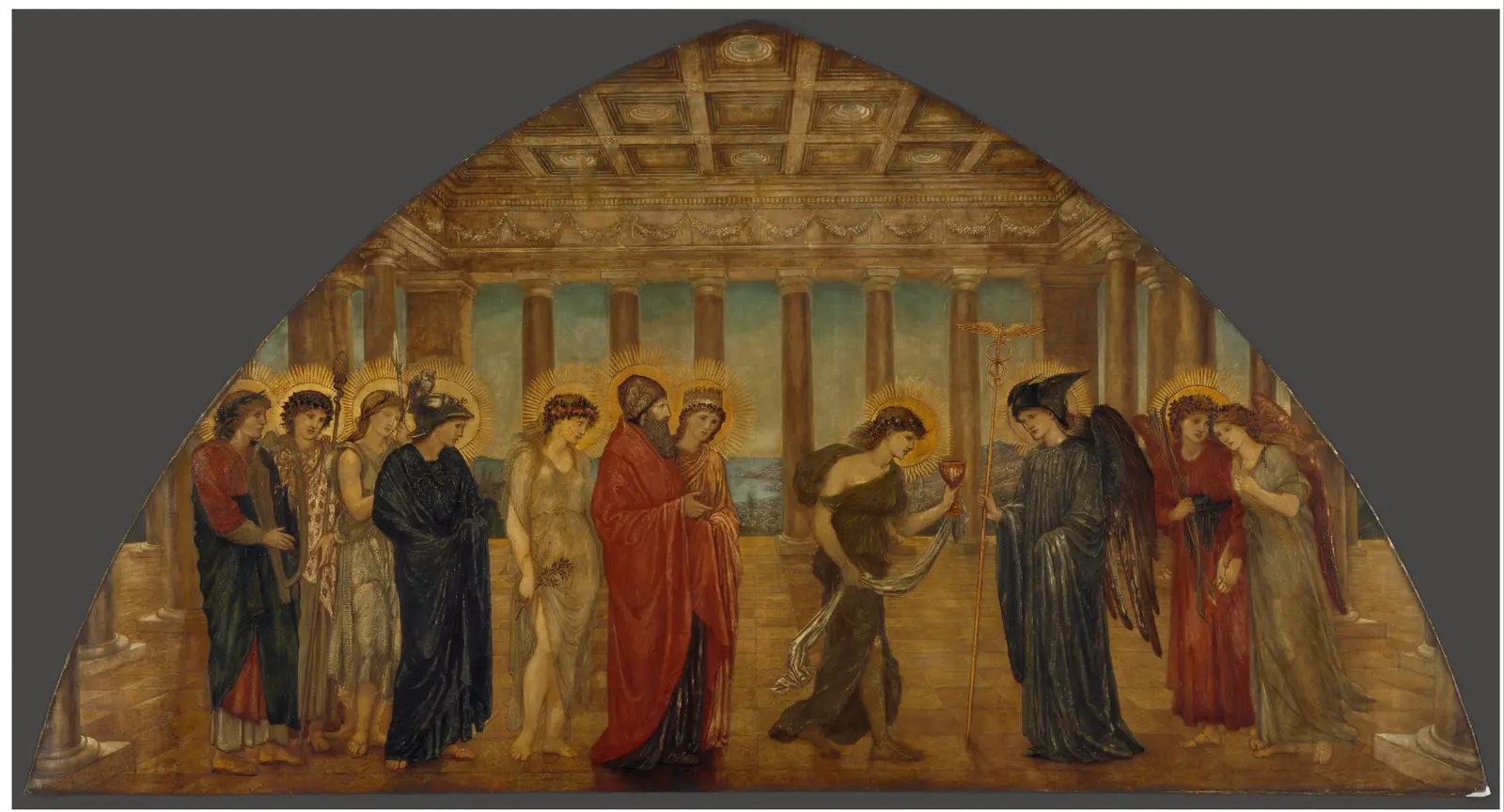
Psyche enters the portals of Olympus, led by Mercury, with Cupid beside her. Edward Burne-Jones, Palace Green murals, 1872–1881. Birmingham Museums Trust, 1922P198.
Full credit
"Cupid and Psyche - Palace Green Murals - Psyche entering the Portals of Olympus" by Edward Burne-Jones — https://commons.wikimedia.org/wiki/File:Edward_Burne-Jones_-_Cupid_and_Psyche_-_Palace_Green_Murals_-_Psyche_entering_the_Portals_of_Olympus_-_Google_Art_Project.jpg — Public domain in US (painted 1872–1881, Burne-Jones d. 1898; Commons marks it published before 1931); DE/FR (Edward Burne-Jones d. 1898, life+70); faithful photograph of a two-dimensional painting (PD-Art; Google Arts & Culture photograph)
In Apuleius’s Latin novel, the story of Cupid and Psyche is told by an old woman in a robbers’ cave. Apuleius, whose dates in the German national authority file are 123 to 170, sets the telling in book 4 of the Metamorphoses, the novel also printed as The Golden Ass. Robbers have carried off a bride on her wedding day, and the woman who keeps their house is ordered to quiet her. Cupid and Psyche is what she tells.
Who tells the story inside Apuleius’s novel?
The old woman is introduced earlier in book 4, when the robbers come home and abuse her for idling. Adlington’s English describes her as “crooked with age, who had the government and rule of all the house” (4.7). She feeds the robbers, heats their bath water and is set to sit with the captive.
The bride cannot stop weeping, and when she wakes from a nightmare in which a robber kills her husband with a stone, the old woman first assures her that dreams of killing foretell good fortune (4.27). Then she tries another remedy.
But I will tell thee a pleasant tale, to put away all thy sorrow, and to revive thy spirits.
told by an unnamed old woman · written by Apuleius · translated by William Adlington · The Golden Asse, 1639 reprint (Project Gutenberg 1666), Metamorphoses 4.27
From the next chapter (4.28) to the end of 6.24, every word of Cupid and Psyche is in her voice, across 63 chapters of the Latin text. Venus, Cupid, a reed and a tower all speak inside the tale, but they speak through her.
Her story runs as follows. Venus, angry that people worship a king’s youngest daughter in her place, sends her son Cupid to make the girl love the lowest of men (4.30–4.31). An oracle orders the king to leave Psyche on a mountain crag for a monstrous husband (4.33), and the west wind carries her down to a palace (4.35–5.1), where a husband she never sees comes to her at night (5.4).
The sisters’ envy, a lamp and a razor end that marriage (5.8–5.23). Psyche wanders, gives herself up to Venus, and performs the goddess’s tasks; Jupiter then calls the gods together and makes her immortal (6.10–6.23).
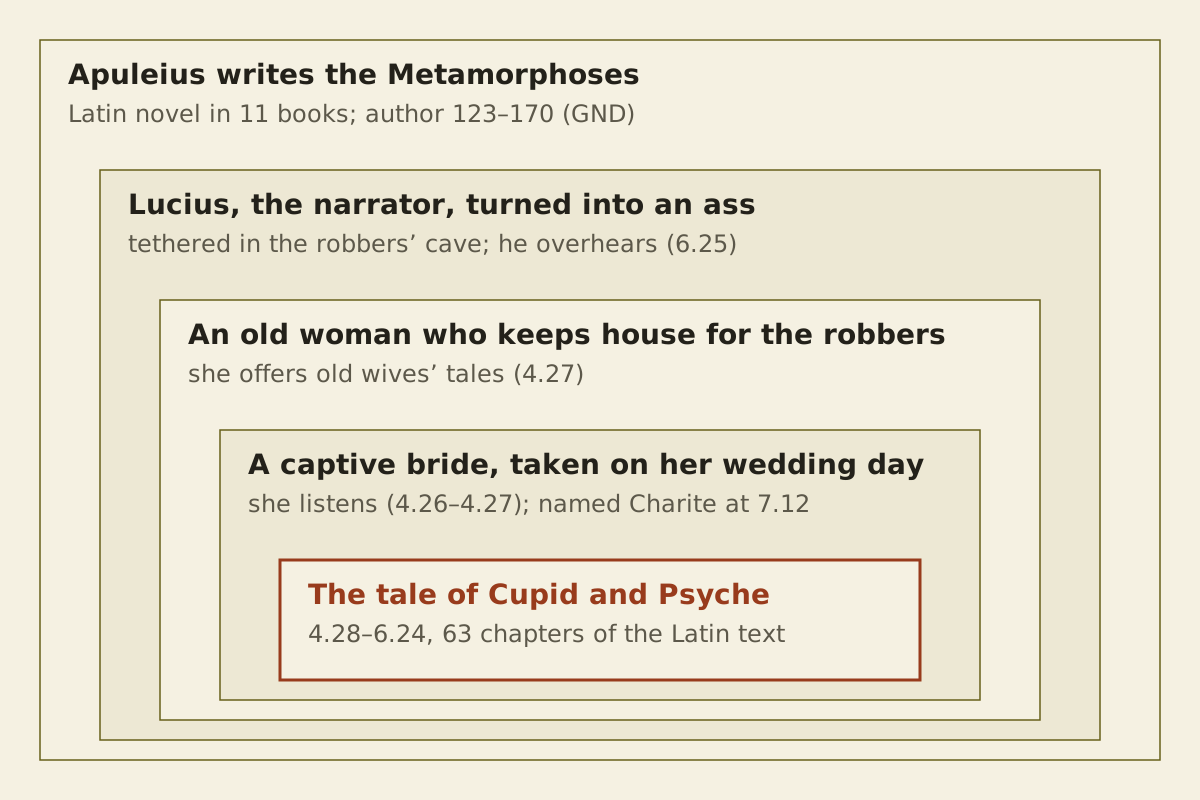
Who tells Cupid and Psyche inside the Metamorphoses, from the author to the tale, with the Latin book and chapter for each frame.
Credit line for reuse
"Who tells Cupid and Psyche inside Apuleius’s novel" by Once Upon a Version — https://onceuponaversion.com/across-cultures/cupid-and-psyche-teller/ — licensed under CC BY 4.0 (https://creativecommons.org/licenses/by/4.0/)
Data: Apuleius, Metamorphoses (Latin ed. Gaselee 1915, Perseus Digital Library; Adlington, Project Gutenberg 1666) and GND 11850374X, retrieved 2026-11-03
The audience is double: the bride hears the tale, and so does Lucius, the novel’s narrator. He has been turned into an ass and is tethered in the cave, and when the story ends he regrets that he “lacked pen and inke to write so worthy a tale” (6.25, Adlington). The reader receives the tale through two tellers: the old woman who speaks it, and the narrator who claims to have heard it without writing it down.
Although the novel stages a single sitting in a single cave, the printed text is still what this site calls the one-evening text: a single fixed witness that can be pinned to an edition and a chapter, not a record of anyone’s performance.
What does the old woman call her story?
In the Latin, she promises to distract the bride narrationibus lepidis anilibusque fabulis (4.27), “with charming stories and old wives’ tales” in this site’s rendering. The teller classes her own story with the stories old women tell. When she finishes, the narrator gives her two more adjectives, and the English printings handle them differently.
Latin · ed. Gaselee, 1915
Sic captivae puellae delira et temulenta illa narrabat anicula
written by Apuleius · Metamorphoses 6.25, Latin text ed. Stephen Gaselee, London 1915
Adlington · 1639 reprint
This the trifling old woman declared unto the captive maiden
translated by William Adlington · The Golden Asse, 1639 reprint (Project Gutenberg 1666), Metamorphoses 6.25
Adlington revised by Gaselee · 1915
This the trifling and drunken old woman declared to the captive maiden
translated by William Adlington, revised by Stephen Gaselee · The Golden Ass, London 1915, p. 285
What changed: The Latin reads “So that crazed and tipsy old woman told it to the captive girl” in this site’s rendering, calling her delira et temulenta; the 1639 printing keeps only “trifling,” and Gaselee’s 1915 revision has “trifling and drunken.”
The opening shows the same pattern. Where the 1639 printing has “a pleasant tale,” Gaselee’s revision has “a pleasant old wives’ tale” (p. 185). Which earlier printing of Adlington first lacked these words is not traced on this page, because the 1566 first edition was not read.
Which tellings are compared here?
Seven printings appear on this page, and three of them (Apuleius’s novel in Adlington’s English and two English poems) are checked motif by motif in the grid further down; the other four (the Latin text, two later English printings of Adlington and Pater’s retelling) are used for what they say about the teller.
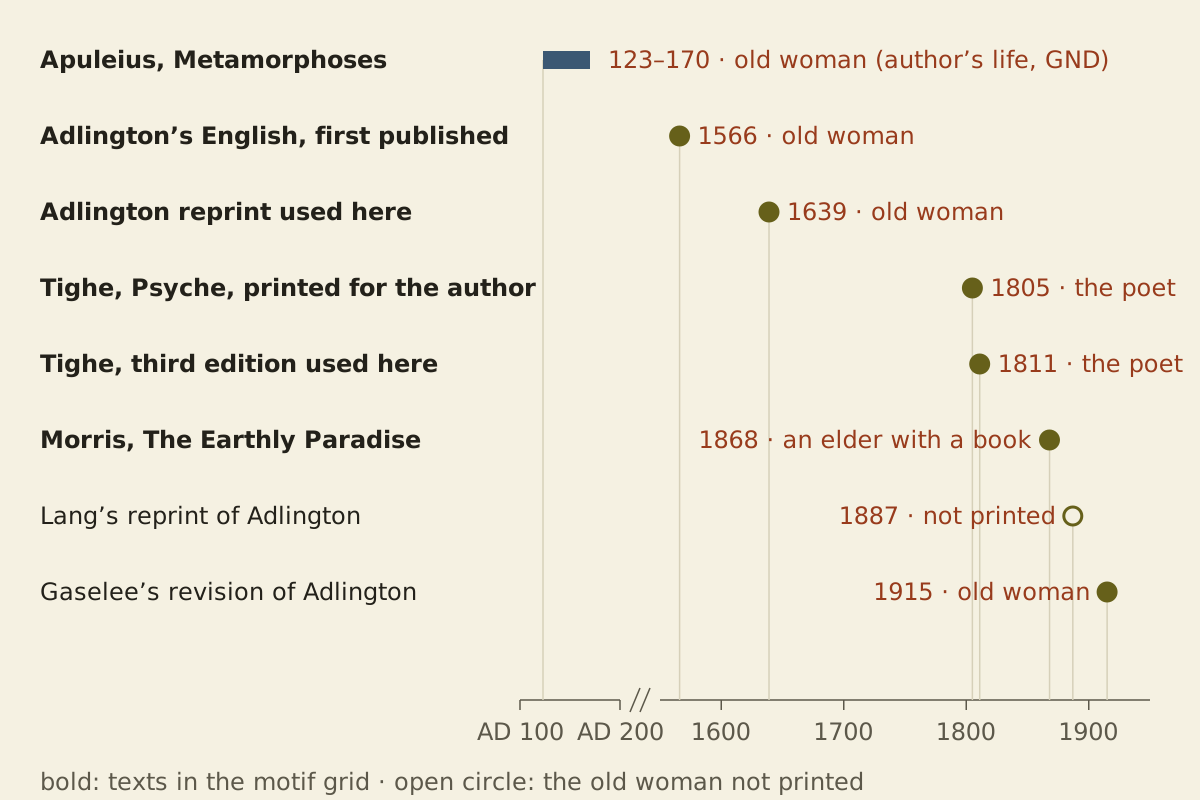
Printed tellings of Cupid and Psyche used on this page, by year, with the teller each one gives the tale; Pater’s 1910 chapter is not plotted.
Credit line for reuse
"Printed tellings of Cupid and Psyche, by year" by Once Upon a Version — https://onceuponaversion.com/across-cultures/cupid-and-psyche-teller/ — licensed under CC BY 4.0 (https://creativecommons.org/licenses/by/4.0/)
Data: Editions named on the page and GND 11850374X, retrieved 2026-11-03
The seven printings and who tells the tale in each, as CSV (where the data comes from) Data: Seven public-domain printings named in the edition_used column, retrieved 2026-11-03
| Telling | Edition used | Who tells the tale |
|---|---|---|
| Apuleius, Metamorphoses 4.28–6.24 | Latin text ed. Gaselee, London 1915 | an old woman who keeps house for robbers |
| Adlington’s English of Apuleius | reprint of the 1639 edition | the old woman, “trifling” |
| Mary Tighe, Psyche | third edition, London 1811 (first printed for the author in 1805) | the poet, in her own voice |
| William Morris, “The Story of Cupid and Psyche” | The Earthly Paradise, London 1868; wording from the 1903 impression | an unnamed elder with a book |
| Andrew Lang’s reprint of Adlington | London: David Nutt, 1887 | not printed |
| Gaselee’s revision of Adlington | London: Heinemann, 1915 | the old woman, “trifling and drunken” |
| Walter Pater, Marius the Epicurean | Library Edition, London 1910 | the book two boys read |
Adlington’s translation was first published in 1566, according to Lang’s preface of 1887 (p. xiii), and the Project Gutenberg text used here says it follows the edition of 1639. Apuleius’s Latin is cited by book and chapter, so that any edition can be checked against the same coordinates.
Is Apuleius’s telling the ‘original’ one?
Apuleius’s Latin is the earliest telling consulted on this page, and no earlier written text of the tale is traced here. That makes it the earliest known telling in this comparison, not an original. The novel itself does not present the story as new: the old woman offers it among the old wives’ tales she promises the bride (4.27), a story told aloud to pass the time.
Later readers took the hint in different ways. Morris’s elder says that the learned know of no written record of the tale from before his people left Greece (p. 346 of the 1868 edition). Lang’s discourse classes it as “a conte or traditional popular tale” and says its kind shows “in the earliest words of the narrative” (p. xvii). Both are claims about where the tale came from; neither is a text older than Apuleius.
The tale is ATU 425B, as classified by D. L. Ashliman: a number in the international index of folktale types, which sorts tales by plot. Ashliman’s page links it to the Norwegian “East of the Sun and West of the Moon” as another tale of that type.
Where did the old woman go?
Mary Tighe kept the start of the plot and dropped the cave. In the preface to the copies printed in 1805, reprinted in the third edition of 1811, she writes that she is “indebted for the outline of my tale in the two first cantos” to Apuleius (p. xiii). Her poem opens with Psyche already wandering after the loss, and the voice that tells it is the poet’s own.
William Morris gave the tale to a new teller. In The Earthly Paradise (London, 1868), the story falls in the month of May, and before it begins “A book upon the board an elder laid” (p. 346). The elder says the learned find no written record of the tale from before his people left Greece, and suggests that such tales travel “From place to place, e’en as the feathery seed” (p. 346).
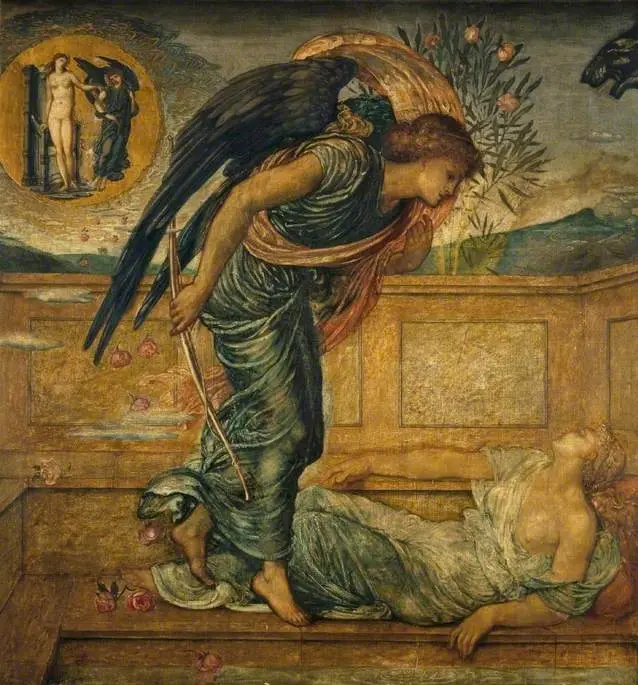
Cupid finds Psyche asleep by a fountain. Edward Burne-Jones, Palace Green murals, 1872–1881. Birmingham Museums Trust, 1922P187.
Full credit
"Cupid Finding Psyche Asleep by a Fountain (Palace Green Murals)" by Edward Burne-Jones — https://commons.wikimedia.org/wiki/File:Edward_Burne-Jones_(1833-1898)_-_Cupid_Finding_Psyche_Asleep_by_a_Fountain_(Palace_Green_Murals)_-_1922P187_-_Birmingham_Museums_Trust.jpg — Public domain in US (painted between 1872 and 1881, Burne-Jones d. 1898; Commons marks it published before 1931); DE/FR (Edward Burne-Jones d. 1898, life+70); faithful photograph of a two-dimensional painting (PD-Art)
Morris’s elder sometimes steps forward as a teller with limits. Near the end, he says he must “leave untold the joy unspeakable” (line 2456 of the tale), and of Love’s plea to Jupiter he admits, “I know not” (line 2403). Morris also adds scenes the old woman does not tell, such as Love finding Psyche asleep (line 351), a moment Burne-Jones painted among the Palace Green murals.
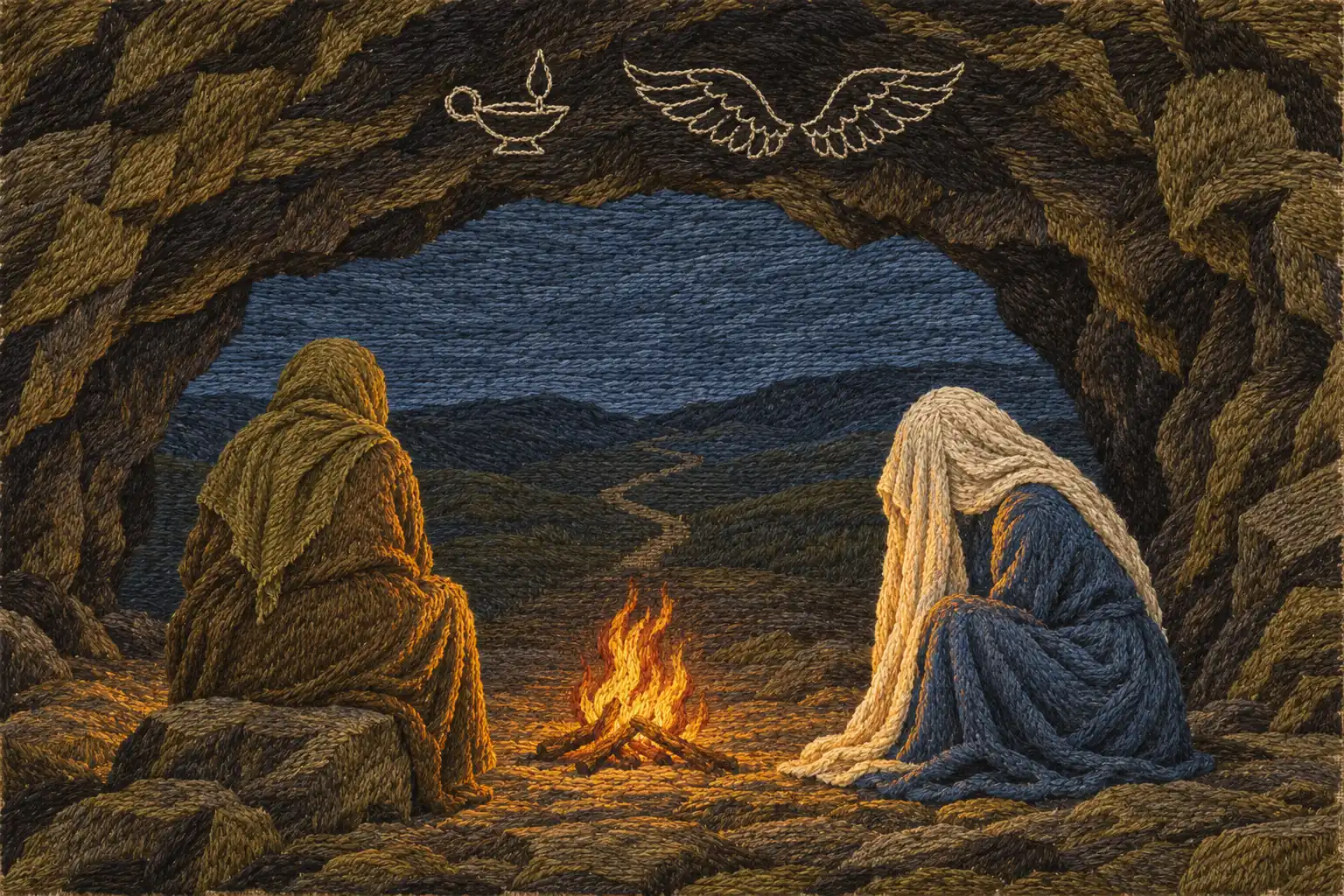
An illustration of the scene Apuleius sets for the tale: an old woman telling a story to a captive bride in a robbers’ cave.
Illustration: Once Upon a Version. Generated illustration — not a historical image, manuscript or record. © Once Upon a Version, all rights reserved; reuse by request.
Andrew Lang, the editor of the coloured fairy books, removed the frame altogether. His 1887 reprint of Adlington, taken from the edition of 1596 (p. xiv), prints the tale from its first sentence, about a king with three daughters, to its last, the birth of a child called Pleasure (pp. 1–65), so neither the cave, the bride nor the old woman appears.
Yet his own discourse on the fable, 70 pages long (xvii–lxxxvi), names her on its first page: after a Scots nursery rhyme it quotes the tale’s first Latin words and adds, “the old woman’s tale begins in Apuleius” (p. xvii).
Lang’s preface also lists Tighe’s, Morris’s and Pater’s versions among the tale’s later forms (p. xvi), and the discourse goes on to compare the fable with folk tales from many countries, among them one “of the type of Beauty and the Beast” (p. l).
Four tasks and a box
Venus sets the tasks after Psyche gives herself up. In Apuleius, the sequence runs over chapters 6.10 to 6.21, and each task has a helper who does what Psyche cannot.
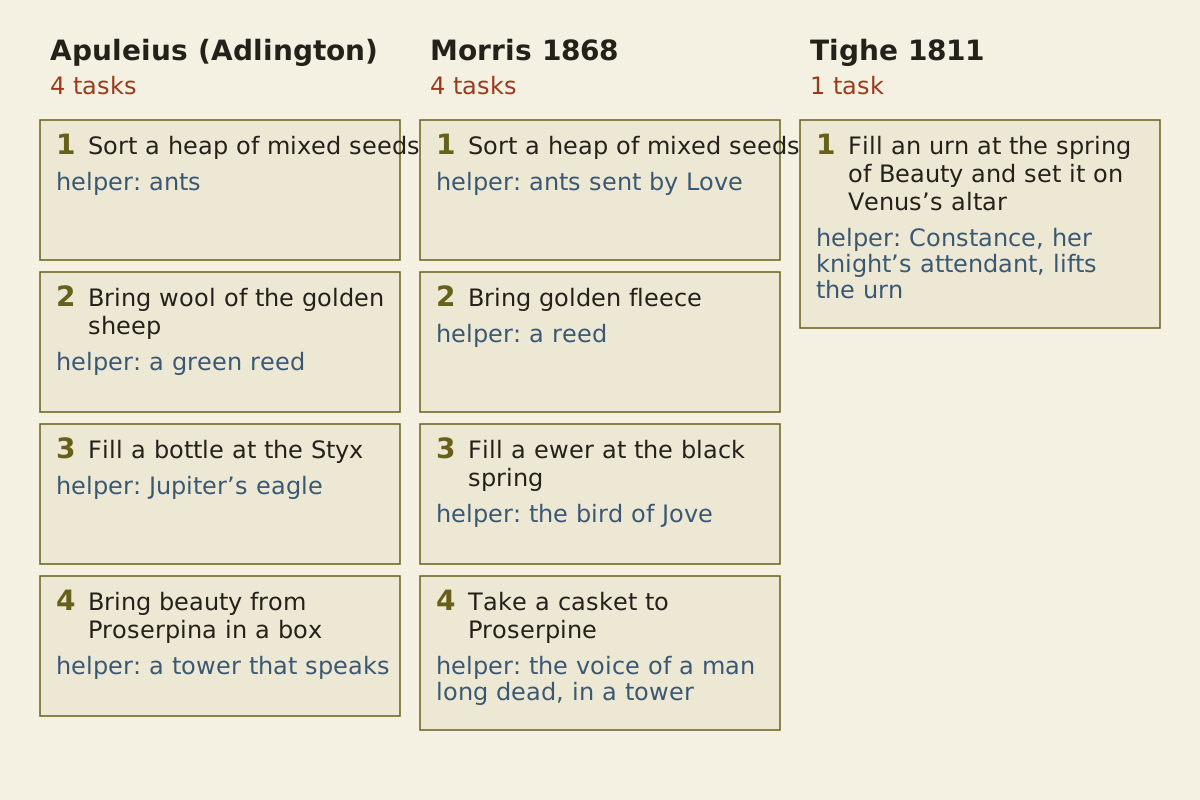
The tasks Venus sets Psyche, in order, with the helper each text names; Morris’s line numbers are counted in the 1903 impression of his 1868 poem.
Credit line for reuse
"The tasks Venus sets Psyche in three tellings" by Once Upon a Version — https://onceuponaversion.com/across-cultures/cupid-and-psyche-teller/ — licensed under CC BY 4.0 (https://creativecommons.org/licenses/by/4.0/)
Data: Apuleius (Adlington, Project Gutenberg 1666), Morris (Project Gutenberg 30332) and Tighe (1811), retrieved 2026-11-03
| Text | Task | Helper | Where |
|---|---|---|---|
| Apuleius (Adlington) | 1. Sort a heap of mixed seeds | ants | 6.10 |
| 2. Bring wool of the golden sheep | a green reed | 6.11–6.13 | |
| 3. Fill a bottle at the Styx | Jupiter’s eagle | 6.13–6.16 | |
| 4. Bring beauty from Proserpina in a box | a tower that speaks | 6.16–6.21 | |
| Morris 1868 | 1. Sort a heap of mixed seeds | ants sent by Love | line 1839 |
| 2. Bring golden fleece | a reed | line 1888 | |
| 3. Fill a ewer at the black spring | the bird of Jove | line 1978 | |
| 4. Take a casket to Proserpine | the voice of a man long dead, in a tower | line 2069 | |
| Tighe 1811 | 1. Fill an urn at the spring of Beauty and set it on Venus’s altar | Constance, her knight’s attendant, lifts the urn | Canto II, p. 66; Canto VI, pp. 204–205 |
Two of the three texts keep the four tasks in the same order. Morris changes the helpers: his ants are sent by Love, and the voice in the tower belongs to “one long slain” (line 2069), where Adlington’s tower simply “spake unto her.” Tighe’s Venus asks for one thing only, an urn filled at the spring of Beauty, and her poem calls it “This one atonement” (Canto II, p. 66).
The fourth task in Apuleius is a journey to Proserpina by way of Taenarus (6.18), which places this tale beside Orpheus and Eurydice, another journey to the dead by a living visitor. The resemblance is a shared motif, counted here; no source read for this page treats one story as borrowed from the other.
Motif grid: what three tellings keep
Each motif was defined before any cell was filled, with what counts as present and which specific changes count as transformed. A cell marked absent means only that the checked text does not contain the motif.
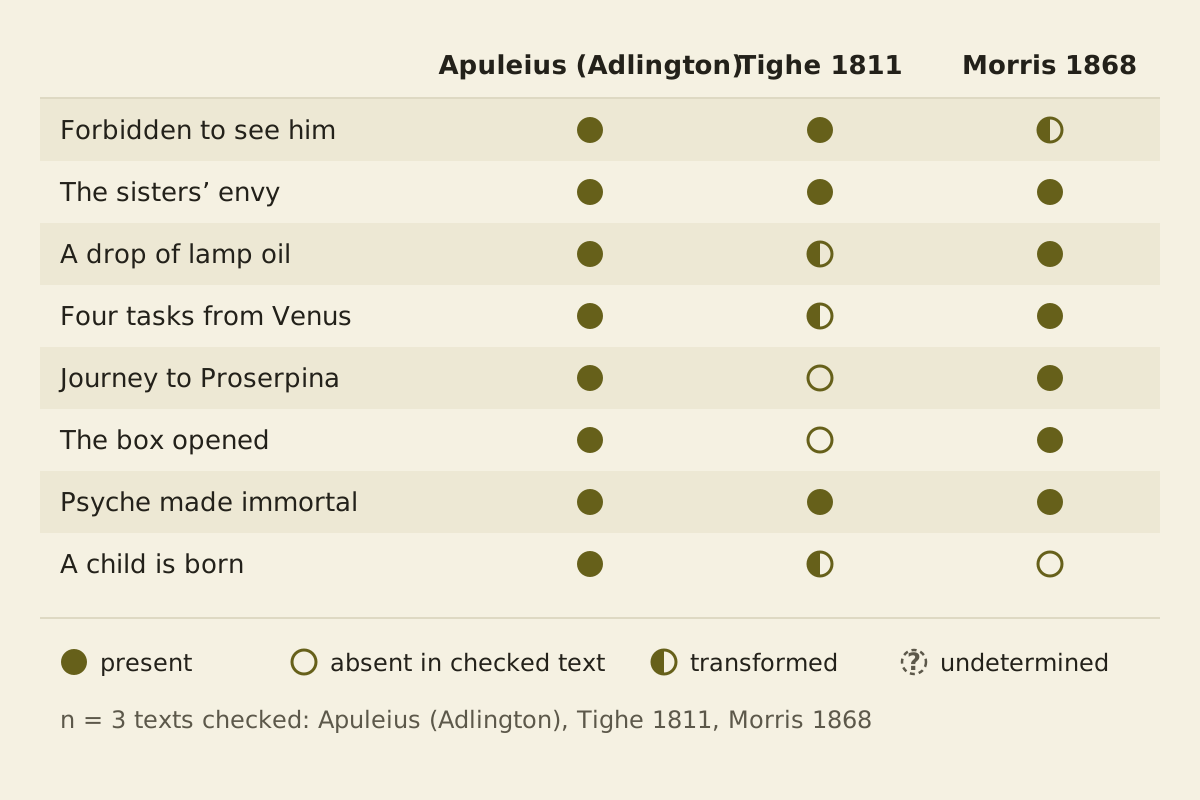
Eight motifs in three tellings; n = 3 texts checked: Apuleius (Adlington), Tighe 1811, Morris 1868 (wording and lines from the 1903 impression).
Credit line for reuse
"Motif grid: Cupid and Psyche in three tellings" by Once Upon a Version — https://onceuponaversion.com/across-cultures/cupid-and-psyche-teller/ — licensed under CC BY 4.0 (https://creativecommons.org/licenses/by/4.0/)
Data: Three public-domain texts named on the page, with Latin chapter numbers from the Perseus Digital Library, retrieved 2026-11-03
The 24 cells, with coordinates and quotations, as CSV (where the data comes from) Data: Three public-domain texts named in the edition column, retrieved 2026-11-03
| Motif | Apuleius (Adlington) | Tighe 1811 | Morris 1868 |
|---|---|---|---|
| Forbidden to see him | present | present | transformed |
| The sisters’ envy | present | present | present |
| A drop of lamp oil | present | transformed | present |
| Four tasks from Venus | present | transformed | present |
| Journey to Proserpina | present | absent in checked text | present |
| The box opened | present | absent in checked text | present |
| Psyche made immortal | present | present | present |
| A child is born | present | transformed | absent in checked text |
n = 3 texts checked: Apuleius, Metamorphoses 4.28–6.24 (Adlington’s English, 1639 reprint, with Latin chapter numbers); Mary Tighe, Psyche, all six cantos (London, 1811); William Morris, “The Story of Cupid and Psyche,” all 2,491 lines (The Earthly Paradise, first published 1868; wording and line numbers from the 1903 impression). Of the 24 cells, 17 are present, 3 absent in the checked text, 4 transformed and 0 undetermined. The definitions are a separate download: the eight motif definitions as CSV (where the data comes from) Data: Once Upon a Version motif definitions, 2026-11-03.
Two of the eight motifs are present in all three texts: the sisters’ envy and Psyche’s immortality. Apuleius has all eight present, Morris six, and Tighe three.
The four transformed cells each follow a form listed in advance. In Tighe, the lamp falls from Psyche’s hand and goes out, and no drop of oil is told (Canto II, p. 58); a son is promised in the first canto (p. 40), but no birth follows. In Morris, the rule against seeing comes from a voice in the empty palace, which says the husband “needs must hide him from thy sight” (line 581), while his own warning is against telling the sisters about him (line 781).
Why may Psyche not see him?
Apuleius gives the husband reasons, and the old woman reports them, at 5.11 in his own words. In Adlington’s English he warns Psyche not to try “to see the shape of my person” on her sisters’ advice (5.6, where the Latin reports the warning indirectly).
Later, speaking directly, he tells her that his face is one “which if thou once fortune to see, as I have often told, thou shalt see no more” (5.11, Adlington). In the same speech he says the child she carries will be divine if she keeps the secret and mortal if she betrays it (5.11).
Tighe’s Cupid gives a different reason: he can protect her only while hidden. “Unseen, I may securely guard thy ways,” he says in the first canto (p. 40), and if he is known he must give her up. Morris gives the husband no speech on the subject at all; a voice in the empty palace tells Psyche he must stay hidden (line 581), and the lamp scene follows without any spoken prohibition being broken.
What do the versions not share?
The three tellings differ at both ends of the story. Only Apuleius tells the birth of a child, a daughter “whom we call Pleasure” (6.24, Adlington). Only Morris has no child of Psyche’s born or promised; such a child comes up only in the sisters’ lie. Tighe alone gives Psyche a knight to guard her across four cantos of allegory, from Canto III to Canto VI.
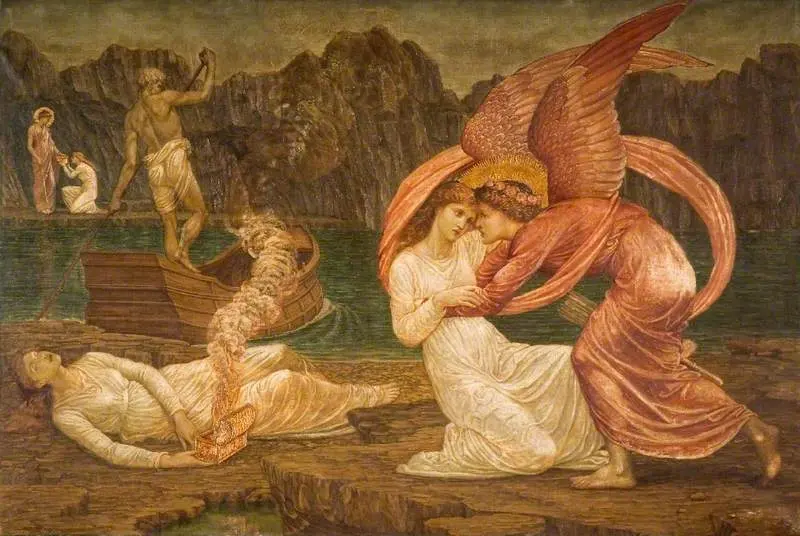
Psyche asleep beside the opened casket, and again in Cupid’s arms as he wakes her, with the ferryman behind. Edward Burne-Jones, Psyche Receiving the Casket Back, Palace Green murals, 1872–1881. Birmingham Museums Trust, 1922P197.
Full credit
"Psyche Receiving the Casket Back (Palace Green Murals)" by Edward Burne-Jones — https://commons.wikimedia.org/wiki/File:Edward_Burne-Jones_(1833-1898)_-_Psyche_Receiving_the_Casket_Back_(Palace_Green_Murals)_-_1922P197_-_Birmingham_Museums_Trust.jpg — Public domain in US (painted between 1872 and 1881, Burne-Jones d. 1898; Commons marks it published before 1931); DE/FR (Edward Burne-Jones d. 1898, life+70); faithful photograph of a two-dimensional painting (PD-Art)
The box scene belongs to two of the three. In Apuleius, Psyche opens it and finds “an infernall and deadly sleepe” (6.21); Morris’s Psyche raises the lid and falls into a sleep “Most like to death” (line 2339). Tighe has no underworld and no box, because her Psyche never goes below and her single task ends at an altar.
The tellers do not match either. Apuleius’s teller is a character inside the novel, Tighe’s is the poet, and Morris’s is an elder who reads from a book while saying, of Psyche’s name, “As ever by our fathers we were told” (line 16). Among the printings on this page, the old woman survives only in the Latin and in the complete English translations of the novel; Lang’s reprint and Pater’s chapter print the tale on its own and leave her out.
The old woman herself never receives a name, yet Apuleius gives her the whole tale and an audience of one captive and one ass. When she stops, the narrator closes the frame in his own voice: sic … narrabat anicula, “so the old woman told it” in this site’s rendering (6.25).
Sources
Editions
- Apuleius, The Golden Asse, translated by William Adlington (first published 1566), reprinted from the edition of 1639 with the original spelling. Project Gutenberg ebook 1666. https://www.gutenberg.org/ebooks/1666 (full text of books 4–6, with the dedication and the translator’s preface)
- Apuleius, Metamorphoses, Latin text in The Golden Ass, being the Metamorphoses of Lucius Apuleius, ed. Stephen Gaselee (London: William Heinemann; New York: G. P. Putnam’s Sons, 1915), as encoded by the Perseus Digital Library (canonical-latinLit, phi1212.phi002.perseus-lat1). https://github.com/PerseusDL/canonical-latinLit/blob/master/data/phi1212/phi002/phi1212.phi002.perseus-lat1.xml (books 4–7, chapter by chapter, for coordinates) Text licence: CC BY-SA 4.0 (Perseus Digital Library encoding), https://creativecommons.org/licenses/by-sa/4.0/
- The Golden Ass, being the Metamorphoses of Lucius Apuleius, with an English translation by W. Adlington (1566), revised by S. Gaselee (London: William Heinemann; New York: G. P. Putnam’s Sons, 1915), as encoded by the Perseus Digital Library (canonical-latinLit, phi1212.phi002.perseus-eng1), pp. 185 and 285. https://github.com/PerseusDL/canonical-latinLit/blob/master/data/phi1212/phi002/phi1212.phi002.perseus-eng1.xml (books 4–6 for the frame of the tale; page numbers as encoded) Text licence: CC BY-SA 4.0 (Perseus Digital Library encoding), https://creativecommons.org/licenses/by-sa/4.0/
- The Most Pleasant and Delectable Tale of the Marriage of Cupid and Psyche, done into English by William Adlington, with a discourse on the fable by Andrew Lang (London: David Nutt, 1887; Bibliothèque de Carabas): title page, preface (pp. xiii–xvi), discourse (pp. xvii–lxxxvi) and the reprinted tale (pp. 1–65). https://archive.org/details/cu31924026490213 (title page, preface and the opening, middle and closing pages of the discourse (among them p. l); the first and last pages of the reprinted tale; catalogue record)
- Mary Tighe, Psyche, with Other Poems, third edition (London: Longman, Hurst, Rees, Orme, and Brown, 1811): “Psyche; or, The Legend of Love,” cantos I–VI, with the preface to the copies printed in 1805. https://archive.org/details/psychewithotherp00tighrich (the whole poem (six cantos) and both prefaces, in the text layer of a scan)
- William Morris, The Earthly Paradise: A Poem (London: F. S. Ellis, 1868): “May” and the opening of “The Story of Cupid and Psyche,” pp. 345–347. https://archive.org/details/earthlyparadise00morr (title page and pp. 345–347)
- William Morris, The Earthly Paradise: A Poem, Part II, eleventh impression (London: Longmans, Green, and Co., 1903): “May,” “The Story of Cupid and Psyche.” Project Gutenberg ebook 30332. https://www.gutenberg.org/ebooks/30332 (“May” and “The Story of Cupid and Psyche” in full, with the closing frame)
- Walter Pater, Marius the Epicurean: His Sensations and Ideas, vol. 1 (London, 1910; The Library Edition), chapters V, “The Golden Book,” and VI. Project Gutenberg ebook 4057. https://www.gutenberg.org/ebooks/4057 (chapters V and VI)
Catalogues and databases
- D. L. Ashliman, “Cupid and Psyche,” Folktexts (University of Pittsburgh): tale type 425B. https://sites.pitt.edu/~dash/cupid.html (tale-type number only)
- Gemeinsame Normdatei (GND) authority records via lobid-gnd (hbz): Apuleius, Madaurensis, 11850374X; Tighe, Mary, 130220981; Morris, William, 118584251; Lang, Andrew, 11877865X; Gaselee, Stephen, 172092728; Pater, Walter, 118739476; Burne-Jones, Edward Coley, 118517767. https://lobid.org/gnd/11850374X (seven authority records) Text licence: CC0 1.0, https://creativecommons.org/publicdomain/zero/1.0/
Cite this page
Once Upon a Version. “Cupid and Psyche: In Apuleius, an Old Woman Tells the Tale.” Once Upon a Version. Published 2026-11-05. https://onceuponaversion.com/across-cultures/cupid-and-psyche-teller/ (accessed day month year).
Write in the date you read the page; the page has no DOI.
More from Motifs Across Cultures
Motifs Across Cultures
Orpheus and Eurydice: In Plato, the Gods Show Him a Phantom
Type myth told inside a philosophical dialogue (no tale-type number cited)
In Plato’s Symposium, the speaker Phaedrus says the gods showed Orpheus only a phantom: no rule, no look back. Five ancient tellings, compared motif by motif.
Picture credit
"Orpheus Leading Eurydice from the Underworld" by Camille Corot — https://commons.wikimedia.org/wiki/File:Jean-Baptiste-Camille_Corot_-_Orpheus_Leading_Eurydice_from_the_Underworld_-_Google_Art_Project.jpg — Public domain in US (exhibited at the Salon of 1861; Corot d. 1875); DE/FR (Jean-Baptiste-Camille Corot d. 1875, life+70); faithful photograph of a two-dimensional painting (PD-Art; Google Arts & Culture photograph)
Motifs Across Cultures
Anansi the Spider: In an Akan Tale, He Buys the Stories
Type Akan folktale, one of the Anansesem or Spider-stories (no ATU number cited)
In an Akan tale printed by R. S. Rattray in 1930, Anansi buys the Sky-god’s stories. Beside Hermes, Loki and Coyote, five texts share one motif in eight.
Picture credit
"SÁM 66, 79r, Loki" by Jakob Sigurðsson — https://commons.wikimedia.org/wiki/File:S%C3%81M_66,_79r,_Loki.jpg — Public domain in US (manuscript of 1765–66); DE/FR (Jakob Sigurðsson, 18th-century draughtsman, life+70); faithful reproduction of a two-dimensional manuscript page (PD-Art), digitized for the Árni Magnússon Institute’s Sagnanet; cropped, rotated and levelled by the Commons uploader
Motifs Across Cultures
Pandora’s Box: No Jar in the Theogony, One in Works and Days
Type Greek myth told in two didactic poems (no ATU number cited)
The Theogony’s woman has no jar and no name. Of the two Hesiodic poems, only Works and Days gives Pandora a jar; the box, by the Panofskys’ account, came later.
Picture credit
"Pandora" by Walter Crane — https://commons.wikimedia.org/wiki/File:Walter_Crane_-_Pandora_(1885).jpg — Public domain in US (painted 1885; Walter Crane d. 1915, so the work is public domain whether it counts as published before 1930 or as unpublished); DE/FR (Walter Crane d. 1915, life+70); faithful photograph of a two-dimensional watercolour (PD-Art; Sotheby’s sale photograph, New York, 20 April 2015, lot 165)