Anansi the Spider: In an Akan Tale, He Buys the Stories
In the Akan tale that R. S. Rattray printed in 1930, the spider does not steal the Sky-god’s stories but pays for them, and theft turns up in only one of the five trickster texts compared here.
By Once Upon a Version
Published
How a version is traced · Version history · Contact · Report an error (contact@onceuponaversion.com)
In short
- In tale no. 17 of R. S. Rattray’s Akan-Ashanti Folk-Tales (1930), Kwaku Ananse the spider buys the Sky-god’s stories with a python, hornets, a leopard, a fairy and his own mother, and the stories are renamed Spider-stories.
- Of eight motifs checked in five texts (the Homeric Hymn to Hermes, two Norse texts about Loki, Rattray’s tale and a Chinook Coyote myth printed by Franz Boas in 1894), only one is present in all five: each passage explains how something in its listeners’ world began.
- Theft is present only in the Hymn to Hermes; trading or paying is present in three of the texts, and in the two Loki texts a bargain is offered or arranged without Loki trading.
Telling card
- Tale
- How it came about that the Sky-god’s stories came to be known as “Spider-stories” (Akan-Ashanti Folk-Tales, no. 17)
- Type
- Akan folktale, one of the Anansesem or Spider-stories (no ATU number cited)
- Teller
- unrecorded (an Akan story-teller; Rattray does not name the teller of no. 17)
- Recorded by
- R. S. Rattray (1881–1938), who had the teller repeat the tale and wrote it down in Twi
5 more fields: edited by, told, published, this text, earliest known
- Edited by
- R. S. Rattray, Twi text with his English translation, Akan-Ashanti Folk-Tales (Oxford: Clarendon Press, 1930)
- Told
- unrecorded; the preface places the collecting in Ashanti and south into Kwawu, after dark, without dates
- Published
- Akan-Ashanti Folk-Tales, Oxford: Clarendon Press, 1930 (preface dated April 1930)
- This text
- Rattray 1930, no. 17, English pp. 55–59, Twi pp. 54–58
- Earliest known
- not traced on this page; Rattray’s 1930 printing is the only text of this tale consulted here
This card as CSV · where these values come from
Data: Rattray, Akan-Ashanti Folk-Tales (1930) and GND 1023257807, retrieved 2026-11-03
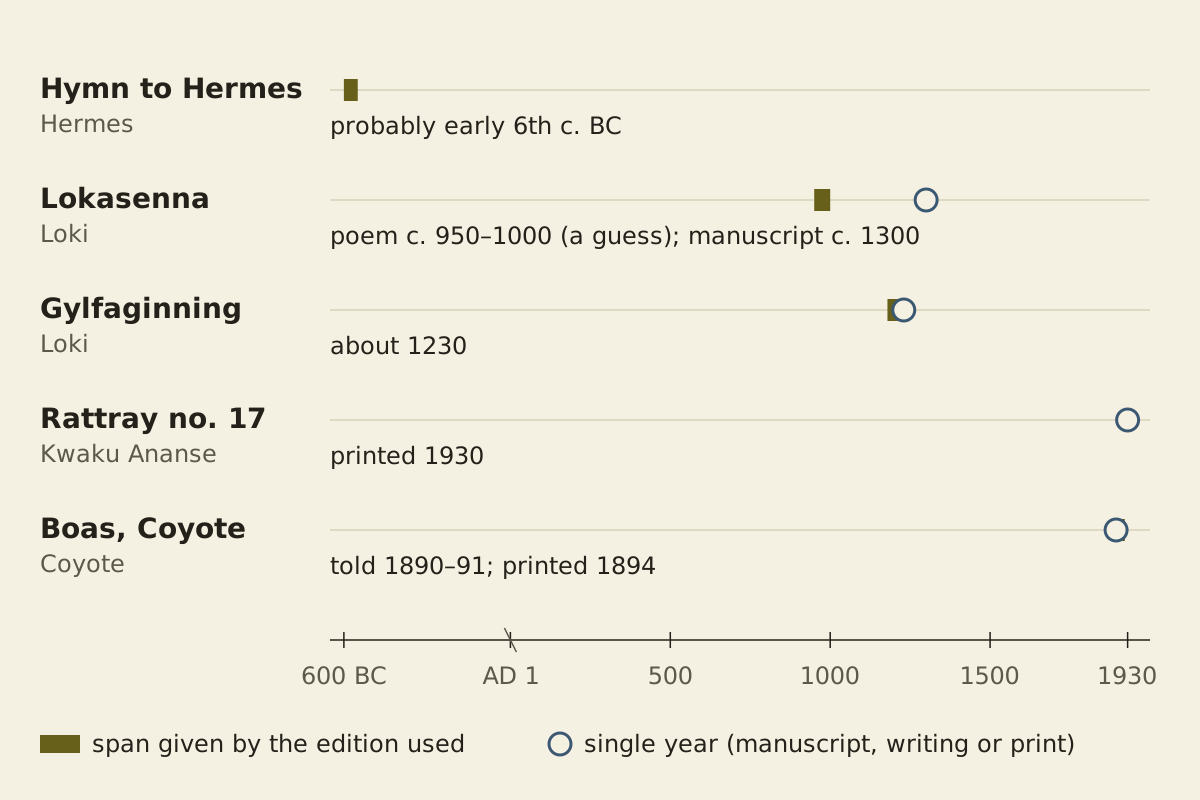
The five texts compared on this page, placed by the dates their own editions give, from a probable early sixth century BC for the Hymn to Hermes to Rattray’s printing of 1930.
Credit line for reuse
"Five trickster texts, by the dates their editions give" by Once Upon a Version — https://onceuponaversion.com/across-cultures/trickster-gods-compared/ — licensed under CC BY 4.0 (https://creativecommons.org/licenses/by/4.0/)
Data: Editions named on the page and GND 118797816 via lobid-gnd, retrieved 2026-11-03
An Akan teller’s tale in R. S. Rattray’s 1930 collection begins by taking its own words back. Rattray says he gathered the tales in villages across most of Ashanti and south into Kwawu, and he printed them at Oxford in 1930 with the Twi text facing his English.
Tale no. 17 opens with the formula “We do not really mean, we do not really mean, (that what we are going to say is true),” and then tells how Kwaku Ananse, the spider, bought the Sky-god’s stories. It is the first of five texts set side by side on this page under one label: trickster gods.
The comparison counts rather than collects. Each text was checked for the same eight motifs, and the count is reported with its denominator, five, so that every claim of likeness on this page comes with the cases where the likeness fails.
Which tellings are compared here?
The five texts were chosen because each has a named public-domain English text, and because together they cover four traditions. Two of them are about Loki, so the grid also shows how much one trickster can vary between two texts from the same tradition.
- The Homeric Hymn to Hermes. All 580 lines, in Hugh G. Evelyn-White’s translation (preface dated 1914, Project Gutenberg 348). Evelyn-White thought a date in the earlier part of the sixth century BC most probable.
- Lokasenna, “Loki’s Wrangling”. The whole poem and its prose passages, in Henry Adams Bellows’s The Poetic Edda (1923, Project Gutenberg 73533). Bellows calls the late tenth century the best guess for the poem and dates its manuscript as early as 1300.
- Gylfaginning, “The Fooling of Gylfe”. Seven of the sections of Snorri Sturluson’s Edda in which Loki appears, in Rasmus B. Anderson’s translation (copyright 1879, Project Gutenberg 18947). Anderson, following Keyser, dates this part of the book to about 1230.
- Rattray, Akan-Ashanti Folk-Tales, no. 17. The English pages 55 to 59 of the 1930 edition, with the Twi on the facing pages. Rattray translated the tale himself.
- Boas, Chinook Texts, myth no. 6, “Coyote”. The English translation on pages 101 to 106 of the 1894 edition. Charles Cultee told the myth to Franz Boas, who collected the book’s texts in the summers of 1890 and 1891; no date is given for this myth.
Other candidates were left out so that every column could be read in full in a public-domain English text. Prometheus, who tricks Zeus in Hesiod’s Theogony, appears at the end of this page as another teller, and Coyote’s other myths in Boas’s book, like the Crane story mentioned later, would each need a column of their own.
Each of these is what this site calls a one-evening text: a passage that can be pinned to an edition and a page or line, not the myth itself. The table below records who tells the story in each one: only the two collected texts come from living tellers, and of those two only Boas names his.
The five texts, their tellers and editions, as CSV (where the data comes from) Data: Five public-domain texts named on the page (Evelyn-White 1914, Bellows 1923, Anderson 1879, Rattray 1930, Boas 1894), retrieved 2026-11-03; GND via lobid-gnd, retrieved 2026-11-03
| Text | Trickster | Who tells it | English text used |
|---|---|---|---|
| Hymn to Hermes | Hermes | an unnamed poet, who opens by asking the Muse to sing and closes with a farewell to Hermes | Hugh G. Evelyn-White, Hesiod, the Homeric Hymns and Homerica (preface dated 1914), Project Gutenberg 348 |
| Lokasenna | Loki | an unnamed poet; the prose before and after the stanzas is by the compiler of the collection, in Bellows’s account | Henry Adams Bellows, The Poetic Edda (New York: American-Scandinavian Foundation, 1923), Project Gutenberg 73533 |
| Gylfaginning | Loki | Snorri Sturluson, who wrote or compiled the main part, in Anderson’s account; inside the book, three speakers called Har, Jafnhar and Thride answer a disguised king (Gylfe, calling himself Ganglere) | Rasmus B. Anderson, The Younger Edda (Chicago, copyright 1879), Project Gutenberg 18947 |
| Rattray no. 17 | Kwaku Ananse | an Akan story-teller whose name is unrecorded | R. S. Rattray, Akan-Ashanti Folk-Tales (Oxford: Clarendon Press, 1930), his own translation from the Twi |
| Boas, Coyote | Coyote | Charles Cultee, at Bay Center, Washington | Franz Boas, Chinook Texts (Washington: Government Printing Office, 1894), his own translation |
The word “trickster” is the comparer’s label, not the tellers’. In the three Project Gutenberg editions used here it occurs once, when Evelyn-White’s Apollo greets the infant god as “Slayer of oxen, trickster, busy one, comrade of the feast” (lines 436–462). It does not occur in Rattray’s no. 17 or in Boas’s Coyote myth, and none of the editions read for this page says who first applied it to figures like these.
How are the five texts dated?
Every date on the timeline comes from the edition used, and three of them are ranges or guesses. Evelyn-White dates the Hymn to Hermes by its seven-stringed lyre, an invention he notes is ascribed to Terpander (flourished 676 BC), so in his view the hymn must be later than that, though he adds that Terpander may only have modified the lyre’s scale.
Bellows offers the late tenth century for Lokasenna only as the best guess, and Anderson, citing the scholar Rudolf Keyser, dates Gylfaginning to about 1230, within Snorri’s life (1179–1241, by the German national authority file).
The two collected texts are dated by their printing. Boas recorded Cultee in 1890 and 1891 and printed the myths in 1894; Rattray’s preface is dated April 1930 and gives no year for any single telling. The Akan tale therefore reached print 36 years after the Chinook myth, but nothing in either book says which story is older.
How does Anansi buy the Sky-god’s stories?
Tale no. 17 opens with a purchase. Kwaku Ananse, the spider, “once went to Nyankonpon, the Sky-god, in order to buy the Sky-god’s stories” (p. 55). The Sky-god doubts him, pointing out that great and powerful towns, Kokofu, Bekwai and Asumengya among them, have already tried and failed, “and you who are but a mere masterless man, (you say) you will be able?”
Ananse asks the price, and when the Sky-god has named it, Ananse raises his own bid without being asked.
I will bring some of all these things, and (what is more), I’ll add my old woman, Nsia (The Sixth-child), to the lot.
told by an unrecorded Akan teller · recorded and translated by R. S. Rattray · Akan-Ashanti Folk-Tales, 1930, no. 17, p. 55
The rest of the tale is four captures, and Ananse’s wife, Aso, supplies the plan for three of them. For the python, she tells him to cut a palm branch and a creeper, and Ananse stages a quarrel within the python’s hearing about whether the branch is longer than the snake. The python offers to be measured, stretches out along the branch, and is tied to it.
For the hornets, Ananse sprinkles water on the hornets and on himself, holds a plantain leaf over his head, and invites them into his gourd out of the rain.
To catch the leopard, he digs a pit across its tracks, then offers to help the trapped animal out and kills it with his knife as it climbs. For the fairy, a plan that is his alone, he carves a wooden doll, smears it with sticky latex, and puts mashed yam in its hand and in a brass basin. The fairy eats, thanks the doll, gets no answer, slaps it, and sticks fast.
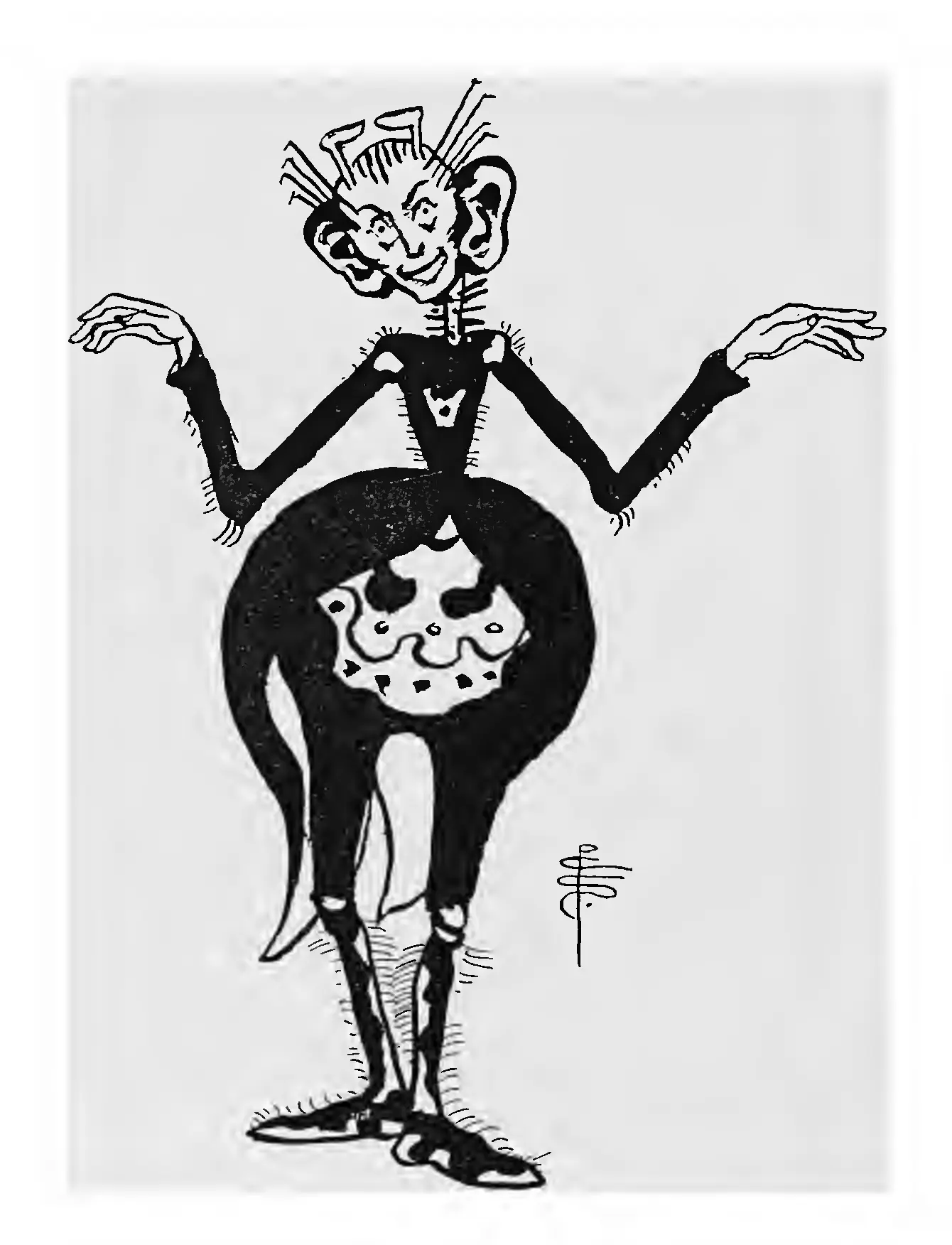
Annancy drawn as half man, half spider, from a collection of Jamaican tales, not the Akan book. Pamela Colman Smith, Annancy Stories (New York: R. H. Russell), 1899.
Full credit
"Illustration for Annancy Stories (Anansi-34)" by Pamela Colman Smith — https://commons.wikimedia.org/wiki/File:Anansi-34.png — Public domain in US (published New York, 1899); DE/FR (Pamela Colman Smith d. 1951, life+70); scan of the Cornell University Library copy (Internet Archive cu31924079620021, sponsored by MSN, not a Google scan), extracted from the Commons PDF of that scan
How does the purchase end?
After each of the first three deliveries the Sky-god answers with the same receipt: his hand has touched, and what remains still remains (p. 57). When the last captive arrives with Ananse’s mother, the Sky-god calls his chiefs and elders, lists the five items, and has them sing the spider’s praise. Then he hands over the goods and changes their name.
No more we shall call them the stories of the Sky-god, but we shall call them Spider-stories.
told by an unrecorded Akan teller · recorded and translated by R. S. Rattray · Akan-Ashanti Folk-Tales, 1930, no. 17, p. 59
Nothing in the tale goes wrong for Ananse. He is not caught, beaten or punished, and the only change of status is upward, from “a mere masterless man” to the owner of a whole kind of story. In the Sky-god’s own words, Ananse added his mother “of his own accord” (p. 59), and the tale lets that detail pass without comment.
“We do not really mean”: what does the Akan frame do?
Rattray’s preface explains the formula that opens tale no. 17. In his account, the stories may only be told after dark (the one exception is the funeral of a famous story-teller), and the teller always disowns the story before starting.
The story-teller invariably precedes his tale with a public disclaimer that what he is about to say is true
written by R. S. Rattray · Akan-Ashanti Folk-Tales, 1930, preface, p. x
He gives the spoken form as “We don’t really mean to say so; we don’t really mean to say so” (p. x), close to the line printed at the head of no. 17.
According to Rattray and the informants he cites, tellers had a licence, and the disclaimer protected them: a story could mock a chief, or even the King of Ashanti, if real names were replaced, so that a great chief might become the Sky-god and another person “the Spider” (p. xi). That is Rattray’s explanation of the custom, reported here as his; this page does not test it.
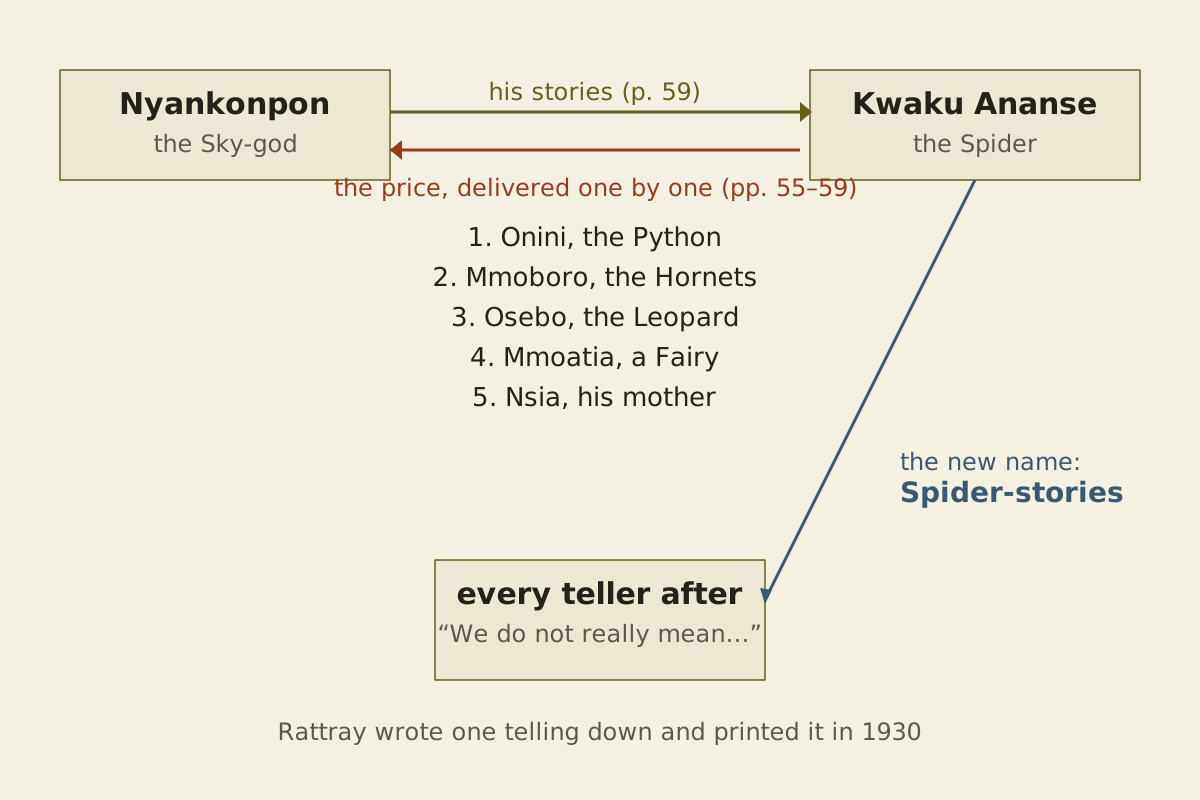
Who owns the stories in Rattray’s tale no. 17: the Sky-god sells them, Ananse pays a price of five items, and the stories are renamed Spider-stories, the name that, by Rattray’s account, Akan tellers give to every tale in his book.
Credit line for reuse
"Who owns the stories in Rattray’s tale no. 17" by Once Upon a Version — https://onceuponaversion.com/across-cultures/trickster-gods-compared/ — licensed under CC BY 4.0 (https://creativecommons.org/licenses/by/4.0/)
Data: Rattray, Akan-Ashanti Folk-Tales (1930), no. 17, retrieved 2026-11-03
The tale and the preface fit together. Rattray notes that every story in the book would be classed by Akan speakers as Anansesem, Spider-stories, whether the spider appears in it or not, and adds in a footnote that the same stories are also called Nyankonsem, “the words of the Sky-god” (p. xiii). Tale no. 17 is the story of how the second name gave way to the first.
Rattray describes how the text was made. After an evening of story-telling, the best tale was noted, its teller was asked to come back later and repeat it, and the tale was written down and read over for correction (p. vi). The teller of no. 17 is not named in the preface or with the tale, so the Telling card above records the teller as unrecorded and the recorder as Rattray.
The English is Rattray’s too, and he says he made the translation “as nearly literal as possible,” that his only editing of the Twi was to record the tales in a more or less uniform dialect, and that in the English he occasionally altered a tense where a teller slipped from past to present (p. vi). The quotations on this page are from that English, with the page of the 1930 edition.
The preface admits one more thing about the text: Rattray says he heard most of the tales three or four times, told by different men and women in places far apart, and “The same tale was never quite the same, although always clearly recognizable” (p. viii). The tale on pages 55 to 59 is one of those tellings, the one he printed.
Is Anansi a god?
Not in this tale: no. 17 never calls Kwaku Ananse a god, and the Sky-god, who is one, dismisses him as “a mere masterless man.” Ananse has a wife, Aso, and a mother, Nsia, and he lives in a world of towns, chiefs and elders. What makes him remarkable here is not divine power but a successful bargain with the one figure in the story who has it.
Rattray’s preface adds a reason to be careful with the question. In his account, the animal names in these tales, and sometimes even the Sky-god’s, stood in for real people whom it would have been unwise to name (pp. xi–xii). On that reading, the spider of a given telling might be a neighbour or a chief as easily as a god. The search label “trickster gods” fits Hermes and Loki, who are gods in their own texts, better than it fits either Ananse or Boas’s Coyote.
How does Hermes get Apollo’s cattle?
The Hymn to Hermes compresses its plot into one sentence near the start: “Born with the dawning, at mid-day he played on the lyre, and in the evening he stole the cattle of far-shooting Apollo” (lines 1–29). The lyre comes first: on his way out of the cave, the newborn god finds a tortoise, and the hymn says that “it was Hermes who first made the tortoise a singer.”
The theft follows that evening, when Hermes cuts fifty cows out of Apollo’s herd, drives them backwards so that their hoof-marks point the wrong way, and ties brushwood under his own feet so that his footprints match no known creature (lines 68–86). He promises an old man at Onchestus plenty of wine if he keeps quiet (lines 90–93), and before dawn he invents fire-sticks, the hymn says, and roasts two of the cows (lines 94–137).
Then he goes home, passing through the keyhole “like the autumn breeze, even as mist” (lines 138–154). The grid below marks this cell undetermined: the words could describe a change of form or simply compare his silent entry to a breeze. When Apollo arrives, Hermes lies from the cradle that he was born yesterday and knows nothing of cows (lines 260–277). Apollo picks him up to carry him off, and the two end up before Zeus (lines 293–330).
Zeus laughs at the performance, orders Hermes to show Apollo where the cattle are hidden, and the quarrel ends in a trade. Set beside Rattray’s tale, the two prices are named by different people at different moments.
Rattray 1930 · no. 17, p. 55
They cannot be bought for anything except the Onini creature the Python; Osebo, the Leopard; Mmoatia, the Fairy; (and) Mmoboro, the Hornets.
told by an unrecorded Akan teller · recorded and translated by R. S. Rattray · Akan-Ashanti Folk-Tales, 1930, no. 17, p. 55
Evelyn-White 1914 · Hymn to Hermes, lines 436–462
Slayer of oxen, trickster, busy one, comrade of the feast, this song of yours is worth fifty cows, and I believe that presently we shall settle our quarrel peacefully.
translated by Hugh G. Evelyn-White · Hesiod, the Homeric Hymns and Homerica, 1914, Hymn to Hermes, lines 436–462
What changed: The Sky-god sets his price before anything changes hands; Apollo puts a value on the lyre after the theft, and the figure he names is the number of cows that were stolen.
Hermes hands over the lyre, and Apollo gives him a shining whip and makes him keeper of herds (lines 496–502). Apollo then asks Hermes to swear not to steal the lyre or his bow, because Hermes has “an office from Zeus, to establish deeds of barter amongst men throughout the fruitful earth” (lines 513–520). Evelyn-White’s own summary uses the same language of trade: Hermes “purchases various prerogatives” with the gift of the lyre.
What does Hermes get in the end?
A share of honour was what Hermes wanted from the start. Back in the cave at dawn, his mother Maia scolds him, and he answers that he will not stay “unfee’d with offerings and prayers” while the other gods are honoured; if Zeus will not give him a share, he will become “a prince of robbers” (lines 162–181).
By the end of the hymn he has the share without the robbery. Zeus makes him lord over birds of omen and over flocks and herds, and the only appointed messenger to Hades (lines 568a–573).
The hymn’s last word on him keeps both sides. Hermes “consorts with all mortals and immortals: a little he profits, but continually throughout the dark night he cozens the tribes of mortal men” (lines 574–578). The grid counts the theft, the trade and the deceptions as present, and counts nothing against him at the end: the hymn’s god comes off worse for a few hours, not for good.
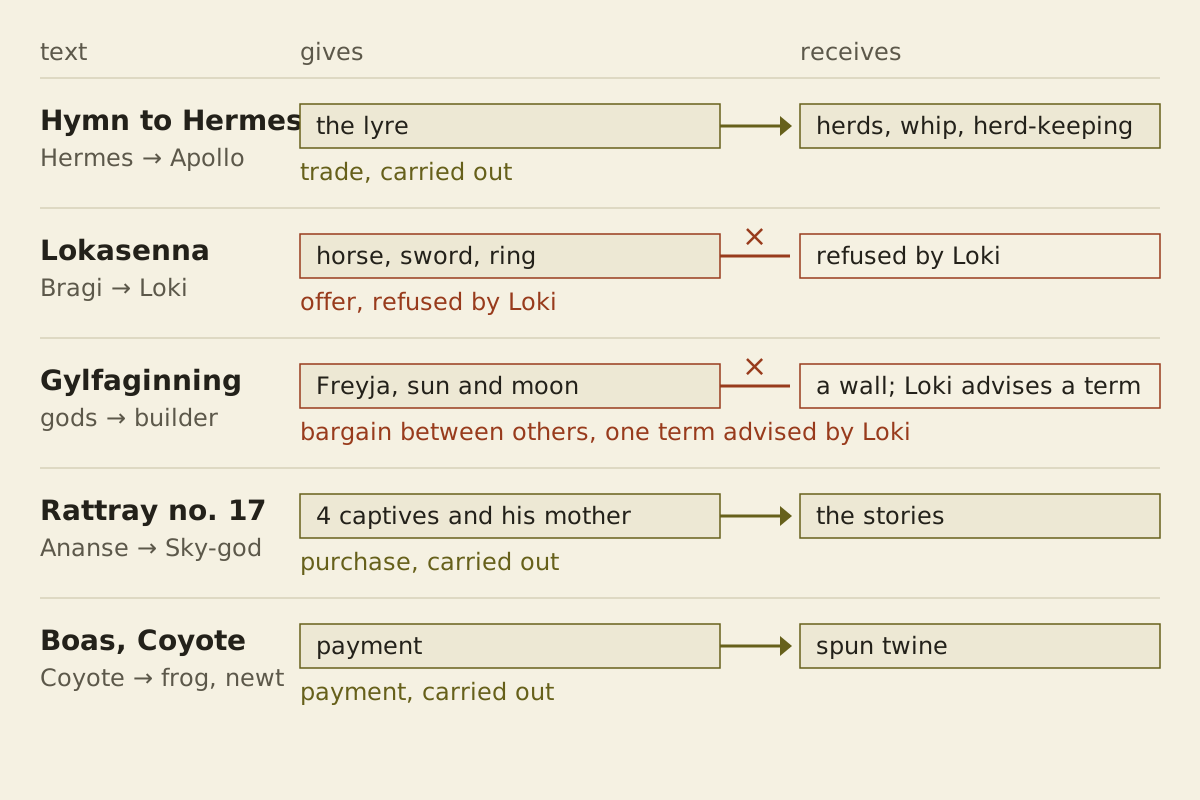
Who gives what to whom in each text: three exchanges are carried out, one offer is refused and one bargain between others includes a term Loki advised.
Credit line for reuse
"Five exchanges in five trickster texts" by Once Upon a Version — https://onceuponaversion.com/across-cultures/trickster-gods-compared/ — licensed under CC BY 4.0 (https://creativecommons.org/licenses/by/4.0/)
Data: Five public-domain texts named on the page (Evelyn-White 1914, Bellows 1923, Anderson 1879, Rattray 1930, Boas 1894), retrieved 2026-11-03
The five exchanges, with line and page numbers, as CSV (where the data comes from) Data: Five public-domain texts named on the page (Evelyn-White 1914, Bellows 1923, Anderson 1879, Rattray 1930, Boas 1894), retrieved 2026-11-03
| Text | Who gives | What | To whom | In return | Outcome |
|---|---|---|---|---|---|
| Hymn to Hermes | Hermes | the lyre he made | Apollo | the herds, a shining whip and the office of keeper of herds | trade, carried out |
| Lokasenna | Bragi | a horse, a sword and a ring | Loki | peace in the hall | offer, refused by Loki |
| Gylfaginning | the gods | Freyja, the sun and the moon, if the wall is done in one winter | a builder | a wall round the gods’ town; Loki advises that the builder may use his horse | bargain between others, one term advised by Loki |
| Rattray no. 17 | Kwaku Ananse | a python, hornets, a leopard, a fairy and his mother Nsia | the Sky-god | the Sky-god’s stories, renamed Spider-stories | purchase, carried out |
| Boas, Coyote | Coyote and the snake | payment (the text does not say what) | the frog and the newt | twine spun for their nets | payment, carried out |
Loki trades insults: what happens in Lokasenna?
Lokasenna survives in a single manuscript, the Codex Regius, which Bellows says was written as early as 1300. In his introductory note he calls the late tenth century and Iceland “the best guesses” for the poem itself, and he credits the prose passages before and after it to the compiler of the collection.
The opening prose sets the scene at a feast in the hall of the sea-god Ægir. The guests praise Ægir’s two serving-men; Loki cannot bear it and kills one of them, Fimafeng, and “the gods shook their shields and howled at Loki and drove him away to the forest.” He comes back, demands a seat, and reminds Othin that the two of them once mixed their blood as sworn brothers (stanza 9).
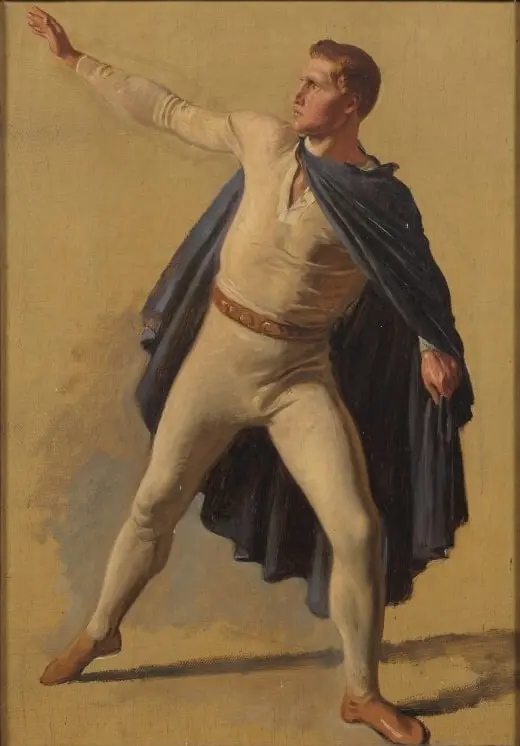
Loki, as a study for a painting of Ægir’s feast. Constantin Hansen, oil on canvas, 1855. Nationalmuseum, Stockholm, NM 7460.
Full credit
"Loki. Study for Ægir’s Feast" by Constantin Hansen — https://commons.wikimedia.org/wiki/File:Constantin_Hansen_-_Loki._Study_for_%C3%86gir%E2%80%99s_Feast_-_NM_7460_-_Nationalmuseum.jpg — Public domain in US (Constantin Hansen d. 1880; painted 1855, exhibited 1918); DE/FR (Constantin Hansen d. 1880, life+70); faithful photograph of a two-dimensional painting (PD-Art; museum photograph, Nationalmuseum, Stockholm); modified: Cropped to the painted canvas; the wooden frame is removed
The poet Bragi tries to buy peace. “A horse and a sword from my hoard will I give, And a ring gives Bragi to boot,” he offers (stanza 12), if Loki will not stir up hatred among the gods. Loki refuses and calls him the least brave in battle of everyone present. On the grid that refused offer counts as a transformed exchange, the only kind of trade that appears in this poem.
What do the insults say about Loki?
From there the poem is a round of insults. Loki answers each god or goddess who speaks with a charge from their past, and twice the charge comes back at him. Othin says that Loki spent eight winters under the earth “Milking the cows as a maid,” and bore children (stanza 23); Njorth calls him a “womanish god” who has borne babes (stanza 33). These are taunts in the mouths of other speakers, and the grid marks the sex-crossing cell for this poem as transformed rather than present.
Loki also claims the blame for the death of Baldr (stanza 28), and one stanza calls him “Loki the crafty in lies” (stanza 54). But nobody is deceived in the poem itself. Thor arrives and threatens him four times (stanzas 57–63), and Loki leaves, saying he goes only because Thor fights well.
The closing prose then tells the punishment. Loki hides in a waterfall “in the guise of a salmon,” the gods catch him and bind him, and poison drips onto his face; when he struggles the earth shakes, “and now that is called an earthquake.” Bellows’s introduction also names a scholar this site meets elsewhere: Jacob Grimm, who linked the word Edda to a word meaning “great-grandmother,” a guess Bellows rejects. He is the same Jacob Grimm whose named tellers this site lists, named in Bellows’s introduction.
Loki in Snorri’s Edda: what does Gylfaginning add?
Gylfaginning is told inside a deception of its own. A king called Gylfe goes in disguise, as Ganglere, to question three speakers in a hall, and the book’s English title in Anderson’s version is “The Fooling of Gylfe.” Everything said about Loki here is an answer given to a disguised questioner.
The first answer introduces him without kindness. Loki is “the originator of deceit, and the disgrace of all gods and men,” fair of face but “evil in disposition,” and the speaker adds that he has often brought the gods into trouble and often helped them out again with his “cunning contrivances” (§ 33).
The sections that follow bear both halves out. When a builder offers to wall in the gods’ town for the price of the goddess Freyja and the sun and moon, the gods agree, and “at the suggestion of Loke” the builder may use his horse (§ 43).
Once the wall is nearly finished, the gods decide that the whole bargain must have been Loki’s advice and lay hands on him, and he undoes it: a mare runs out of the woods and lures the builder’s stallion away. Some time later Loki bears a foal, the gray, eight-legged Sleipner, “the best horse among gods and men,” and it is on Sleipner that Hermod later rides to the underworld to ask for Baldr back (§ 50).
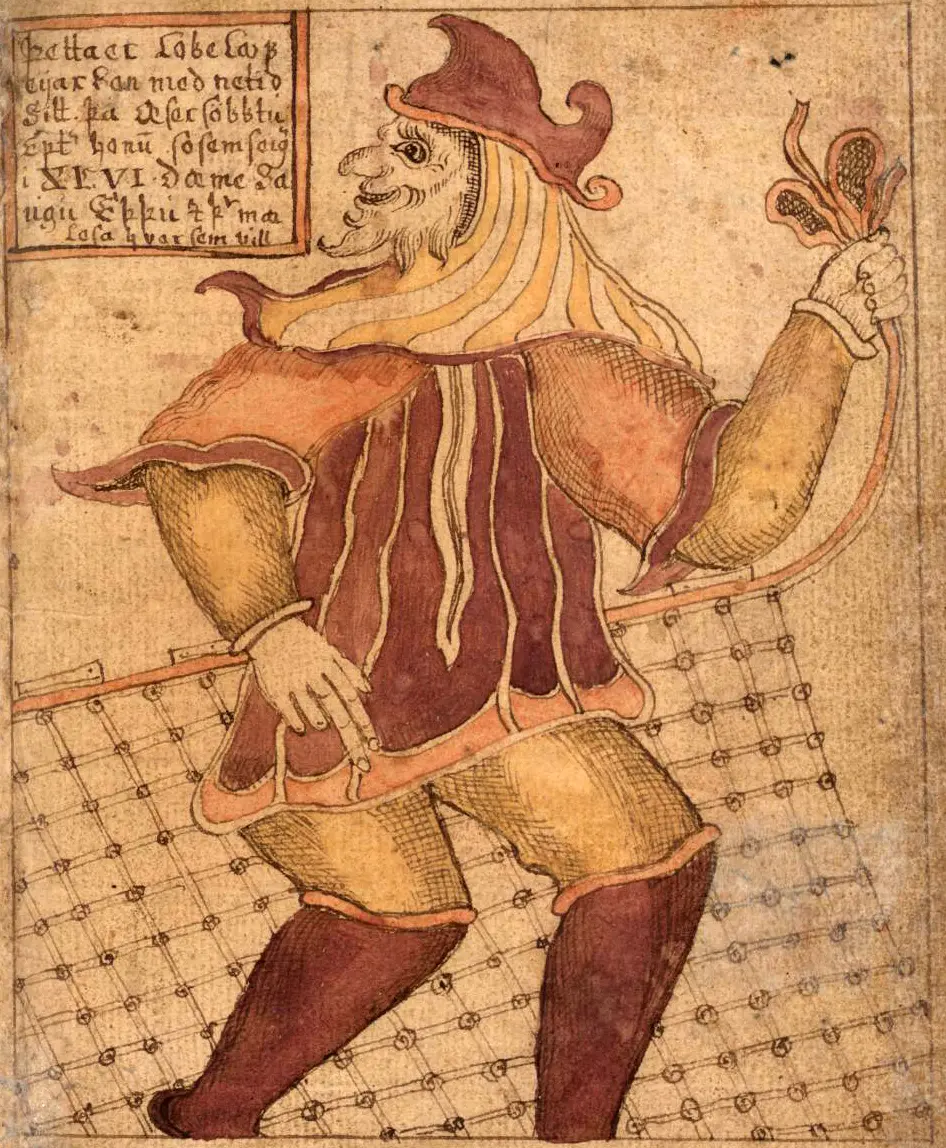
Loki with the net he knotted, as drawn in an Icelandic manuscript. Jakob Sigurðsson, SÁM 66, fol. 79r, 1765–66. Árni Magnússon Institute, Reykjavík.
Full credit
"SÁM 66, 79r, Loki" by Jakob Sigurðsson — https://commons.wikimedia.org/wiki/File:S%C3%81M_66,_79r,_Loki.jpg — Public domain in US (manuscript of 1765–66); DE/FR (Jakob Sigurðsson, 18th-century draughtsman, life+70); faithful reproduction of a two-dimensional manuscript page (PD-Art), digitized for the Árni Magnússon Institute’s Sagnanet; cropped, rotated and levelled by the Commons uploader
Loki does not always win, either: on Thor’s journey to Utgard he claims that no one eats faster, and he loses the eating contest to a man named Loge, who turns out to be wildfire (§§ 47–48). In the account of Baldr’s death, he takes “the likeness of a woman” to learn from Frigg that the mistletoe alone swore no oath, then guides the blind Hoder’s shot (§ 50). A giantess who refuses to weep Baldr out of the underworld, the text adds, “is generally believed” to have been Loki (§ 53).
The last section is the punishment that Lokasenna’s closing prose also tells. Read side by side, the two texts agree on the salmon, the binding with a son’s entrails and the earthquakes, and disagree about the two sons.
Bellows 1923 · Lokasenna, closing prose
He was bound with the bowels of his son Vali, but his son Narfi was changed to a wolf.
translated by Henry Adams Bellows · The Poetic Edda, 1923, Lokasenna, closing prose
Anderson · Gylfaginning, § 54
Vale they changed into the likeness of a wolf, whereupon he tore his brother Narfe to pieces, with whose intestines the asas bound Loke over the three rocks.
translated by Rasmus B. Anderson · The Younger Edda, 1879, § 54
What changed: The two sons swap roles. In Bellows’s note on stanza 49, Snorri “turns the story about,” making Vali the wolf and using Narfi’s entrails for the binding.
Gylfaginning also gives Loki an invention. In hiding, he sits in his house and knots flax into meshes “in the manner that nets have since been made,” burns the net when the gods come, and the gods copy it from the ashes to catch him (§ 54). When Thor catches him by the tail, the text says, “this is the reason why the salmon has so slim a tail.”
Is Loki a trickster in both Norse texts?
On this page’s definitions, the two texts give different answers. Gylfaginning narrates three deceptions, of the builder, of Frigg and of the blind Hoder, and calls Loki “the originator of deceit.” Lokasenna narrates none. Its Loki kills a servant, insults a hall full of gods to their faces, refuses a bribe and walks out, and the poem’s only word for his lying is an epithet in a single stanza.
Both texts end with the same punishment, and in both the gods act together: they catch him, bind him and leave him under dripping poison, and Anderson’s text adds that he will lie bound until Ragnarok. Neither Bellows nor Anderson uses the word trickster anywhere in his book. Whether Loki is a trickster therefore depends on which text is read and on what the reader counts, which is why the two Loki texts have separate columns in the grid.
Coyote in Boas’s Chinook texts: does he trick anyone?
Franz Boas names the teller of every text in his book. The book’s heading credits the texts as told by Charles Cultee and recorded and translated by Boas (p. 5), and the introduction says they were collected in the summers of 1890 and 1891, from one of the last two speakers of Chinook, at Bay Center, Washington. Boas calls Cultee “a veritable storehouse of information” and says the two of them could talk only through the Chinook jargon (p. 6).
In myth no. 6, Coyote travels from place to place, changing the land and setting rules as he goes. Afraid of the surf at Clatsop, he throws sand on it and says, “This shall be a prairie and no surf. The future generations shall walk on this prairie” (p. 101). Most of the myth is about salmon. Again and again his catch fails, he asks his own excrements why the fish have gone, and they scold him with the rule he broke.
Coyote pays for help but deceives no one. With the snake, he “bought material for twine, and paid the frog and the newt to spin it” (p. 102). He races the snake at net-making and loses: “Coyote was ashamed. The snake had won over him” (p. 103). In the end he fixes the salmon customs for the people to come: “Thus shall be the taboos for all generations of Indians” (p. 105), adding, “Even I got tired.”
The rules are local, and the myth says so. When Coyote moves with his companions to “the other side,” the old rules stop working, and his excrements tell him that on this side a salmon must be kicked, must not be thrown ashore head down, and must have salmonberries put in its mouth, and they ask him whether he thinks “it is the same here as at Clatsop” (p. 105). These are story rules recorded from one teller, and they are given here as plot, not as instructions.
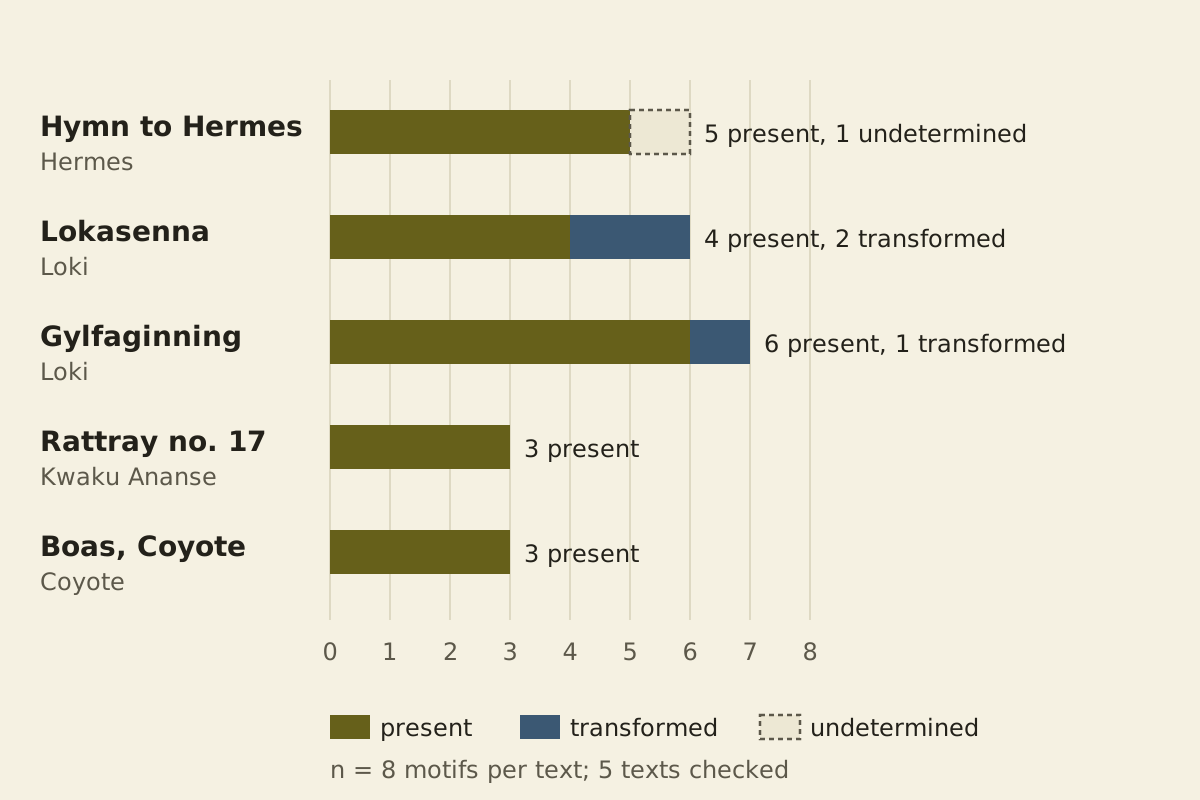
How many of the eight motifs each text has: Gylfaginning has the most, and the Akan and Chinook texts have three each.
Credit line for reuse
"Motifs present in each of five trickster texts" by Once Upon a Version — https://onceuponaversion.com/across-cultures/trickster-gods-compared/ — licensed under CC BY 4.0 (https://creativecommons.org/licenses/by/4.0/)
Data: Five public-domain texts named on the page (Evelyn-White 1914, Bellows 1923, Anderson 1879, Rattray 1930, Boas 1894), retrieved 2026-11-03
On this page’s definitions, this Coyote is not a deceiver at all. The next myth in Boas’s book, “The Crane,” opens with Coyote fooling Crane at night with a false alarm and saying he has only deceived him (p. 110). That myth lies outside the checked passage, so the deception cell for myth no. 6 stays absent in the checked text, and the Crane story is left for another grid.
Motif grid: eight motifs in five texts
Each motif, a recurring story element defined by this site, was written down before any cell was filled: what counts as present, which specific changes count as transformed, and what does not count. A cell marked absent means only that the checked passage does not contain the motif, not that the trickster lacks it in other texts or in the wider tradition.
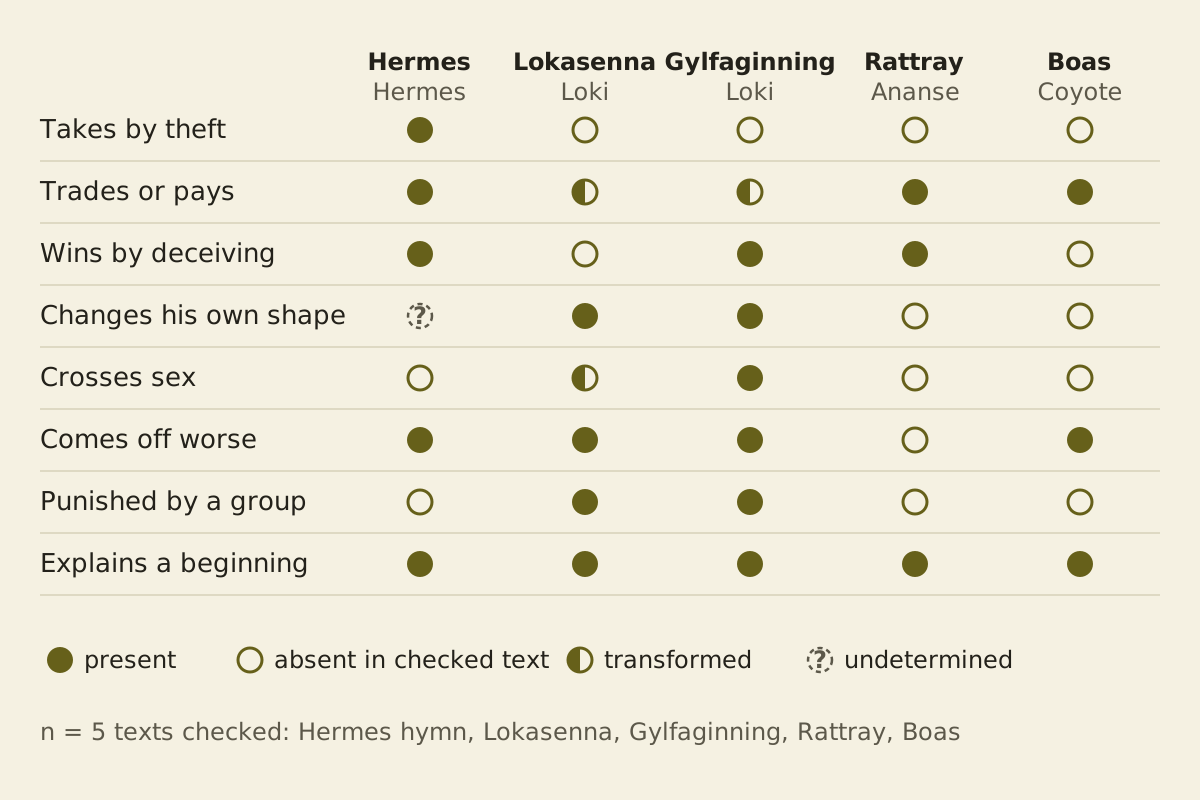
Eight motifs in five texts; n = 5 texts checked: Hymn to Hermes, Lokasenna, Gylfaginning, Rattray no. 17, Boas’s Coyote.
Credit line for reuse
"Motif grid: five trickster texts, eight motifs" by Once Upon a Version — https://onceuponaversion.com/across-cultures/trickster-gods-compared/ — licensed under CC BY 4.0 (https://creativecommons.org/licenses/by/4.0/)
Data: Five public-domain texts named on the page (Evelyn-White 1914, Bellows 1923, Anderson 1879, Rattray 1930, Boas 1894), retrieved 2026-11-03
The 40 cells, with line and page numbers, as CSV (where the data comes from) Data: Five public-domain texts named on the page (Evelyn-White 1914, Bellows 1923, Anderson 1879, Rattray 1930, Boas 1894), retrieved 2026-11-03
| Motif | Hymn to Hermes | Lokasenna | Gylfaginning | Rattray no. 17 | Boas, Coyote |
|---|---|---|---|---|---|
| Takes by theft | present | absent in checked text | absent in checked text | absent in checked text | absent in checked text |
| Trades or pays | present | transformed | transformed | present | present |
| Wins by deceiving | present | absent in checked text | present | present | absent in checked text |
| Changes his own shape | undetermined | present | present | absent in checked text | absent in checked text |
| Crosses sex | absent in checked text | transformed | present | absent in checked text | absent in checked text |
| Comes off worse | present | present | present | absent in checked text | present |
| Punished by a group | absent in checked text | present | present | absent in checked text | absent in checked text |
| Explains a beginning | present | present | present | present | present |
n = 5 texts checked: the Hymn to Hermes, lines 1–580 (Evelyn-White); Lokasenna, with its prose (Bellows); Gylfaginning, §§ 33–34, 43, 47, 50, 53–54 (Anderson); Rattray 1930, no. 17, pp. 55–59; Boas 1894, myth no. 6, pp. 101–106. Of the 40 cells, 21 are present, 3 transformed, 1 undetermined and 15 absent in the checked text. The definitions are a separate download: the eight motif definitions as CSV (where the data comes from) Data: Once Upon a Version, 2026-11-03.
One motif is present in all five texts: each passage ties to its trickster the beginning of something its listeners know, whether an object, a custom, a name or a natural event, and no other motif reaches five. “Comes off worse” is present in four, missing only from Rattray’s tale, and “Takes by theft” is present in one.
The transformed cells follow forms listed in advance. Both Loki texts have an exchange that Loki does not make: in Lokasenna an offer to him is refused, and in Gylfaginning he advises one term of a bargain struck between the gods and a builder. The third transformed cell is the sex-crossing in Lokasenna, which other speakers allege but the poem does not narrate.
The single undetermined cell is the Hermes keyhole. The definitions count a change of shape only when the text says the trickster takes another form, and “like the autumn breeze, even as mist” could be read as either a change into mist or a comparison for his silent entry. Marking it absent would claim more than the English line says, so the cell is left open, and the motif is counted as present in two texts, not three.
What do the five texts not share?
Read for differences, the five tricksters come apart quickly, beginning with theft, which only Hermes commits. Only the two Loki texts have a group that punishes the trickster, only they plainly say he changes his shape (the Hermes keyhole is left open), and only Gylfaginning narrates a change of sex. Ananse never fails, and Coyote fails often but is never punished. In Ananse’s tale the trickster’s own household also carries much of the plot: his wife plans three of the four captures, and his mother is part of the price.
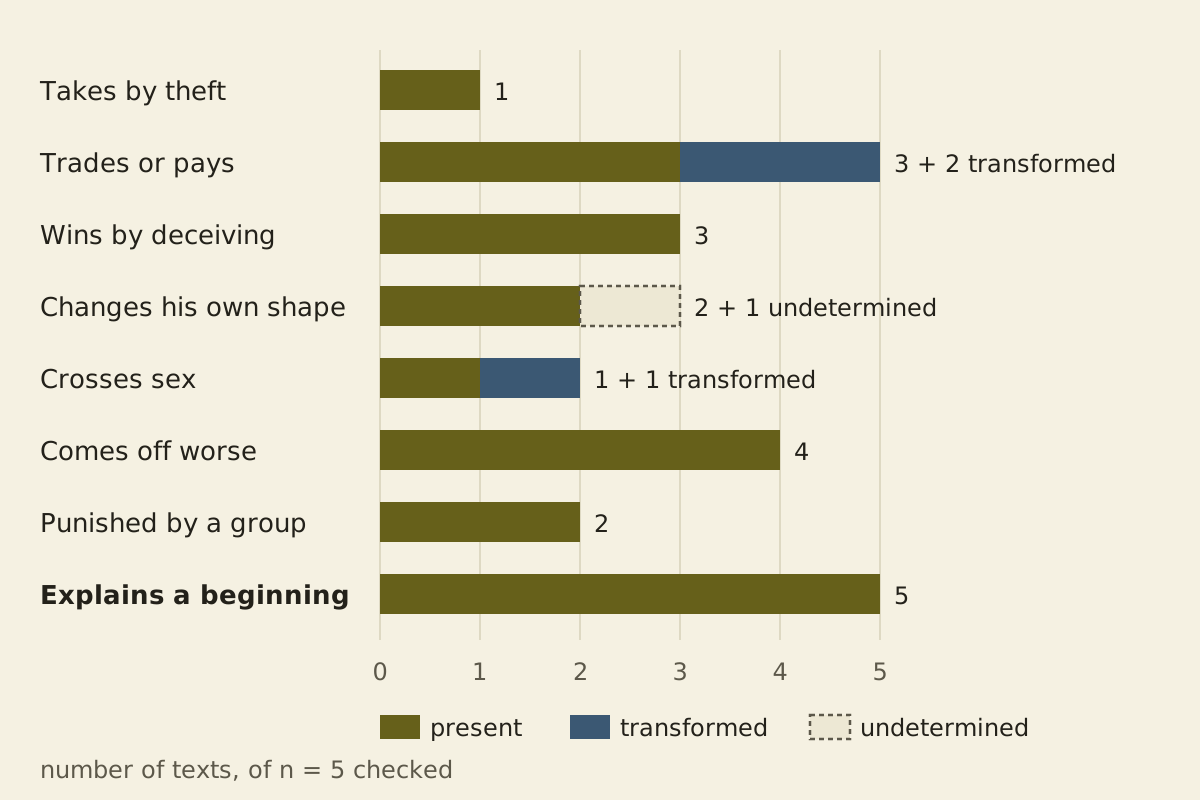
In how many of the five texts each motif is present, with the transformed and undetermined cells shown separately.
Credit line for reuse
"In how many of five trickster texts each motif appears" by Once Upon a Version — https://onceuponaversion.com/across-cultures/trickster-gods-compared/ — licensed under CC BY 4.0 (https://creativecommons.org/licenses/by/4.0/)
Data: Five public-domain texts named on the page (Evelyn-White 1914, Bellows 1923, Anderson 1879, Rattray 1930, Boas 1894), retrieved 2026-11-03
The five also reach the reader through different frames, and each frame says something about who is speaking. The hymn opens by asking the Muse to sing and closes with the singer’s farewell to Hermes.
Lokasenna is wrapped in a compiler’s prose, Gylfaginning is a set of answers given to a king in disguise, Rattray’s tale is fenced by a disclaimer at the start and a request at the end, and Boas’s book credits every myth to Cultee in its heading. Only the Akan frame tells the listener not to believe what follows.
Even the one shared motif explains very different things. The Hymn to Hermes claims the lyre and fire-sticks for its god; both Loki texts explain earthquakes, and Gylfaginning adds the net and the salmon’s thin tail. Rattray’s tale explains the name of a whole kind of story, and Boas’s myth explains a prairie and the rules for catching salmon.
An illustration of a spider above a knotted cord, a reminder of the four captures in Rattray’s tale no. 17; not a historical object.
Illustration: Once Upon a Version. Generated illustration — not a historical image, manuscript or record. © Once Upon a Version, all rights reserved; reuse by request.
These are counts, not a family tree. The grid records what each passage says; it cannot show who heard whom, and no source read for this page traces a line of borrowing between an Akan tale, a Greek hymn, two Icelandic texts and a Chinook myth. Rattray himself believed that tales alike in different lands usually shared “a common origin” (p. vii), but that is his opinion in a 1930 preface, and five texts and eight motifs cannot settle it.
The tale itself ends in Rattray’s printing with the teller’s second formula, spoken after the Sky-god has given his stories away: “if it be sweet, (or) if it be not sweet, take some elsewhere, and let some come back to me” (p. 59). The Sky-god sold his stories once; the teller of no. 17, unnamed in the 1930 book, gives this one away and asks for others in return.
Sources
Editions
- R. S. Rattray, collector and translator, Akan-Ashanti Folk-Tales, Twi text with English translation, illustrated by members of the Ashanti, Fanti and Ewe tribes (Oxford: Clarendon Press, 1930): preface (pp. v–xiv, dated April 1930) and tale no. 17, “How it came about that the Sky-god’s stories came to be known as ‘Spider-stories’” (Twi pp. 54–58, English pp. 55–59). https://archive.org/details/akanashantifolkt0000ratt (preface, contents and tale no. 17 in full, in a lithographic reprint of the 1930 edition)
- Hesiod, the Homeric Hymns, and Homerica, translated by Hugh G. Evelyn-White (preface dated 9 September 1914). Project Gutenberg ebook 348. https://www.gutenberg.org/ebooks/348 (the Hymn to Hermes in full (lines 1–580) and the introduction on the Homeric Hymns; the Theogony passages numbered lines 507–616 (Prometheus at Mecone in lines 507–558, then the first woman) and the Works and Days, lines 1–105 and 814–821, with the introduction on Hesiod’s life and the dates of the poems and the translator’s notes)
- The Poetic Edda, translated from the Icelandic with an introduction and notes by Henry Adams Bellows (New York: American-Scandinavian Foundation, 1923). Project Gutenberg ebook 73533. https://www.gutenberg.org/ebooks/73533 (Lokasenna in full, with its introductory note, prose passages and notes; the general introduction)
- Snorri Sturluson, The Younger Edda, also called Snorre’s Edda, or The Prose Edda, translated by Rasmus B. Anderson (Chicago, copyright 1879; printing of 1901, Scott, Foresman and Company). Project Gutenberg ebook 18947. https://www.gutenberg.org/ebooks/18947 (The Fooling of Gylfe (Gylfaginning), §§ 33–34, 43 and 45–54, with the translator’s introduction)
- Franz Boas, Chinook Texts, told by Charles Cultee, recorded and translated by Franz Boas (Washington: Government Printing Office, 1894; Smithsonian Institution, Bureau of Ethnology): introduction (pp. 5–6), myth no. 6, “Coyote” (pp. 92–106; English translation pp. 101–106), and the opening of myth no. 7, “The Crane” (p. 110). https://archive.org/details/chinooktext00boas (introduction, contents and the translation of myth no. 6 in full)
Catalogues and databases
- Gemeinsame Normdatei (GND) 124470416, “Evelyn-White, Hugh Gerard,” authority record, via lobid-gnd (hbz). https://lobid.org/gnd/124470416 (authority record) Text licence: CC0 1.0, https://creativecommons.org/publicdomain/zero/1.0/
- Gemeinsame Normdatei (GND) authority records via lobid-gnd (hbz): Rattray, Robert Sutherland, 1023257807; Boas, Franz, 118512153; Anderson, Rasmus Björn, 117661015; Snorri Sturluson, 118797816. https://lobid.org/gnd/1023257807 (four authority records) Text licence: CC0 1.0, https://creativecommons.org/publicdomain/zero/1.0/
Cite this page
Once Upon a Version. “Anansi the Spider: In an Akan Tale, He Buys the Stories.” Once Upon a Version. Published 2026-11-05. https://onceuponaversion.com/across-cultures/trickster-gods-compared/ (accessed day month year).
Write in the date you read the page; the page has no DOI.
More from Motifs Across Cultures
Motifs Across Cultures
Orpheus and Eurydice: In Plato, the Gods Show Him a Phantom
Type myth told inside a philosophical dialogue (no tale-type number cited)
In Plato’s Symposium, the speaker Phaedrus says the gods showed Orpheus only a phantom: no rule, no look back. Five ancient tellings, compared motif by motif.
Picture credit
"Orpheus Leading Eurydice from the Underworld" by Camille Corot — https://commons.wikimedia.org/wiki/File:Jean-Baptiste-Camille_Corot_-_Orpheus_Leading_Eurydice_from_the_Underworld_-_Google_Art_Project.jpg — Public domain in US (exhibited at the Salon of 1861; Corot d. 1875); DE/FR (Jean-Baptiste-Camille Corot d. 1875, life+70); faithful photograph of a two-dimensional painting (PD-Art; Google Arts & Culture photograph)
Motifs Across Cultures
Cupid and Psyche: In Apuleius, an Old Woman Tells the Tale
Type ATU 425B, as classified by D. L. Ashliman
In Apuleius’s Metamorphoses, Cupid and Psyche is told by an old woman in a robbers’ cave to a captive bride. Later tellers kept her, cut her or replaced her.
Picture credit
"Cupid and Psyche - Palace Green Murals - Psyche entering the Portals of Olympus" by Edward Burne-Jones — https://commons.wikimedia.org/wiki/File:Edward_Burne-Jones_-_Cupid_and_Psyche_-_Palace_Green_Murals_-_Psyche_entering_the_Portals_of_Olympus_-_Google_Art_Project.jpg — Public domain in US (painted 1872–1881, Burne-Jones d. 1898; Commons marks it published before 1931); DE/FR (Edward Burne-Jones d. 1898, life+70); faithful photograph of a two-dimensional painting (PD-Art; Google Arts & Culture photograph)
Motifs Across Cultures
Pandora’s Box: No Jar in the Theogony, One in Works and Days
Type Greek myth told in two didactic poems (no ATU number cited)
The Theogony’s woman has no jar and no name. Of the two Hesiodic poems, only Works and Days gives Pandora a jar; the box, by the Panofskys’ account, came later.
Picture credit
"Pandora" by Walter Crane — https://commons.wikimedia.org/wiki/File:Walter_Crane_-_Pandora_(1885).jpg — Public domain in US (painted 1885; Walter Crane d. 1915, so the work is public domain whether it counts as published before 1930 or as unpublished); DE/FR (Walter Crane d. 1915, life+70); faithful photograph of a two-dimensional watercolour (PD-Art; Sotheby’s sale photograph, New York, 20 April 2015, lot 165)